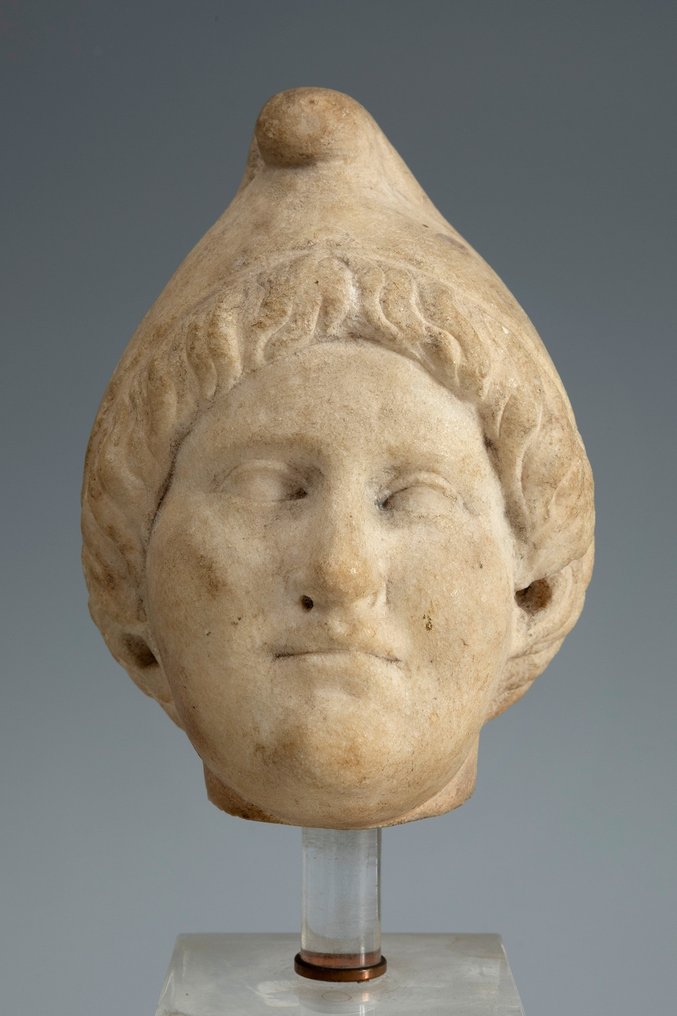
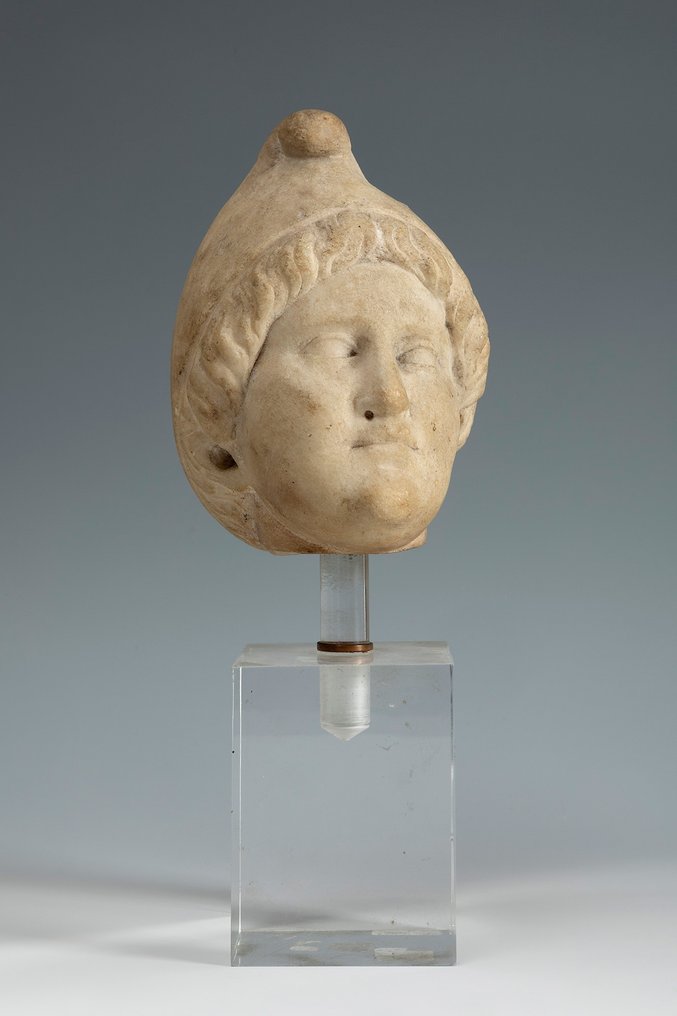
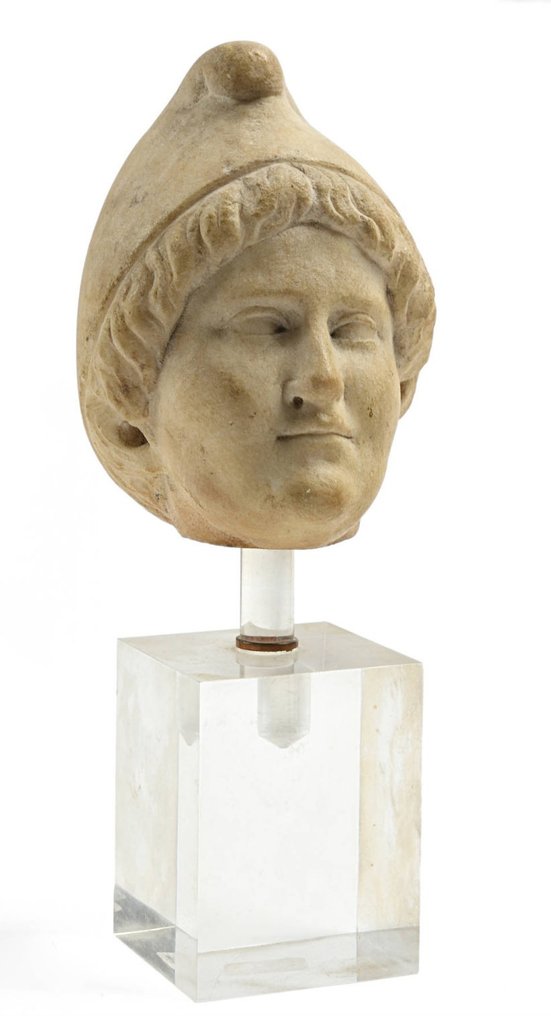
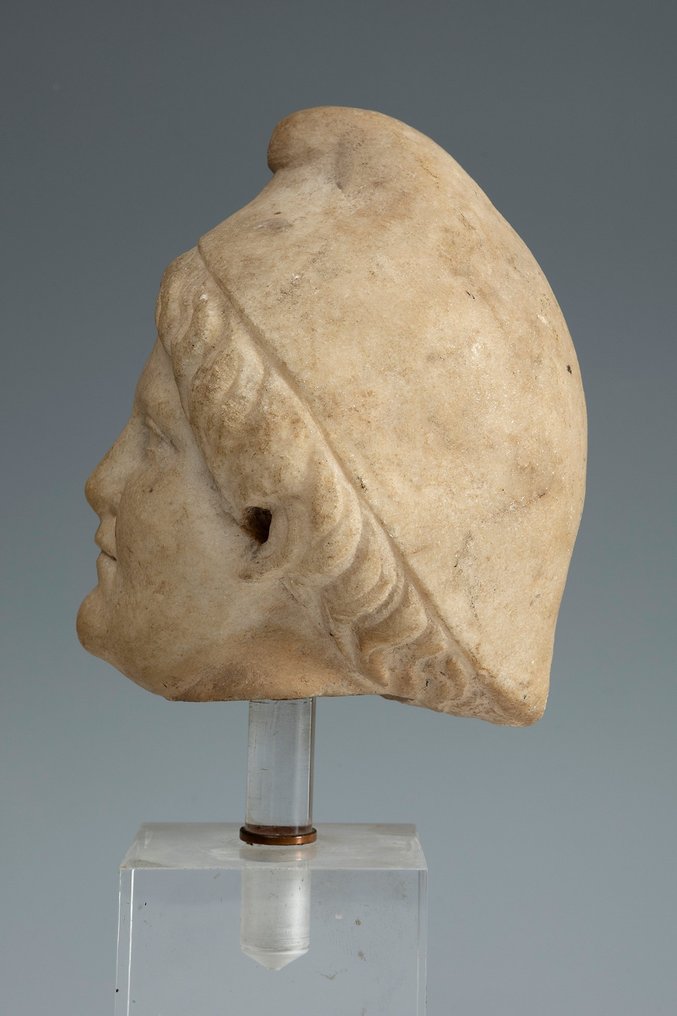
Ancient Roman Marble Attis sculpture's head. 2nd - 3rd century AD. 24 cm H. Very fine. Spanish Export License.
07
days
17
hours
30
minutes
23
seconds
Starting bid
€ 1
Reserve price not met

Expert
Selected by Ruth Garrido Vila
Directed the Ifergan Collection Museum, specialising in Phoenician and Mediterranean archaeology.
Estimate € 10,800 - € 11,900
No bids placed
Catawiki Buyer Protection
Your payment’s safe with us until you receive your object.View details
Trustpilot 4.4 | 122986 reviews
Rated Excellent on Trustpilot.
Roman marble head of Attis, dating to the 2nd–3rd century AD, about 24 cm high with stand, in good intact condition, from a private collection.
AI-assisted summary
Description from the seller
Attis sculpture's head
CULTURE: Roman Empire
PERIOD: 2nd - 3rd century AD
MATERIAL: Marble
DIMENSIONS: Height 24 cm with stand, 13,5 cm height witout stand.
PROVENANCE: Private collection, Paris, France. 1970 - 1980.
CONDITION: Intact, good state.
DESCRIPTION:
Round head representing the face of the god Attis, which can be deduced by the presence of the Phrygian cap. The work stands out for the quality of the carving, of fine and rounded forms, although the lack of idealization in the features is also appreciated, in favor of a greater realism that was a common characteristic in the Roman sculpture of the II-III centuries AD, in which the aesthetics had become detached from the ideal of Greek statuary. Attis, a Greek god adopted from the Phrygians and who in turn was also venerated by the Romans. God of lost and rediscovered vegetation, he personifies the ephemeral and revived spring. Attis represents the nature that dies in autumn and that rises again in spring. This oriental divinity has its origins in Phrygia and several versions of the mythological legend are known, always highlighting his death due to self-castration and his subsequent resurrection. He was considered the lover of the goddess Cybele. In the Roman world we find representations of Attis in all kinds of artistic manifestations, among which we want to highlight the sculpture. His iconography is very varied, since this divinity is presented in different attitudes, sometimes alone and sometimes in the company of Cybele. This diversity is due to the desire to show the god in the most relevant moments of his myth or to express through his image ideologies of symbolic-religious content. We must highlight those figures that represent him as the protector deity of the dead and their resurrection, in this case without any relation to Cybele, since he had also known suffering and death and had overcome them.
Precisely, Roman sculpture stood out from Greek sculpture in the creation of the sculpture-portrait. The Roman portrait has its roots in Etruscan art, but also in the Hellenistic Greek world and in the "masks mayorum", that is, wax masks that were applied to the faces of the deceased for their memory and later worship. The materials most commonly used in Roman portraiture were bronze and marble. At the beginning, Roman portrait sculpture only represented the head and part of the neck. Later, progress was made in the representation of the entire bust, including shoulders and chest. However, full body sculptures were also sculpted, as in the one presented here.
Notes:
The seller guarantees that he acquired this piece according to all national and international laws related to the ownership of cultural property. Provenance statement seen by Catawiki.
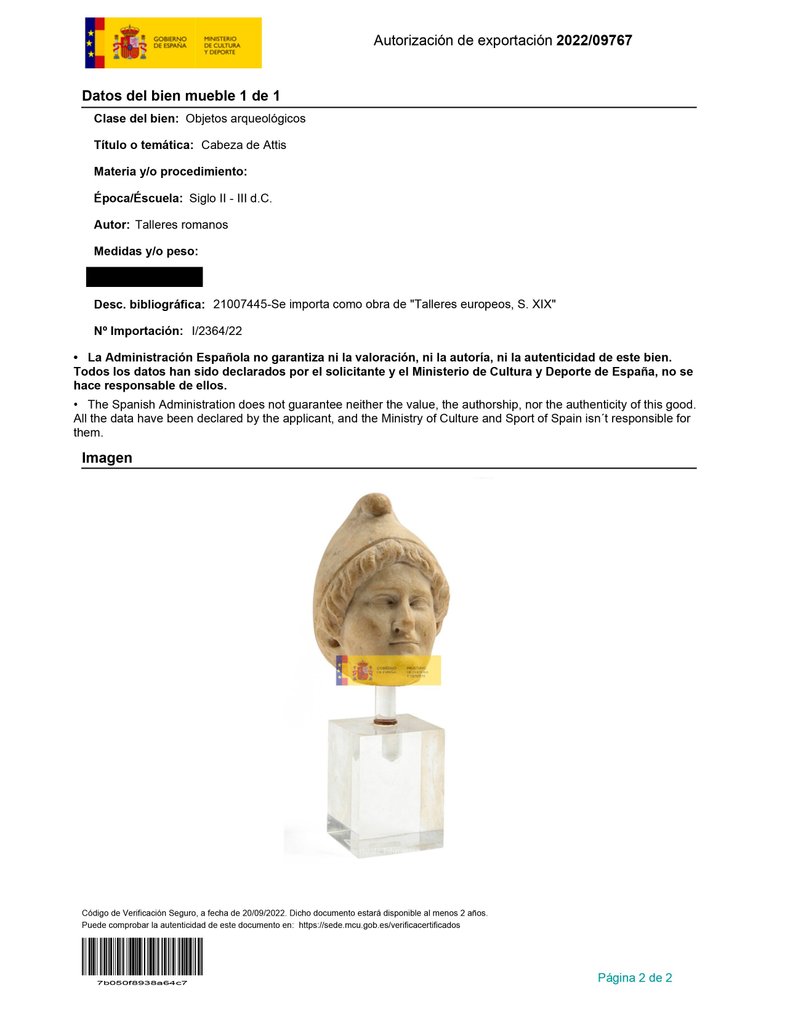
The piece includes authenticity certificate.
The piece includes Spanish Export License (Passport for European Union) - If the piece is destined outside the European Union a substitution of the export permit should be requested.
THE MINISTRY OF CULTURE FROM SPAIN ASKS ALL SELLERS FOR INVOICES OR OTHER DOCUMENTATION ABLE TO PROVE THE LEGALITY OF EACH ITEM BEFORE PROVIDING AN IMPORT OR EXPORT LICENSE.
#MasterpiecesW39
Seller's Story
Gallery of Ancient Art - Archeology based in Barcelona with more than fifteen years of experience. Specialized in classical art, Egyptian art, Asian art and pre-Columbian art. It guarantees the authenticity of all its pieces. It participates in the most important art fairs in Spain, such as Feriarte, as well as in fairs abroad, BRAFA, Parcours des Mondes, Cultures Brussels.
All the pieces are sent with an Export Permit issued by the Spanish Ministry of Culture.
We are quick to ship via DHL Express or Direct Art Transport.
Translated by Google TranslateAttis sculpture's head
CULTURE: Roman Empire
PERIOD: 2nd - 3rd century AD
MATERIAL: Marble
DIMENSIONS: Height 24 cm with stand, 13,5 cm height witout stand.
PROVENANCE: Private collection, Paris, France. 1970 - 1980.
CONDITION: Intact, good state.
DESCRIPTION:
Round head representing the face of the god Attis, which can be deduced by the presence of the Phrygian cap. The work stands out for the quality of the carving, of fine and rounded forms, although the lack of idealization in the features is also appreciated, in favor of a greater realism that was a common characteristic in the Roman sculpture of the II-III centuries AD, in which the aesthetics had become detached from the ideal of Greek statuary. Attis, a Greek god adopted from the Phrygians and who in turn was also venerated by the Romans. God of lost and rediscovered vegetation, he personifies the ephemeral and revived spring. Attis represents the nature that dies in autumn and that rises again in spring. This oriental divinity has its origins in Phrygia and several versions of the mythological legend are known, always highlighting his death due to self-castration and his subsequent resurrection. He was considered the lover of the goddess Cybele. In the Roman world we find representations of Attis in all kinds of artistic manifestations, among which we want to highlight the sculpture. His iconography is very varied, since this divinity is presented in different attitudes, sometimes alone and sometimes in the company of Cybele. This diversity is due to the desire to show the god in the most relevant moments of his myth or to express through his image ideologies of symbolic-religious content. We must highlight those figures that represent him as the protector deity of the dead and their resurrection, in this case without any relation to Cybele, since he had also known suffering and death and had overcome them.
Precisely, Roman sculpture stood out from Greek sculpture in the creation of the sculpture-portrait. The Roman portrait has its roots in Etruscan art, but also in the Hellenistic Greek world and in the "masks mayorum", that is, wax masks that were applied to the faces of the deceased for their memory and later worship. The materials most commonly used in Roman portraiture were bronze and marble. At the beginning, Roman portrait sculpture only represented the head and part of the neck. Later, progress was made in the representation of the entire bust, including shoulders and chest. However, full body sculptures were also sculpted, as in the one presented here.
Notes:
The seller guarantees that he acquired this piece according to all national and international laws related to the ownership of cultural property. Provenance statement seen by Catawiki.
The piece includes authenticity certificate.
The piece includes Spanish Export License (Passport for European Union) - If the piece is destined outside the European Union a substitution of the export permit should be requested.
THE MINISTRY OF CULTURE FROM SPAIN ASKS ALL SELLERS FOR INVOICES OR OTHER DOCUMENTATION ABLE TO PROVE THE LEGALITY OF EACH ITEM BEFORE PROVIDING AN IMPORT OR EXPORT LICENSE.
#MasterpiecesW39
Seller's Story
Gallery of Ancient Art - Archeology based in Barcelona with more than fifteen years of experience. Specialized in classical art, Egyptian art, Asian art and pre-Columbian art. It guarantees the authenticity of all its pieces. It participates in the most important art fairs in Spain, such as Feriarte, as well as in fairs abroad, BRAFA, Parcours des Mondes, Cultures Brussels.
All the pieces are sent with an Export Permit issued by the Spanish Ministry of Culture.
We are quick to ship via DHL Express or Direct Art Transport.
Translated by Google TranslateDetails
Culture
Ancient Roman
Century/ Timeframe
2nd - 3rd century AD
Name of object
Attis sculpture's head. 2nd - 3rd century AD. 24 cm H. Very fine. Spanish Export License.
Acquired from
Private collection
Material
Marble
Condition
Good
Disclaimer
The seller was informed by Catawiki about documentation requirements and guarantees the following: - the object was legally obtained, - the seller has the right to sell and/or export the object, as relevant, - the seller will provide the necessary provenance information and arrange required documentation and permits/licenses, as applicable and as per local laws, - the seller will notify the buyer of any delays in obtaining permits/licenses. By bidding, you acknowledge that import documentation may be required depending on your country of residence and that obtaining permits/licenses may cause delays in the delivery of your object.
The seller was informed by Catawiki about documentation requirements and guarantees the following: - the object was legally obtained, - the seller has the right to sell and/or export the object, as relevant, - the seller will provide the necessary provenance information and arrange required documentation and permits/licenses, as applicable and as per local laws, - the seller will notify the buyer of any delays in obtaining permits/licenses. By bidding, you acknowledge that import documentation may be required depending on your country of residence and that obtaining permits/licenses may cause delays in the delivery of your object.
