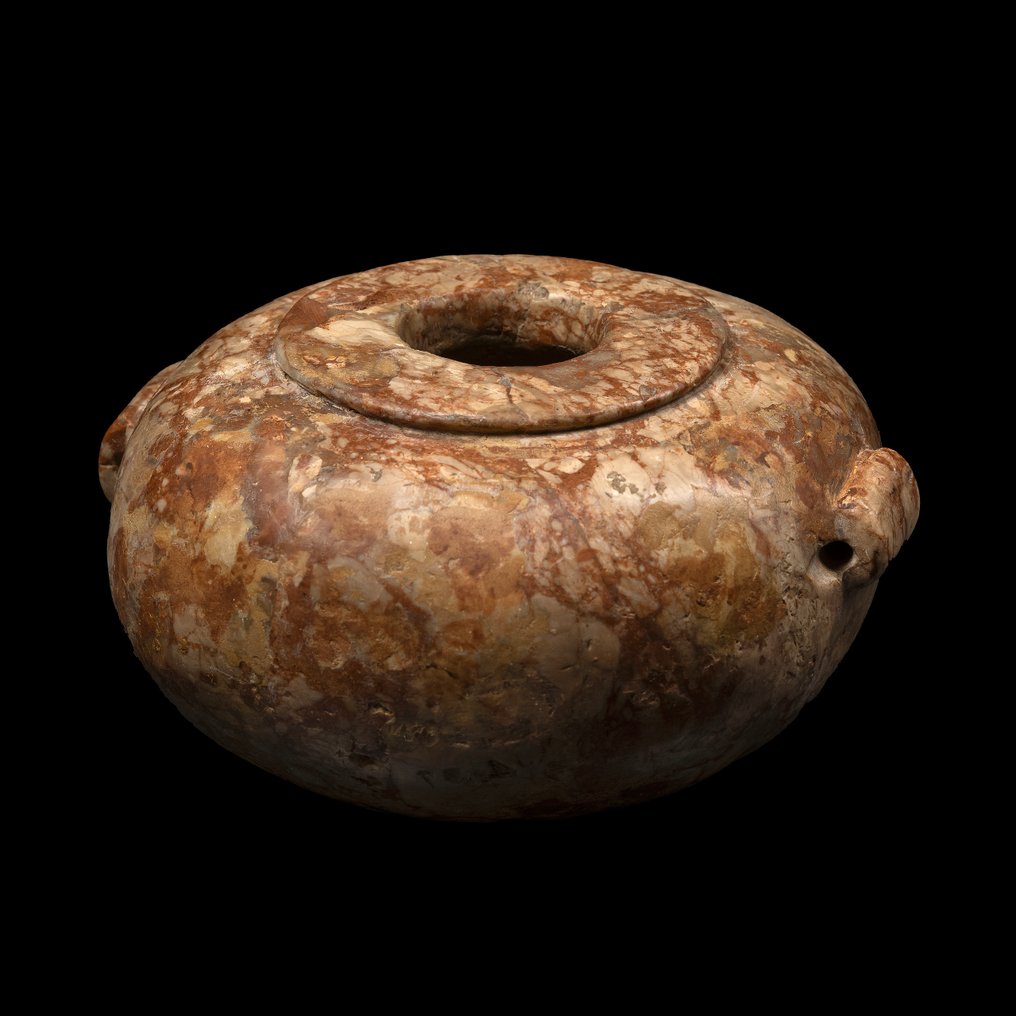
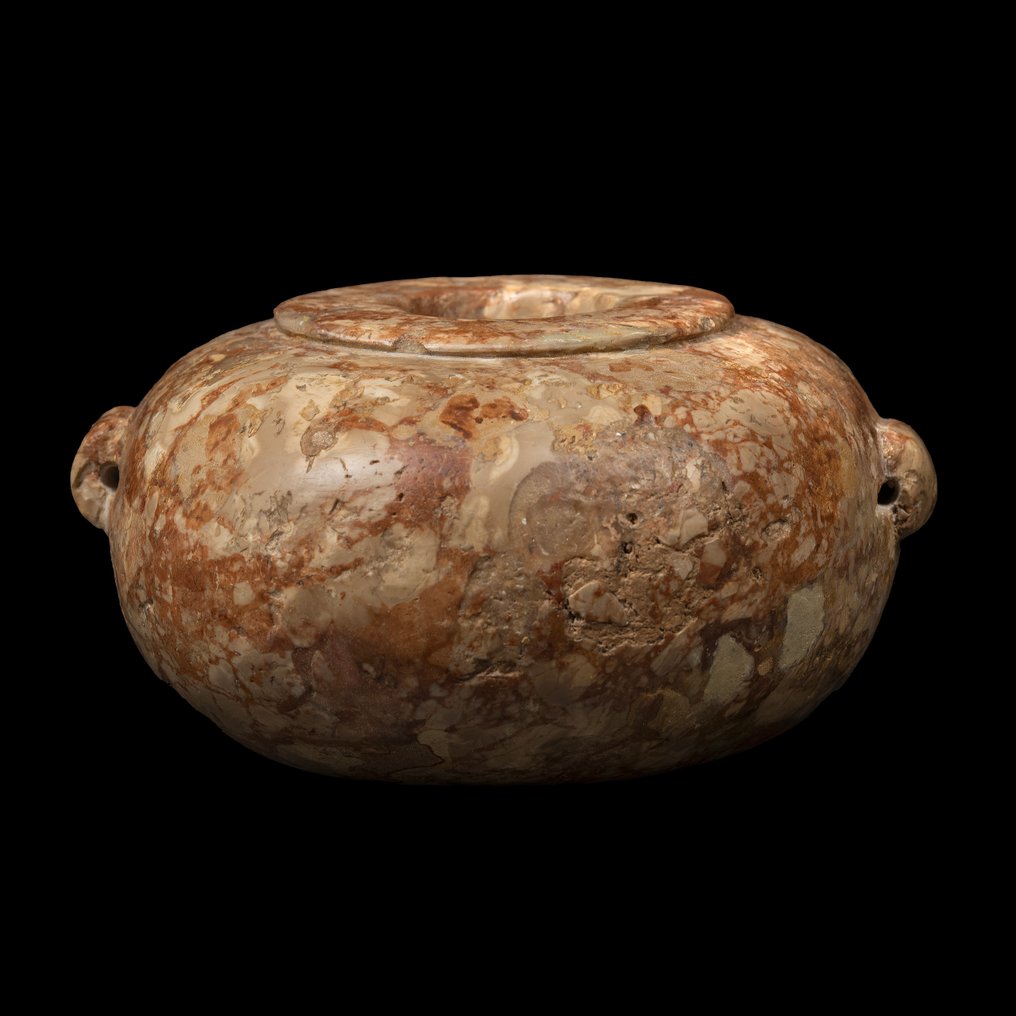
Ancient Egyptian Stone Globular Vessel, "Ear" Type. Tinite Period, Dynasties I-II, 3050 - 2686 BC. 15.3 cm diameter.


Opens Sunday
Starting bid
€ 1
Add to your favourites to get an alert when the auction starts.

Expert
Selected by Ruth Garrido Vila
Directed the Ifergan Collection Museum, specialising in Phoenician and Mediterranean archaeology.
Estimate € 9,900 - € 11,000
Catawiki Buyer Protection
Your payment’s safe with us until you receive your object.View details
Trustpilot 4.4 | 122813 reviews
Rated Excellent on Trustpilot.
Description from the seller
Globular Vessel, "Ear" Type.
Ancient Egypt, Tinite Period, Dynasties I-II, 3050 - 2686 BC.
Breccia stone.
15.3 cm diameter and 8.2 cm height.
CONDITION: Good general condition, with slight surface restorations.
PROVENANCE: Collection of Gaia Cecilia Metella Servadio 1938-2021, Italian writer living in London.
PUBLISHED:
Attached is a study on the piece's antiquity issued by Egyptologist and architect Fernando Estrada Laza. Author of "Los Obreros de la Muerte" and "Entender y Amar el Arte Egipcio" (The Workers of Death) and "Entender y Amar el Arte Egipcio" (Understanding and Loving Egyptian Art). Advisor to the Lamela architectural team for the future Grand Egyptian Museum in Cairo (GEM). Advisor to the Arata Isozaki architectural team (Tokyo) for the organization and selection of pieces for the new National Museum of Egyptian Civilization (NMEC) and the Grand Egyptian Museum in Cairo (GEM).
DESCRIPTION:
Vase made entirely from a single block of orange-coloured breccia, restored without loss of original material. Breccia, a sedimentary rock characterised by being composed of approximately 50% angular rock fragments, was used to make containers in Egypt since predynastic times, although its use became less frequent in the early dynastic periods. The vessel has a flattened globular shape, with relatively thick walls and a circular mouth, surrounded by a very wide, flat lip, carved in relief. It has two cylindrical handles on the sides, trepanned, located approximately halfway up the body. The dating to the Thinite or Archaic period of Egypt is determined by the perforation of the handles; it was later, at the beginning of the Old Kingdom, when holes were no longer made in them, as by then these vessels had become purely symbolic objects, representing the highest social status, given that, due to the quality of the stone and the complexity of their manufacture, they were only available to nobles and kings.
The Louvre collection contains a similar vessel, although much smaller, which still has its upper gold filigree handle (fig. 1). Another example, in this case from the British Museum, has an almost identical flattened shape to the piece under study, except for the rim, which is slightly raised above the body of the vessel (fig. 2). A third parallel, from the Metropolitan Museum and carved in diorite, shows a practically identical typology, although the rim is differentiated from the body by a groove (fig. 3).
Vessels made of hard stones, such as basalt or breccia, were manufactured from predynastic times (c. 3900 BC onwards) following the same process, which began with the general shaping of the stone block with a chisel, first made of copper and later of bronze. The inner core was then excavated with a serrated tube made of the same metal, and the interior shape was finished with a hand-operated auger. Finally, the exterior was polished with a harder stone. The production of these vessels developed in the predynastic Nagada period (c. 4000-3050 BC), with very distinct and almost unmistakable characteristics. Specifically, this type of flattened vessel emerged in the third phase of Nagada (c. 3300-3050 BC) and continued, with slight modifications in design and increasing frequency, during the first two Thinite dynasties and the early part of the Old Kingdom.
All vessels of this type are almost identical in shape, with one difference: those with perforated handles, such as the piece under study, belong to the 1st and 2nd Dynasties (3050-2686 BC), while those with blind handles come from the 3rd Dynasty (2686-2613 BC). The largest deposit of these vessels was found in 1933 by architect Jean P. Lauer in the underground galleries of King Djeser's step pyramid in Saqqara. Of the more than 36,000 examples, 162 are engraved with the names of kings and more than 1,000 are painted with hieroglyphics alluding to their author or donor — many of them were offerings deposited on the occasion of the heb sed festival. Although Djoser, who ruled between 2682 and 2663 BC, belonged to the Third Dynasty, he treasured a large number of stone vessels from the Thinite period in his funerary monument. Lauer interpreted this as a pious tribute to his predecessors on the part of the king, but it is more likely that Djoser stole the vessels bearing the names of other kings from their tombs in Abydos in order to increase his power and prestige, following a common and documented practice of usurping earlier monuments by the pharaohs.
Despite being an extraordinarily resistant vessel, this piece has several fragments glued to the top and base. This breakage, caused by a flat blow from top to bottom, indicates that it was subjected to a strong impact outside its original location, a Thinite tomb in Abydos or Saqqara. It is therefore logical to deduce that the vase was recovered from one of the underground galleries of the pyramid of Djeser where, due to the collapse of the limestone ceiling, the fallen stones struck and broke this and many other vases deposited in the same gallery (fig. 4). This vase was made exclusively for funerary purposes, as part of the grave goods, and given its great value, it is very unlikely that it was broken by accident. Furthermore, its use as an element of prestige would not make sense if the vessel were broken; it would have been unthinkable to place it in a tomb, as it would have been considered a bad omen. For all these reasons, it can be deduced that the vessel was placed, intact, in a Thinite mastaba tomb around 2925 BC. Three centuries later, around 2660 BC, the piece would have been removed from the Thinite funerary goods and placed in galleries VI or VII of the step pyramid at Saqqara, along with the rest of the funerary goods from the tomb of Pharaoh Djoser.
BIBLIOGRAPHY:
- ASTON, B.G. Ancient Egyptian Stone Vessels: Materials and Forms. Heidelberger Orientverlag. 1994.
- HAYES, W.C. The Scepter of Egypt I: From the Earliest Times to the End of the Middle Kingdom. The Metropolitan Museum of Art. 1968.
- SPENCER, A.J. Catalogue of Egyptian Antiquities in the British Museum: Early Dynastic Objects. British Museum. 1968.
- WILKINSON, T. Early Dynastic Egypt: Strategies, Society and Security. Routledge. 2001.
PARALLELS:
Fig. 1 Globular cup. Abydos, Egypt, late Predynastic period or Thinite period, c. 3200–2700 BC. Reddish breccia and gold, 3.8 x 4.5 cm. Musée du Louvre, Paris, inv. E 23239.
Fig. 2 Globular vase. Egypt, Thinite period, 1st–2nd dynasties, 3050–2686 BC. Reddish breccia, 22 x 24 cm. British Museum, London, inv. EA43061.
Fig. 3 Globular vase. Egypt, Old Kingdom, early 3rd Dynasty, c. 2649-2630 BC. Diorite, 8.5 x 15 cm. Metropolitan Museum, New York, inv. 24.75.
Fig. 4 Photographs of galleries VI and VII of the step pyramid of Djeser, after the removal of debris. 1933–1934.
Notes:
- The piece includes authenticity certificate.
- The piece includes Spanish Export License (Passport for European Union) - If the piece is destined outside the European Union a substitution of the export permit should be requested, can take between 1-2 weeks maximum.
- The seller guarantees that he acquired this piece according to all national and international laws related to the ownership of cultural property. Provenance statement seen by Catawiki.
Seller's Story
Gallery of Ancient Art - Archeology based in Barcelona with more than fifteen years of experience. Specialized in classical art, Egyptian art, Asian art and pre-Columbian art. It guarantees the authenticity of all its pieces. It participates in the most important art fairs in Spain, such as Feriarte, as well as in fairs abroad, BRAFA, Parcours des Mondes, Cultures Brussels.
All the pieces are sent with an Export Permit issued by the Spanish Ministry of Culture.
We are quick to ship via DHL Express or Direct Art Transport.
Translated by Google TranslateGlobular Vessel, "Ear" Type.
Ancient Egypt, Tinite Period, Dynasties I-II, 3050 - 2686 BC.
Breccia stone.
15.3 cm diameter and 8.2 cm height.
CONDITION: Good general condition, with slight surface restorations.
PROVENANCE: Collection of Gaia Cecilia Metella Servadio 1938-2021, Italian writer living in London.
PUBLISHED:
Attached is a study on the piece's antiquity issued by Egyptologist and architect Fernando Estrada Laza. Author of "Los Obreros de la Muerte" and "Entender y Amar el Arte Egipcio" (The Workers of Death) and "Entender y Amar el Arte Egipcio" (Understanding and Loving Egyptian Art). Advisor to the Lamela architectural team for the future Grand Egyptian Museum in Cairo (GEM). Advisor to the Arata Isozaki architectural team (Tokyo) for the organization and selection of pieces for the new National Museum of Egyptian Civilization (NMEC) and the Grand Egyptian Museum in Cairo (GEM).
DESCRIPTION:
Vase made entirely from a single block of orange-coloured breccia, restored without loss of original material. Breccia, a sedimentary rock characterised by being composed of approximately 50% angular rock fragments, was used to make containers in Egypt since predynastic times, although its use became less frequent in the early dynastic periods. The vessel has a flattened globular shape, with relatively thick walls and a circular mouth, surrounded by a very wide, flat lip, carved in relief. It has two cylindrical handles on the sides, trepanned, located approximately halfway up the body. The dating to the Thinite or Archaic period of Egypt is determined by the perforation of the handles; it was later, at the beginning of the Old Kingdom, when holes were no longer made in them, as by then these vessels had become purely symbolic objects, representing the highest social status, given that, due to the quality of the stone and the complexity of their manufacture, they were only available to nobles and kings.
The Louvre collection contains a similar vessel, although much smaller, which still has its upper gold filigree handle (fig. 1). Another example, in this case from the British Museum, has an almost identical flattened shape to the piece under study, except for the rim, which is slightly raised above the body of the vessel (fig. 2). A third parallel, from the Metropolitan Museum and carved in diorite, shows a practically identical typology, although the rim is differentiated from the body by a groove (fig. 3).
Vessels made of hard stones, such as basalt or breccia, were manufactured from predynastic times (c. 3900 BC onwards) following the same process, which began with the general shaping of the stone block with a chisel, first made of copper and later of bronze. The inner core was then excavated with a serrated tube made of the same metal, and the interior shape was finished with a hand-operated auger. Finally, the exterior was polished with a harder stone. The production of these vessels developed in the predynastic Nagada period (c. 4000-3050 BC), with very distinct and almost unmistakable characteristics. Specifically, this type of flattened vessel emerged in the third phase of Nagada (c. 3300-3050 BC) and continued, with slight modifications in design and increasing frequency, during the first two Thinite dynasties and the early part of the Old Kingdom.
All vessels of this type are almost identical in shape, with one difference: those with perforated handles, such as the piece under study, belong to the 1st and 2nd Dynasties (3050-2686 BC), while those with blind handles come from the 3rd Dynasty (2686-2613 BC). The largest deposit of these vessels was found in 1933 by architect Jean P. Lauer in the underground galleries of King Djeser's step pyramid in Saqqara. Of the more than 36,000 examples, 162 are engraved with the names of kings and more than 1,000 are painted with hieroglyphics alluding to their author or donor — many of them were offerings deposited on the occasion of the heb sed festival. Although Djoser, who ruled between 2682 and 2663 BC, belonged to the Third Dynasty, he treasured a large number of stone vessels from the Thinite period in his funerary monument. Lauer interpreted this as a pious tribute to his predecessors on the part of the king, but it is more likely that Djoser stole the vessels bearing the names of other kings from their tombs in Abydos in order to increase his power and prestige, following a common and documented practice of usurping earlier monuments by the pharaohs.
Despite being an extraordinarily resistant vessel, this piece has several fragments glued to the top and base. This breakage, caused by a flat blow from top to bottom, indicates that it was subjected to a strong impact outside its original location, a Thinite tomb in Abydos or Saqqara. It is therefore logical to deduce that the vase was recovered from one of the underground galleries of the pyramid of Djeser where, due to the collapse of the limestone ceiling, the fallen stones struck and broke this and many other vases deposited in the same gallery (fig. 4). This vase was made exclusively for funerary purposes, as part of the grave goods, and given its great value, it is very unlikely that it was broken by accident. Furthermore, its use as an element of prestige would not make sense if the vessel were broken; it would have been unthinkable to place it in a tomb, as it would have been considered a bad omen. For all these reasons, it can be deduced that the vessel was placed, intact, in a Thinite mastaba tomb around 2925 BC. Three centuries later, around 2660 BC, the piece would have been removed from the Thinite funerary goods and placed in galleries VI or VII of the step pyramid at Saqqara, along with the rest of the funerary goods from the tomb of Pharaoh Djoser.
BIBLIOGRAPHY:
- ASTON, B.G. Ancient Egyptian Stone Vessels: Materials and Forms. Heidelberger Orientverlag. 1994.
- HAYES, W.C. The Scepter of Egypt I: From the Earliest Times to the End of the Middle Kingdom. The Metropolitan Museum of Art. 1968.
- SPENCER, A.J. Catalogue of Egyptian Antiquities in the British Museum: Early Dynastic Objects. British Museum. 1968.
- WILKINSON, T. Early Dynastic Egypt: Strategies, Society and Security. Routledge. 2001.
PARALLELS:
Fig. 1 Globular cup. Abydos, Egypt, late Predynastic period or Thinite period, c. 3200–2700 BC. Reddish breccia and gold, 3.8 x 4.5 cm. Musée du Louvre, Paris, inv. E 23239.
Fig. 2 Globular vase. Egypt, Thinite period, 1st–2nd dynasties, 3050–2686 BC. Reddish breccia, 22 x 24 cm. British Museum, London, inv. EA43061.
Fig. 3 Globular vase. Egypt, Old Kingdom, early 3rd Dynasty, c. 2649-2630 BC. Diorite, 8.5 x 15 cm. Metropolitan Museum, New York, inv. 24.75.
Fig. 4 Photographs of galleries VI and VII of the step pyramid of Djeser, after the removal of debris. 1933–1934.
Notes:
- The piece includes authenticity certificate.
- The piece includes Spanish Export License (Passport for European Union) - If the piece is destined outside the European Union a substitution of the export permit should be requested, can take between 1-2 weeks maximum.
- The seller guarantees that he acquired this piece according to all national and international laws related to the ownership of cultural property. Provenance statement seen by Catawiki.
Seller's Story
Gallery of Ancient Art - Archeology based in Barcelona with more than fifteen years of experience. Specialized in classical art, Egyptian art, Asian art and pre-Columbian art. It guarantees the authenticity of all its pieces. It participates in the most important art fairs in Spain, such as Feriarte, as well as in fairs abroad, BRAFA, Parcours des Mondes, Cultures Brussels.
All the pieces are sent with an Export Permit issued by the Spanish Ministry of Culture.
We are quick to ship via DHL Express or Direct Art Transport.
Translated by Google TranslateDetails
Culture
Ancient Egyptian
Century/ Timeframe
Tinite Period, Dynasties I-II, 3050 - 2686 BC.
Name of object
Globular Vessel, "Ear" Type. Tinite Period, Dynasties I-II, 3050 - 2686 BC. 15.3 cm diameter.
Acquired from
Private collection
Year acquired
2025
Material
Stone
Country acquired from
United Kingdom
Condition
Good
Previous owner acquired from
Private collection
Previous owner - year acquired
1960
Previous owner - country acquired from
United Kingdom
I verify that I have obtained this object legally and that I am allowed to sell it
Yes
Disclaimer
The seller was informed by Catawiki about documentation requirements and guarantees the following: - the object was legally obtained, - the seller has the right to sell and/or export the object, as relevant, - the seller will provide the necessary provenance information and arrange required documentation and permits/licenses, as applicable and as per local laws, - the seller will notify the buyer of any delays in obtaining permits/licenses. By bidding, you acknowledge that import documentation may be required depending on your country of residence and that obtaining permits/licenses may cause delays in the delivery of your object.
The seller was informed by Catawiki about documentation requirements and guarantees the following: - the object was legally obtained, - the seller has the right to sell and/or export the object, as relevant, - the seller will provide the necessary provenance information and arrange required documentation and permits/licenses, as applicable and as per local laws, - the seller will notify the buyer of any delays in obtaining permits/licenses. By bidding, you acknowledge that import documentation may be required depending on your country of residence and that obtaining permits/licenses may cause delays in the delivery of your object.
