Ancient Roman Marble Important Ganymede torso. 2nd century AD. 47 cm H. Spanish Export License and French passport

Opens Sunday
Starting bid
€ 1
Add to your favourites to get an alert when the auction starts.

Expert
Selected by Ruth Garrido Vila
Directed the Ifergan Collection Museum, specialising in Phoenician and Mediterranean archaeology.
Estimate € 28,000 - € 31,000
Catawiki Buyer Protection
Your payment’s safe with us until you receive your object.View details
Trustpilot 4.4 | 122813 reviews
Rated Excellent on Trustpilot.
Description from the seller
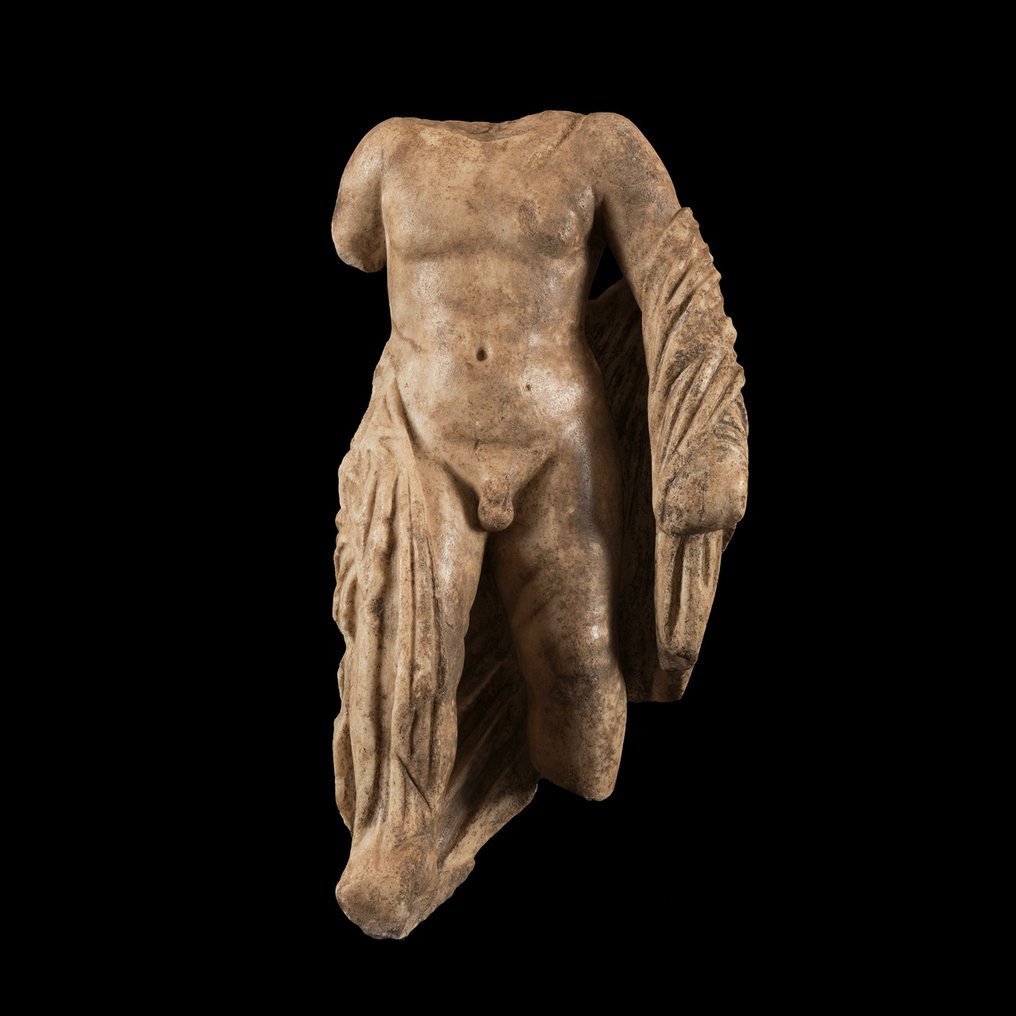
Nice Ganymede torso
- big sculpture -
CULTURE: Roman Empire
PERIOD: 2nd century AD
MATERIAL: Marble
DIMENSIONS: 47 cm height, and 50 cm heigh with stand.
PROVENANCE:
- Private collection, Mr. Firmin - Didot, 19th century.
- Auctioned at Jean Loiseau Alain Schmitz, Saint Germain en Laye, March 8, 1981, Lot 187.
- Private Collection, Marquis du G., Château de Terraube, Franica.
- Private Collection, Geneva, Switzerland .
CONDITION: IGood state of conservation, without restorations. It presents a superficial patina in reddish-brown tones of marble.
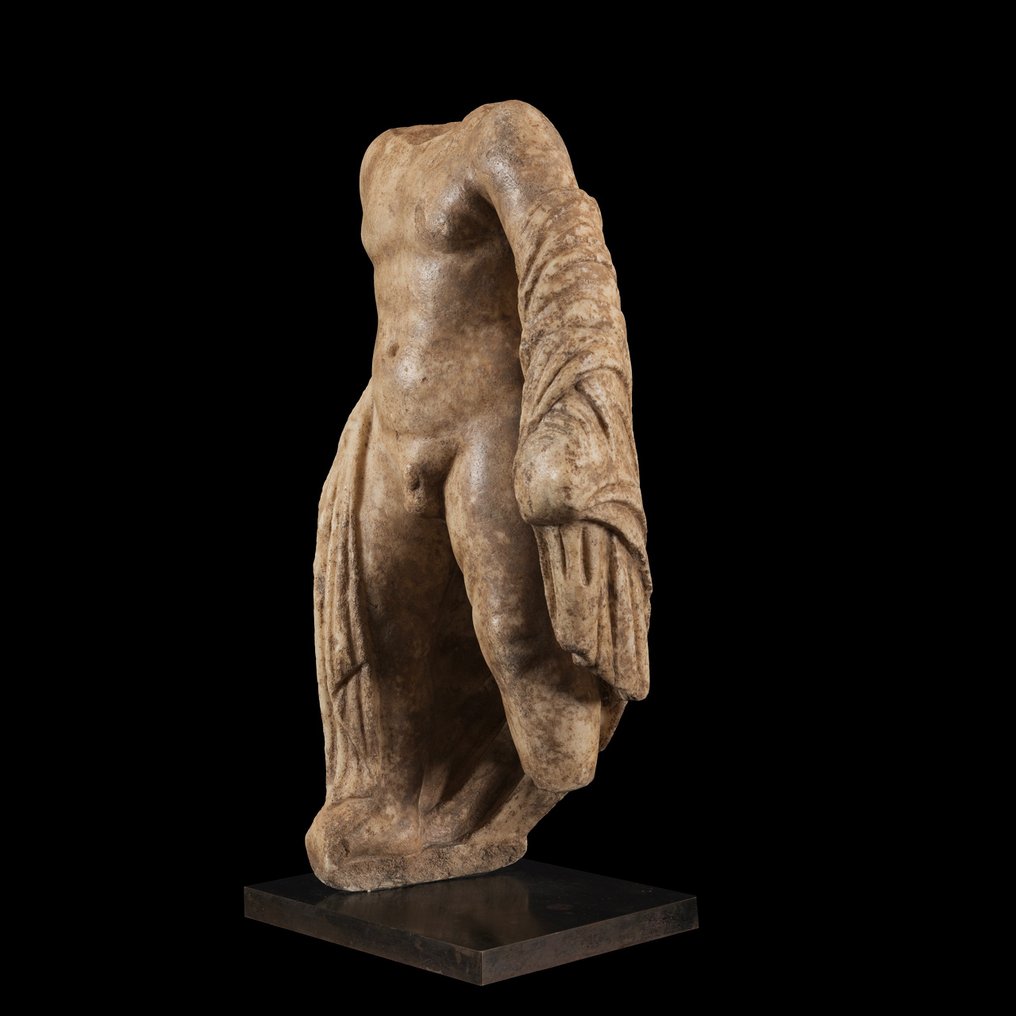
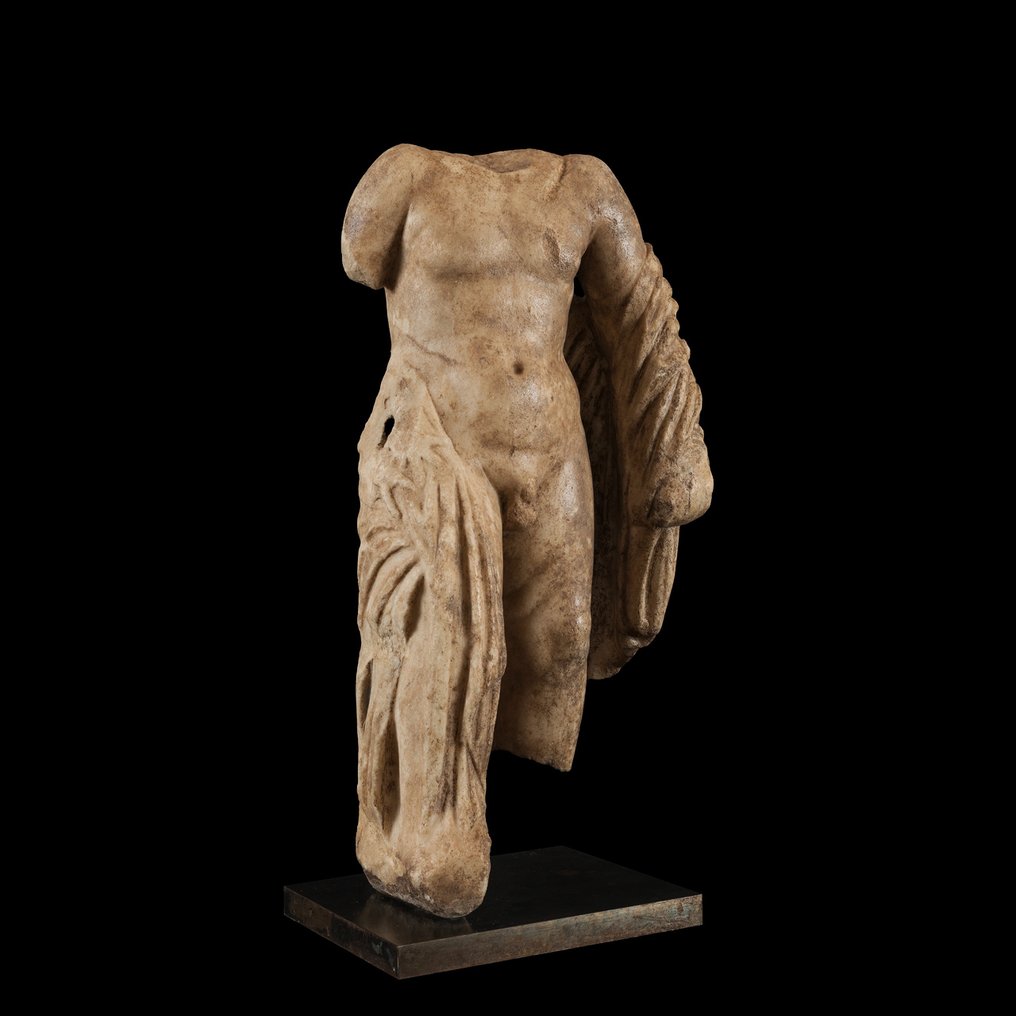
Torso belonging to a complete sculpture of the divine hero Ganymede. It is carved from a single block of marble. Possibly, given its dimensions, it would be a private sculpture, decorating a garden, although it could well be a public one.
As the lover of Zeus, the chief god of Olympus, her mythical history was often depicted by vase painters in Athens, which was well suited for all-male symposiums or formal banquets. Around 350 BC, the Athenian sculptor Leochares, who worked with Scopas on the mausoleum at Halicarnassus, modeled a bronze group of Ganymede and the eagle, an extraordinary work for its ingenious composition, which boldly ventures to the edge of the permissible by the laws of sculpture, and also by his charming treatment of the young man flying through the air. This sculpture is apparently imitated by a well-known marble group from the Vatican (fig. 1), at half natural scale. Such Hellenistic feats in defying gravity influenced the arts of the Baroque.
The attribution of this headless sculpture to Ganymede is due to the conservation on the side of his right thigh of both claws of the eagle that would be holding him to ascend to Olympus. Next to them there is a perfectly carved cavity in the shape of a rectangle, together with two slight circular holes, they are nothing more than anchor points for other parts of the sculpture, also carved in marble but a separate piece, a very common resource in classical statuary. . In this case, the eagle, which due to its anatomical complexity, if it had its wings outstretched, the artist would make this sculptural ensemble using different blocks of marble, at least one for the figure and one for the bird. The Prado Museum preserves a set in which the claws are holding the hero's waist (fig. 2), a position similar to this torso, although it would not correspond to the same composition, since it is presented on a shelf.
The nude figure is supported by the left forearm, where a mantle is wrapped around it, with accentuated folds, which passes through the lower part of the back and legs until it rests and descends through the right leg. It is worth noting the youthful appearance of the body, without developing as an adult. The detail and finesse in the sculpture is frontally correct, the back, as in most statues, is carved in a simpler way and without the same degree of polishing, a fact that indicates that it would be made to be seen from the front, located in a niche or in front of a wall.
In Greek mythology, Ganymede (fig. 3) was a divine hero from the Troas and a handsome Trojan prince. Son of King Tros, who gave his name to Troy, his mother was Callírroe. He was kidnapped by the god Zeus on Mount Ida, in Phrygia. Ganymede spent there the time of exile to which many heroes underwent in his youth, tending a flock of sheep and educating himself, together with his friends and tutors. Zeus saw him and instantly fell in love with him, and by sending an eagle or transforming himself into one, he took him to Mount Olympus, making him his lover, bedfellow, and cupbearer to the gods. Zeus later ascended Ganymede into heaven as the constellation of Aquarius (the Water Bearer), which is related to that of Aquila (the Eagle).
This myth had an important later influence, in ancient Rome the passive object of a man's homosexual desire was a catamitus, a word that evolves from the Greek Ganymede. In poetry it is a symbol of the ideally beautiful young man and of homosexual love, and related to the Trojan War it is contrasted with Helen of Troy in the role of a symbol of love for women. Zeus for the Romans is Jupiter, the main satellite of this planet was baptized with the name of Ganymede.
PARALLELS:
Fig. 1 Ganymede caught by the eagle. Roman copy of a Greek original c. 325 BC Marble. Galleria dei Candelabri, Vatican Museum. Inv. 2445.
Fig. 2 Ganymede. Roman Empire, c. 160 – 170 AD Marble. 150 cm high. Prado Museum, Madrid. E000035.
Fig. 3 Bust of Ganymede. Roman Empire, 2nd century AD. Marble. 56 cm high. Musee du Louvre, Paris. Ma535.
Notes:
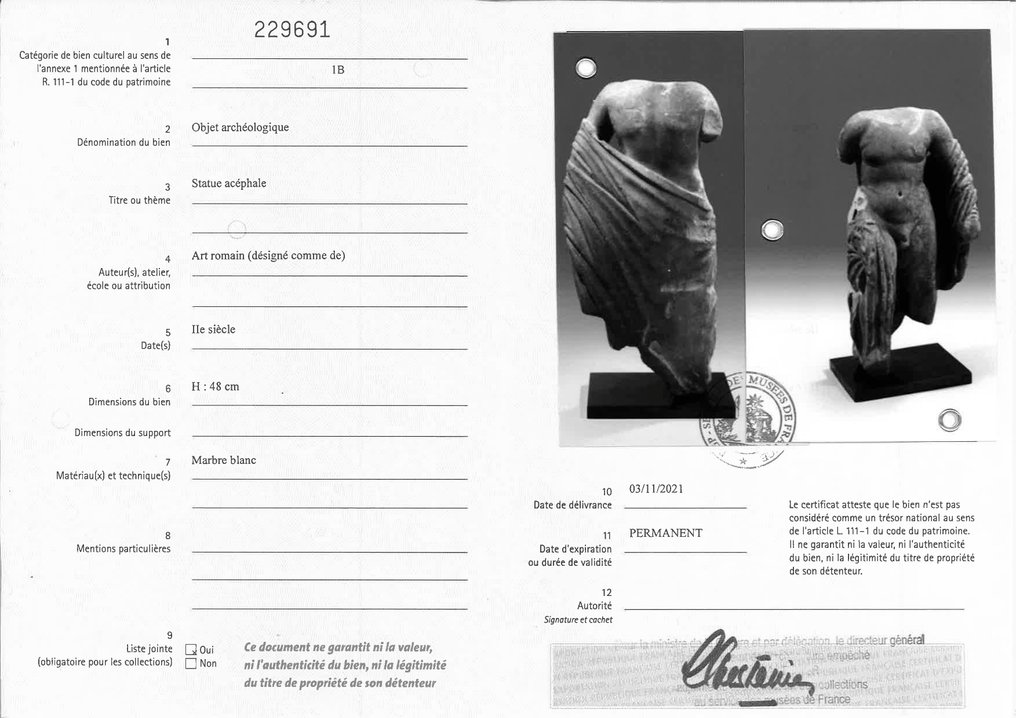
- The piece includes authenticity certificate.
- The piece includes Spanish Export License.
- The seller guarantees that he acquired this piece according to all national and international laws related to the ownership of cultural property. Provenance statement seen by Catawiki.
Seller's Story
Gallery of Ancient Art - Archeology based in Barcelona with more than fifteen years of experience. Specialized in classical art, Egyptian art, Asian art and pre-Columbian art. It guarantees the authenticity of all its pieces. It participates in the most important art fairs in Spain, such as Feriarte, as well as in fairs abroad, BRAFA, Parcours des Mondes, Cultures Brussels.
All the pieces are sent with an Export Permit issued by the Spanish Ministry of Culture.
We are quick to ship via DHL Express or Direct Art Transport.
Translated by Google TranslateNice Ganymede torso
- big sculpture -
CULTURE: Roman Empire
PERIOD: 2nd century AD
MATERIAL: Marble
DIMENSIONS: 47 cm height, and 50 cm heigh with stand.
PROVENANCE:
- Private collection, Mr. Firmin - Didot, 19th century.
- Auctioned at Jean Loiseau Alain Schmitz, Saint Germain en Laye, March 8, 1981, Lot 187.
- Private Collection, Marquis du G., Château de Terraube, Franica.
- Private Collection, Geneva, Switzerland .
CONDITION: IGood state of conservation, without restorations. It presents a superficial patina in reddish-brown tones of marble.
Torso belonging to a complete sculpture of the divine hero Ganymede. It is carved from a single block of marble. Possibly, given its dimensions, it would be a private sculpture, decorating a garden, although it could well be a public one.
As the lover of Zeus, the chief god of Olympus, her mythical history was often depicted by vase painters in Athens, which was well suited for all-male symposiums or formal banquets. Around 350 BC, the Athenian sculptor Leochares, who worked with Scopas on the mausoleum at Halicarnassus, modeled a bronze group of Ganymede and the eagle, an extraordinary work for its ingenious composition, which boldly ventures to the edge of the permissible by the laws of sculpture, and also by his charming treatment of the young man flying through the air. This sculpture is apparently imitated by a well-known marble group from the Vatican (fig. 1), at half natural scale. Such Hellenistic feats in defying gravity influenced the arts of the Baroque.
The attribution of this headless sculpture to Ganymede is due to the conservation on the side of his right thigh of both claws of the eagle that would be holding him to ascend to Olympus. Next to them there is a perfectly carved cavity in the shape of a rectangle, together with two slight circular holes, they are nothing more than anchor points for other parts of the sculpture, also carved in marble but a separate piece, a very common resource in classical statuary. . In this case, the eagle, which due to its anatomical complexity, if it had its wings outstretched, the artist would make this sculptural ensemble using different blocks of marble, at least one for the figure and one for the bird. The Prado Museum preserves a set in which the claws are holding the hero's waist (fig. 2), a position similar to this torso, although it would not correspond to the same composition, since it is presented on a shelf.
The nude figure is supported by the left forearm, where a mantle is wrapped around it, with accentuated folds, which passes through the lower part of the back and legs until it rests and descends through the right leg. It is worth noting the youthful appearance of the body, without developing as an adult. The detail and finesse in the sculpture is frontally correct, the back, as in most statues, is carved in a simpler way and without the same degree of polishing, a fact that indicates that it would be made to be seen from the front, located in a niche or in front of a wall.
In Greek mythology, Ganymede (fig. 3) was a divine hero from the Troas and a handsome Trojan prince. Son of King Tros, who gave his name to Troy, his mother was Callírroe. He was kidnapped by the god Zeus on Mount Ida, in Phrygia. Ganymede spent there the time of exile to which many heroes underwent in his youth, tending a flock of sheep and educating himself, together with his friends and tutors. Zeus saw him and instantly fell in love with him, and by sending an eagle or transforming himself into one, he took him to Mount Olympus, making him his lover, bedfellow, and cupbearer to the gods. Zeus later ascended Ganymede into heaven as the constellation of Aquarius (the Water Bearer), which is related to that of Aquila (the Eagle).
This myth had an important later influence, in ancient Rome the passive object of a man's homosexual desire was a catamitus, a word that evolves from the Greek Ganymede. In poetry it is a symbol of the ideally beautiful young man and of homosexual love, and related to the Trojan War it is contrasted with Helen of Troy in the role of a symbol of love for women. Zeus for the Romans is Jupiter, the main satellite of this planet was baptized with the name of Ganymede.
PARALLELS:
Fig. 1 Ganymede caught by the eagle. Roman copy of a Greek original c. 325 BC Marble. Galleria dei Candelabri, Vatican Museum. Inv. 2445.
Fig. 2 Ganymede. Roman Empire, c. 160 – 170 AD Marble. 150 cm high. Prado Museum, Madrid. E000035.
Fig. 3 Bust of Ganymede. Roman Empire, 2nd century AD. Marble. 56 cm high. Musee du Louvre, Paris. Ma535.
Notes:
- The piece includes authenticity certificate.
- The piece includes Spanish Export License.
- The seller guarantees that he acquired this piece according to all national and international laws related to the ownership of cultural property. Provenance statement seen by Catawiki.
Seller's Story
Gallery of Ancient Art - Archeology based in Barcelona with more than fifteen years of experience. Specialized in classical art, Egyptian art, Asian art and pre-Columbian art. It guarantees the authenticity of all its pieces. It participates in the most important art fairs in Spain, such as Feriarte, as well as in fairs abroad, BRAFA, Parcours des Mondes, Cultures Brussels.
All the pieces are sent with an Export Permit issued by the Spanish Ministry of Culture.
We are quick to ship via DHL Express or Direct Art Transport.
Translated by Google TranslateDetails
Culture
Ancient Roman
Century/ Timeframe
2nd century AD
Name of object
Important Ganymede torso. 2nd century AD. 47 cm H. Spanish Export License and French passport
Acquired from
Auction house
Material
Marble
Condition
Good
Disclaimer
The seller was informed by Catawiki about documentation requirements and guarantees the following: - the object was legally obtained, - the seller has the right to sell and/or export the object, as relevant, - the seller will provide the necessary provenance information and arrange required documentation and permits/licenses, as applicable and as per local laws, - the seller will notify the buyer of any delays in obtaining permits/licenses. By bidding, you acknowledge that import documentation may be required depending on your country of residence and that obtaining permits/licenses may cause delays in the delivery of your object.
The seller was informed by Catawiki about documentation requirements and guarantees the following: - the object was legally obtained, - the seller has the right to sell and/or export the object, as relevant, - the seller will provide the necessary provenance information and arrange required documentation and permits/licenses, as applicable and as per local laws, - the seller will notify the buyer of any delays in obtaining permits/licenses. By bidding, you acknowledge that import documentation may be required depending on your country of residence and that obtaining permits/licenses may cause delays in the delivery of your object.
