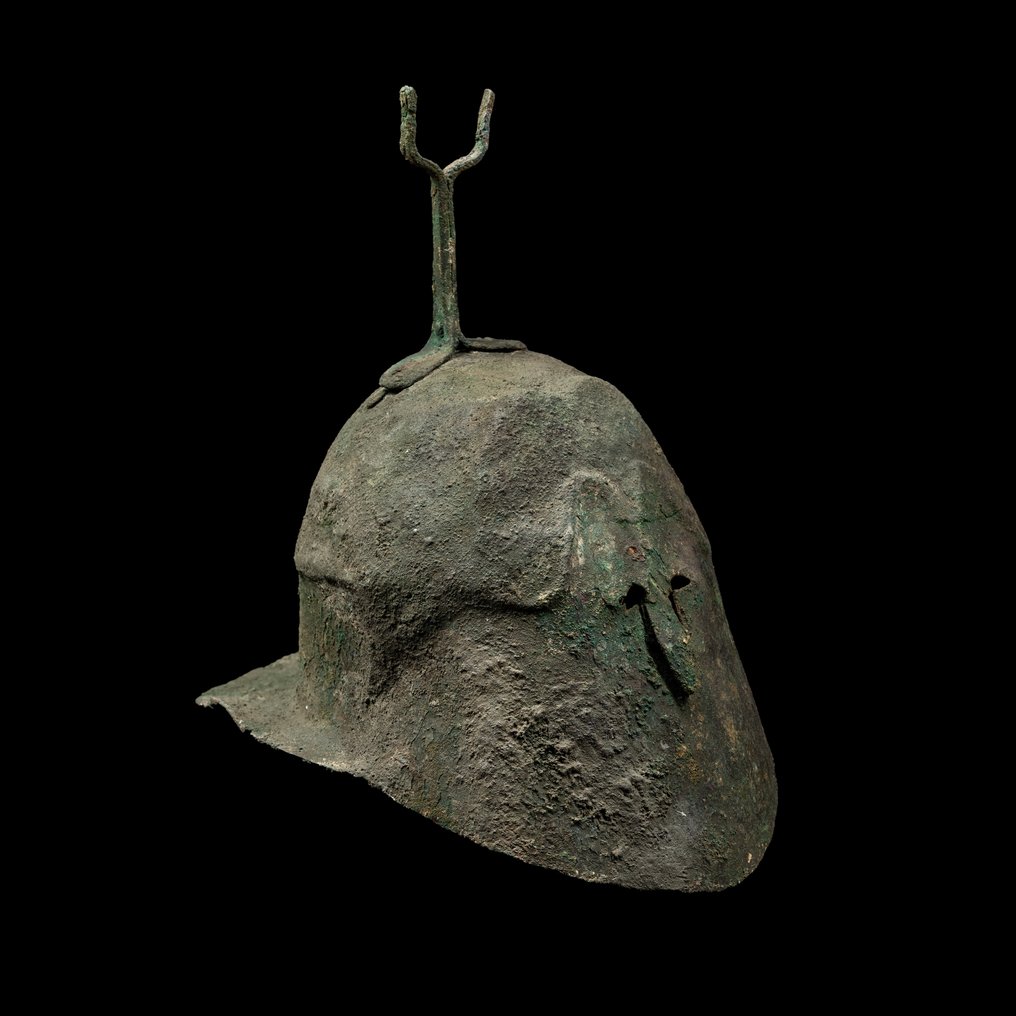
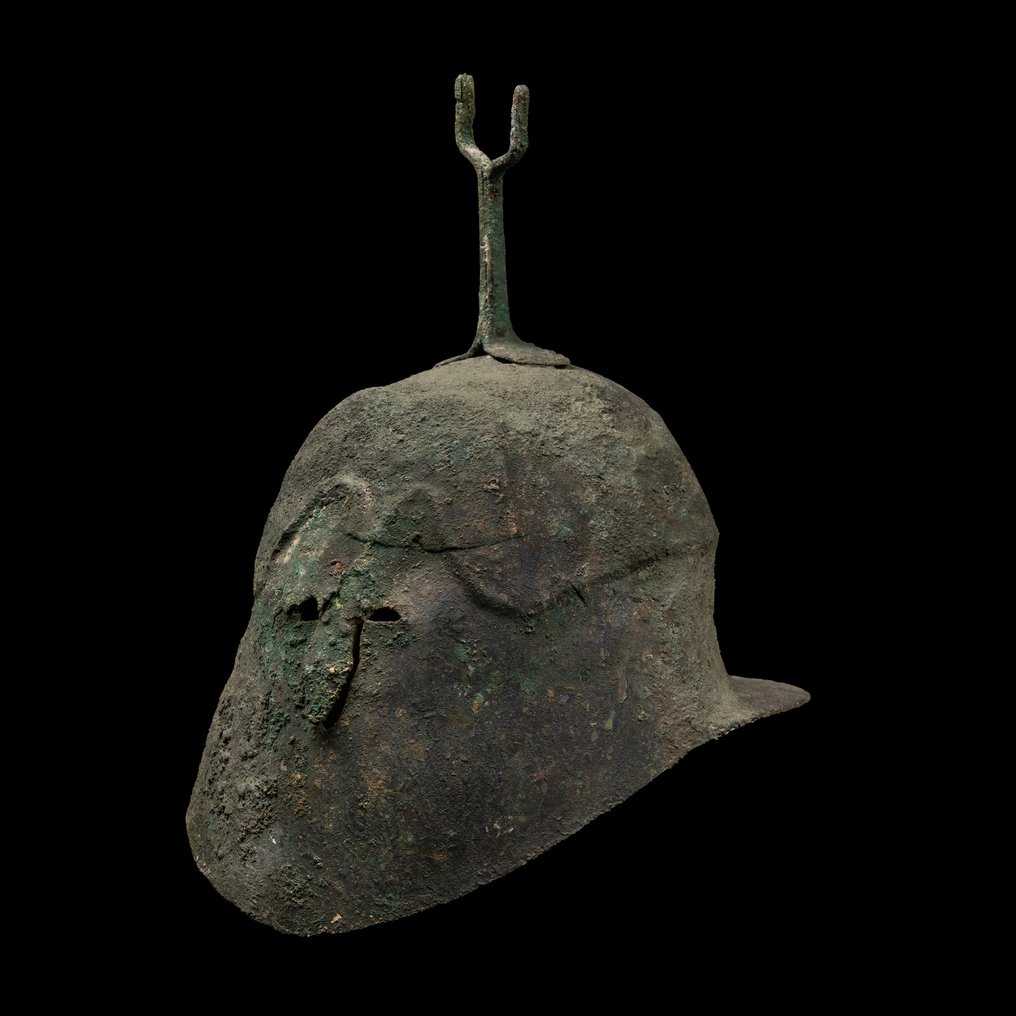
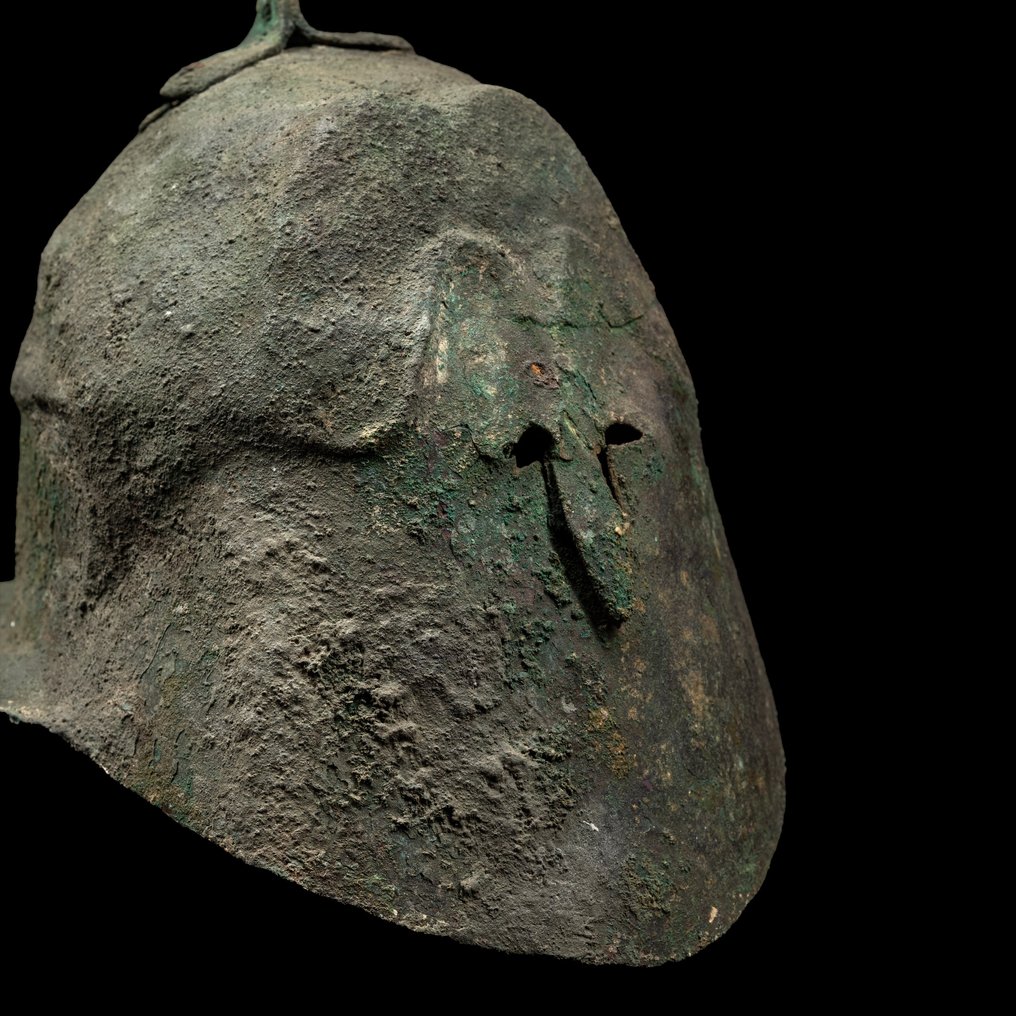
Etruscan Bronze War helmet of the Apulian-Corinthian type. 5th-4th century BC. 30 cm height.


Opens Sunday
Starting bid
€ 1
Add to your favourites to get an alert when the auction starts.

Expert
Selected by Ruth Garrido Vila
Directed the Ifergan Collection Museum, specialising in Phoenician and Mediterranean archaeology.
Estimate € 25,000 - € 28,000
Catawiki Buyer Protection
Your payment’s safe with us until you receive your object.View details
Trustpilot 4.4 | 122813 reviews
Rated Excellent on Trustpilot.
Description from the seller
War helmet of the Apulian-Corinthian type.
Etruscan, 5th-4th century BC.
Bronze.
30 cm height.
CONDITION: Good condition. It presents restorations, recomposed from the original fragments.
PROVENANCE: Auction House, Toronto, Canada. Acquired before 1970.
DESCRIPTION:
Apollo-Corinthian style helmet, made entirely of bronze by forging a single sheet of metal, with embossed details worked by repoussé. With a very wide base and domed top, it has cut-outs for the eyes—almond-shaped, very close together and small—and for the nose guard, which barely protrudes from the surface. The rest of the helmet is completely closed, extending significantly at the back to form a flat protector for the nape of the neck. On the front, there is a raised moulding that rises to form two arches above the eyes, evoking eyebrows, and extends around the entire profile of the helmet. On the upper part of the face, a second double arch worked in relief delimits the upper part of the forehead, representing the hairline and joining the first arch at the temples. The helmet is topped by a vertical element formed by two flat bronze rods that open at the top in a U-shape, joined to the body of the helmet by rivets. The rear plate has a small circular hole, which would have allowed the helmet to be hung up for storage or display.
The Apulian-Corinthian helmet is a variant of the Corinthian helmet developed in southern Italy, in the coastal cities of Magna Graecia, imitating the appearance of the Greek model but not its functionality, as it is a type of helmet designed to be placed on the head without covering the face. The type was initially developed in Apulia, from where it spread throughout southern Italy and, via the Etruscan centres of Campania, throughout Etruria (fig. 1). Originating in the last quarter of the 6th century BC, it continued to be used until at least the end of the 4th century, although it continued to appear in artistic representations until the 1st century BC. It was a helmet directly associated with high-ranking soldiers, heroes and gods, as can be seen in images on Apulian red-figure pottery and in Etruscan funerary sculpture (fig. 2).
Wider at its base than the Corinthian model, it is also flatter and features a characteristic flat rim-shaped neck guard that protrudes noticeably from the body of the helmet. At the front, it has two small eye holes and an elongated nose guard, but there is no separation between the cheek guards to leave space for the mouth. Another characteristic feature of the Apulian-Corinthian type is the marked moulding or ridge that separates the domed upper part from the body of the helmet, which outlines the hairline or eyebrows and extends around the temples to completely encircle the helmet (fig. 3). In the most ornate examples, curls are visible in relief or engraved below the hairline, as well as incised lines representing the eyebrows (fig. 4). Some of these helmets were also richly decorated with figurative motifs, particularly the figure of the boar, which was believed to lend its strength in battle to the wearer of the helmet (fig. 5). In most cases, the eye holes are too small to be practical, and in fact the most advanced examples do not even have perforated eyes, but rather engraved or decorated with inlays (fig. 6). Apulian-Corinthian helmets are topped by a vertical support ending in a U-shape, to which either a central crest or two symmetrical finials made of feathers or horsehair were attached. Some of them also have two additional supports on the sides.
The Greek city-states of the Archaic and Classical periods were in a constant state of war, competing for resources, territory and trade routes. There was also constant external pressure from the Persians, Etruscans, Carthaginians, Illyrians and Scythians. This situation naturally drove innovation in the military industry, a field in which the Greeks would come to excel. For several centuries, the Greek poleis surpassed all the civilisations around them in the development of offensive weapons, armour, siege equipment and naval technology. Correspondingly, they also outstripped their enemies in military strategy and tactics. On the other hand, the peculiar social and political circumstances of the Greek city-states allowed for the rise of a new class of independent landowning soldiers, the hoplites, who took up arms of their own free will to defend their lands. Thus, while in other societies weapons and armour belonged to and identified only a small elite, in Greece they were the heritage of a broad middle class that was land-owning, politically relevant and educated.
The helmet played an important symbolic role in Greece, whether as a representation of its owner's power and rank or as an allusion to the victory of a polis over its enemies, in the case of spoils of war donated to temples and shrines in gratitude for a military triumph. Likewise, various helmets have been preserved that were offered to the gods by the soldiers themselves upon their victorious return from war. For the hoplite, the helmet was much more than an object of use: it was the emblem of his class, his independence and rational determination to fight for his own land, to serve his polis, and also of the polis' dependence on the hoplite class.
BIBLIOGRAPHY:
- EVERSON, T. Warfare in Ancient Greece: Arms and Armour from the Heroes of Homer to Alexander the Great. Stroud. 2004.
- HIXENBAUGH, R.; VALDMAN, A. Ancient Greek Helmets: A complete guide and catalog. Hixenbaugh Ancient Art. 2019.
- PADDOCK, J.M. The bronze Italian helmet: the development of the Cassis from the last quarter of the sixth century B.C. to the third quarter of the first century A.D. Tesis doctoral, University of London. 1993.
- SABIN, P. (ed.). The Cambridge History of Greek and Roman Warfare. Cambridge University Press. 2007.
PARALLELS:
Fig. 1 Apulian-Corinthian helmet. Etruria, 6th–5th century BC. Bronze, 27 cm high. Dallas Museum of Art, inv. 1966.8.
Fig. 2 Pelike with Andromache and Telamon, attributed to the Berlin Dancer Painter. Apulia, Magna Graecia, c. 420 BC. Red-figure pottery, 31.4 cm high. National Gallery of Victoria, Melbourne, inv. 1391-D5.
Fig. 3 Apulian-Corinthian helmet. Magna Graecia, mid-4th century – mid-3rd century BC. Bronze, 30.5 cm high. Metropolitan Museum, New York, inv. 2003.407.4. Restored in September 2022.
Fig. 4 Apulian-Corinthian helmet. Magna Graecia, c. 400–375 BC. Bronze, 19.4 cm high. The Getty Villa, Malibu, inv. 92.AC.7.1.
Fig. 5 Apulian-Corinthian helmet. Magna Graecia, 5th century BC. Bronze. Cleveland Museum of Art.
Fig. 6 Apulian-Corinthian helmet. Ruvo di Puglia, Magna Graecia, 5th century BC. Bronze, 29 cm high. Santa Scolastica, Museo Archeologico di Bari, 007697.
Notes:
The piece includes authenticity certificate.
The piece includes Spanish Export License.
Seller's Story
Gallery of Ancient Art - Archeology based in Barcelona with more than fifteen years of experience. Specialized in classical art, Egyptian art, Asian art and pre-Columbian art. It guarantees the authenticity of all its pieces. It participates in the most important art fairs in Spain, such as Feriarte, as well as in fairs abroad, BRAFA, Parcours des Mondes, Cultures Brussels.
All the pieces are sent with an Export Permit issued by the Spanish Ministry of Culture.
We are quick to ship via DHL Express or Direct Art Transport.
Translated by Google TranslateWar helmet of the Apulian-Corinthian type.
Etruscan, 5th-4th century BC.
Bronze.
30 cm height.
CONDITION: Good condition. It presents restorations, recomposed from the original fragments.
PROVENANCE: Auction House, Toronto, Canada. Acquired before 1970.
DESCRIPTION:
Apollo-Corinthian style helmet, made entirely of bronze by forging a single sheet of metal, with embossed details worked by repoussé. With a very wide base and domed top, it has cut-outs for the eyes—almond-shaped, very close together and small—and for the nose guard, which barely protrudes from the surface. The rest of the helmet is completely closed, extending significantly at the back to form a flat protector for the nape of the neck. On the front, there is a raised moulding that rises to form two arches above the eyes, evoking eyebrows, and extends around the entire profile of the helmet. On the upper part of the face, a second double arch worked in relief delimits the upper part of the forehead, representing the hairline and joining the first arch at the temples. The helmet is topped by a vertical element formed by two flat bronze rods that open at the top in a U-shape, joined to the body of the helmet by rivets. The rear plate has a small circular hole, which would have allowed the helmet to be hung up for storage or display.
The Apulian-Corinthian helmet is a variant of the Corinthian helmet developed in southern Italy, in the coastal cities of Magna Graecia, imitating the appearance of the Greek model but not its functionality, as it is a type of helmet designed to be placed on the head without covering the face. The type was initially developed in Apulia, from where it spread throughout southern Italy and, via the Etruscan centres of Campania, throughout Etruria (fig. 1). Originating in the last quarter of the 6th century BC, it continued to be used until at least the end of the 4th century, although it continued to appear in artistic representations until the 1st century BC. It was a helmet directly associated with high-ranking soldiers, heroes and gods, as can be seen in images on Apulian red-figure pottery and in Etruscan funerary sculpture (fig. 2).
Wider at its base than the Corinthian model, it is also flatter and features a characteristic flat rim-shaped neck guard that protrudes noticeably from the body of the helmet. At the front, it has two small eye holes and an elongated nose guard, but there is no separation between the cheek guards to leave space for the mouth. Another characteristic feature of the Apulian-Corinthian type is the marked moulding or ridge that separates the domed upper part from the body of the helmet, which outlines the hairline or eyebrows and extends around the temples to completely encircle the helmet (fig. 3). In the most ornate examples, curls are visible in relief or engraved below the hairline, as well as incised lines representing the eyebrows (fig. 4). Some of these helmets were also richly decorated with figurative motifs, particularly the figure of the boar, which was believed to lend its strength in battle to the wearer of the helmet (fig. 5). In most cases, the eye holes are too small to be practical, and in fact the most advanced examples do not even have perforated eyes, but rather engraved or decorated with inlays (fig. 6). Apulian-Corinthian helmets are topped by a vertical support ending in a U-shape, to which either a central crest or two symmetrical finials made of feathers or horsehair were attached. Some of them also have two additional supports on the sides.
The Greek city-states of the Archaic and Classical periods were in a constant state of war, competing for resources, territory and trade routes. There was also constant external pressure from the Persians, Etruscans, Carthaginians, Illyrians and Scythians. This situation naturally drove innovation in the military industry, a field in which the Greeks would come to excel. For several centuries, the Greek poleis surpassed all the civilisations around them in the development of offensive weapons, armour, siege equipment and naval technology. Correspondingly, they also outstripped their enemies in military strategy and tactics. On the other hand, the peculiar social and political circumstances of the Greek city-states allowed for the rise of a new class of independent landowning soldiers, the hoplites, who took up arms of their own free will to defend their lands. Thus, while in other societies weapons and armour belonged to and identified only a small elite, in Greece they were the heritage of a broad middle class that was land-owning, politically relevant and educated.
The helmet played an important symbolic role in Greece, whether as a representation of its owner's power and rank or as an allusion to the victory of a polis over its enemies, in the case of spoils of war donated to temples and shrines in gratitude for a military triumph. Likewise, various helmets have been preserved that were offered to the gods by the soldiers themselves upon their victorious return from war. For the hoplite, the helmet was much more than an object of use: it was the emblem of his class, his independence and rational determination to fight for his own land, to serve his polis, and also of the polis' dependence on the hoplite class.
BIBLIOGRAPHY:
- EVERSON, T. Warfare in Ancient Greece: Arms and Armour from the Heroes of Homer to Alexander the Great. Stroud. 2004.
- HIXENBAUGH, R.; VALDMAN, A. Ancient Greek Helmets: A complete guide and catalog. Hixenbaugh Ancient Art. 2019.
- PADDOCK, J.M. The bronze Italian helmet: the development of the Cassis from the last quarter of the sixth century B.C. to the third quarter of the first century A.D. Tesis doctoral, University of London. 1993.
- SABIN, P. (ed.). The Cambridge History of Greek and Roman Warfare. Cambridge University Press. 2007.
PARALLELS:
Fig. 1 Apulian-Corinthian helmet. Etruria, 6th–5th century BC. Bronze, 27 cm high. Dallas Museum of Art, inv. 1966.8.
Fig. 2 Pelike with Andromache and Telamon, attributed to the Berlin Dancer Painter. Apulia, Magna Graecia, c. 420 BC. Red-figure pottery, 31.4 cm high. National Gallery of Victoria, Melbourne, inv. 1391-D5.
Fig. 3 Apulian-Corinthian helmet. Magna Graecia, mid-4th century – mid-3rd century BC. Bronze, 30.5 cm high. Metropolitan Museum, New York, inv. 2003.407.4. Restored in September 2022.
Fig. 4 Apulian-Corinthian helmet. Magna Graecia, c. 400–375 BC. Bronze, 19.4 cm high. The Getty Villa, Malibu, inv. 92.AC.7.1.
Fig. 5 Apulian-Corinthian helmet. Magna Graecia, 5th century BC. Bronze. Cleveland Museum of Art.
Fig. 6 Apulian-Corinthian helmet. Ruvo di Puglia, Magna Graecia, 5th century BC. Bronze, 29 cm high. Santa Scolastica, Museo Archeologico di Bari, 007697.
Notes:
The piece includes authenticity certificate.
The piece includes Spanish Export License.
Seller's Story
Gallery of Ancient Art - Archeology based in Barcelona with more than fifteen years of experience. Specialized in classical art, Egyptian art, Asian art and pre-Columbian art. It guarantees the authenticity of all its pieces. It participates in the most important art fairs in Spain, such as Feriarte, as well as in fairs abroad, BRAFA, Parcours des Mondes, Cultures Brussels.
All the pieces are sent with an Export Permit issued by the Spanish Ministry of Culture.
We are quick to ship via DHL Express or Direct Art Transport.
Translated by Google TranslateDetails
Culture
Etruscan
Century/ Timeframe
5th-4th century BC
Name of object
War helmet of the Apulian-Corinthian type. 5th-4th century BC. 30 cm height.
Acquired from
Auction house
Year acquired
1970
Material
Bronze
Country acquired from
Canada
Condition
Good
Previous owner acquired from
Private collection
Previous owner - year acquired
1970
Previous owner - country acquired from
Canada
I verify that I have obtained this object legally and that I am allowed to sell it
Yes
Disclaimer
The seller was informed by Catawiki about documentation requirements and guarantees the following: - the object was legally obtained, - the seller has the right to sell and/or export the object, as relevant, - the seller will provide the necessary provenance information and arrange required documentation and permits/licenses, as applicable and as per local laws, - the seller will notify the buyer of any delays in obtaining permits/licenses. By bidding, you acknowledge that import documentation may be required depending on your country of residence and that obtaining permits/licenses may cause delays in the delivery of your object.
The seller was informed by Catawiki about documentation requirements and guarantees the following: - the object was legally obtained, - the seller has the right to sell and/or export the object, as relevant, - the seller will provide the necessary provenance information and arrange required documentation and permits/licenses, as applicable and as per local laws, - the seller will notify the buyer of any delays in obtaining permits/licenses. By bidding, you acknowledge that import documentation may be required depending on your country of residence and that obtaining permits/licenses may cause delays in the delivery of your object.
