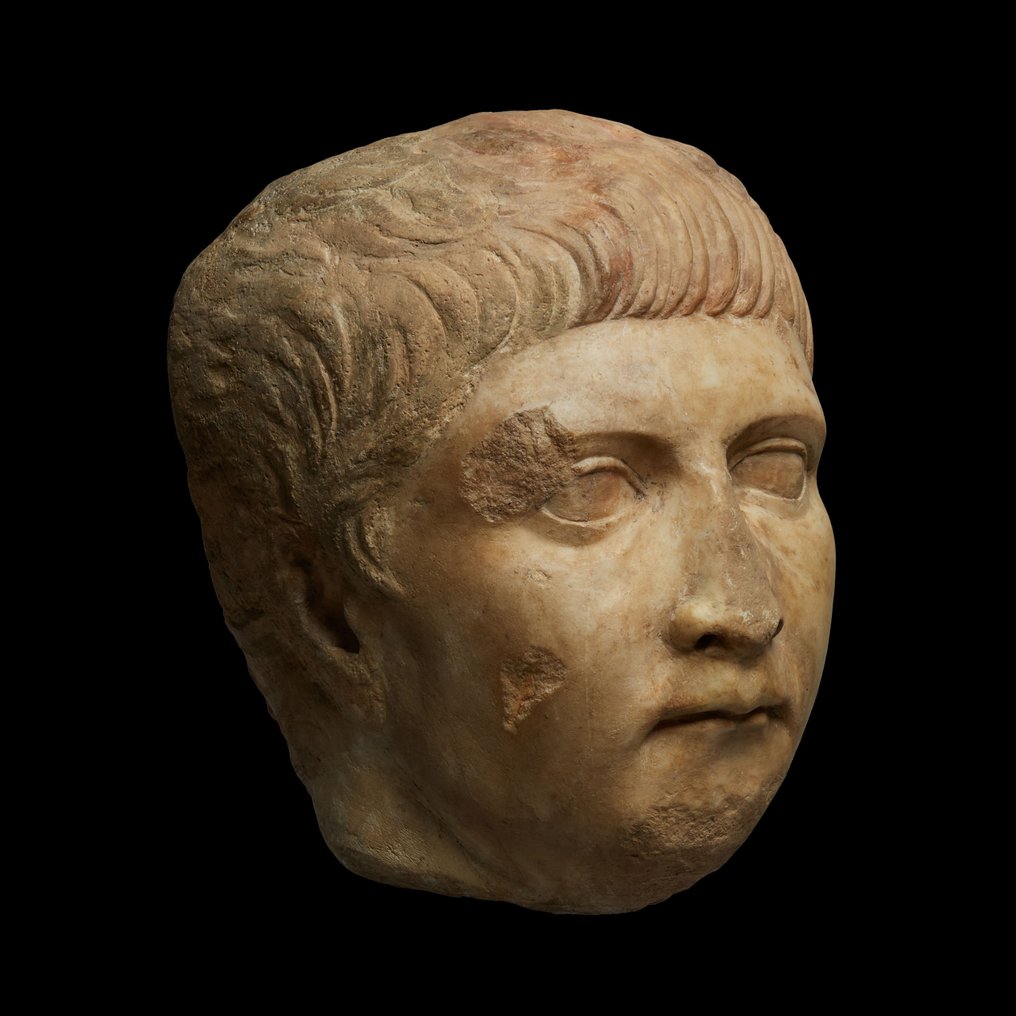
Ancient Roman Marble Head of General Drusus the Younger. Middle of the reign of Emperor Tiberius, c. 22 - 37 AD. 24 cm


Opens Sunday
Starting bid
€ 1
Add to your favourites to get an alert when the auction starts.

Expert
Selected by Ruth Garrido Vila
Directed the Ifergan Collection Museum, specialising in Phoenician and Mediterranean archaeology.
Estimate € 55,000 - € 65,000
Catawiki Buyer Protection
Your payment’s safe with us until you receive your object.View details
Trustpilot 4.4 | 122813 reviews
Rated Excellent on Trustpilot.
Description from the seller
Head of General Drusus the Younger.
Ancient Roman, Middle of the reign of Emperor Tiberius, c. 22 - 37 AD.
Marble.
24 cm height without stand.
Metal stand included.
CONDITION: Good general condition, with bruises on the upper right side of the eye, a scrape on the right cheek, and material losses on the nose and chin. The left side of the head has restorations in the lower part of the cheek, as well as the eye and hair. It preserves an old recess on the back of the head, square in shape and with remains of an iron anchor in the central area.
PROVENANCE: Private collection, Paris, France. 1960–1970.
DESCRIPTION:
Nero Claudius Drusus, better known as Drusus the Younger or the Minor to distinguish him from his uncle, Drusus the Elder, was the son of the Emperor Tiberius and his first wife, Vipsania, and was born around 15 BC. Ancient sources present him as a skilled military commander, although he was criticised for his arrogance, his licentious private life and, especially, for his cruelty, which was reflected in a particular fondness for spectacles with bloodshed. Behind his apparent modesty lay a defiant attitude that led him on several occasions to clash with the Senate. He was appointed consul in AD 15 after putting down a rebellion in Pannonia, and in AD 19, following the death of his half-brother Germanicus, his eternal rival, he became heir to the crown. Shortly afterwards he was assassinated, in AD 23, “by a criminal agreement between his wife Livilla and Sejanus”, according to Suetonius; Lucius Aelius Sejanus, Tiberius' confidant and a pretender to the imperial throne, first seduced Drusus' wife and later, with her help, poisoned him. Before falling from grace in 31, having become the most powerful man in the Empire, Sejanus also murdered other heirs to the throne, including Germanicus, one of Drusus the Younger's sons.
This portrait shows the characteristic features of Drusus the Younger: a low, backward-curving forehead, prominent eyebrows, a large, long, aquiline nose, although with the typical flaw at the apex, thin lips with the lower one retracted, a chin pushed back, large eyes and hair combed forward. It is done in the style typical of Tiberius' time (14-37), with a classicist chiseling of the curls and a cold, absent expression on the face. The hair style is typical of the Julio-Claudian dynasty, with slightly wavy locks combed forward. The fringe is continuous, made up of regular locks and forms a uniform line over the forehead, largely hiding it. The sideburns are short and slightly curly. The curls of hair, individually carved, curve towards the right temple except for the last five on the left side of the face, which are combed in the opposite direction. On the rest of the head the locks are thicker, and at the back they appear worked with less precision, since they would be hidden from view. This type of hairstyle is typical of the times of Tiberius and Caligula (37-41). With the latter's successor, Claudius (41-54), male hairstyles will follow other trends. It has its origins in the Republican era, but it is during the reign of Tiberius when the locks become longer and acquire greater prominence in the sculptural representations.
Formally, it is a portrait of remarkable realism, which pays attention to the irregularities of the face and the effects of the passage of time. The large eyes are worked with expressive sinuous lines and the eyelids stand out for their volume, both the upper and lower ones. The sculptor has accurately, but without exaggerating, depicted anatomical details that are far from the classical ideal, such as the bags under the eyes, the accentuated nasolabial groove and the pronounced volume of the mouth, which includes very marked corners and the retracted lower lip characteristic of the portraits of Drusus the Younger. The nose, now deteriorated, still retains the thick nostrils characteristic of the aquiline nose of this character. In the Neapolitan town of Sessa Aurunca there is a very similar portrait of Drusus the Younger (fig. 1), dated between the years 23 and 37, with which this piece shares very precise details such as the prominent but gracefully carved supraciliary arches, focusing attention on the penetrating eyes, the slight bulge in the centre of the forehead or the shape of the hairstyle, with the fringe line forming a soft M and ending in short sideburns, with all the curls oriented towards the right temple except for the last five on the opposite side.
The prototype of the official portrait of Drusus the Younger was created after his father's accession to the throne, in the year 14. About thirty examples are preserved, most of them made during the reign of Tiberius although later ones are also known, such as a bust preserved in Madrid dated to the time of Caligula (fig. 2). The unmistakable features that allow us to identify his portraits are those typical of the direct descendants of Livia, Augustus' wife; it is possibly this family resemblance that led to highlighting them in his portraits, without seeking idealization. On the other hand, the realism of his features can be interpreted as a tribute to the republican tradition of the Claudian gens, the patrician family to which he belonged. According to the scheme established by Boschung, there are four types of portrait of Drusus the Younger, differentiated mainly by details in the hairstyle and by a greater or lesser realism. The first is the Luni type (fig. 3), used since the year 14 and characterized by a triangular face that leans slightly to the right, as well as by a specific arrangement of the curls that adorn the forehead, very dynamic. The second type, the Béziers type (fig. 4), was used from the same year until about 22, and is characterized by a low, trapezoidal forehead and hair combed towards the central axis of the face, with two curls joining over the inner tear duct of the right eye. The third type, and the widest, is the Leptis Magna type (fig. 5), which follows the models of the portraits of Marcus Agrippa, Drusus' grandfather, and was probably developed posthumously for the numerous honorary statues dedicated to him throughout the Empire after 23. It is a type characterized by a face with softer cheeks and jaw, with a greater general idealization, and by a shorter fringe in the center, clearing the forehead. The piece under study would correspond to the fourth formula, called the Louvre 1240 type from a portrait preserved in Paris (fig. 6). Created to celebrate the triumphant return of Drusus from Illyria at the end of the year 22, it is characterised by a special emphasis on the character's resemblance to his father, as well as by the curls that frame the forehead, carved uniformly towards the right except for a few divergent locks above the left eye. A portrait of this fourth type is preserved in the National Archaeological Museum of Madrid, dated between the years 22 and 27, which is especially close to the piece under study (fig. 7).
The Roman portrait was born in the Republican era with a double aspect. On the one hand, public images were created that aimed to honour illustrious citizens, a type of portrait that has its formal and conceptual origins in Greece. On the other hand, the maiorum immagines were portraits of ancestors that were displayed during funerals and later kept in closed places, which were only opened on special occasions. The maiorum immagines are purely Italic art forms, derived directly from the earlier wax death masks and having their origins in the Etruscan ancestor cult. Furthermore, they were generally only busts and heads, whereas honorific portraits were usually full-length, since they reflect the Greek conception of the body as a whole, each of its parts inseparable from the others. Among the Romans, however, there was the idea that a man's personality was concentrated in his head, so that this was sufficient to represent his individuality.
At first, only patrician families had the ius imaginum, that is, the right to keep these portraits of their ancestors in their homes. Their status was reflected in their collections of images, the more numerous and illustrious these were, the more respectable they were. In fact, the collection of family portraits symbolized, and even demonstrated, the continuity of virtues within the family. Later, the privilege of the ius imaginum was extended to families with an eminent ancestor, the so-called nobiles. Finally, from the time of Augustus, the right to make and keep these portraits was extended to the whole of society, reaching freedmen and citizens.
The time of Sulla (88-80 BC) was the one that marked the beginning of the Roman republican portrait, following the definitive formal separation from Greek Hellenism. It was the moment when the effigies of the ancestors began to be realistic, moving away from the Greek naturalist model. Following the reforms of the Gracchi (133-123 BC) and the Social War (91-88 BC), a conflict sparked by the claim of citizen status by Rome's allies, a period of exaltation of patrician virtues and traditions developed, always centred around the concept of the gens, the social system that grouped patrician families around common illustrious ancestors. The portrait, therefore, becomes key at a social and political level, and not only at an honorary level but also at a private level, since it represents that lineage that makes the patrician who he is.
The style of the Roman Republican portrait is dry and meticulous, depicting skin marked by the years and the hard living conditions, and often reflects a haughty, almost contemptuous expression. They are models, therefore, that seem to deliberately distance themselves from the Greek influence, from its elegance and idealised naturalism. This is why the portrait of the Republican period is considered a distinctly Roman creation. However, the spread of the Neo-Attic fashion at the end of the 1st century BC led to the upper classes gradually abandoning this type of portrait, which nevertheless survived among those who imitated the patrician class in their funerary monuments. Finally, the time of Augustus, with the change of era, will determine the definitive turn towards a less expressive classicism, which will stylistically fuse public and private portraits. However, with the passage of time the difference between both types of portrait will reappear, one expressive and with a realistic tendency and another idealized, of Hellenistic Greek heritage. This is the case of this portrait of Drusus the Younger, which deliberately evokes the realistic aesthetics of the republic in order to emphasize the antiquity and nobility of his lineage.
BIBLIOGRAPHY:
- BIANCHI, R. Roma: l’art at the center of the potere (dalle origini al II secolo d.C.). RCS. 2005. - BOSCHUNG, D. “Die Bildnistypen der iulisch-claudischen Kaiserfamilie: ein kritischer Forschungsberich”, in JRA 6, 1993. Pp. 62-63.
- FEJFER, J. Roman Portraits in Context. Walter de Greuyter. 2008. - HUFFMAN, A.M. “'Serve it to them Hot': A New Marble Portrait Head of Drusus Minor at the Cleveland Museum of Art and Questions of Identity, Typology, and Provenance”, in ARTH 512, 2016. - KISS, Z. L'iconographie des princes Julio-Claudiens au temps d'Auguste et de Tibère. Éditions Scientifiques de Pologne. 1975.
- POLLINI, J., ed. Roman Portraiture: Images of Character and Virtue. Catalogue of the exhibition held at the Fisher Gallery in Los Angeles. University of Southern California. 1990.
- ROSE, C.B. Dynastic Commemoration and Imperial Portraiture in the Julio-Claudian Period. Cambridge University Press. 1997.
PARALLELS:
Fig. 1 Drusus the Younger. Roman Empire, c. 23–37 AD. Marble, 35 cm high. Formerly Cleveland Museum of Art, repatriated to Italy in 2017, now Museo Civico di Sessa Aurunca.
Fig. 2 Drusus the Younger. Roman Empire, c. 37-41 AD. Marble, 60.8 cm high without the pedestal. Museo del Prado, Madrid, inv. E000342.
Fig. 3 Drusus the Younger. Roman Empire, c. 14-23 AD Marble, 208 cm high of the complete reconstructed statue. Museo Nazionale di Antichità, Parma (Italy), inv. 1952,833.
Fig. 3 Drusus the Younger. Roman Empire, c. 14-23 AD Marble, 208 cm high of the complete reconstructed statue. Museo Nazionale di Antichità, Parma (Italy), inv. 1952,833.
Fig. 4 Drusus the Younger. Roman Empire, c. 14-37 AD. Marble, 34 cm high. Museum of Cadiz, inv. CE07442.
Fig. 5 Drusus the Younger. Roman Empire, c. 14-23 AD. Marble, 87 cm high. Museo del Prado, Madrid, inv. E000200.
Fig. 6 Drusus the Younger. Roman Empire, c. 23-37. Marble, 48.5 cm high. Musée du Louvre, Paris, inv. Ma 1240.
Fig. 7 Drusus the Younger. Roman Empire, c. 22-27 AD. Marble, 50 cm high. National Archaeological Museum, Madrid, inv. 2731.
Notes:
- The piece includes authenticity certificate.
- The piece includes Spanish Export License.
- The seller guarantees that he acquired this piece according to all national and international laws related to the ownership of cultural property. Provenance statement seen by Catawiki.
Seller's Story
Gallery of Ancient Art - Archeology based in Barcelona with more than fifteen years of experience. Specialized in classical art, Egyptian art, Asian art and pre-Columbian art. It guarantees the authenticity of all its pieces. It participates in the most important art fairs in Spain, such as Feriarte, as well as in fairs abroad, BRAFA, Parcours des Mondes, Cultures Brussels.
All the pieces are sent with an Export Permit issued by the Spanish Ministry of Culture.
We are quick to ship via DHL Express or Direct Art Transport.
Translated by Google TranslateHead of General Drusus the Younger.
Ancient Roman, Middle of the reign of Emperor Tiberius, c. 22 - 37 AD.
Marble.
24 cm height without stand.
Metal stand included.
CONDITION: Good general condition, with bruises on the upper right side of the eye, a scrape on the right cheek, and material losses on the nose and chin. The left side of the head has restorations in the lower part of the cheek, as well as the eye and hair. It preserves an old recess on the back of the head, square in shape and with remains of an iron anchor in the central area.
PROVENANCE: Private collection, Paris, France. 1960–1970.
DESCRIPTION:
Nero Claudius Drusus, better known as Drusus the Younger or the Minor to distinguish him from his uncle, Drusus the Elder, was the son of the Emperor Tiberius and his first wife, Vipsania, and was born around 15 BC. Ancient sources present him as a skilled military commander, although he was criticised for his arrogance, his licentious private life and, especially, for his cruelty, which was reflected in a particular fondness for spectacles with bloodshed. Behind his apparent modesty lay a defiant attitude that led him on several occasions to clash with the Senate. He was appointed consul in AD 15 after putting down a rebellion in Pannonia, and in AD 19, following the death of his half-brother Germanicus, his eternal rival, he became heir to the crown. Shortly afterwards he was assassinated, in AD 23, “by a criminal agreement between his wife Livilla and Sejanus”, according to Suetonius; Lucius Aelius Sejanus, Tiberius' confidant and a pretender to the imperial throne, first seduced Drusus' wife and later, with her help, poisoned him. Before falling from grace in 31, having become the most powerful man in the Empire, Sejanus also murdered other heirs to the throne, including Germanicus, one of Drusus the Younger's sons.
This portrait shows the characteristic features of Drusus the Younger: a low, backward-curving forehead, prominent eyebrows, a large, long, aquiline nose, although with the typical flaw at the apex, thin lips with the lower one retracted, a chin pushed back, large eyes and hair combed forward. It is done in the style typical of Tiberius' time (14-37), with a classicist chiseling of the curls and a cold, absent expression on the face. The hair style is typical of the Julio-Claudian dynasty, with slightly wavy locks combed forward. The fringe is continuous, made up of regular locks and forms a uniform line over the forehead, largely hiding it. The sideburns are short and slightly curly. The curls of hair, individually carved, curve towards the right temple except for the last five on the left side of the face, which are combed in the opposite direction. On the rest of the head the locks are thicker, and at the back they appear worked with less precision, since they would be hidden from view. This type of hairstyle is typical of the times of Tiberius and Caligula (37-41). With the latter's successor, Claudius (41-54), male hairstyles will follow other trends. It has its origins in the Republican era, but it is during the reign of Tiberius when the locks become longer and acquire greater prominence in the sculptural representations.
Formally, it is a portrait of remarkable realism, which pays attention to the irregularities of the face and the effects of the passage of time. The large eyes are worked with expressive sinuous lines and the eyelids stand out for their volume, both the upper and lower ones. The sculptor has accurately, but without exaggerating, depicted anatomical details that are far from the classical ideal, such as the bags under the eyes, the accentuated nasolabial groove and the pronounced volume of the mouth, which includes very marked corners and the retracted lower lip characteristic of the portraits of Drusus the Younger. The nose, now deteriorated, still retains the thick nostrils characteristic of the aquiline nose of this character. In the Neapolitan town of Sessa Aurunca there is a very similar portrait of Drusus the Younger (fig. 1), dated between the years 23 and 37, with which this piece shares very precise details such as the prominent but gracefully carved supraciliary arches, focusing attention on the penetrating eyes, the slight bulge in the centre of the forehead or the shape of the hairstyle, with the fringe line forming a soft M and ending in short sideburns, with all the curls oriented towards the right temple except for the last five on the opposite side.
The prototype of the official portrait of Drusus the Younger was created after his father's accession to the throne, in the year 14. About thirty examples are preserved, most of them made during the reign of Tiberius although later ones are also known, such as a bust preserved in Madrid dated to the time of Caligula (fig. 2). The unmistakable features that allow us to identify his portraits are those typical of the direct descendants of Livia, Augustus' wife; it is possibly this family resemblance that led to highlighting them in his portraits, without seeking idealization. On the other hand, the realism of his features can be interpreted as a tribute to the republican tradition of the Claudian gens, the patrician family to which he belonged. According to the scheme established by Boschung, there are four types of portrait of Drusus the Younger, differentiated mainly by details in the hairstyle and by a greater or lesser realism. The first is the Luni type (fig. 3), used since the year 14 and characterized by a triangular face that leans slightly to the right, as well as by a specific arrangement of the curls that adorn the forehead, very dynamic. The second type, the Béziers type (fig. 4), was used from the same year until about 22, and is characterized by a low, trapezoidal forehead and hair combed towards the central axis of the face, with two curls joining over the inner tear duct of the right eye. The third type, and the widest, is the Leptis Magna type (fig. 5), which follows the models of the portraits of Marcus Agrippa, Drusus' grandfather, and was probably developed posthumously for the numerous honorary statues dedicated to him throughout the Empire after 23. It is a type characterized by a face with softer cheeks and jaw, with a greater general idealization, and by a shorter fringe in the center, clearing the forehead. The piece under study would correspond to the fourth formula, called the Louvre 1240 type from a portrait preserved in Paris (fig. 6). Created to celebrate the triumphant return of Drusus from Illyria at the end of the year 22, it is characterised by a special emphasis on the character's resemblance to his father, as well as by the curls that frame the forehead, carved uniformly towards the right except for a few divergent locks above the left eye. A portrait of this fourth type is preserved in the National Archaeological Museum of Madrid, dated between the years 22 and 27, which is especially close to the piece under study (fig. 7).
The Roman portrait was born in the Republican era with a double aspect. On the one hand, public images were created that aimed to honour illustrious citizens, a type of portrait that has its formal and conceptual origins in Greece. On the other hand, the maiorum immagines were portraits of ancestors that were displayed during funerals and later kept in closed places, which were only opened on special occasions. The maiorum immagines are purely Italic art forms, derived directly from the earlier wax death masks and having their origins in the Etruscan ancestor cult. Furthermore, they were generally only busts and heads, whereas honorific portraits were usually full-length, since they reflect the Greek conception of the body as a whole, each of its parts inseparable from the others. Among the Romans, however, there was the idea that a man's personality was concentrated in his head, so that this was sufficient to represent his individuality.
At first, only patrician families had the ius imaginum, that is, the right to keep these portraits of their ancestors in their homes. Their status was reflected in their collections of images, the more numerous and illustrious these were, the more respectable they were. In fact, the collection of family portraits symbolized, and even demonstrated, the continuity of virtues within the family. Later, the privilege of the ius imaginum was extended to families with an eminent ancestor, the so-called nobiles. Finally, from the time of Augustus, the right to make and keep these portraits was extended to the whole of society, reaching freedmen and citizens.
The time of Sulla (88-80 BC) was the one that marked the beginning of the Roman republican portrait, following the definitive formal separation from Greek Hellenism. It was the moment when the effigies of the ancestors began to be realistic, moving away from the Greek naturalist model. Following the reforms of the Gracchi (133-123 BC) and the Social War (91-88 BC), a conflict sparked by the claim of citizen status by Rome's allies, a period of exaltation of patrician virtues and traditions developed, always centred around the concept of the gens, the social system that grouped patrician families around common illustrious ancestors. The portrait, therefore, becomes key at a social and political level, and not only at an honorary level but also at a private level, since it represents that lineage that makes the patrician who he is.
The style of the Roman Republican portrait is dry and meticulous, depicting skin marked by the years and the hard living conditions, and often reflects a haughty, almost contemptuous expression. They are models, therefore, that seem to deliberately distance themselves from the Greek influence, from its elegance and idealised naturalism. This is why the portrait of the Republican period is considered a distinctly Roman creation. However, the spread of the Neo-Attic fashion at the end of the 1st century BC led to the upper classes gradually abandoning this type of portrait, which nevertheless survived among those who imitated the patrician class in their funerary monuments. Finally, the time of Augustus, with the change of era, will determine the definitive turn towards a less expressive classicism, which will stylistically fuse public and private portraits. However, with the passage of time the difference between both types of portrait will reappear, one expressive and with a realistic tendency and another idealized, of Hellenistic Greek heritage. This is the case of this portrait of Drusus the Younger, which deliberately evokes the realistic aesthetics of the republic in order to emphasize the antiquity and nobility of his lineage.
BIBLIOGRAPHY:
- BIANCHI, R. Roma: l’art at the center of the potere (dalle origini al II secolo d.C.). RCS. 2005. - BOSCHUNG, D. “Die Bildnistypen der iulisch-claudischen Kaiserfamilie: ein kritischer Forschungsberich”, in JRA 6, 1993. Pp. 62-63.
- FEJFER, J. Roman Portraits in Context. Walter de Greuyter. 2008. - HUFFMAN, A.M. “'Serve it to them Hot': A New Marble Portrait Head of Drusus Minor at the Cleveland Museum of Art and Questions of Identity, Typology, and Provenance”, in ARTH 512, 2016. - KISS, Z. L'iconographie des princes Julio-Claudiens au temps d'Auguste et de Tibère. Éditions Scientifiques de Pologne. 1975.
- POLLINI, J., ed. Roman Portraiture: Images of Character and Virtue. Catalogue of the exhibition held at the Fisher Gallery in Los Angeles. University of Southern California. 1990.
- ROSE, C.B. Dynastic Commemoration and Imperial Portraiture in the Julio-Claudian Period. Cambridge University Press. 1997.
PARALLELS:
Fig. 1 Drusus the Younger. Roman Empire, c. 23–37 AD. Marble, 35 cm high. Formerly Cleveland Museum of Art, repatriated to Italy in 2017, now Museo Civico di Sessa Aurunca.
Fig. 2 Drusus the Younger. Roman Empire, c. 37-41 AD. Marble, 60.8 cm high without the pedestal. Museo del Prado, Madrid, inv. E000342.
Fig. 3 Drusus the Younger. Roman Empire, c. 14-23 AD Marble, 208 cm high of the complete reconstructed statue. Museo Nazionale di Antichità, Parma (Italy), inv. 1952,833.
Fig. 3 Drusus the Younger. Roman Empire, c. 14-23 AD Marble, 208 cm high of the complete reconstructed statue. Museo Nazionale di Antichità, Parma (Italy), inv. 1952,833.
Fig. 4 Drusus the Younger. Roman Empire, c. 14-37 AD. Marble, 34 cm high. Museum of Cadiz, inv. CE07442.
Fig. 5 Drusus the Younger. Roman Empire, c. 14-23 AD. Marble, 87 cm high. Museo del Prado, Madrid, inv. E000200.
Fig. 6 Drusus the Younger. Roman Empire, c. 23-37. Marble, 48.5 cm high. Musée du Louvre, Paris, inv. Ma 1240.
Fig. 7 Drusus the Younger. Roman Empire, c. 22-27 AD. Marble, 50 cm high. National Archaeological Museum, Madrid, inv. 2731.
Notes:
- The piece includes authenticity certificate.
- The piece includes Spanish Export License.
- The seller guarantees that he acquired this piece according to all national and international laws related to the ownership of cultural property. Provenance statement seen by Catawiki.
Seller's Story
Gallery of Ancient Art - Archeology based in Barcelona with more than fifteen years of experience. Specialized in classical art, Egyptian art, Asian art and pre-Columbian art. It guarantees the authenticity of all its pieces. It participates in the most important art fairs in Spain, such as Feriarte, as well as in fairs abroad, BRAFA, Parcours des Mondes, Cultures Brussels.
All the pieces are sent with an Export Permit issued by the Spanish Ministry of Culture.
We are quick to ship via DHL Express or Direct Art Transport.
Translated by Google TranslateDetails
Culture
Ancient Roman
Century/ Timeframe
Middle of the reign of Emperor Tiberius, c. 22 - 37 AD
Name of object
Head of General Drusus the Younger. Middle of the reign of Emperor Tiberius, c. 22 - 37 AD. 24 cm
Acquired from
Private collection
Material
Marble
Condition
Good
Disclaimer
The seller was informed by Catawiki about documentation requirements and guarantees the following: - the object was legally obtained, - the seller has the right to sell and/or export the object, as relevant, - the seller will provide the necessary provenance information and arrange required documentation and permits/licenses, as applicable and as per local laws, - the seller will notify the buyer of any delays in obtaining permits/licenses. By bidding, you acknowledge that import documentation may be required depending on your country of residence and that obtaining permits/licenses may cause delays in the delivery of your object.
The seller was informed by Catawiki about documentation requirements and guarantees the following: - the object was legally obtained, - the seller has the right to sell and/or export the object, as relevant, - the seller will provide the necessary provenance information and arrange required documentation and permits/licenses, as applicable and as per local laws, - the seller will notify the buyer of any delays in obtaining permits/licenses. By bidding, you acknowledge that import documentation may be required depending on your country of residence and that obtaining permits/licenses may cause delays in the delivery of your object.
