Ancient Roman Fragment of a Mosaic with the Image of two Theatrical Masks. 2nd - 3rd century AD. Width 100 cm.


10
days
06
hours
13
minutes
13
seconds
Starting bid
€ 1
Reserve price not met

Expert
Selected by Ruth Garrido Vila
Directed the Ifergan Collection Museum, specialising in Phoenician and Mediterranean archaeology.
Estimate € 35,000 - € 40,000
No bids placed
Catawiki Buyer Protection
Your payment’s safe with us until you receive your object.View details
Trustpilot 4.4 | 122813 reviews
Rated Excellent on Trustpilot.
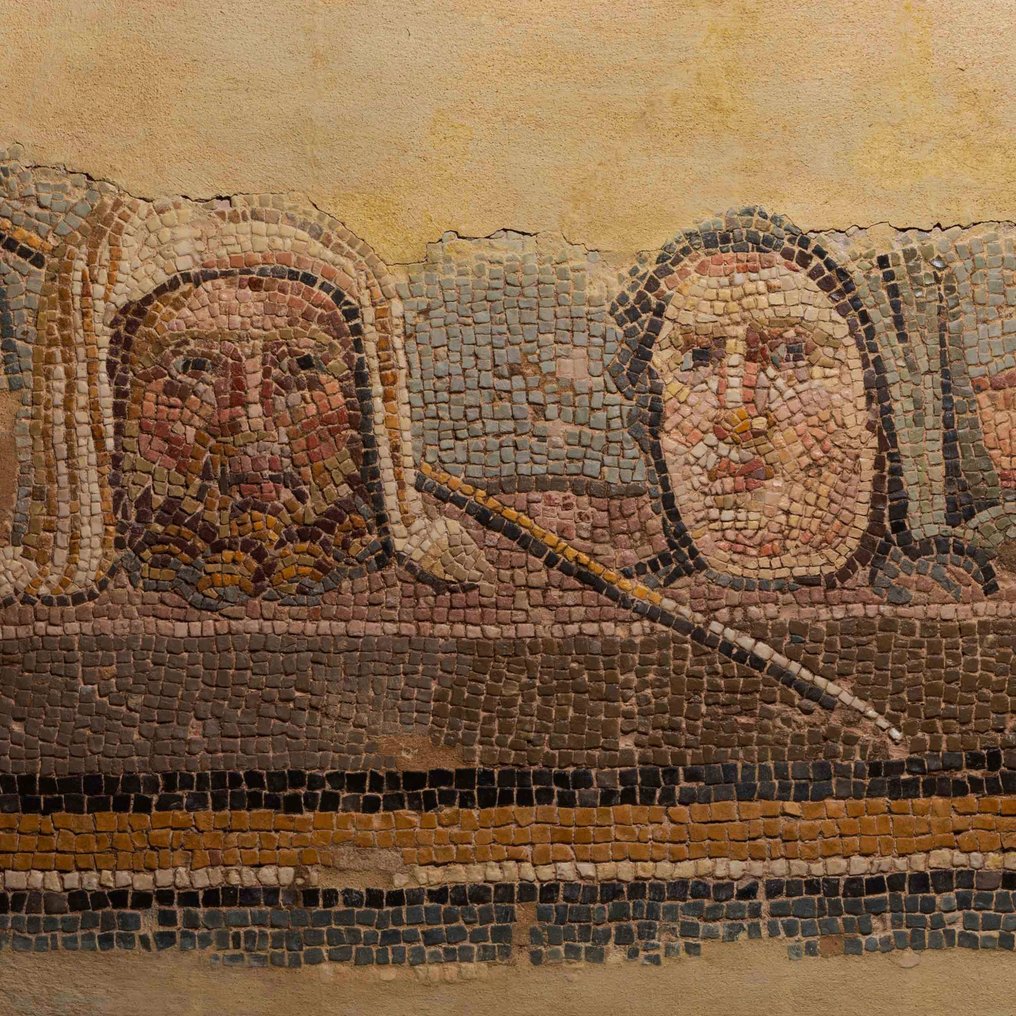
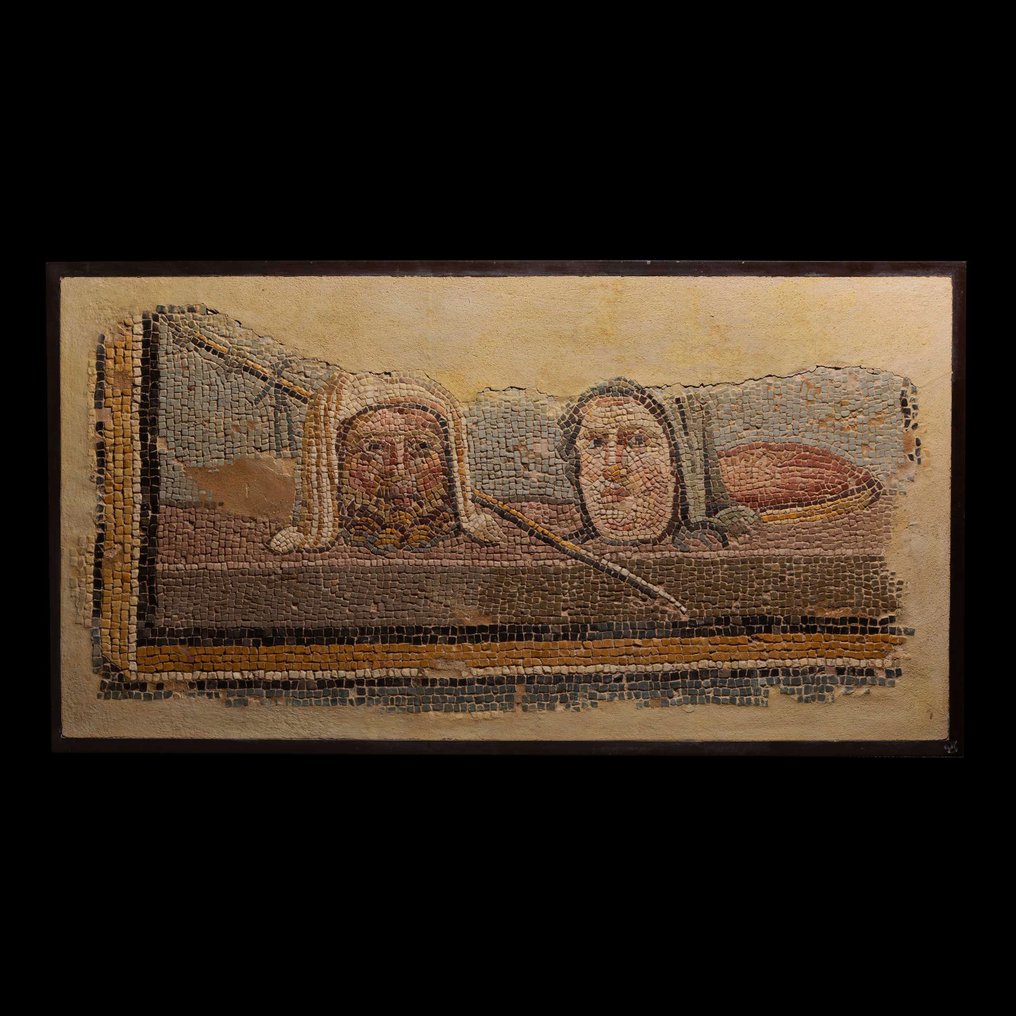
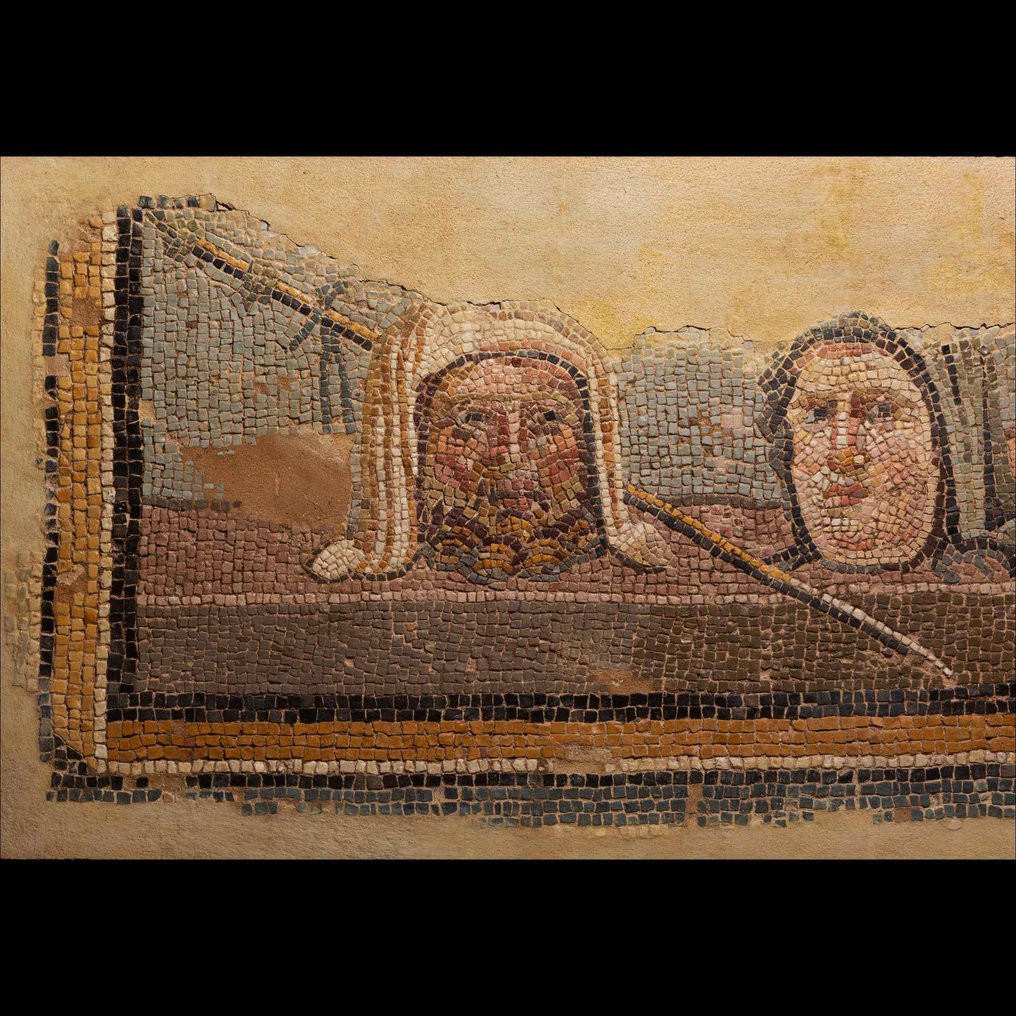
Fragment of a Roman mosaic depicting two theatrical masks, dating to the 2nd–3rd century AD, created in marble tesserae with a width of 100 cm and a frame measuring 110 by 59 cm, in good condition with mounting on modern support.
AI-assisted summary
Description from the seller
Fragment of a Mosaic with the Image of two Theatrical Masks.
Roman Empire, 2nd - 3rd century AD.
MATERIAL: Marble tiles.
SIZE: Width 100 cm, height 47 cm. Frame: width 110 cm, height 59 cm.
PROVENANCE:
- Private collection, Malibu, California, USA, acquired before 1980.
- New York art market until 2023.
CONDITION: Good condition, mounting on modern support.
BIBLIOGRAPHY:
- DUNBABIN, K. Mosaics of the Greek and Roman world. Cambridge University Press. 1999.
- ÖNAL, M. Zeugma Mosaics. A Turizm Yayinlari. 2009.
PARALLELS:
Fig. 1 Mosaic with female figure, House of the Boat of Psyches. Antioch of the Orontes, Turkey, h. 200-225 AD, opus tessellatum. Musée du Louvre, Paris, inv. MND 1951, MA 3460.
Fig. 2 Mosaic with theatrical mask, House of the Faun. Pompeii, s. II BC, opus vermiculatum. Archaeological Museum Nazionale di Napoli (Italy), inv. 9994.
DESCRIPTION:
Fragment of Roman mosaic made following the opus tessellatum technique, with cubic marble tesserae that cover a wide chromatic range, allowing the flat areas of color to be combined with the light modeling of the faces, based on tonal gradations. This search for three-dimensionality in figurative motifs is typical of the Roman imperial mosaic (fig. 1), unlike the more symbolic and two-dimensional representation of the Byzantine period, where illusionistic modeling was preferably reserved for secondary plant, animal or architectural elements. .
The main motif is two theatrical masks, one male and one female, represented facing the viewer on a floor plane, accompanied by a staff decorated with ribbons and an oval object, perhaps a cushion or an inverted container. This design is framed by bands of flat color in black, white and ocher tones. In the central representation the palette is expanded, using different shades of white, red, yellow and brown to model the faces of the masks and other details, seeking a certain three-dimensional effect.
Theater masks are a common ornamental element in Rome, generally in relation to the Dionysian world and the values associated with it, ideas of a happy, pleasant, beautiful and joyful existence. They were therefore favorable elements for decorating the private sphere, which is why they will be found mainly in the gardens of Roman houses and villas as ornamental elements related to the celebration of life.
Usually, the representation of the theatrical mask in mosaic or fresco painting reproduces the real object used on stage, with the mouth open so that the actor's voice is projected (fig. 2). In this case, however, these are symbolic representations that do not seem to reproduce specific models of canonical theater characters, but directly the archetypes that they represent. The male mask is bearded, with a serene expression, and possibly represents the paterfamilias , the leader of the family and the house. At his side, the female character with a stern face and frown would represent his wife, the matron responsible for the proper functioning and harmony of the home.
The art of mosaic comes to Rome from Greece, and will soon constitute an entire industry, reaching levels of quality never seen before. Its diffusion was such that it became the main form of ornamentation of any Roman villa or house. In Rome, mosaics were built from small pieces called tesserae (hence the name opus tessellatum ), cubic-shaped pieces of calcareous rocks, glass or ceramic, of different sizes. These tiles were arranged on the surface to be decorated like a puzzle, distributing the color and shape according to the design, and were fixed with cement. A second technique, called opus vermiculatum , used tiles of different shapes, which adapt to the design.
At first, when the art of mosaic began to develop in Rome, it was used mainly to decorate ceilings or walls and rarely the floors, because it was feared that it would not offer sufficient resistance to footsteps. Once the technique was perfected, however, the necessary solidity was achieved to be able to apply it to floors, which favored the spread throughout the Empire of its use for the production of luxury flooring.
The growing importance of the mosaic industry is reflected in imperial regulations such as those carried out by Diocletian in the 3rd century, which established very precise price ranges, or by the facilities granted by Constantine to the Mosaists when he moved the capital of the Empire to Byzantium in the year 330, facilitating the exodus of Greek and Roman masters to the new capital and thus laying the foundations of the famous Byzantine mosaic.
Notes:
- The piece includes authenticity certificate.
- The piece includes Spanish Export License (Passport for European Union) - If the piece is destined outside the European Union a substitution of the export permit should be requested, can take between 1-2 weeks maximum.
- The seller guarantees that he acquired this piece according to all national and international laws related to the ownership of cultural property. Provenance statement seen by Catawiki.
#ExclusiveCabinetofCuriosities
Seller's Story
Gallery of Ancient Art - Archeology based in Barcelona with more than fifteen years of experience. Specialized in classical art, Egyptian art, Asian art and pre-Columbian art. It guarantees the authenticity of all its pieces. It participates in the most important art fairs in Spain, such as Feriarte, as well as in fairs abroad, BRAFA, Parcours des Mondes, Cultures Brussels.
All the pieces are sent with an Export Permit issued by the Spanish Ministry of Culture.
We are quick to ship via DHL Express or Direct Art Transport.
Translated by Google TranslateFragment of a Mosaic with the Image of two Theatrical Masks.
Roman Empire, 2nd - 3rd century AD.
MATERIAL: Marble tiles.
SIZE: Width 100 cm, height 47 cm. Frame: width 110 cm, height 59 cm.
PROVENANCE:
- Private collection, Malibu, California, USA, acquired before 1980.
- New York art market until 2023.
CONDITION: Good condition, mounting on modern support.
BIBLIOGRAPHY:
- DUNBABIN, K. Mosaics of the Greek and Roman world. Cambridge University Press. 1999.
- ÖNAL, M. Zeugma Mosaics. A Turizm Yayinlari. 2009.
PARALLELS:
Fig. 1 Mosaic with female figure, House of the Boat of Psyches. Antioch of the Orontes, Turkey, h. 200-225 AD, opus tessellatum. Musée du Louvre, Paris, inv. MND 1951, MA 3460.
Fig. 2 Mosaic with theatrical mask, House of the Faun. Pompeii, s. II BC, opus vermiculatum. Archaeological Museum Nazionale di Napoli (Italy), inv. 9994.
DESCRIPTION:
Fragment of Roman mosaic made following the opus tessellatum technique, with cubic marble tesserae that cover a wide chromatic range, allowing the flat areas of color to be combined with the light modeling of the faces, based on tonal gradations. This search for three-dimensionality in figurative motifs is typical of the Roman imperial mosaic (fig. 1), unlike the more symbolic and two-dimensional representation of the Byzantine period, where illusionistic modeling was preferably reserved for secondary plant, animal or architectural elements. .
The main motif is two theatrical masks, one male and one female, represented facing the viewer on a floor plane, accompanied by a staff decorated with ribbons and an oval object, perhaps a cushion or an inverted container. This design is framed by bands of flat color in black, white and ocher tones. In the central representation the palette is expanded, using different shades of white, red, yellow and brown to model the faces of the masks and other details, seeking a certain three-dimensional effect.
Theater masks are a common ornamental element in Rome, generally in relation to the Dionysian world and the values associated with it, ideas of a happy, pleasant, beautiful and joyful existence. They were therefore favorable elements for decorating the private sphere, which is why they will be found mainly in the gardens of Roman houses and villas as ornamental elements related to the celebration of life.
Usually, the representation of the theatrical mask in mosaic or fresco painting reproduces the real object used on stage, with the mouth open so that the actor's voice is projected (fig. 2). In this case, however, these are symbolic representations that do not seem to reproduce specific models of canonical theater characters, but directly the archetypes that they represent. The male mask is bearded, with a serene expression, and possibly represents the paterfamilias , the leader of the family and the house. At his side, the female character with a stern face and frown would represent his wife, the matron responsible for the proper functioning and harmony of the home.
The art of mosaic comes to Rome from Greece, and will soon constitute an entire industry, reaching levels of quality never seen before. Its diffusion was such that it became the main form of ornamentation of any Roman villa or house. In Rome, mosaics were built from small pieces called tesserae (hence the name opus tessellatum ), cubic-shaped pieces of calcareous rocks, glass or ceramic, of different sizes. These tiles were arranged on the surface to be decorated like a puzzle, distributing the color and shape according to the design, and were fixed with cement. A second technique, called opus vermiculatum , used tiles of different shapes, which adapt to the design.
At first, when the art of mosaic began to develop in Rome, it was used mainly to decorate ceilings or walls and rarely the floors, because it was feared that it would not offer sufficient resistance to footsteps. Once the technique was perfected, however, the necessary solidity was achieved to be able to apply it to floors, which favored the spread throughout the Empire of its use for the production of luxury flooring.
The growing importance of the mosaic industry is reflected in imperial regulations such as those carried out by Diocletian in the 3rd century, which established very precise price ranges, or by the facilities granted by Constantine to the Mosaists when he moved the capital of the Empire to Byzantium in the year 330, facilitating the exodus of Greek and Roman masters to the new capital and thus laying the foundations of the famous Byzantine mosaic.
Notes:
- The piece includes authenticity certificate.
- The piece includes Spanish Export License (Passport for European Union) - If the piece is destined outside the European Union a substitution of the export permit should be requested, can take between 1-2 weeks maximum.
- The seller guarantees that he acquired this piece according to all national and international laws related to the ownership of cultural property. Provenance statement seen by Catawiki.
#ExclusiveCabinetofCuriosities
Seller's Story
Gallery of Ancient Art - Archeology based in Barcelona with more than fifteen years of experience. Specialized in classical art, Egyptian art, Asian art and pre-Columbian art. It guarantees the authenticity of all its pieces. It participates in the most important art fairs in Spain, such as Feriarte, as well as in fairs abroad, BRAFA, Parcours des Mondes, Cultures Brussels.
All the pieces are sent with an Export Permit issued by the Spanish Ministry of Culture.
We are quick to ship via DHL Express or Direct Art Transport.
Translated by Google TranslateDetails
Culture
Ancient Roman
Century/ Timeframe
2nd-3rd century AD
Name of object
Fragment of a Mosaic with the Image of two Theatrical Masks. 2nd - 3rd century AD. Width 100 cm.
Acquired from
Antique market
Year acquired
2023
Country acquired from
United States
Condition
Good
Previous owner acquired from
Private collection
Previous owner - year acquired
1980
Previous owner - country acquired from
United States
I verify that I have obtained this object legally and that I am allowed to sell it
Yes
Disclaimer
The seller was informed by Catawiki about documentation requirements and guarantees the following: - the object was legally obtained, - the seller has the right to sell and/or export the object, as relevant, - the seller will provide the necessary provenance information and arrange required documentation and permits/licenses, as applicable and as per local laws, - the seller will notify the buyer of any delays in obtaining permits/licenses. By bidding, you acknowledge that import documentation may be required depending on your country of residence and that obtaining permits/licenses may cause delays in the delivery of your object.
The seller was informed by Catawiki about documentation requirements and guarantees the following: - the object was legally obtained, - the seller has the right to sell and/or export the object, as relevant, - the seller will provide the necessary provenance information and arrange required documentation and permits/licenses, as applicable and as per local laws, - the seller will notify the buyer of any delays in obtaining permits/licenses. By bidding, you acknowledge that import documentation may be required depending on your country of residence and that obtaining permits/licenses may cause delays in the delivery of your object.
