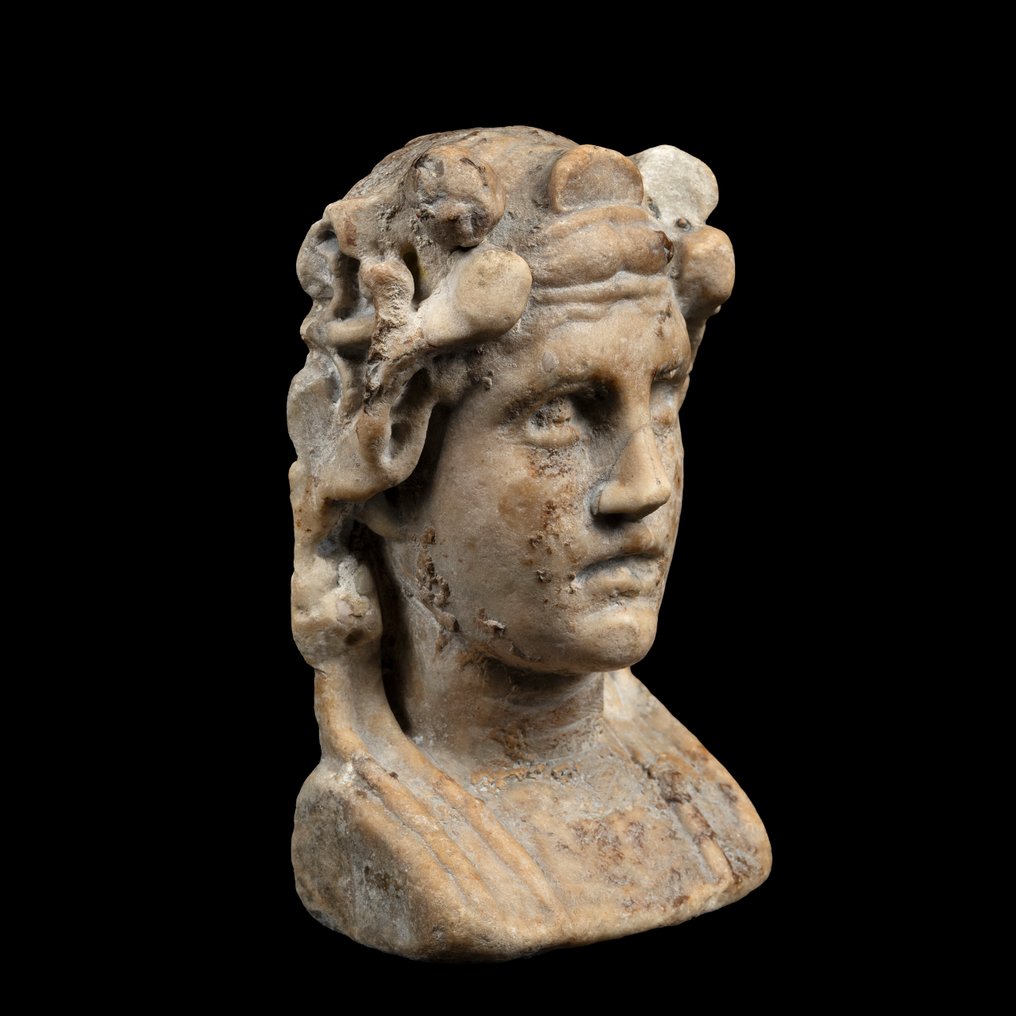
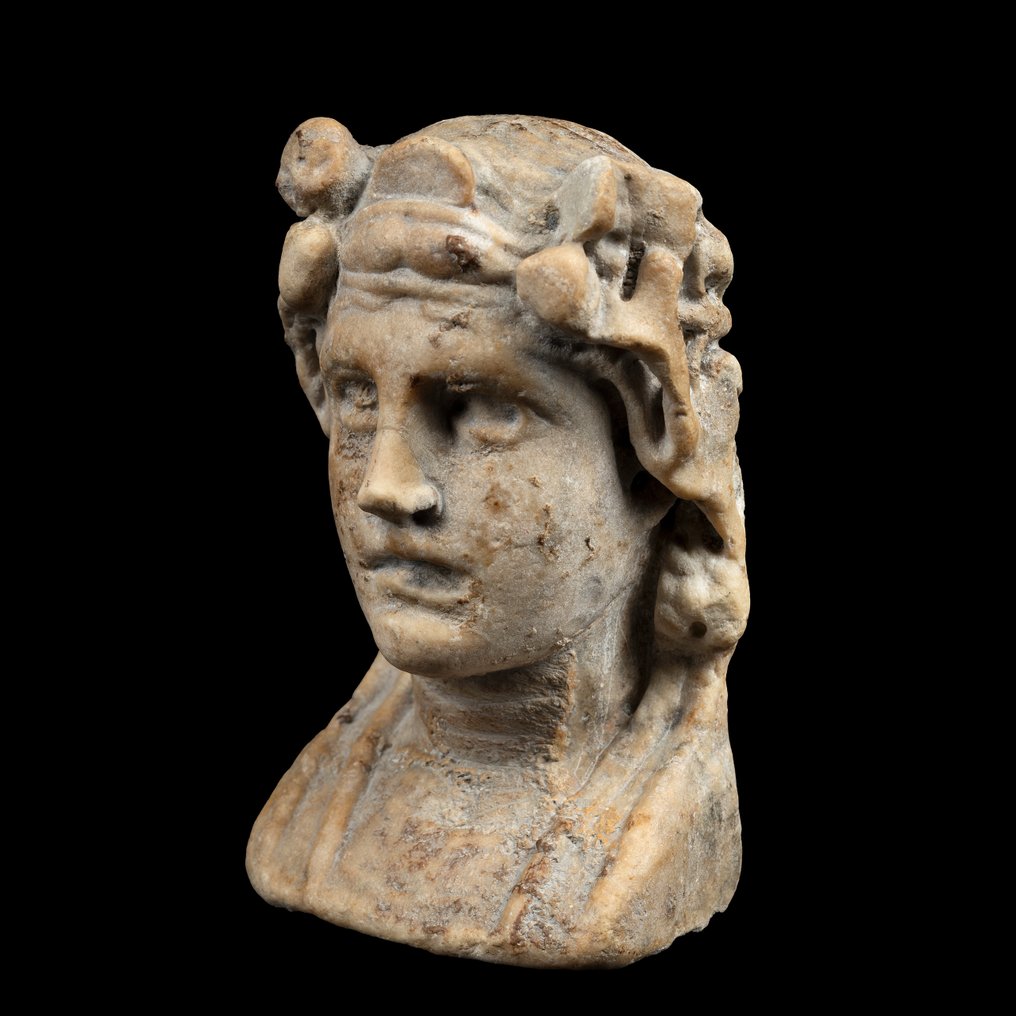
Ancient Roman Giallo Antico Marble Herma of Bacchus. 1st-2nd Century AD. 16.5 cm height.



10
days
01
hour
55
minutes
22
seconds
Current bid
€ 10
Reserve price not met

Expert
Selected by Ruth Garrido Vila
Directed the Ifergan Collection Museum, specialising in Phoenician and Mediterranean archaeology.
Estimate € 11,000 - € 14,000
5 other people are watching this object
 Bidder 0257 Bidder 0257 | €10 |
|---|
Catawiki Buyer Protection
Your payment’s safe with us until you receive your object.View details
Trustpilot 4.4 | 122813 reviews
Rated Excellent on Trustpilot.
Herma of Bacchus, Ancient Roman, 1st–2nd century AD, carved in Giallo Antico marble and standing 16.5 cm high, in good condition with provenance to a private collection in France dating to before the 18th century and acquired from an auction house in 2025, and supplied with an authenticity certificate and an export licence.
AI-assisted summary
Description from the seller
Herma of Bacchus.
Ancient Roman, 1st-2nd Century AD.
Giallo Antico Marble.
16.5 cm height.
Condition: Good condition.
Provenance: Private collection, France, pre-18th century.
Description:
Half-length head carved in Giallo Antico marble depicting Bacchus in his youthful, beardless appearance, with his hair adorned by a wreath of foliage. The beautiful classical face, somewhat archaic in style, is characterised by large eyes with irises and eyelids in relief and a half-open mouth with downturned corners. Its structure, with a completely flat back and a short, narrow bust, also flat at the base and sides, suggests that it was originally part of a janiform or double herm (fig. 1).
Bacchus is the Greek Dionysus, whose name means “son of Zeus”. He was the Olympian god of nature, celebrations (symposia), wine, ecstasy, disorder and theatre, and his myths include journeys to distant lands (Egypt, Anatolia, India, etc.), a detail that could indicate the eastern origin of the deity. The fact that he survived the death of his pregnant mother, struck down by Zeus' fire, was interpreted as a triumph over death; for this reason, he was worshipped as a mystery deity by the Greeks and Romans in Eleusis, alongside Demeter and Persephone.
The herm is a Greek creation whose origins date back to the Archaic period, derived from the ancient custom of marking boundaries with piles of stones or simple cairns, which over time would be crowned with a head of Hermes. It is a pillar carved in stone, usually square in section, on top of which was placed the bust of the god Hermes, from whom it takes its name, while on the front of it was carved an erect phallus, a symbol of fertility and also of defence and prophylaxis. Other theories hold that the first herm actually represented Dionysus, god of fertility and nature in its primal state. These figurative pillars were placed in rural areas to mark roads and establish property boundaries, although in cities it was common to find them outside houses, next to a figure of Hecate, protector of crossroads. Painted Attic vases have been preserved that illustrate the custom of dedicating special sacrifices to these urban hermai. In ancient times, it was believed that liminal areas—border areas, areas of transit—were inhabited by evil beings who could decide the fate of anyone who dared to cross them. For this reason, all kinds of beliefs and amulets proliferated that claimed to protect travellers and merchants. In the case of two-faced or janiform hermæ, the double face ensured the protection of the space both in front of and behind the herm.
The apotropaic qualities of the hermai meant that even in classical times they retained a certain formal archaism, setting them apart from other contemporary sculpture. Although over time the image of Hermes or Dionysus was replaced by those of other gods and illustrious figures, for the most part the hermai retained the archaic appearance of the early Greek examples. In Roman times, they lost their original meaning when they were incorporated into the gardens of large domus with a purely aesthetic function, a simple evocation of Hellenic classicism, although on occasions the erect phallus continued to be carved at the bottom as a symbol of protection against evil. The hermai in Roman gardens could be topped with busts of philosophers, heroes or gods, and were often inserted into railings through holes made in the sides of the pillar. They were also used in imperial public architecture, with a purely architectural function, as in the case of the hermai that held up the barriers of the Circus Maximus.
This sculpture is made of Giallo Antico marble, a precious type of marble that was a favourite of the Romans, who called it marmor numidicum (marble from Numidia). Quarried in the ancient city of Simitthu, in north-western Tunisia, its colour varies from intense yellow to lighter, almost white tones, with reddish-yellow and brown veins and angular inclusions of various sizes and shades, including ochre, pinkish red and brown. It was used by the kings of Numidia from the second half of the 2nd century BC and, after the conquest of Carthage and the establishment of the Roman province of Africa, the quarries became state property. In Rome, it was mainly used as a sumptuous ornamental material for making column shafts, pavements and wall coverings. Its use in sculpture was rarer, mainly for the representation of barbarians and wild animals.
Bibliography:
- CUADRA RUBIO, R.M. « Herms : From Custodians of Boundaries to Custodians of Gardens » dans REID, H.L. et DELONG, J.C., The Many Faces of Mimesis : Selected Essays from the 2017 Symposium on the Hellenic Heritage of Western Greece. Parnassos Press. 2018.
- D’AMBRA, E. Roman Art. Cambridge. 1998.
- FRIEDLAND, E. A. ; SOBOCINSKI, M. G. ; GAZDA, E. K., éd.). The Oxford Handbook of Roman Sculpture. Oxford University Press. 2015.
- KLEINER, D. E. Roman sculpture. Yale University Press. 1992.
- WREDE, H. Die antike Herme. Mayence. 1896.
PARALLELS:
Fig. 1 Janiform herm with Bacchus and a maenad. Roman Empire, 2nd century AD. Marble, 19.05 cm high. British Museum, London, inv. 1805,0703.441.
Notes:
- The piece includes authenticity certificate.
- The piece includes Spanish Export License (Passport for European Union) - If the piece is destined outside the European Union a substitution of the export permit should be requested, can take between 1-2 weeks maximum.
- The seller guarantees that he acquired this piece according to all national and international laws related to the ownership of cultural property. Provenance statement seen by Catawiki.
Seller's Story
Gallery of Ancient Art - Archeology based in Barcelona with more than fifteen years of experience. Specialized in classical art, Egyptian art, Asian art and pre-Columbian art. It guarantees the authenticity of all its pieces. It participates in the most important art fairs in Spain, such as Feriarte, as well as in fairs abroad, BRAFA, Parcours des Mondes, Cultures Brussels.
All the pieces are sent with an Export Permit issued by the Spanish Ministry of Culture.
We are quick to ship via DHL Express or Direct Art Transport.
Translated by Google TranslateHerma of Bacchus.
Ancient Roman, 1st-2nd Century AD.
Giallo Antico Marble.
16.5 cm height.
Condition: Good condition.
Provenance: Private collection, France, pre-18th century.
Description:
Half-length head carved in Giallo Antico marble depicting Bacchus in his youthful, beardless appearance, with his hair adorned by a wreath of foliage. The beautiful classical face, somewhat archaic in style, is characterised by large eyes with irises and eyelids in relief and a half-open mouth with downturned corners. Its structure, with a completely flat back and a short, narrow bust, also flat at the base and sides, suggests that it was originally part of a janiform or double herm (fig. 1).
Bacchus is the Greek Dionysus, whose name means “son of Zeus”. He was the Olympian god of nature, celebrations (symposia), wine, ecstasy, disorder and theatre, and his myths include journeys to distant lands (Egypt, Anatolia, India, etc.), a detail that could indicate the eastern origin of the deity. The fact that he survived the death of his pregnant mother, struck down by Zeus' fire, was interpreted as a triumph over death; for this reason, he was worshipped as a mystery deity by the Greeks and Romans in Eleusis, alongside Demeter and Persephone.
The herm is a Greek creation whose origins date back to the Archaic period, derived from the ancient custom of marking boundaries with piles of stones or simple cairns, which over time would be crowned with a head of Hermes. It is a pillar carved in stone, usually square in section, on top of which was placed the bust of the god Hermes, from whom it takes its name, while on the front of it was carved an erect phallus, a symbol of fertility and also of defence and prophylaxis. Other theories hold that the first herm actually represented Dionysus, god of fertility and nature in its primal state. These figurative pillars were placed in rural areas to mark roads and establish property boundaries, although in cities it was common to find them outside houses, next to a figure of Hecate, protector of crossroads. Painted Attic vases have been preserved that illustrate the custom of dedicating special sacrifices to these urban hermai. In ancient times, it was believed that liminal areas—border areas, areas of transit—were inhabited by evil beings who could decide the fate of anyone who dared to cross them. For this reason, all kinds of beliefs and amulets proliferated that claimed to protect travellers and merchants. In the case of two-faced or janiform hermæ, the double face ensured the protection of the space both in front of and behind the herm.
The apotropaic qualities of the hermai meant that even in classical times they retained a certain formal archaism, setting them apart from other contemporary sculpture. Although over time the image of Hermes or Dionysus was replaced by those of other gods and illustrious figures, for the most part the hermai retained the archaic appearance of the early Greek examples. In Roman times, they lost their original meaning when they were incorporated into the gardens of large domus with a purely aesthetic function, a simple evocation of Hellenic classicism, although on occasions the erect phallus continued to be carved at the bottom as a symbol of protection against evil. The hermai in Roman gardens could be topped with busts of philosophers, heroes or gods, and were often inserted into railings through holes made in the sides of the pillar. They were also used in imperial public architecture, with a purely architectural function, as in the case of the hermai that held up the barriers of the Circus Maximus.
This sculpture is made of Giallo Antico marble, a precious type of marble that was a favourite of the Romans, who called it marmor numidicum (marble from Numidia). Quarried in the ancient city of Simitthu, in north-western Tunisia, its colour varies from intense yellow to lighter, almost white tones, with reddish-yellow and brown veins and angular inclusions of various sizes and shades, including ochre, pinkish red and brown. It was used by the kings of Numidia from the second half of the 2nd century BC and, after the conquest of Carthage and the establishment of the Roman province of Africa, the quarries became state property. In Rome, it was mainly used as a sumptuous ornamental material for making column shafts, pavements and wall coverings. Its use in sculpture was rarer, mainly for the representation of barbarians and wild animals.
Bibliography:
- CUADRA RUBIO, R.M. « Herms : From Custodians of Boundaries to Custodians of Gardens » dans REID, H.L. et DELONG, J.C., The Many Faces of Mimesis : Selected Essays from the 2017 Symposium on the Hellenic Heritage of Western Greece. Parnassos Press. 2018.
- D’AMBRA, E. Roman Art. Cambridge. 1998.
- FRIEDLAND, E. A. ; SOBOCINSKI, M. G. ; GAZDA, E. K., éd.). The Oxford Handbook of Roman Sculpture. Oxford University Press. 2015.
- KLEINER, D. E. Roman sculpture. Yale University Press. 1992.
- WREDE, H. Die antike Herme. Mayence. 1896.
PARALLELS:
Fig. 1 Janiform herm with Bacchus and a maenad. Roman Empire, 2nd century AD. Marble, 19.05 cm high. British Museum, London, inv. 1805,0703.441.
Notes:
- The piece includes authenticity certificate.
- The piece includes Spanish Export License (Passport for European Union) - If the piece is destined outside the European Union a substitution of the export permit should be requested, can take between 1-2 weeks maximum.
- The seller guarantees that he acquired this piece according to all national and international laws related to the ownership of cultural property. Provenance statement seen by Catawiki.
Seller's Story
Gallery of Ancient Art - Archeology based in Barcelona with more than fifteen years of experience. Specialized in classical art, Egyptian art, Asian art and pre-Columbian art. It guarantees the authenticity of all its pieces. It participates in the most important art fairs in Spain, such as Feriarte, as well as in fairs abroad, BRAFA, Parcours des Mondes, Cultures Brussels.
All the pieces are sent with an Export Permit issued by the Spanish Ministry of Culture.
We are quick to ship via DHL Express or Direct Art Transport.
Translated by Google TranslateDetails
Culture
Ancient Roman
Century/ Timeframe
1st-2nd Century AD.
Name of object
Herma of Bacchus. 1st-2nd Century AD. 16.5 cm height.
Acquired from
Auction house
Year acquired
2025
Material
Giallo Antico Marble
Country acquired from
France
Condition
Good
Previous owner acquired from
Private collection
Previous owner - year acquired
1750
Previous owner - country acquired from
France
I verify that I have obtained this object legally and that I am allowed to sell it
Yes
Disclaimer
The seller was informed by Catawiki about documentation requirements and guarantees the following: - the object was legally obtained, - the seller has the right to sell and/or export the object, as relevant, - the seller will provide the necessary provenance information and arrange required documentation and permits/licenses, as applicable and as per local laws, - the seller will notify the buyer of any delays in obtaining permits/licenses. By bidding, you acknowledge that import documentation may be required depending on your country of residence and that obtaining permits/licenses may cause delays in the delivery of your object.
The seller was informed by Catawiki about documentation requirements and guarantees the following: - the object was legally obtained, - the seller has the right to sell and/or export the object, as relevant, - the seller will provide the necessary provenance information and arrange required documentation and permits/licenses, as applicable and as per local laws, - the seller will notify the buyer of any delays in obtaining permits/licenses. By bidding, you acknowledge that import documentation may be required depending on your country of residence and that obtaining permits/licenses may cause delays in the delivery of your object.
