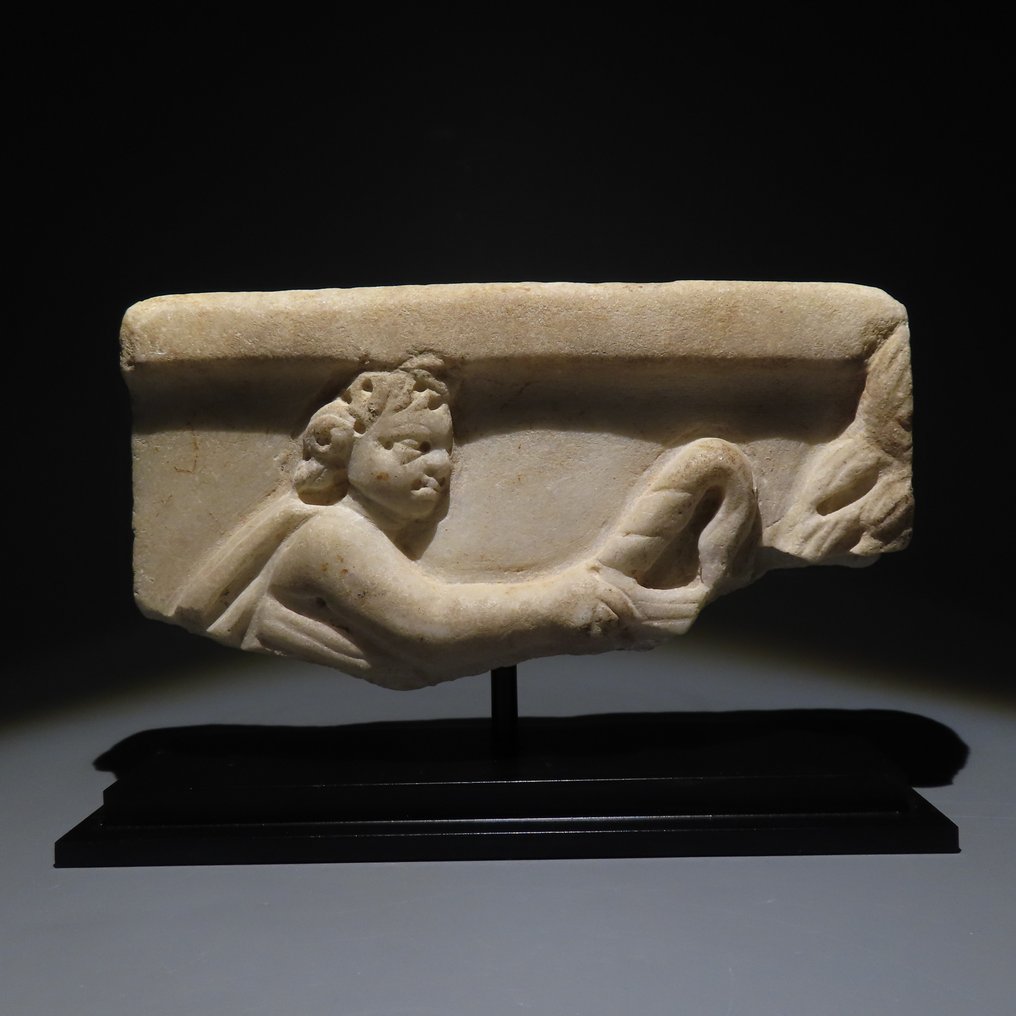
Ancient Roman Marble Fragment of a sarcophagus with the image of Phaethon. 2nd – 3rd century AD. 17.2 cm length. Spanish




Opens 11:00
Starting bid
€ 1
Add to your favourites to get an alert when the auction starts.

Expert
Selected by Ruth Garrido Vila
Directed the Ifergan Collection Museum, specialising in Phoenician and Mediterranean archaeology.
Estimate € 6,500 - € 8,000
Catawiki Buyer Protection
Your payment’s safe with us until you receive your object.View details
Trustpilot 4.4 | 122713 reviews
Rated Excellent on Trustpilot.
Description from the seller
Fragment of a sarcophagus with the image of Phaethon.
Ancient Roman, 2nd – 3rd century AD.
Marble.
17.2 cm length.
CONDITION: Unrestored fragment, in good condition.
PROVENANCE:
- Private collection, UK, established in the 1980s.
- Private collection, Cambridgeshire, UK, until 2024.
DESCRIPTION:
Fragment of a Roman relief carved in marble, with the bottom excavated to enhance the volume of the motifs. Under a protruding flat profile, which frames the image, appears the figure of the young Phaeton driving his father's chariot. Dressed in a long-sleeved tunic and himation, in profile to the right, he shows his hair loose, with thick wavy locks that end at shoulder height. He extends his right arm to hold the reins, in front of which the mane of a horse can be seen, moved by the wind. The relief combines carving with trepanning work on elements such as the curls, the eye and the corners of the mouth, thus enhancing the volume and details of the representation. Due to the format, closed by a protruding lintelled band at the top, it can be deduced that this fragment would have been part of the ornamentation of a sarcophagus, more specifically one of the continuous friezes common on the top of these objects.
Son of the sun god Helios, Phaethon went to his father, offended by Epaphus, son of Zeus, who had questioned his divine origin. In other versions of the myth, the details are changed, although Phaethon's reason for seeking Helios is always to confirm his paternity, that is, to confirm the legitimacy of his divine lineage. To do so, Phaethon asks Helios to drive his chariot for a day; the god is aware of the danger this entails, but finds it impossible to refuse and finally agrees. Unable to control the horses of the sun chariot, Phaethon causes disaster in his wake, burning some lands and freezing others; Zeus is then forced to intervene, throwing a bolt of lightning to stop his race and thus causing his death.
The story of Phaethon is a common theme in the decoration of Roman sarcophagi (Fig. 1), as a symbol of the ubiquity of death but also of mourning, since the Greek myth gave great importance to the mourners who mourn the death of Phaethon—his companion Cycnus and his sisters, the Heliades. It has also been speculated that the myth served, according to the Roman interpretation of the Greek myth, as an example of virtue for the deceased.
BIBLIOGRAPHY:
- BORG, B.E. “No one is immortal: From exemplum mortalitatis to exemplum virtutis”, in Wandering Myths. De Gruyter. 2018.
- KOORTBOJIAN, M. Myth, Meaning, and Memory on Roman Sarcophagi. University of California Press. 1993.
PARALLELS:
Fig. 1 Front of a sarcophagus with the fall of Phaethon. Roman Empire, 2nd century AD. Marble, 179 cm long. Hermitage Museum, St. Petersburg, inv. ГР-11304.
Notes:
- The piece includes authenticity certificate.
- The piece includes Spanish Export License (Passport for European Union) - If the piece is destined outside the European Union a substitution of the export permit should be requested, can take between 1-2 weeks maximum.
- The seller guarantees that he acquired this piece according to all national and international laws related to the ownership of cultural property. Provenance statement seen by Catawiki.
Seller's Story
Gallery of Ancient Art - Archeology based in Barcelona with more than fifteen years of experience. Specialized in classical art, Egyptian art, Asian art and pre-Columbian art. It guarantees the authenticity of all its pieces. It participates in the most important art fairs in Spain, such as Feriarte, as well as in fairs abroad, BRAFA, Parcours des Mondes, Cultures Brussels.
All the pieces are sent with an Export Permit issued by the Spanish Ministry of Culture.
We are quick to ship via DHL Express or Direct Art Transport.
Translated by Google TranslateFragment of a sarcophagus with the image of Phaethon.
Ancient Roman, 2nd – 3rd century AD.
Marble.
17.2 cm length.
CONDITION: Unrestored fragment, in good condition.
PROVENANCE:
- Private collection, UK, established in the 1980s.
- Private collection, Cambridgeshire, UK, until 2024.
DESCRIPTION:
Fragment of a Roman relief carved in marble, with the bottom excavated to enhance the volume of the motifs. Under a protruding flat profile, which frames the image, appears the figure of the young Phaeton driving his father's chariot. Dressed in a long-sleeved tunic and himation, in profile to the right, he shows his hair loose, with thick wavy locks that end at shoulder height. He extends his right arm to hold the reins, in front of which the mane of a horse can be seen, moved by the wind. The relief combines carving with trepanning work on elements such as the curls, the eye and the corners of the mouth, thus enhancing the volume and details of the representation. Due to the format, closed by a protruding lintelled band at the top, it can be deduced that this fragment would have been part of the ornamentation of a sarcophagus, more specifically one of the continuous friezes common on the top of these objects.
Son of the sun god Helios, Phaethon went to his father, offended by Epaphus, son of Zeus, who had questioned his divine origin. In other versions of the myth, the details are changed, although Phaethon's reason for seeking Helios is always to confirm his paternity, that is, to confirm the legitimacy of his divine lineage. To do so, Phaethon asks Helios to drive his chariot for a day; the god is aware of the danger this entails, but finds it impossible to refuse and finally agrees. Unable to control the horses of the sun chariot, Phaethon causes disaster in his wake, burning some lands and freezing others; Zeus is then forced to intervene, throwing a bolt of lightning to stop his race and thus causing his death.
The story of Phaethon is a common theme in the decoration of Roman sarcophagi (Fig. 1), as a symbol of the ubiquity of death but also of mourning, since the Greek myth gave great importance to the mourners who mourn the death of Phaethon—his companion Cycnus and his sisters, the Heliades. It has also been speculated that the myth served, according to the Roman interpretation of the Greek myth, as an example of virtue for the deceased.
BIBLIOGRAPHY:
- BORG, B.E. “No one is immortal: From exemplum mortalitatis to exemplum virtutis”, in Wandering Myths. De Gruyter. 2018.
- KOORTBOJIAN, M. Myth, Meaning, and Memory on Roman Sarcophagi. University of California Press. 1993.
PARALLELS:
Fig. 1 Front of a sarcophagus with the fall of Phaethon. Roman Empire, 2nd century AD. Marble, 179 cm long. Hermitage Museum, St. Petersburg, inv. ГР-11304.
Notes:
- The piece includes authenticity certificate.
- The piece includes Spanish Export License (Passport for European Union) - If the piece is destined outside the European Union a substitution of the export permit should be requested, can take between 1-2 weeks maximum.
- The seller guarantees that he acquired this piece according to all national and international laws related to the ownership of cultural property. Provenance statement seen by Catawiki.
Seller's Story
Gallery of Ancient Art - Archeology based in Barcelona with more than fifteen years of experience. Specialized in classical art, Egyptian art, Asian art and pre-Columbian art. It guarantees the authenticity of all its pieces. It participates in the most important art fairs in Spain, such as Feriarte, as well as in fairs abroad, BRAFA, Parcours des Mondes, Cultures Brussels.
All the pieces are sent with an Export Permit issued by the Spanish Ministry of Culture.
We are quick to ship via DHL Express or Direct Art Transport.
Translated by Google TranslateDetails
Culture
Ancient Roman
Century/ Timeframe
2nd – 3rd century AD
Name of object
Fragment of a sarcophagus with the image of Phaethon. 2nd – 3rd century AD. 17.2 cm length. Spanish
Acquired from
Private collection
Year acquired
2024
Material
Marble
Country acquired from
United Kingdom
Condition
Very good
Previous owner acquired from
Private collection
Previous owner - year acquired
1980
Previous owner - country acquired from
United Kingdom
I verify that I have obtained this object legally and that I am allowed to sell it
Yes
Disclaimer
The seller was informed by Catawiki about documentation requirements and guarantees the following: - the object was legally obtained, - the seller has the right to sell and/or export the object, as relevant, - the seller will provide the necessary provenance information and arrange required documentation and permits/licenses, as applicable and as per local laws, - the seller will notify the buyer of any delays in obtaining permits/licenses. By bidding, you acknowledge that import documentation may be required depending on your country of residence and that obtaining permits/licenses may cause delays in the delivery of your object.
The seller was informed by Catawiki about documentation requirements and guarantees the following: - the object was legally obtained, - the seller has the right to sell and/or export the object, as relevant, - the seller will provide the necessary provenance information and arrange required documentation and permits/licenses, as applicable and as per local laws, - the seller will notify the buyer of any delays in obtaining permits/licenses. By bidding, you acknowledge that import documentation may be required depending on your country of residence and that obtaining permits/licenses may cause delays in the delivery of your object.
