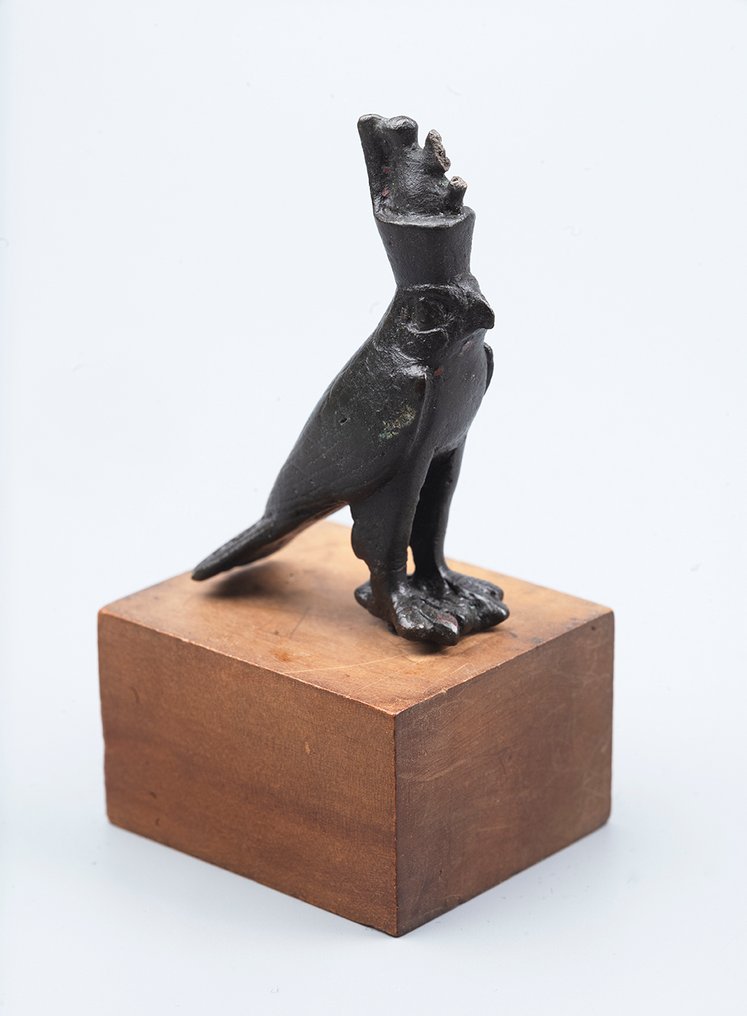
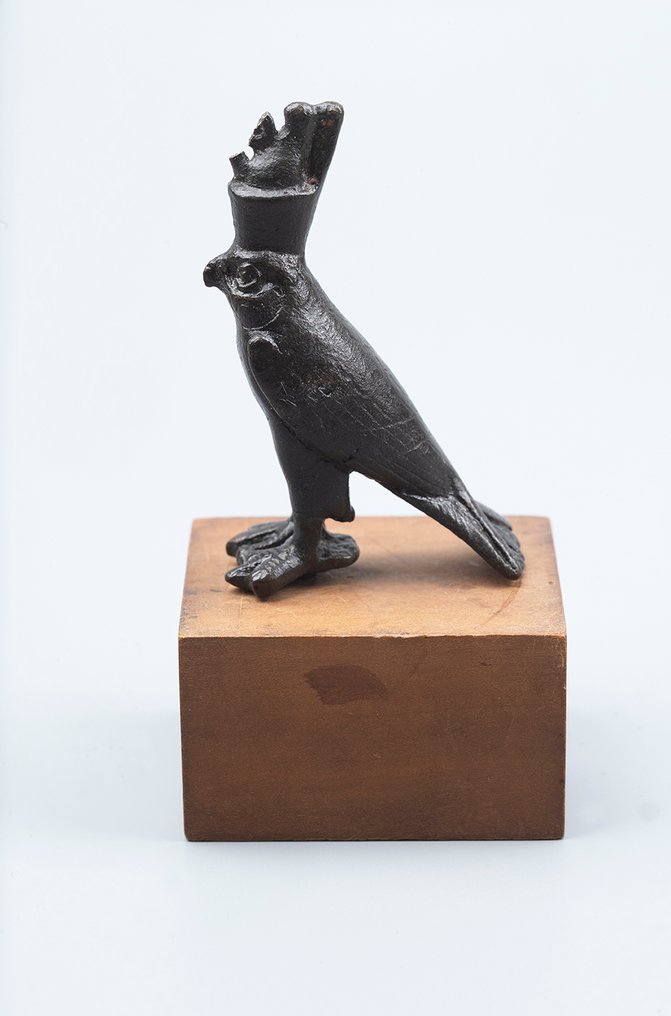
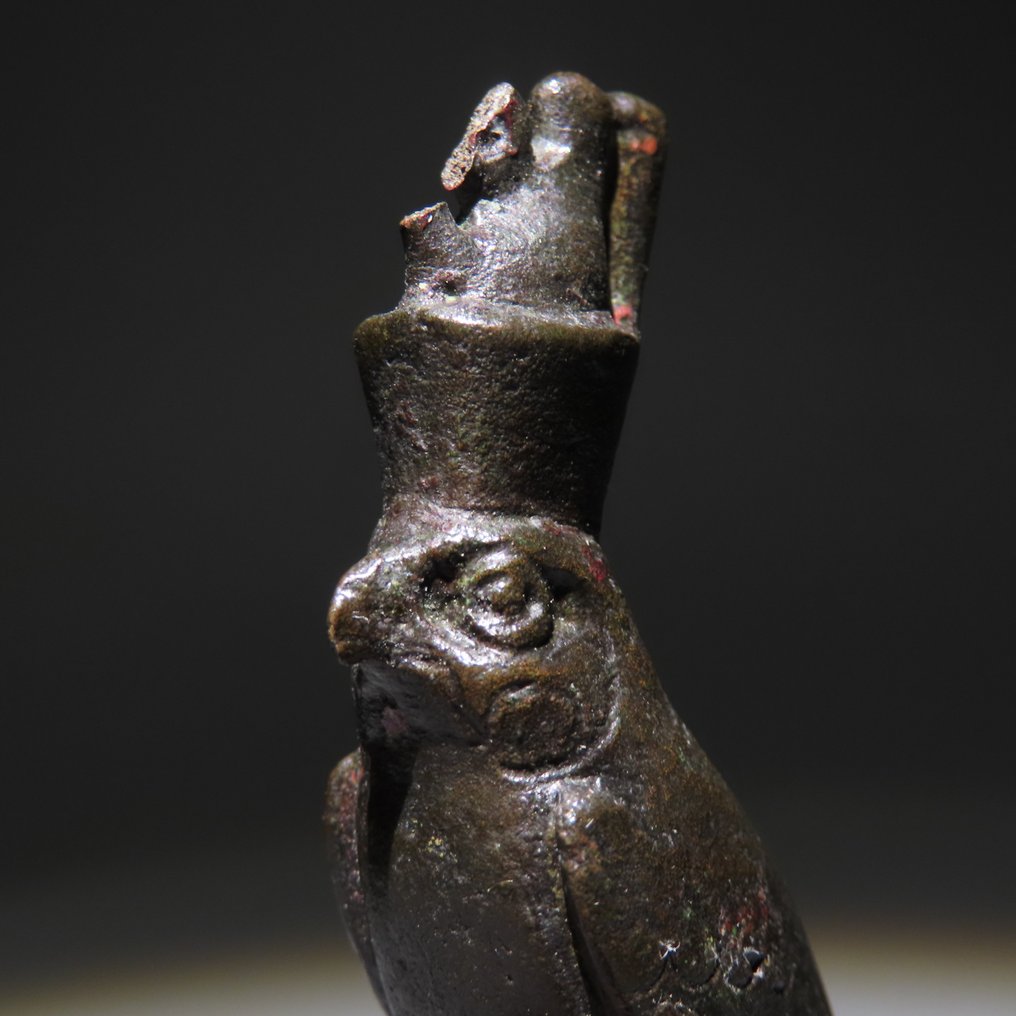
Ancient Egyptian Bronze God Horus as a falcon. Late Period 664-332 B.C. 6.5 cm height.


08
days
01
hour
31
minutes
15
seconds
Current bid
€ 110
Reserve price not met

Expert
Selected by Ruth Garrido Vila
Directed the Ifergan Collection Museum, specialising in Phoenician and Mediterranean archaeology.
Estimate € 5,500 - € 6,100
4 other people are watching this object
 Bidder 2179 Bidder 2179 | €110 | |
|---|---|---|
 Bidder 9404 Bidder 9404 | €100 |
Catawiki Buyer Protection
Your payment’s safe with us until you receive your object.View details
Trustpilot 4.4 | 122986 reviews
Rated Excellent on Trustpilot.
Bronze God Horus as a falcon from Ancient Egypt, Late Period (664–332 BC), 6.5 cm high (9.8 cm with stand), in good condition, acquired from a private collection.
AI-assisted summary
Description from the seller
God Horus as a falcon.
- A copy of the provenance documents will be provided -
Ancient Egypt, Late Period 664-332 B.C.
Bronze.
6.5 cm height and 9.8 cm with the stand.
CONDITION: Good condition.
PROVENANCE:
The Vercamer collection has been in the family for three generations, brought to us by Monsieur Emile Vercamer (1846-1934), a lawyer at the mixed court of Alexandria, who lived in Egypt around 1895. Documentation included, a copy of an old black and white photograph of Monsieur Vercamer and his wife at the foot of the statue of Ramses II, and a declaration on the honour of the descendants.
DESCRIPTION:
The astute falcon, able to fly long distances, was one of the first images of the Egyptian monarchy and in the culture of mankind. The extended wings evoked the breadth of the blue skies. The fierce round eyes suggested the sun and the moon. The speckled breast resembled light clouds with the feathers dappling the high heavens, while the breath of the bird was compared to the winds of the world. Due to all these similarities, the falcon was the emblem of the supreme god, and the king was the representative or the earthly incarnation of god. The Horus Falcon in the end was turned into the title of royal dignity and the “personification of divine and royal power”. In Egypt, then, the pharaoh was considered to be at the same time the god Horus and his incarnation on the earth.
This elegant falcon easily evokes this symbolism. Circling the skies and then shooting down like a feathered bullet, a falcon can reach speeds of over 320 km/h, and thus easily break the neck of the prey with one blow. This ability connects it with the images of supernatural astuteness, expert vigilance and lightning attack, which have also expressed the idea of war as a power which swoops down on the other. This can be seen clearly in the Narmer Palette where the image of the god Horus, depicted as a falcon, is seen perched above six papyrus flowers which refer to the delta of the Nile. He is subduing an enemy by gripping him with a hook through the nose. This iconography symbolizes the way the god appropriates the breath and the life of those who oppose him.
Falcons built their nests in the highest part of the ancient palaces and temples of Egypt. Since the beginning of consciousness in Egypt of the existence of god, the first pharaohs tried to introduce those elements which most clearly and unequivocally affirmed their right to the throne. The pharaoh Dyet had a stele placed in his tomb which was one of the most important and most beautiful examples of monumental sculpture in its time. The artist depicted the name of Horus, the most ancient symbol used to represent the title of the pharaoh. A falcon (the god Horus) is seen on a serekh (a palace facade crest) with the name of the king in Egyptian hieroglyphic script.
The sculptors represented the falcon perched on the neck of the pharaoh, caressing his head with its wings in a protective manner. This suggests a protecting intercession from a celestial domain, such as that seen on the real-life size diorite statue of the pharaoh Khafra. This is a masterpiece of the Old Kingdom, both for the skill of the work as for its symbolic character, as it represents the concept of sovereignty. We see an entire seated figure, a semi-naked pharaoh wearing only a pleated kilt, in a rigid symmetrical posture. He is seated on a throne decorated on either side with the flowers of Upper and Lower Egypt entwined as a symbol of union. A falcon which represents god caresses his head from the back with its wings.
With its extraordinary visual acuity, the falcon can recognise small objects 1.5 km distant. Its spherical eyes are thirty times more sensitive to colour than those of a human. The eye of the falcon is the eye of the primeval sun which protects from the waters of disintegration. One of the protective amulets most used by the Egyptians was the Eye of Horus, an image of an eye of an Egyptian archetype, belonging to the same god, who lost it in the fight with his uncle Seth when he was struggling to avenge the death of his father, Osiris, who had been killed by his brother.
Due to its ability to fly so high, to travel everywhere and even see ultraviolet light, in Egyptian myths the falcon is a messenger who lives between the earthly world and the supernatural. Sculptures of the falcon in funerary placements in Egypt helped to ensure the rebirth of the pharaoh, as when the Horus Falcon emerged triumphant from the darkness and death to be born again, it also ascended the ba of the deceased pharaoh, his soul with a falcon-head, to eternity. In the Late Period above all, stone sculptures of the Horus Falcon, let us say from 50cm up to almost three metres in height, became widespread. Most were placed in temples, like the four which were erected and are still in place in the sanctuary par excellence devoted to Horus, the Temple of Edfu. Those of smaller size were made for private worship and were placed in funerary chambers in the tombs of their owners, as offerings in a temple or chapel dedicated to the god. Both in Edfu as in other sanctuaries there were pilgrimages where an Egyptian would arrive with a mummy of a falcon to deposit it in honour of the god and request in this manner the benefit of the god’s power.
All in all, Horus, “the High One”, was considered the initiator of civilization, the deity of the heavens, of war and hunting. Its original site was Hieraconpolis, the capital of Upper Egypt in the Pre-dynastic Period, the point of departure of Narmer to unify the two territories. And, as is logical, his emblem was a falcon perched on a post. In burials sites, many beads were found which made up necklaces and bracelets, and many of them had figures in the form of a falcon cut into different types of stone. From then on, this bird was a symbolic element which could be seen in every corner of Egypt.
Notes:
The seller guarantees that he acquired this piece according to all national and international laws related to the ownership of cultural property. Provenance statement seen by Catawiki.
The seller will take care that any necessary permits, like an export license will be arranged, he will inform the buyer about the status of it if this takes more than a few days.
The piece includes authenticity certificate.
The piece includes Spanish Export License (Passport for European Union) - If the piece is destined outside the European Union a substitution of the export permit should be requested. This process could take between 1 and 2 months.
Seller's Story
Gallery of Ancient Art - Archeology based in Barcelona with more than fifteen years of experience. Specialized in classical art, Egyptian art, Asian art and pre-Columbian art. It guarantees the authenticity of all its pieces. It participates in the most important art fairs in Spain, such as Feriarte, as well as in fairs abroad, BRAFA, Parcours des Mondes, Cultures Brussels.
All the pieces are sent with an Export Permit issued by the Spanish Ministry of Culture.
We are quick to ship via DHL Express or Direct Art Transport.
Translated by Google TranslateGod Horus as a falcon.
- A copy of the provenance documents will be provided -
Ancient Egypt, Late Period 664-332 B.C.
Bronze.
6.5 cm height and 9.8 cm with the stand.
CONDITION: Good condition.
PROVENANCE:
The Vercamer collection has been in the family for three generations, brought to us by Monsieur Emile Vercamer (1846-1934), a lawyer at the mixed court of Alexandria, who lived in Egypt around 1895. Documentation included, a copy of an old black and white photograph of Monsieur Vercamer and his wife at the foot of the statue of Ramses II, and a declaration on the honour of the descendants.
DESCRIPTION:
The astute falcon, able to fly long distances, was one of the first images of the Egyptian monarchy and in the culture of mankind. The extended wings evoked the breadth of the blue skies. The fierce round eyes suggested the sun and the moon. The speckled breast resembled light clouds with the feathers dappling the high heavens, while the breath of the bird was compared to the winds of the world. Due to all these similarities, the falcon was the emblem of the supreme god, and the king was the representative or the earthly incarnation of god. The Horus Falcon in the end was turned into the title of royal dignity and the “personification of divine and royal power”. In Egypt, then, the pharaoh was considered to be at the same time the god Horus and his incarnation on the earth.
This elegant falcon easily evokes this symbolism. Circling the skies and then shooting down like a feathered bullet, a falcon can reach speeds of over 320 km/h, and thus easily break the neck of the prey with one blow. This ability connects it with the images of supernatural astuteness, expert vigilance and lightning attack, which have also expressed the idea of war as a power which swoops down on the other. This can be seen clearly in the Narmer Palette where the image of the god Horus, depicted as a falcon, is seen perched above six papyrus flowers which refer to the delta of the Nile. He is subduing an enemy by gripping him with a hook through the nose. This iconography symbolizes the way the god appropriates the breath and the life of those who oppose him.
Falcons built their nests in the highest part of the ancient palaces and temples of Egypt. Since the beginning of consciousness in Egypt of the existence of god, the first pharaohs tried to introduce those elements which most clearly and unequivocally affirmed their right to the throne. The pharaoh Dyet had a stele placed in his tomb which was one of the most important and most beautiful examples of monumental sculpture in its time. The artist depicted the name of Horus, the most ancient symbol used to represent the title of the pharaoh. A falcon (the god Horus) is seen on a serekh (a palace facade crest) with the name of the king in Egyptian hieroglyphic script.
The sculptors represented the falcon perched on the neck of the pharaoh, caressing his head with its wings in a protective manner. This suggests a protecting intercession from a celestial domain, such as that seen on the real-life size diorite statue of the pharaoh Khafra. This is a masterpiece of the Old Kingdom, both for the skill of the work as for its symbolic character, as it represents the concept of sovereignty. We see an entire seated figure, a semi-naked pharaoh wearing only a pleated kilt, in a rigid symmetrical posture. He is seated on a throne decorated on either side with the flowers of Upper and Lower Egypt entwined as a symbol of union. A falcon which represents god caresses his head from the back with its wings.
With its extraordinary visual acuity, the falcon can recognise small objects 1.5 km distant. Its spherical eyes are thirty times more sensitive to colour than those of a human. The eye of the falcon is the eye of the primeval sun which protects from the waters of disintegration. One of the protective amulets most used by the Egyptians was the Eye of Horus, an image of an eye of an Egyptian archetype, belonging to the same god, who lost it in the fight with his uncle Seth when he was struggling to avenge the death of his father, Osiris, who had been killed by his brother.
Due to its ability to fly so high, to travel everywhere and even see ultraviolet light, in Egyptian myths the falcon is a messenger who lives between the earthly world and the supernatural. Sculptures of the falcon in funerary placements in Egypt helped to ensure the rebirth of the pharaoh, as when the Horus Falcon emerged triumphant from the darkness and death to be born again, it also ascended the ba of the deceased pharaoh, his soul with a falcon-head, to eternity. In the Late Period above all, stone sculptures of the Horus Falcon, let us say from 50cm up to almost three metres in height, became widespread. Most were placed in temples, like the four which were erected and are still in place in the sanctuary par excellence devoted to Horus, the Temple of Edfu. Those of smaller size were made for private worship and were placed in funerary chambers in the tombs of their owners, as offerings in a temple or chapel dedicated to the god. Both in Edfu as in other sanctuaries there were pilgrimages where an Egyptian would arrive with a mummy of a falcon to deposit it in honour of the god and request in this manner the benefit of the god’s power.
All in all, Horus, “the High One”, was considered the initiator of civilization, the deity of the heavens, of war and hunting. Its original site was Hieraconpolis, the capital of Upper Egypt in the Pre-dynastic Period, the point of departure of Narmer to unify the two territories. And, as is logical, his emblem was a falcon perched on a post. In burials sites, many beads were found which made up necklaces and bracelets, and many of them had figures in the form of a falcon cut into different types of stone. From then on, this bird was a symbolic element which could be seen in every corner of Egypt.
Notes:
The seller guarantees that he acquired this piece according to all national and international laws related to the ownership of cultural property. Provenance statement seen by Catawiki.
The seller will take care that any necessary permits, like an export license will be arranged, he will inform the buyer about the status of it if this takes more than a few days.
The piece includes authenticity certificate.
The piece includes Spanish Export License (Passport for European Union) - If the piece is destined outside the European Union a substitution of the export permit should be requested. This process could take between 1 and 2 months.
Seller's Story
Gallery of Ancient Art - Archeology based in Barcelona with more than fifteen years of experience. Specialized in classical art, Egyptian art, Asian art and pre-Columbian art. It guarantees the authenticity of all its pieces. It participates in the most important art fairs in Spain, such as Feriarte, as well as in fairs abroad, BRAFA, Parcours des Mondes, Cultures Brussels.
All the pieces are sent with an Export Permit issued by the Spanish Ministry of Culture.
We are quick to ship via DHL Express or Direct Art Transport.
Translated by Google TranslateDetails
Culture
Ancient Egyptian
Century/ Timeframe
Late Period 664-332 B.C.
Name of object
God Horus as a falcon. Late Period 664-332 B.C. 6.5 cm height.
Acquired from
Private collection
Material
Bronze
Condition
Good
Disclaimer
The seller was informed by Catawiki about documentation requirements and guarantees the following: - the object was legally obtained, - the seller has the right to sell and/or export the object, as relevant, - the seller will provide the necessary provenance information and arrange required documentation and permits/licenses, as applicable and as per local laws, - the seller will notify the buyer of any delays in obtaining permits/licenses. By bidding, you acknowledge that import documentation may be required depending on your country of residence and that obtaining permits/licenses may cause delays in the delivery of your object.
The seller was informed by Catawiki about documentation requirements and guarantees the following: - the object was legally obtained, - the seller has the right to sell and/or export the object, as relevant, - the seller will provide the necessary provenance information and arrange required documentation and permits/licenses, as applicable and as per local laws, - the seller will notify the buyer of any delays in obtaining permits/licenses. By bidding, you acknowledge that import documentation may be required depending on your country of residence and that obtaining permits/licenses may cause delays in the delivery of your object.
