Shoowa cloth - Kuba - DR Congo (No reserve price)



00
days
19
hours
34
minutes
37
seconds

16 other people are watching this object
 Bidder 6318 Bidder 6318 | €6 | |
|---|---|---|
| Bidder 4376 | €5 | |
 Bidder 1045 Bidder 1045 | €4 | |
Catawiki Buyer Protection
Your payment’s safe with us until you receive your object.View details
Trustpilot 4.4 | 123718 reviews
Rated Excellent on Trustpilot.
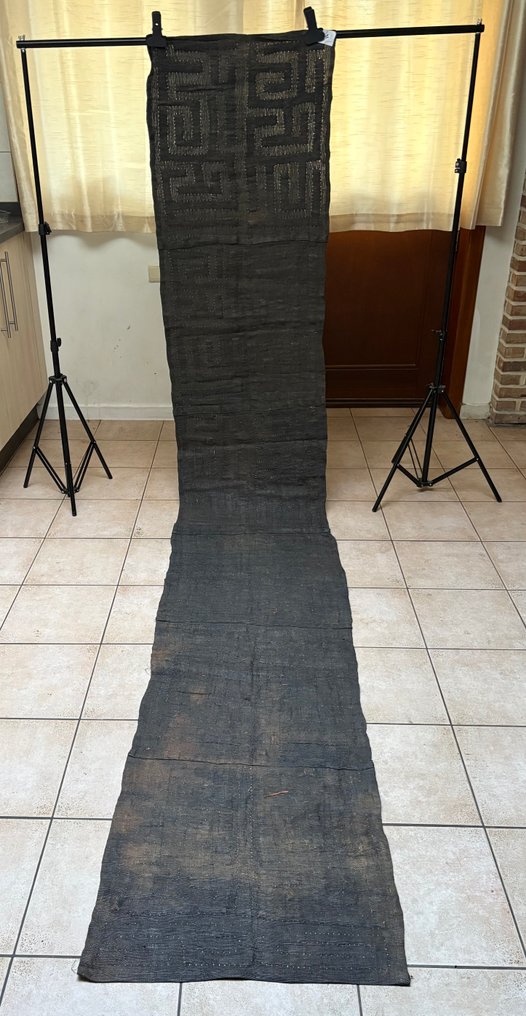
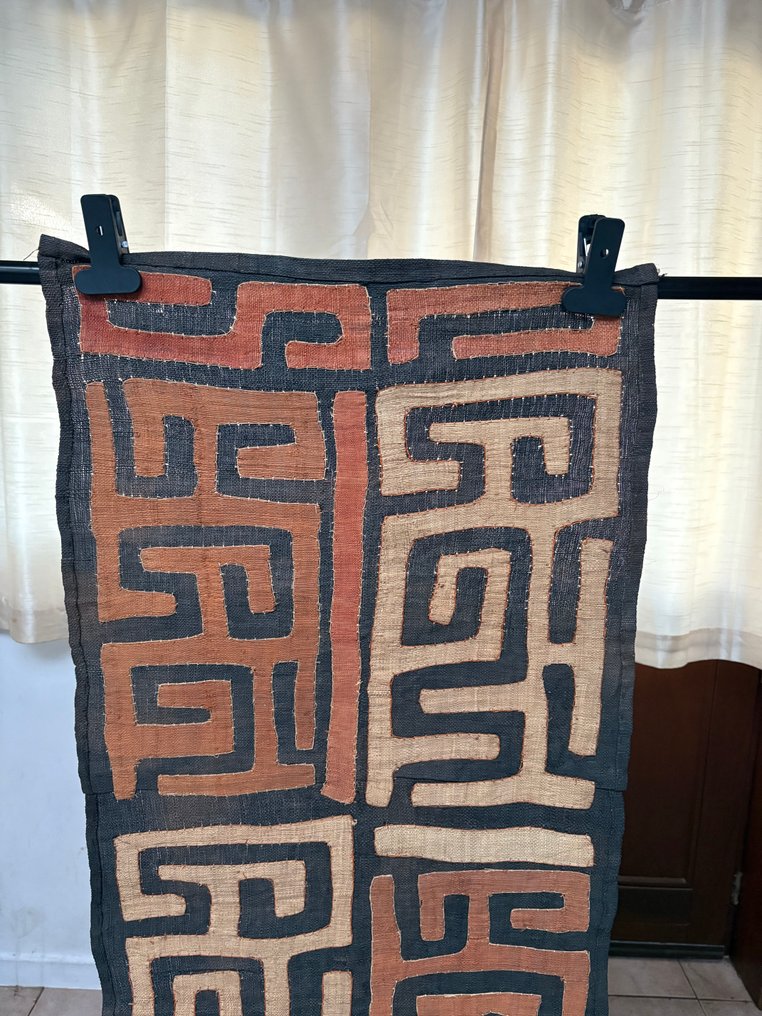
Tapis Shoowa, a raffia textile from the Democratic Republic of Congo, woven by the Shoowa/Bashoowa Kuba ethnic group and sourced from a private collection, in good condition, without a stand, measuring 320 cm by 56 cm.
AI-assisted summary
Description from the seller
African art and the refinement of Kuba weaving.
Produced in the DRC by the Shoowa, a subgroup of the Bashoowa of the Kuba, these textiles are made from a base of raphia fabric with the threads cut close to the surface, creating a velvet-like effect accentuated by tonal contrasts. The geometric patterns formed represent the body scarifications of the ethnic group or the decorations of sculptures.
These refined fabrics were intended to be used at the royal court, as seats or covers, to enhance its prestige. In many cases, they also served as currency or accompanied their owners into the tomb, covering the deceased's body. It was King Shamba Bolongongo who is said to have introduced the velvet weaving technique to the Kuba country in the 17th century. He had previously introduced the Kuba to the art of forging. These men softened the fibers of young palms and bark to produce long threads, a delicate and laborious task that took several months. Embroidery was then primarily the domain of women, originally pregnant women.
Men's pagnes, mapel, and women's, ntschak, were decorated with motifs that reflected the social rank of their owner.
Ochre, khaki, beige, and black.
Note: Some signs of wear due to use.
Seller's Story
I am a professional seller of African art objects, holding a VAT number.
Translated by Google TranslateAfrican art and the refinement of Kuba weaving.
Produced in the DRC by the Shoowa, a subgroup of the Bashoowa of the Kuba, these textiles are made from a base of raphia fabric with the threads cut close to the surface, creating a velvet-like effect accentuated by tonal contrasts. The geometric patterns formed represent the body scarifications of the ethnic group or the decorations of sculptures.
These refined fabrics were intended to be used at the royal court, as seats or covers, to enhance its prestige. In many cases, they also served as currency or accompanied their owners into the tomb, covering the deceased's body. It was King Shamba Bolongongo who is said to have introduced the velvet weaving technique to the Kuba country in the 17th century. He had previously introduced the Kuba to the art of forging. These men softened the fibers of young palms and bark to produce long threads, a delicate and laborious task that took several months. Embroidery was then primarily the domain of women, originally pregnant women.
Men's pagnes, mapel, and women's, ntschak, were decorated with motifs that reflected the social rank of their owner.
Ochre, khaki, beige, and black.
Note: Some signs of wear due to use.
Seller's Story
I am a professional seller of African art objects, holding a VAT number.
Translated by Google TranslateDetails
No. of items
1
Ethnic group/ culture
Kuba
Country of Origin
DR Congo
Material
Raffia
Sold with stand
No
Condition
Good condition
Title of artwork
Shoowa cloth
Height
320 cm
Width
56 cm
Provenance
Private collection
