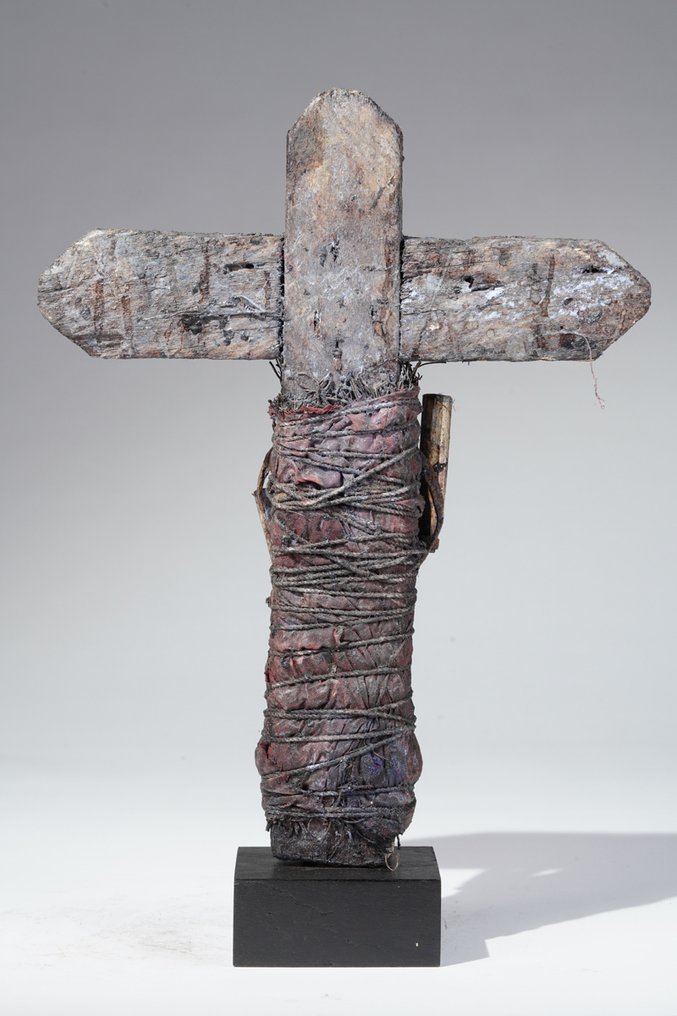
A wooden sculpture - Fon - Benin (No reserve price)




07
days
22
hours
02
minutes
41
seconds
Starting bid
€ 1
No reserve price

Expert
Selected by Dimitri André
Holds a postgraduate degree in African studies and 15 years experience in African art.
Estimate € 330 - € 400
No bids placed
Catawiki Buyer Protection
Your payment’s safe with us until you receive your object.View details
Trustpilot 4.4 | 122385 reviews
Rated Excellent on Trustpilot.
Description from the seller
A Fon Crucifix sculpture, South-West Benin. Signs of ritual use and age.
Fon crucifix sculptures are syncretic religious objects created by the Fon people of the Republic of Benin, formerly the Kingdom of Dahomey. These sculptures represent a confluence of Christian iconography and Fon religious cosmology, often resulting from the complex historical processes of colonialism, missionary influence, and indigenous reinterpretation of imported symbols. Though they outwardly resemble the Christian crucifix, Fon crucifixes are embedded with local spiritual meanings and are frequently used in contexts far removed from Christian liturgical practice.
The introduction of Christian symbolism into the Fon region began in earnest during the 18th and 19th centuries, particularly with the expansion of European missionary activity and trade along the West African coast. The cross, initially a foreign emblem, was absorbed into Fon cosmological systems through a process of religious and visual translation. Within Fon metaphysics, the crossroads—symbolized by the intersection of vertical and horizontal axes—is a powerful spiritual metaphor, often associated with the deity Legba, a trickster and intermediary figure who governs communication between the earthly and divine realms. The cruciform shape, therefore, resonated with pre-existing indigenous symbols and was repurposed in ways that retained Christian associations while extending into Vodun theology.
Fon crucifixes are typically made from iron or bronze, forged by local blacksmiths who occupy a respected position in society due to their control over transformational technologies and sacred materials. The figures on these crucifixes may resemble the European Christ but are often abstracted or stylized according to local aesthetic norms. Arms may be disproportionately long, the torso rendered as a compact mass, and the head enlarged or elongated—characteristics not meant to replicate anatomical reality but to encode spiritual force and symbolic weight.
These objects are often not devotional in the Christian sense. Instead, they function as charms, talismans, or ritual tools within Vodun religious practice. They may be used in healing ceremonies, placed on altars, or carried by individuals for protection or empowerment. Their presence in domestic and public shrines reflects a broader pattern of cultural adaptation in which Christian forms are recontextualized to serve local cosmological purposes. In some cases, crucifix imagery may be blended with depictions of local deities or ancestral figures, reinforcing the layered, pluralistic nature of Fon religious expression.
Scholars such as Suzanne Preston Blier have argued that such syncretic forms should not be viewed as derivative or corrupted versions of Christian art but as evidence of dynamic cultural negotiation and visual innovation. These works are emblematic of the ways in which African societies have historically responded to foreign religious impositions—not by passive acceptance, but through processes of selective incorporation, resistance, and reinterpretation.
In the context of Western museum collections, Fon crucifixes have often been catalogued either as "African Christian art" or, less accurately, as evidence of conversion. Such readings frequently overlook the localized theological systems in which these objects are embedded and the agency of African artisans and devotees in shaping their visual and spiritual meanings.
References:
Suzanne Preston Blier, African Vodun: Art, Psychology, and Power (Chicago: University of Chicago Press, 1995).
Edna G. Bay, Wives of the Leopard: Gender, Politics, and Culture in the Kingdom of Dahomey (Charlottesville: University Press of Virginia, 1998).
Robert Farris Thompson, Flash of the Spirit: African and Afro-American Art and Philosophy (New York: Random House, 1983).
John Pemberton, “Crosses in Africa,” African Arts 18, no. 4 (1985): 68–69.
Seller's Story
I have been collecting for 25 years and dealing in African art for 20 years. I was inspired by my father's passion for collecting, who left us a collection of "German Colonies". I studied ethnology, art history and comparative law at the Freie Universität Berlin without graduating. After extensive travels through Cameroon, Mali, Ivory Coast, Burkina Faso, Togo and Ghana, I lived in Bamako and Segou for 10 years. In Segou I managed the gallery "Tribalartforum", which had to close in 2012 because of the war in Mali. Then I settled in Lomé Togo, where we have a branch. 16 years ago, Jaenicke-Njoya GmbH was founded, and I have been its managing partner ever since. In 2018 we opened a gallery in Berlin Charlottenburg opposite the Charlottenburg Palace and near the Picasso Museum Berggruen. Our team consists of 6 employees. An archaeologist, an art historian, a photographer, a financial controller, a permanent representative for our branch in Lomé, Togo, and an acting director in Berlin / Togo. You can find us on the web at wolfgang-jaenicke or Galerie Wolfgang Jaenicke, Klausenerplatz 7, 14059 Berlin, Germany.
A Fon Crucifix sculpture, South-West Benin. Signs of ritual use and age.
Fon crucifix sculptures are syncretic religious objects created by the Fon people of the Republic of Benin, formerly the Kingdom of Dahomey. These sculptures represent a confluence of Christian iconography and Fon religious cosmology, often resulting from the complex historical processes of colonialism, missionary influence, and indigenous reinterpretation of imported symbols. Though they outwardly resemble the Christian crucifix, Fon crucifixes are embedded with local spiritual meanings and are frequently used in contexts far removed from Christian liturgical practice.
The introduction of Christian symbolism into the Fon region began in earnest during the 18th and 19th centuries, particularly with the expansion of European missionary activity and trade along the West African coast. The cross, initially a foreign emblem, was absorbed into Fon cosmological systems through a process of religious and visual translation. Within Fon metaphysics, the crossroads—symbolized by the intersection of vertical and horizontal axes—is a powerful spiritual metaphor, often associated with the deity Legba, a trickster and intermediary figure who governs communication between the earthly and divine realms. The cruciform shape, therefore, resonated with pre-existing indigenous symbols and was repurposed in ways that retained Christian associations while extending into Vodun theology.
Fon crucifixes are typically made from iron or bronze, forged by local blacksmiths who occupy a respected position in society due to their control over transformational technologies and sacred materials. The figures on these crucifixes may resemble the European Christ but are often abstracted or stylized according to local aesthetic norms. Arms may be disproportionately long, the torso rendered as a compact mass, and the head enlarged or elongated—characteristics not meant to replicate anatomical reality but to encode spiritual force and symbolic weight.
These objects are often not devotional in the Christian sense. Instead, they function as charms, talismans, or ritual tools within Vodun religious practice. They may be used in healing ceremonies, placed on altars, or carried by individuals for protection or empowerment. Their presence in domestic and public shrines reflects a broader pattern of cultural adaptation in which Christian forms are recontextualized to serve local cosmological purposes. In some cases, crucifix imagery may be blended with depictions of local deities or ancestral figures, reinforcing the layered, pluralistic nature of Fon religious expression.
Scholars such as Suzanne Preston Blier have argued that such syncretic forms should not be viewed as derivative or corrupted versions of Christian art but as evidence of dynamic cultural negotiation and visual innovation. These works are emblematic of the ways in which African societies have historically responded to foreign religious impositions—not by passive acceptance, but through processes of selective incorporation, resistance, and reinterpretation.
In the context of Western museum collections, Fon crucifixes have often been catalogued either as "African Christian art" or, less accurately, as evidence of conversion. Such readings frequently overlook the localized theological systems in which these objects are embedded and the agency of African artisans and devotees in shaping their visual and spiritual meanings.
References:
Suzanne Preston Blier, African Vodun: Art, Psychology, and Power (Chicago: University of Chicago Press, 1995).
Edna G. Bay, Wives of the Leopard: Gender, Politics, and Culture in the Kingdom of Dahomey (Charlottesville: University Press of Virginia, 1998).
Robert Farris Thompson, Flash of the Spirit: African and Afro-American Art and Philosophy (New York: Random House, 1983).
John Pemberton, “Crosses in Africa,” African Arts 18, no. 4 (1985): 68–69.
Seller's Story
I have been collecting for 25 years and dealing in African art for 20 years. I was inspired by my father's passion for collecting, who left us a collection of "German Colonies". I studied ethnology, art history and comparative law at the Freie Universität Berlin without graduating. After extensive travels through Cameroon, Mali, Ivory Coast, Burkina Faso, Togo and Ghana, I lived in Bamako and Segou for 10 years. In Segou I managed the gallery "Tribalartforum", which had to close in 2012 because of the war in Mali. Then I settled in Lomé Togo, where we have a branch. 16 years ago, Jaenicke-Njoya GmbH was founded, and I have been its managing partner ever since. In 2018 we opened a gallery in Berlin Charlottenburg opposite the Charlottenburg Palace and near the Picasso Museum Berggruen. Our team consists of 6 employees. An archaeologist, an art historian, a photographer, a financial controller, a permanent representative for our branch in Lomé, Togo, and an acting director in Berlin / Togo. You can find us on the web at wolfgang-jaenicke or Galerie Wolfgang Jaenicke, Klausenerplatz 7, 14059 Berlin, Germany.
Details
Ethnic group/ culture
Fon
Country of Origin
Benin
Material
Wood
Sold with stand
No
Condition
Fair condition
Title of artwork
A wooden sculpture
Height
40 cm
Weight
920 g
Sold by
GermanyVerified
protop
Rechtliche Informationen des Verkäufers
- Unternehmen:
- Jaenicke Njoya GmbH
- Repräsentant:
- Wolfgang Jaenicke
- Adresse:
- Jaenicke Njoya GmbH
Klausenerplatz 7
14059 Berlin
GERMANY - Telefonnummer:
- +493033951033
- Email:
- w.jaenicke@jaenicke-njoya.com
- USt-IdNr.:
- DE241193499
AGB
AGB des Verkäufers. Mit einem Gebot auf dieses Los akzeptieren Sie ebenfalls die AGB des Verkäufers.
Widerrufsbelehrung
- Frist: 14 Tage sowie gemäß den hier angegebenen Bedingungen
- Rücksendkosten: Käufer trägt die unmittelbaren Kosten der Rücksendung der Ware
- Vollständige Widerrufsbelehrung
