Clock Louis XVI Style - Gilt bronze - 1850-1900 - Costumbrista Scene



07
days
15
hours
24
minutes
15
seconds
Current bid
€ 150
Reserve price not met

Expert
Selected by Justus Heutink
Holds broad knowledge of religious icons with six years of collecting experience.
Estimate € 400 - € 450
8 other people are watching this object
 Bidder 2077 Bidder 2077 | €150 |
|---|
Catawiki Buyer Protection
Your payment’s safe with us until you receive your object.View details
Trustpilot 4.4 | 122473 reviews
Rated Excellent on Trustpilot.
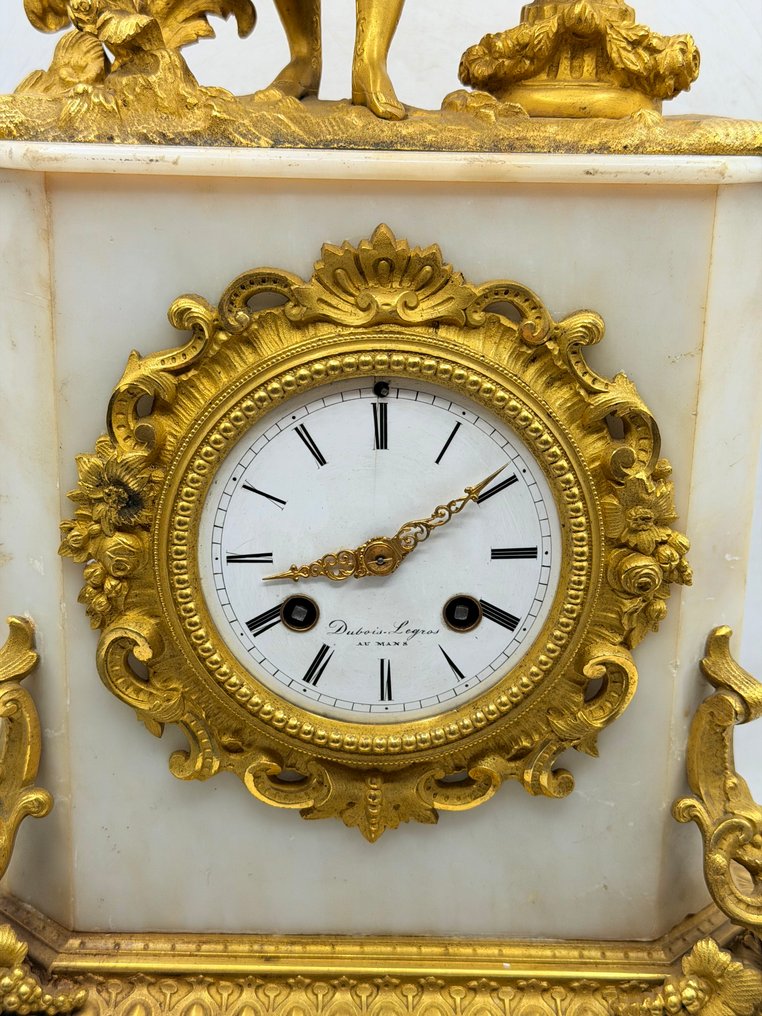
An 1850–1900 desk clock in bronze grafted with ormolu and alabaster, with a mechanical 8-day movement that strikes once on a bell every half hour, in good used condition, in antique Louis XVI style with a scene titled Escena Costumbrista, made in France, measuring 51 × 30 × 20 cm and weighing 5 kg with the winding key included.
AI-assisted summary
Description from the seller
This tabletop clock, dated to the second half of the 19th century, is a representative piece of palatial taste and high-period decoration. Made of bronze with gilding in Ormolu gold, it features a scene from everyday life at the top: a female figure dressed in period attire, accompanied by floral and architectural elements that evoke aristocratic daily life of the 19th century. This composition not only enhances the piece's beauty but also conveys the ideal of refinement and culture that characterized the interiors of noble residences.
The main structure is crafted in white marble, adding contrast and solemnity to the overall design. The gold in Ormolu, expertly applied over bronze, highlights the sculptural details and gives the clock a luminous and sophisticated presence. The dial, with Roman numerals and ornate hands, is framed by a decorative bezel that harmonizes with the other gold elements.
Although the mechanism is operational, it requires lubrication and adjustments typical of its age, which is common in pieces of this category. Its mechanical functioning and narrative aesthetics make it a living testimony of 19th-century artistic watchmaking, when clocks not only kept time but also served as symbols of status, taste, and power.
This type of clock, designed for high-end salons, reflects the importance given to ornamentation and visual storytelling in decorative objects. It is a piece that combines history, art, and technique, ideal for discerning collectors or spaces seeking to revive the splendor of European tradition.
Certified shipping and good packaging.
Seller's Story
Translated by Google TranslateThis tabletop clock, dated to the second half of the 19th century, is a representative piece of palatial taste and high-period decoration. Made of bronze with gilding in Ormolu gold, it features a scene from everyday life at the top: a female figure dressed in period attire, accompanied by floral and architectural elements that evoke aristocratic daily life of the 19th century. This composition not only enhances the piece's beauty but also conveys the ideal of refinement and culture that characterized the interiors of noble residences.
The main structure is crafted in white marble, adding contrast and solemnity to the overall design. The gold in Ormolu, expertly applied over bronze, highlights the sculptural details and gives the clock a luminous and sophisticated presence. The dial, with Roman numerals and ornate hands, is framed by a decorative bezel that harmonizes with the other gold elements.
Although the mechanism is operational, it requires lubrication and adjustments typical of its age, which is common in pieces of this category. Its mechanical functioning and narrative aesthetics make it a living testimony of 19th-century artistic watchmaking, when clocks not only kept time but also served as symbols of status, taste, and power.
This type of clock, designed for high-end salons, reflects the importance given to ornamentation and visual storytelling in decorative objects. It is a piece that combines history, art, and technique, ideal for discerning collectors or spaces seeking to revive the splendor of European tradition.
Certified shipping and good packaging.
Seller's Story
Translated by Google TranslateDetails
Bronze type
Gilt bronze
Style subtype
Louis XVI Style
Era
1400-1900
Title additional information
Costumbrista Scene
Material
Alabaster, Bronze, Wood
Clock mechanism
Mechanical
Power Reserve
8 day movement
Striking
half hour, one bell
Style
Antique
Country of Origin
France
Condition
Good condition - used with small signs of ageing
In working order
Yes
Height
51 cm
Width
30 cm
Depth
20 cm
Estimated period
1850-1900
Weight
5 kg
Winding Key
Yes
Sold by
