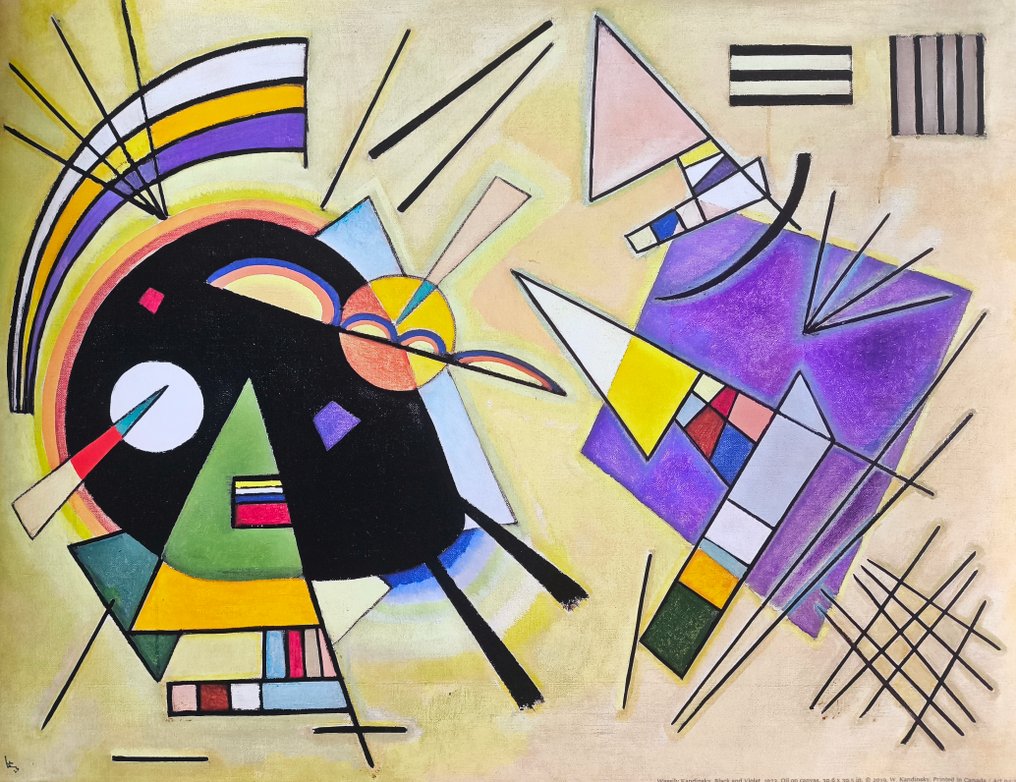
Wassily Kandinsky (1866-1944) (after) - "Black and Violet, 1923"


03
days
22
hours
22
minutes
48
seconds

7 other people are watching this object
 Bidder 3595 Bidder 3595 | €5 | |
|---|---|---|
 Bidder 4724 Bidder 4724 | €2 |
Catawiki Buyer Protection
Your payment’s safe with us until you receive your object.View details
Trustpilot 4.4 | 122813 reviews
Rated Excellent on Trustpilot.
Authorized giclée print after Wassily Kandinsky (1866–1944), titled “Black and Violet, 1923,” on heavyweight smooth matte paper (~300 gsm), signed in the plate, original edition, 42 × 54.5 cm, produced in Canada in 2010–2020, in excellent condition, never framed, with a stamp on the verso.
AI-assisted summary
Description from the seller
- Wasily Kandinsky (after). Authorized giclée print on heavyweight smooth matte paper (approximately 300 gsm).
Signed on the plate.
- Size: 42 x 54.5cm.
Stamp on the verso.
- Condition: excellent. Never framed, never exposed.
Wassily Kandinsky (1866–1944) was a Russian-born painter, theorist, and one of the most influential pioneers of abstract art. Initially trained in law and economics, Kandinsky turned to painting in his 30s, quickly becoming a central figure in the development of modernism. His work radically broke away from figurative traditions, aiming instead to express spiritual and emotional truths through color, form, and rhythm. As a leading member of the Blue Rider (Der Blaue Reiter) movement and later a teacher at the Bauhaus, Kandinsky’s writings and paintings established a theoretical and visual foundation for abstraction in the 20th century.
Kandinsky’s market has consistently ranked among the most prestigious in modern art. His works regularly achieve multi-million-dollar results at auction, with significant paintings exceeding $20–40 million, reflecting their rarity, historical importance, and enduring influence. Collectors and institutions alike value Kandinsky not only as a painter but also as a philosopher of abstraction.
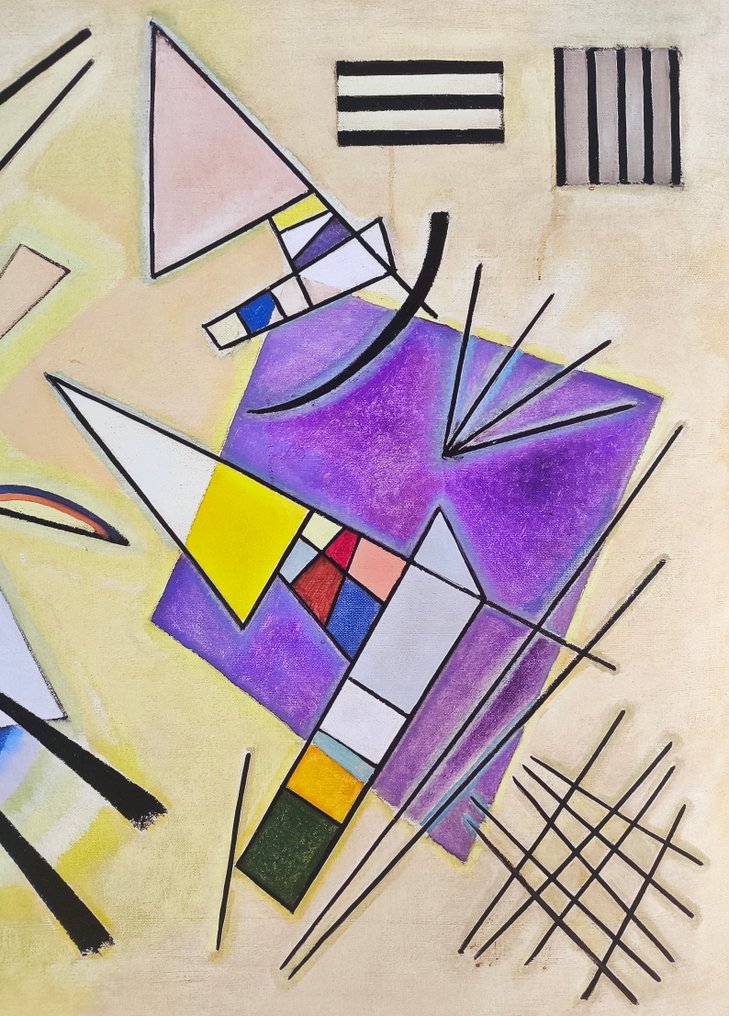
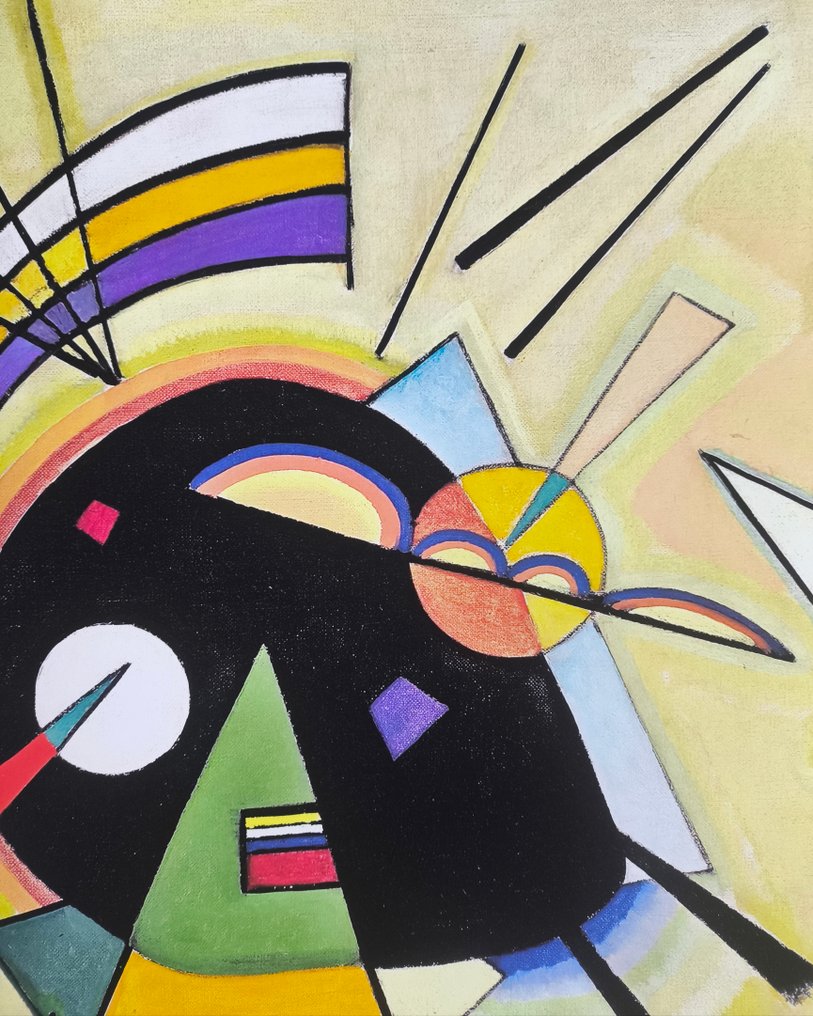
His 1923 work Black and Violet epitomizes his mature Bauhaus period, where geometry, balance, and dynamic composition dominate. The work features a striking interplay between a central black mass and vivid, angular forms of violet, yellow, and green, all orchestrated with Kandinsky’s precise use of lines and arcs. The contrast between darkness and color creates both tension and harmony, suggesting movement and inner resonance rather than external reality. This synthesis of geometry and vibrant palette demonstrates Kandinsky’s belief in the 'spiritual in art' and the power of abstract forms to evoke deep human emotions.
Today, Black and Violet is celebrated as one of Kandinsky’s key compositions from the early Bauhaus years. If offered on the market, it would be considered a masterpiece of interwar abstraction and command a price at the very top tier of modern art sales.
Artists of similar importance: Basquiat, Picasso, Hockney, Lichtenstein, Miró, Banksy, Brainwash, Delaunay, Nara, Soulages, Jenk, Orlinski, Wille, Rizzi, Manara, Thiebaud, Herrera, Laurent, Klein, Coa, Dior, Lagasse, Vuitton, Kaws, Valentino, Cappiello, Rothko, Dalí, Ramos, Warhol, Lautrec, Klimt, Matisse, Hirst, Chagall, Koons, Haring, Indiana, Mondrian, Groening, Richter, Monroe, Kusama, Murakami, Testa, Villemot, Oldenburg, Hopper, Ripolles, Wesselmann, Magritte, among others.
Seller's Story
Seller on Catawiki for over seven years.
I invite you to visit my profile, where you'll find a complete list of the different lots currently being auctioned. Click on "Yuke."
Good luck at the auctions!
Translated by Google Translate- Wasily Kandinsky (after). Authorized giclée print on heavyweight smooth matte paper (approximately 300 gsm).
Signed on the plate.
- Size: 42 x 54.5cm.
Stamp on the verso.
- Condition: excellent. Never framed, never exposed.
Wassily Kandinsky (1866–1944) was a Russian-born painter, theorist, and one of the most influential pioneers of abstract art. Initially trained in law and economics, Kandinsky turned to painting in his 30s, quickly becoming a central figure in the development of modernism. His work radically broke away from figurative traditions, aiming instead to express spiritual and emotional truths through color, form, and rhythm. As a leading member of the Blue Rider (Der Blaue Reiter) movement and later a teacher at the Bauhaus, Kandinsky’s writings and paintings established a theoretical and visual foundation for abstraction in the 20th century.
Kandinsky’s market has consistently ranked among the most prestigious in modern art. His works regularly achieve multi-million-dollar results at auction, with significant paintings exceeding $20–40 million, reflecting their rarity, historical importance, and enduring influence. Collectors and institutions alike value Kandinsky not only as a painter but also as a philosopher of abstraction.
His 1923 work Black and Violet epitomizes his mature Bauhaus period, where geometry, balance, and dynamic composition dominate. The work features a striking interplay between a central black mass and vivid, angular forms of violet, yellow, and green, all orchestrated with Kandinsky’s precise use of lines and arcs. The contrast between darkness and color creates both tension and harmony, suggesting movement and inner resonance rather than external reality. This synthesis of geometry and vibrant palette demonstrates Kandinsky’s belief in the 'spiritual in art' and the power of abstract forms to evoke deep human emotions.
Today, Black and Violet is celebrated as one of Kandinsky’s key compositions from the early Bauhaus years. If offered on the market, it would be considered a masterpiece of interwar abstraction and command a price at the very top tier of modern art sales.
Artists of similar importance: Basquiat, Picasso, Hockney, Lichtenstein, Miró, Banksy, Brainwash, Delaunay, Nara, Soulages, Jenk, Orlinski, Wille, Rizzi, Manara, Thiebaud, Herrera, Laurent, Klein, Coa, Dior, Lagasse, Vuitton, Kaws, Valentino, Cappiello, Rothko, Dalí, Ramos, Warhol, Lautrec, Klimt, Matisse, Hirst, Chagall, Koons, Haring, Indiana, Mondrian, Groening, Richter, Monroe, Kusama, Murakami, Testa, Villemot, Oldenburg, Hopper, Ripolles, Wesselmann, Magritte, among others.
Seller's Story
Seller on Catawiki for over seven years.
I invite you to visit my profile, where you'll find a complete list of the different lots currently being auctioned. Click on "Yuke."
Good luck at the auctions!
Translated by Google TranslateDetails
Artist
Wassily Kandinsky (1866-1944) (after)
Sold by
Owner or reseller
Edition
Original
Title of artwork
"Black and Violet, 1923"
Technique
Giclée
Signature
Plate signed
Country of Origin
Canada
Condition
Excellent condition
Height
42 cm
Width
54.5 cm
Style
Bauhaus
Period
2010-2020
Sold with frame
No