Ancient Egyptian Faience, Steatite, Stone Ancient Egyptian Necklace with Three Rare Steatite Scarabs and Faience Beads circa 1700–1100 BC –



Opens Friday
Starting bid
€ 1
Add to your favourites to get an alert when the auction starts.

Expert
Selected by Ruth Garrido Vila
Directed the Ifergan Collection Museum, specialising in Phoenician and Mediterranean archaeology.
Estimate € 1,400 - € 1,700
Catawiki Buyer Protection
Your payment’s safe with us until you receive your object.View details
Trustpilot 4.4 | 122713 reviews
Rated Excellent on Trustpilot.
Description from the seller
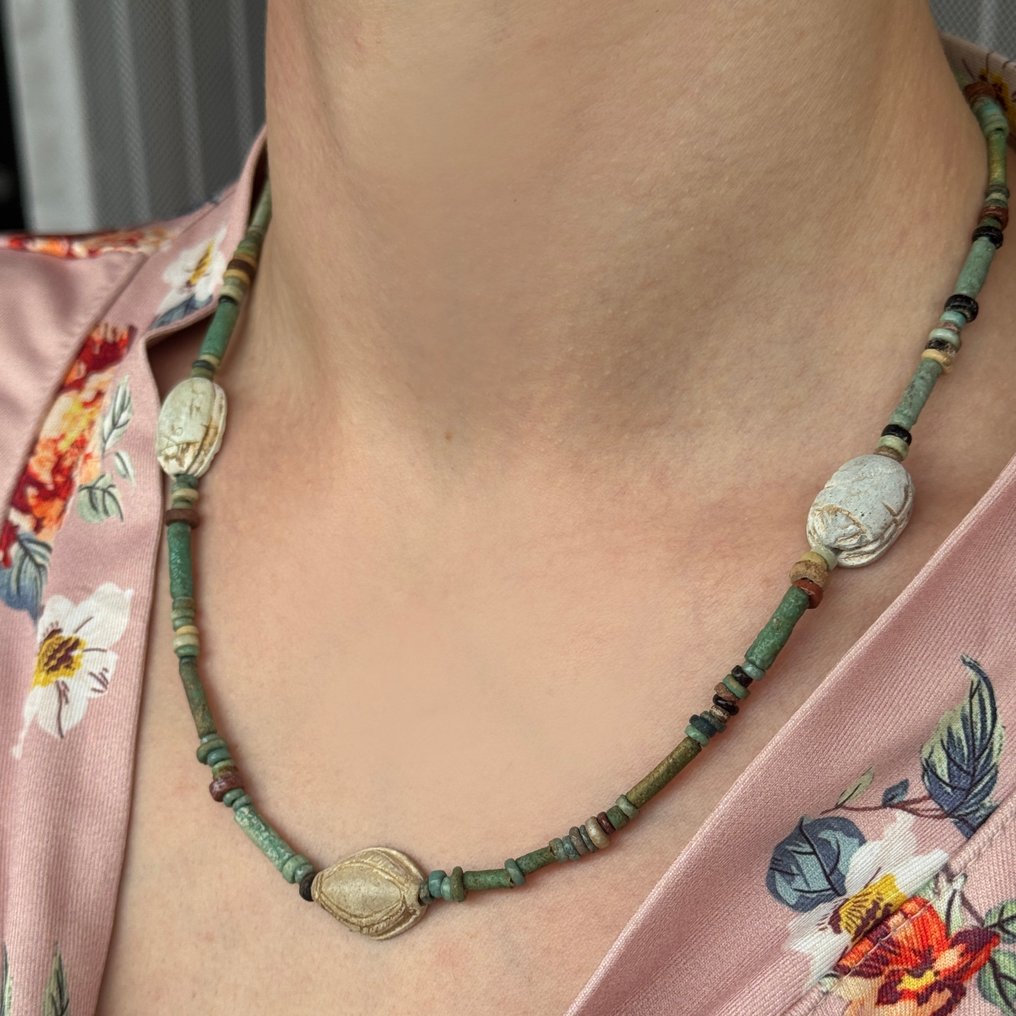
Ancient Egyptian Necklace with Three Rare Stone Scarabs and Faience Beads – Middle to New Kingdom, circa 1700–1100 BC
A remarkable ancient Egyptian necklace composed of authentic faience beads in shades of turquoise, green, and brown, interspersed with three finely carved stone scarabs, each featuring distinct hieroglyphic or figural engravings. The necklace measures 46 cm in total length and has been restrung for modern wear while preserving all original ancient components.
Description of Components:
1. Central Scarab (Image 2):
Expertly carved from stone, likely schist or steatite, this scarab bears an intricate hieroglyphic composition depicting a standing figure, possibly representing Osiris or a high official, surrounded by hieroglyphic signs invoking protection and divine favour. Such scarabs were often used as personal amulets or seals, symbolising rebirth and eternal life.
Dating: New Kingdom, circa 1550–1070 BC.
2. Right Scarab (Image 3):
Depicting a striding falcon-headed deity, most likely Horus, wearing the double crown of Upper and Lower Egypt. This depiction symbolises divine kingship and protection. The detailed carving reflects the artistry of the 18th Dynasty period.
Dating: New Kingdom, circa 1400–1200 BC.
3. Left Scarab (Image 4):
Featuring hieroglyphic inscriptions possibly including a cartouche or titulary motif, perhaps symbolic rather than royal. The symmetrical design and crisp carving are typical of the Second Intermediate Period to early New Kingdom.
Dating: Middle to New Kingdom, circa 1700–1400 BC.
Faience Beads:
The necklace is composed of dozens of ancient Egyptian faience tube and disc beads, hand-made and kiln-fired to achieve their characteristic turquoise-blue glaze. These beads were widely worn by both men and women as symbols of fertility, vitality, and protection.
Condition:
Excellent ancient condition with minor surface wear consistent with age and burial. The necklace has been professionally restrung on a modern cord for stability and wearability, with all components being genuinely ancient.
Dimensions:
Total length: 46 cm
Largest scarab: approx. 2.2 × 1.6 cm
Beads: various sizes, typically 0.5–1.2 cm
Provenance:
From an old European collection, acquired prior to 1980.
References:
Comparable examples in:
Andrews, C. Amulets of Ancient Egypt, British Museum Press, 1994.
Petrie, W.M.F. Scarabs and Cylinders with Names, 1917.
A beautifully balanced and historically significant piece, showcasing the artistic refinement and spiritual symbolism of ancient Egyptian craftsmanship.
Ancient Egyptian Necklace with Three Rare Stone Scarabs and Faience Beads – Middle to New Kingdom, circa 1700–1100 BC
A remarkable ancient Egyptian necklace composed of authentic faience beads in shades of turquoise, green, and brown, interspersed with three finely carved stone scarabs, each featuring distinct hieroglyphic or figural engravings. The necklace measures 46 cm in total length and has been restrung for modern wear while preserving all original ancient components.
Description of Components:
1. Central Scarab (Image 2):
Expertly carved from stone, likely schist or steatite, this scarab bears an intricate hieroglyphic composition depicting a standing figure, possibly representing Osiris or a high official, surrounded by hieroglyphic signs invoking protection and divine favour. Such scarabs were often used as personal amulets or seals, symbolising rebirth and eternal life.
Dating: New Kingdom, circa 1550–1070 BC.
2. Right Scarab (Image 3):
Depicting a striding falcon-headed deity, most likely Horus, wearing the double crown of Upper and Lower Egypt. This depiction symbolises divine kingship and protection. The detailed carving reflects the artistry of the 18th Dynasty period.
Dating: New Kingdom, circa 1400–1200 BC.
3. Left Scarab (Image 4):
Featuring hieroglyphic inscriptions possibly including a cartouche or titulary motif, perhaps symbolic rather than royal. The symmetrical design and crisp carving are typical of the Second Intermediate Period to early New Kingdom.
Dating: Middle to New Kingdom, circa 1700–1400 BC.
Faience Beads:
The necklace is composed of dozens of ancient Egyptian faience tube and disc beads, hand-made and kiln-fired to achieve their characteristic turquoise-blue glaze. These beads were widely worn by both men and women as symbols of fertility, vitality, and protection.
Condition:
Excellent ancient condition with minor surface wear consistent with age and burial. The necklace has been professionally restrung on a modern cord for stability and wearability, with all components being genuinely ancient.
Dimensions:
Total length: 46 cm
Largest scarab: approx. 2.2 × 1.6 cm
Beads: various sizes, typically 0.5–1.2 cm
Provenance:
From an old European collection, acquired prior to 1980.
References:
Comparable examples in:
Andrews, C. Amulets of Ancient Egypt, British Museum Press, 1994.
Petrie, W.M.F. Scarabs and Cylinders with Names, 1917.
A beautifully balanced and historically significant piece, showcasing the artistic refinement and spiritual symbolism of ancient Egyptian craftsmanship.
Details
Culture
Ancient Egyptian
Century/ Timeframe
circa 1700–1100 BC
Name of object
Ancient Egyptian Necklace with Three Rare Steatite Scarabs and Faience Beads circa 1700–1100 BC –
Acquired from
Private collection
Year acquired
2019
Material
Faience, Steatite, Stone
Country acquired from
United Kingdom
Condition
Good
Previous owner acquired from
Antique market
Previous owner - year acquired
1995
Previous owner - country acquired from
United Kingdom
I verify that I have obtained this object legally and that I am allowed to sell it
Yes
Sold by
Disclaimer
The seller was informed by Catawiki about documentation requirements and guarantees the following: - the object was legally obtained, - the seller has the right to sell and/or export the object, as relevant, - the seller will provide the necessary provenance information and arrange required documentation and permits/licenses, as applicable and as per local laws, - the seller will notify the buyer of any delays in obtaining permits/licenses. By bidding, you acknowledge that import documentation may be required depending on your country of residence and that obtaining permits/licenses may cause delays in the delivery of your object.
The seller was informed by Catawiki about documentation requirements and guarantees the following: - the object was legally obtained, - the seller has the right to sell and/or export the object, as relevant, - the seller will provide the necessary provenance information and arrange required documentation and permits/licenses, as applicable and as per local laws, - the seller will notify the buyer of any delays in obtaining permits/licenses. By bidding, you acknowledge that import documentation may be required depending on your country of residence and that obtaining permits/licenses may cause delays in the delivery of your object.
