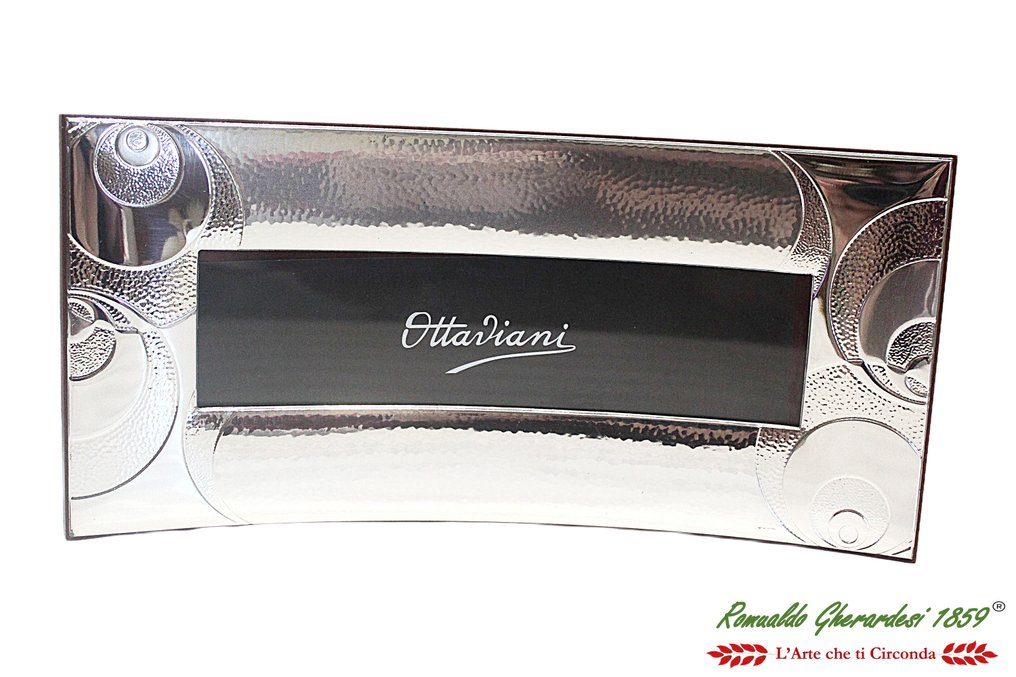
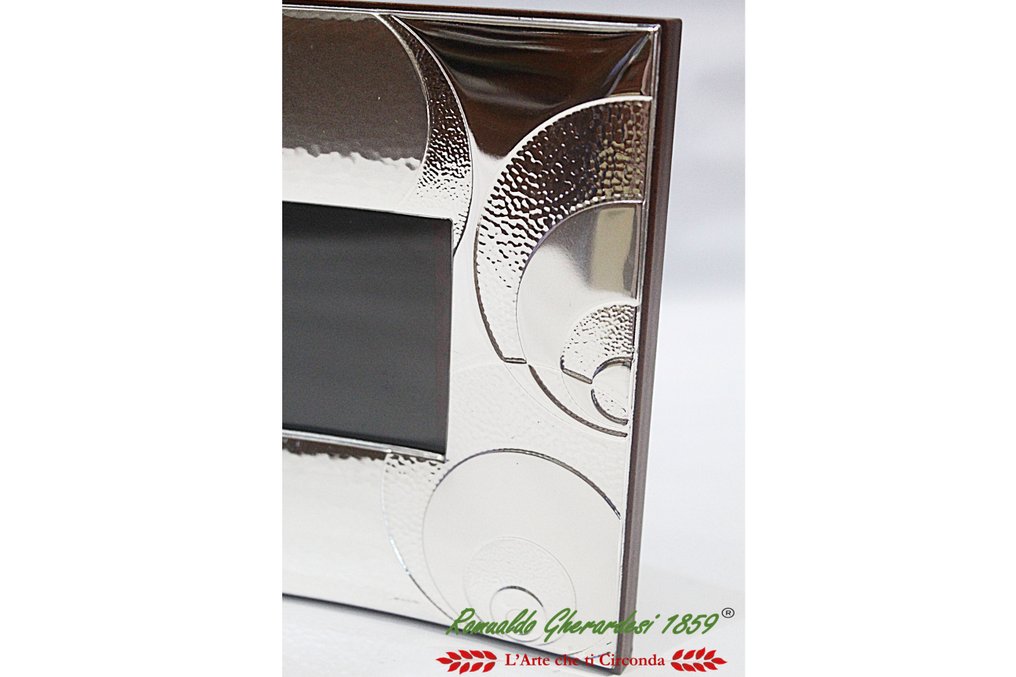
Giuliano Ottaviani Cornice firmata base legno massello - Frame - .925 silver


00
days
15
hours
52
minutes
20
seconds
Current bid
€ 46
No reserve price

Expert
Selected by Jeroen Zoetmulder
Has over 30 years of experience in archaeology and is an appraiser specialising in archaeological objects.
Estimate € 150 - € 200
13 other people are watching this object
 Bidder 4274 Bidder 4274 | €46 | |
|---|---|---|
 Bidder 1980 Bidder 1980 | €41 | |
 Bidder 4579 Bidder 4579 | €36 | |
Catawiki Buyer Protection
Your payment’s safe with us until you receive your object.View details
Trustpilot 4.4 | 123609 reviews
Rated Excellent on Trustpilot.
Italian-made Giuliano Ottaviani frame with solid wood base, silver-plated on a 925 sterling silver plate, external 16 × 32 × 2 cm, internal 6 × 23 cm, signed and deposited by Studio Ottaviani, in excellent condition.
AI-assisted summary
Description from the seller
Incredible authentic Ottaviani frame, composition on a silver plate. Plate composition: 925 silver hallmark, i.e., copper alloy, covered with a 925/°°° silver plate and an electrolytic coating of 1000/°°° silver. Registered work by Studio Ottaviani. Signature hallmark (BEWARE OF IMITATIONS)
The weight is present in the silver punches.
Condition: work in excellent condition; - ; .Dimensions: external approximately 16x32x2 cm,
The work will be shipped in 3-wave, puncture-proof and shock-proof cardboard with insurance.
Product deliveries are entrusted only to top couriers such as UPS, DHL, and BRT, with guaranteed and insured delivery. The price lists are publicly available online.
Giuliano Ottaviani was born in Foligno (Perugia). His talent for the applied arts was evident from an early age, with his unbridled creativity and remarkable technical virtuosity. For these reasons, he attended the School of Art in Perugia and, under the critical eye of Maestro Domenico Purificato, earned a diploma from the Brera Academy of Fine Arts in Milan.
After debuting with a solo exhibition in Milan at just 17, he turned his attention to Switzerland, where the renowned gallery owner Her Bolag in Zurich sought to acquire some of his works for his private collection. Until 1976, Ottaviani divided his time between Italy and Switzerland, both countries witnessing his growing desire to fully realize his artistic potential with more solo exhibitions. Requests to continue teaching painting and sculpture, which he had briefly taught, were to no avail, devoting his life to a constant and total commitment to the pursuit of new ideas and forms.
Giuliano Ottaviani's career has been marked by many successes: in Paris, after being awarded the Gold Medal of the Academy of Arts, Sciences and Letters, first prize—the only Italian—he created several frescoes in a well-known, trendy venue. Galleries in the French capital competed to exhibit his works in solo shows, including the Galeries du Pack Royal and Galeries Robin.
In Italy, he regularly exhibits his work on the Amalfi Coast: from Positano to Ravello, Amalfi hosts him in the Arsenali della Repubblica, and on that occasion he tries his hand at illustrating the book "Masamoeòòp do Amalfi" at the request of the Municipality itself. He will be present for eight years with solo exhibitions.
In 1988, the city of Nantes requested his presence on the occasion of the bicentenary of the French Revolution, and a major exhibition was held to commemorate the event. The works of "Masaniello of Amalfi" were displayed on that occasion as a testament to the Neapolitan revolt. His art thus led him to become a European citizen, exhibiting in Cologne, Nuremberg, and other German cities. He held 6-8 solo exhibitions annually, and rather than in private galleries, his works were displayed in centers made available by various municipalities and provinces, which were honored to host the artist, presenting his vast creativity to the public.
Maestro Ottaviani's work is not limited to painting and sculpture, but extends to jewelry, interior design, and street furniture, with the creation of monumental sculptures ranging from 2 to 6 meters in height. These sculptures, while externally of exquisite artistic craftsmanship, are also of great social use internally. He also has underground car parks and multi-story exhibition stands showcasing a wide variety of items: art, fashion, and regional folklore. In the 1980s, Maestro Ottaviani founded a European group, which includes many artists of various nationalities, and organizes high-level international exhibitions. In France, the artist exhibits at various times in several cities: Lyon hosts him in the town halls, Beaulieu-sur-Mer invites him to the Monumental Sculpture exhibition on several occasions, and in Charlieu, Maestro Ottaviani creates a 300-meter mural in the civic museum. 10 x 20 and holds a summer sculpture course at the invitation of a European university. The French Riviera also benefits from his work: Cannes, Antibes, Valauris, Biot, Le Luc, Saint-Janet, and Cap d'Ail host a succession of solo exhibitions, and the prestigious Quadrige gallery in Nice permanently exhibits his works. The artist's work has been seen in almost every Italian city: from the prestigious Teatro Rendano in Cosenza to the exhibition hall in Taormina, from Palazzo Barberini in Rome to Galleria La Loggia in Udine, from Galleria Percorsi d'arte in Venice to Galleria Le Muse in Bari, and many other notable cities such as the Sanremo Casino and, for another eight years, in many towns on the Costa Smeralda in Sardinia. Europe has now become a limited field for Maestro Ottaviani's perspectives, and his work has landed in America. New York University officially invites him and hosts a major solo exhibition. Los Angeles, Laguna Beach, and many others followed. The world's largest and most prestigious nuclear center, Fermilab in Chicago, invited him to publicly unveil a grandiose 2 x 20 meter canvas in a performance entitled "Symbiosi in Concerto," a new idea of his: combining music with painting. Two talented artists, a pianist and a violinist, accompanied Maestro Ottaviani in a classical music concert.
The Principality of Monaco hosts him repeatedly for performances in Monte Carlo, and his tour continues in Italy. Liguria is the Italian region that has repeatedly invited Giuliano Ottaviani to its charming towns of Spotorno, Savona, Celle Ligure, Loano, Varazze, and others. For his valuable contributions to the arts, in 1991, President Francesco Cossiga awarded him the Order of Merit of the Italian Republic. His extensive work also extends to numismatics and philately: he creates commissioned medals for banks and religious institutions, and for the centenary of the birth of the poet Eugenio Montale, he designed the postmark for the Italian State Printing Office. Since 1997, Maestro Ottaviani has dedicated his time and remarkable creativity to social work: in São Paulo, Brazil, he was offered the opportunity to teach sculpture to street children, known as pichadores, young people who, through the misfortune of being born poor, become misfits and commit crimes punishable by local law. The rehabilitation of these children has prompted various municipal administrations to recognize Ottaviani's work by offering him the opportunity to establish the First Ottaviani Academy in Brazil. The same initiative will be followed in the near future in other cities in Brazil and very likely in Italy as well.
1998 marked a turning point in Giuliano Ottaviani's career. He won an international sculptor's competition and had the opportunity to create a 5-meter-tall marble sculpture in Changchun, China. He was honored to be the first Italian to have a sculpture permanently displayed in a Chinese square. He then exhibited his work at the World Art Museum China Millennium Monument, marking the Year of Italy in China 2006, where 13 large monumental works will remain permanently in the Museum's collection. His Chinese tour continued in Shanghai, where the city acquired numerous works for its public collection. After Shanghai, he returned to Brazil for an exhibition at the Salvador City Museum.
His curriculum vitae is deposited in the archives in: Florence, Kunstoriches Institut in Florence, in Paris, Beaubourg, Centre Pompidour.
He is registered at the National Gallery of Modern and Contemporary Art – Rome.
Seller's Story
Designers and crafts specialists, with a passion for textiles, show us their works of art, jewels, furnishing objects, vintage textile clothing, experiments and other textile expressions and briefly tell something about themselves and their work .
a harmonious overall vision that creates color where time stops
Translated by Google TranslateIncredible authentic Ottaviani frame, composition on a silver plate. Plate composition: 925 silver hallmark, i.e., copper alloy, covered with a 925/°°° silver plate and an electrolytic coating of 1000/°°° silver. Registered work by Studio Ottaviani. Signature hallmark (BEWARE OF IMITATIONS)
The weight is present in the silver punches.
Condition: work in excellent condition; - ; .Dimensions: external approximately 16x32x2 cm,
The work will be shipped in 3-wave, puncture-proof and shock-proof cardboard with insurance.
Product deliveries are entrusted only to top couriers such as UPS, DHL, and BRT, with guaranteed and insured delivery. The price lists are publicly available online.
Giuliano Ottaviani was born in Foligno (Perugia). His talent for the applied arts was evident from an early age, with his unbridled creativity and remarkable technical virtuosity. For these reasons, he attended the School of Art in Perugia and, under the critical eye of Maestro Domenico Purificato, earned a diploma from the Brera Academy of Fine Arts in Milan.
After debuting with a solo exhibition in Milan at just 17, he turned his attention to Switzerland, where the renowned gallery owner Her Bolag in Zurich sought to acquire some of his works for his private collection. Until 1976, Ottaviani divided his time between Italy and Switzerland, both countries witnessing his growing desire to fully realize his artistic potential with more solo exhibitions. Requests to continue teaching painting and sculpture, which he had briefly taught, were to no avail, devoting his life to a constant and total commitment to the pursuit of new ideas and forms.
Giuliano Ottaviani's career has been marked by many successes: in Paris, after being awarded the Gold Medal of the Academy of Arts, Sciences and Letters, first prize—the only Italian—he created several frescoes in a well-known, trendy venue. Galleries in the French capital competed to exhibit his works in solo shows, including the Galeries du Pack Royal and Galeries Robin.
In Italy, he regularly exhibits his work on the Amalfi Coast: from Positano to Ravello, Amalfi hosts him in the Arsenali della Repubblica, and on that occasion he tries his hand at illustrating the book "Masamoeòòp do Amalfi" at the request of the Municipality itself. He will be present for eight years with solo exhibitions.
In 1988, the city of Nantes requested his presence on the occasion of the bicentenary of the French Revolution, and a major exhibition was held to commemorate the event. The works of "Masaniello of Amalfi" were displayed on that occasion as a testament to the Neapolitan revolt. His art thus led him to become a European citizen, exhibiting in Cologne, Nuremberg, and other German cities. He held 6-8 solo exhibitions annually, and rather than in private galleries, his works were displayed in centers made available by various municipalities and provinces, which were honored to host the artist, presenting his vast creativity to the public.
Maestro Ottaviani's work is not limited to painting and sculpture, but extends to jewelry, interior design, and street furniture, with the creation of monumental sculptures ranging from 2 to 6 meters in height. These sculptures, while externally of exquisite artistic craftsmanship, are also of great social use internally. He also has underground car parks and multi-story exhibition stands showcasing a wide variety of items: art, fashion, and regional folklore. In the 1980s, Maestro Ottaviani founded a European group, which includes many artists of various nationalities, and organizes high-level international exhibitions. In France, the artist exhibits at various times in several cities: Lyon hosts him in the town halls, Beaulieu-sur-Mer invites him to the Monumental Sculpture exhibition on several occasions, and in Charlieu, Maestro Ottaviani creates a 300-meter mural in the civic museum. 10 x 20 and holds a summer sculpture course at the invitation of a European university. The French Riviera also benefits from his work: Cannes, Antibes, Valauris, Biot, Le Luc, Saint-Janet, and Cap d'Ail host a succession of solo exhibitions, and the prestigious Quadrige gallery in Nice permanently exhibits his works. The artist's work has been seen in almost every Italian city: from the prestigious Teatro Rendano in Cosenza to the exhibition hall in Taormina, from Palazzo Barberini in Rome to Galleria La Loggia in Udine, from Galleria Percorsi d'arte in Venice to Galleria Le Muse in Bari, and many other notable cities such as the Sanremo Casino and, for another eight years, in many towns on the Costa Smeralda in Sardinia. Europe has now become a limited field for Maestro Ottaviani's perspectives, and his work has landed in America. New York University officially invites him and hosts a major solo exhibition. Los Angeles, Laguna Beach, and many others followed. The world's largest and most prestigious nuclear center, Fermilab in Chicago, invited him to publicly unveil a grandiose 2 x 20 meter canvas in a performance entitled "Symbiosi in Concerto," a new idea of his: combining music with painting. Two talented artists, a pianist and a violinist, accompanied Maestro Ottaviani in a classical music concert.
The Principality of Monaco hosts him repeatedly for performances in Monte Carlo, and his tour continues in Italy. Liguria is the Italian region that has repeatedly invited Giuliano Ottaviani to its charming towns of Spotorno, Savona, Celle Ligure, Loano, Varazze, and others. For his valuable contributions to the arts, in 1991, President Francesco Cossiga awarded him the Order of Merit of the Italian Republic. His extensive work also extends to numismatics and philately: he creates commissioned medals for banks and religious institutions, and for the centenary of the birth of the poet Eugenio Montale, he designed the postmark for the Italian State Printing Office. Since 1997, Maestro Ottaviani has dedicated his time and remarkable creativity to social work: in São Paulo, Brazil, he was offered the opportunity to teach sculpture to street children, known as pichadores, young people who, through the misfortune of being born poor, become misfits and commit crimes punishable by local law. The rehabilitation of these children has prompted various municipal administrations to recognize Ottaviani's work by offering him the opportunity to establish the First Ottaviani Academy in Brazil. The same initiative will be followed in the near future in other cities in Brazil and very likely in Italy as well.
1998 marked a turning point in Giuliano Ottaviani's career. He won an international sculptor's competition and had the opportunity to create a 5-meter-tall marble sculpture in Changchun, China. He was honored to be the first Italian to have a sculpture permanently displayed in a Chinese square. He then exhibited his work at the World Art Museum China Millennium Monument, marking the Year of Italy in China 2006, where 13 large monumental works will remain permanently in the Museum's collection. His Chinese tour continued in Shanghai, where the city acquired numerous works for its public collection. After Shanghai, he returned to Brazil for an exhibition at the Salvador City Museum.
His curriculum vitae is deposited in the archives in: Florence, Kunstoriches Institut in Florence, in Paris, Beaubourg, Centre Pompidour.
He is registered at the National Gallery of Modern and Contemporary Art – Rome.
Seller's Story
Designers and crafts specialists, with a passion for textiles, show us their works of art, jewels, furnishing objects, vintage textile clothing, experiments and other textile expressions and briefly tell something about themselves and their work .
a harmonious overall vision that creates color where time stops
Translated by Google TranslateDetails
Sold by