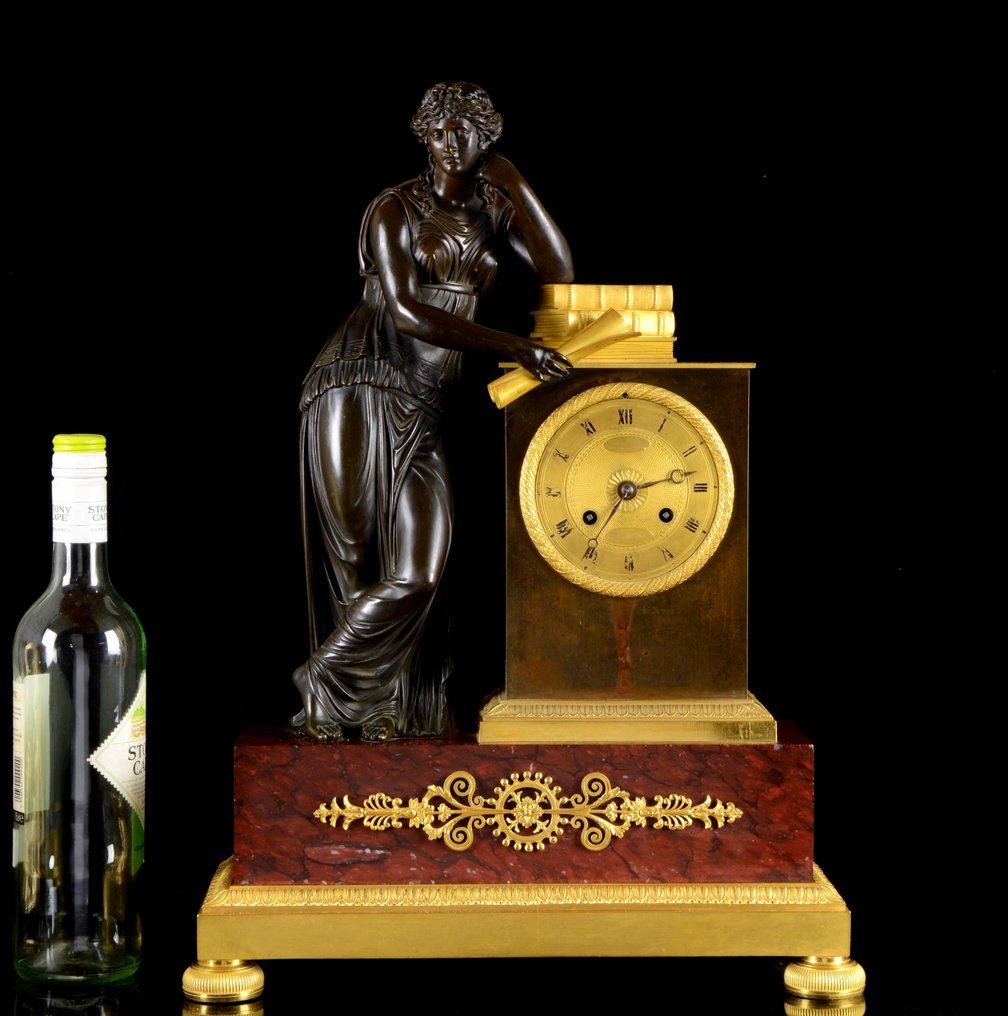
Figural mantel clock - Pierre-Victor Ledure (attributed) Empire Red marble griotte, gilt and patinated bronze - 1805-1810 - Large (H:51,4 cm) - 'L'étude'



07
days
04
hours
16
minutes
47
seconds
Current bid
€ 1,600
Reserve price not met

Expert
Selected by Paula Martin-Calero Toro
Holds a degree in art history; over six years cataloguing and appraising antiques.
Estimate € 2,800 - € 3,200
13 other people are watching this object
 Bidder 8473 Bidder 8473 | €1,600 | |
|---|---|---|
| Bidder 8473 | €1,400 | |
 Bidder 7052 Bidder 7052 | €1,200 | |
Catawiki Buyer Protection
Your payment’s safe with us until you receive your object.View details
Trustpilot 4.4 | 122986 reviews
Rated Excellent on Trustpilot.
Empire period French figural mantel clock in red griotte marble with gilt and patinated bronze, measuring 51.4 cm high, 38 cm wide and 16 cm deep, with an 8‑day mechanical movement that strikes on half an hour with one bell; movement is two‑train and in working order, supplied with a winding key; attributed to Pierre‑Victor Ledure and dating circa 1805–1810.
AI-assisted summary
Description from the seller
An important and large French marbre Rouge Griotte, patinated and gilt bronze mantel clock 'Allegory of the study (l'etude)' preserved in virtually perfect condition. The bronzes attributed to Pierre-Victor Ledure, famous Parisian marchand-fabricant. France, Empire period, early 19th century, circa 1805-10. Very rare, top quality model!
Offered with no reserve, Buyer decides about the final price!
Dimensions: height - 51,4 cm; width - 38 cm; depth - 16 cm. Diameter of the dial - 10,6 cm.
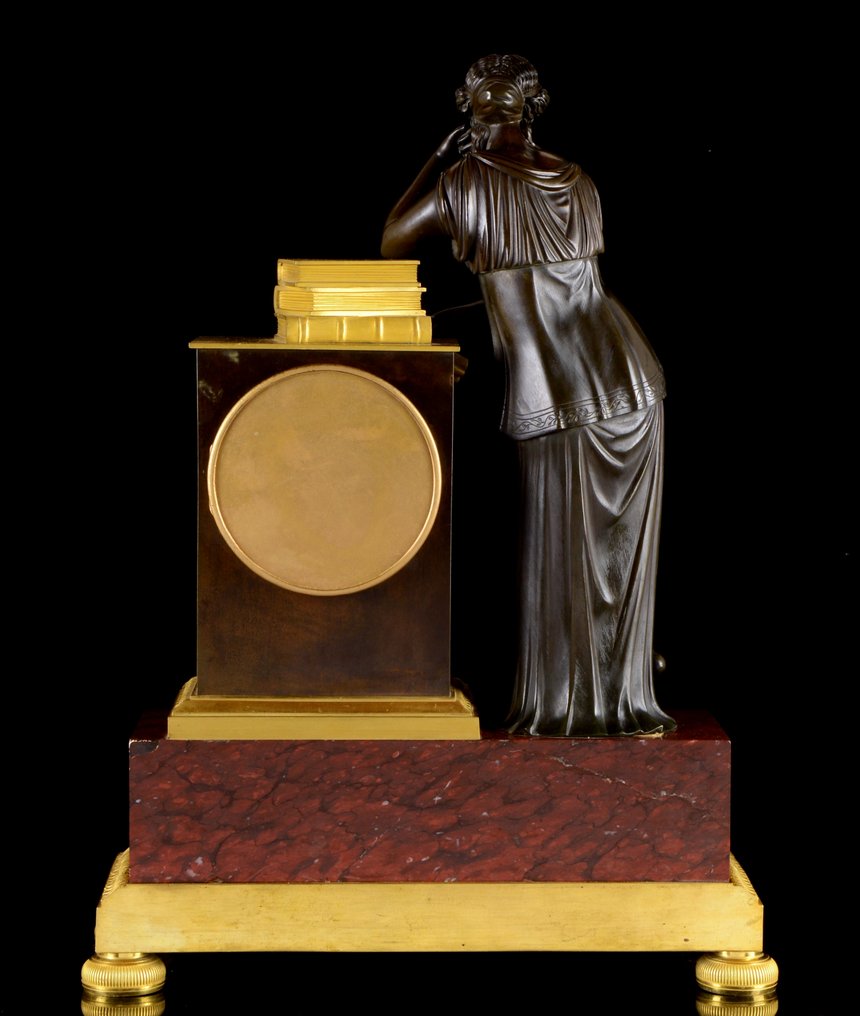
The clock case, depicting the allegory of study, is attributed to Pierre-Victor Ledure (1783-1840), shows the personification of the study (or science). On the left side dark patinated figure dressed in the ancient Greek style, leans on a pile of books, holding a parchment in her hand. On backs of books inscriptions: 'ASTRO/TOM.I' and 'PHYSIQ/TOM.2.' Movement installed in brown patinated part on the right side. Rectangular base made of the Red Griotte marble and gilt bronze, with an empire mount on front, all supported on four feet.
French, Parisian, two train movement of good technical quality with silk suspension. The clock comes with a pendulum, winding key and small regulation key. Big gilt bronze, machine-turned dial with black Roman numerals for hours. Dark-oxidized steel hands.
Pierre-Victor Ledure, (1783–1840?) was a French marchand-fabricant (merchant-manufacturer) of bronzes, specializing in ormolu clock cases. He often worked together with the clockmaker Claude Hémon (1770–1820), who supplied the clockworks (Claude Hémon became a Maître Horloger (Master Clockmacker) in 1770 and had a workshop in the Rue Saint Martin in Paris between 1812 and 1820). Ledure's workshop is listed in Paris between 1813 and 1840, first in the Rue Neuve-des-Petits-Champs, then in the Rue Vivienne and finally in the Rue d'Angoulême.
Bibliography:
- Tardy, “Les Plus Belles Pendules Françaises”, 1994, p. 252, illustrating a very similar clock case by Pierre-Victor Ledure, from the F. Maitzner collection;
- Hans Ottomeyer and Peter Pröschel, “Vergoldete Bronzen”, 1986, p. 349, pl. 5.6.8, illustrating a similar clock case by Ledure, 1814 in the British Embassy, Paris.
- Elke Niehüser, “Die Französische Bronzeuhr”, 1997, p. 233, pl. 715, illustrating similar case model.
- Dupuy-Baylet, "Les pendules des lendemains de la Révolution", L'Objet d'art, n° 324, mai 1998, pp. 54-65;
- Dupuy-Baylet, "Pendules du Mobilier national 1800-1870", Dijon, 2006, p. 74-75, notice 26;
- Dupuy-Baylet, cat. exp. Napoleon and the Decorative Arts: Treasures of the Imperial Palaces. Macao Museum of Art, Macao, 2013, n° 42, pp. 104-105.
References - last pictures, similar clocks, one in the French museum, others offered by major auction houses or dealers.
Conditions report: case in excellent condition, no missing parts, very well preserved. Some age- and use-related wear, minor marks and scratches, very clean. Gilding on bronzes in amazing condition considering the age. Small chip to the stone on front top-edge and restored chip on the back-right-top corner. Dial in very good condition, minor wear to numerals, signatures on the dial worn, partially visible against the light. Trace of oil (?) under the dial. Movement in working order, recently overhauled by a clock-master. Check pictures for details.
Worldwide delivery with online tracking. Shipping by courier only!!!
An important and large French marbre Rouge Griotte, patinated and gilt bronze mantel clock 'Allegory of the study (l'etude)' preserved in virtually perfect condition. The bronzes attributed to Pierre-Victor Ledure, famous Parisian marchand-fabricant. France, Empire period, early 19th century, circa 1805-10. Very rare, top quality model!
Offered with no reserve, Buyer decides about the final price!
Dimensions: height - 51,4 cm; width - 38 cm; depth - 16 cm. Diameter of the dial - 10,6 cm.
The clock case, depicting the allegory of study, is attributed to Pierre-Victor Ledure (1783-1840), shows the personification of the study (or science). On the left side dark patinated figure dressed in the ancient Greek style, leans on a pile of books, holding a parchment in her hand. On backs of books inscriptions: 'ASTRO/TOM.I' and 'PHYSIQ/TOM.2.' Movement installed in brown patinated part on the right side. Rectangular base made of the Red Griotte marble and gilt bronze, with an empire mount on front, all supported on four feet.
French, Parisian, two train movement of good technical quality with silk suspension. The clock comes with a pendulum, winding key and small regulation key. Big gilt bronze, machine-turned dial with black Roman numerals for hours. Dark-oxidized steel hands.
Pierre-Victor Ledure, (1783–1840?) was a French marchand-fabricant (merchant-manufacturer) of bronzes, specializing in ormolu clock cases. He often worked together with the clockmaker Claude Hémon (1770–1820), who supplied the clockworks (Claude Hémon became a Maître Horloger (Master Clockmacker) in 1770 and had a workshop in the Rue Saint Martin in Paris between 1812 and 1820). Ledure's workshop is listed in Paris between 1813 and 1840, first in the Rue Neuve-des-Petits-Champs, then in the Rue Vivienne and finally in the Rue d'Angoulême.
Bibliography:
- Tardy, “Les Plus Belles Pendules Françaises”, 1994, p. 252, illustrating a very similar clock case by Pierre-Victor Ledure, from the F. Maitzner collection;
- Hans Ottomeyer and Peter Pröschel, “Vergoldete Bronzen”, 1986, p. 349, pl. 5.6.8, illustrating a similar clock case by Ledure, 1814 in the British Embassy, Paris.
- Elke Niehüser, “Die Französische Bronzeuhr”, 1997, p. 233, pl. 715, illustrating similar case model.
- Dupuy-Baylet, "Les pendules des lendemains de la Révolution", L'Objet d'art, n° 324, mai 1998, pp. 54-65;
- Dupuy-Baylet, "Pendules du Mobilier national 1800-1870", Dijon, 2006, p. 74-75, notice 26;
- Dupuy-Baylet, cat. exp. Napoleon and the Decorative Arts: Treasures of the Imperial Palaces. Macao Museum of Art, Macao, 2013, n° 42, pp. 104-105.
References - last pictures, similar clocks, one in the French museum, others offered by major auction houses or dealers.
Conditions report: case in excellent condition, no missing parts, very well preserved. Some age- and use-related wear, minor marks and scratches, very clean. Gilding on bronzes in amazing condition considering the age. Small chip to the stone on front top-edge and restored chip on the back-right-top corner. Dial in very good condition, minor wear to numerals, signatures on the dial worn, partially visible against the light. Trace of oil (?) under the dial. Movement in working order, recently overhauled by a clock-master. Check pictures for details.
Worldwide delivery with online tracking. Shipping by courier only!!!
Details
Over 200 years old
Yes
Style subtype
Empire
Manufacturer/ Brand
Pierre-Victor Ledure (attributed)
Era
1400-1900
Title additional information
Large (H:51,4 cm) - 'L'étude'
Clock type
Figural mantel clock
Material
Red marble griotte, gilt and patinated bronze
Clock mechanism
Mechanical
Power Reserve
8 day movement
Striking
half hour, one bell
Maker/Designer
Unknown (illegible signature) maker from Paris
Style
Antique
Country of Origin
France
Condition
Good condition - used with small signs of ageing
In working order
Yes
Height
51.4 cm
Width
38 cm
Depth
16 cm
Estimated period
1805-1810
Weight
12 kg
Winding Key
Yes
Sold by