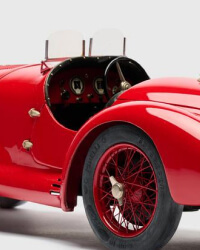
werk83 1:18 - Model car - Porsche 356 Le Mans winner 1951 #46 - DIRTY VERSION


05
days
18
hours
15
minutes
22
seconds

12 other people are watching this object
 Bidder 6318 Bidder 6318 | €1 |
|---|
Catawiki Buyer Protection
Your payment’s safe with us until you receive your object.View details
Trustpilot 4.4 | 123077 reviews
Rated Excellent on Trustpilot.
werk83 brand, model type Porsche 356 Le Mans winner 1951 #46, silver in white metal, new and in original packaging, handmade dirty version.
AI-assisted summary
Description from the seller
Two local men played a crucial role in the path Porsche took to victory at Le Mans. The manufacturer has covered many kilometers since 1951 and achieved a record number of seventeen wins in the world-famous endurance race.
Porsche forged relationships with the race organizers even before the manufacturer ever participated in the French 24-hour race. It all started with a conversation between Ferdinand Porsche and journalist Charles Faroux in the autumn of 1950 at the Paris Motor Show. Faroux, one of the founders of the 24 Hours of Le Mans, managed to persuade the Porsche patriarch, who did not need to be convinced immediately, to participate in the race. A decisive factor was that the grueling race could serve as a testing ground for the 356, the first car to bear Ferdinand Porsche's name. After his father's death shortly thereafter, on January 30, 1951, Ferry Porsche confirmed the manufacturer's intention to continue the project.
Charles Faroux, an experienced public relations expert, saw the publicity potential of a fully French racing team behind the wheel of a Porsche for the 24-hour race. The second local driver, Edmond Mouche, signed up. Together with Auguste Veuillet in the #46 356, Mouche took his place behind the wheel of the only Porsche on the starting grid. The duo finished twentieth and won the under 1100 cc class. In 1952, they took their chance again and finished eleventh, breaking the class record for distance covered with an average speed of 123 km/h over 2955 kilometers. This marked the beginning of Porsche's story at Le Mans, with the most recent chapter being the seventeenth victory for Nico Hülkenberg, Nick Tandy, and Earl Bamber in the 919 Hybrid.
This model is a handmade, dirty version of the 356 where it all started. The paint is dull, the car is covered in dust, dirt, and here and there a streak. Exactly how the 356 with number #46 looked on Sunday, June 24, 1951, at 4:00 PM.
Two local men played a crucial role in the path Porsche took to victory at Le Mans. The manufacturer has covered many kilometers since 1951 and achieved a record number of seventeen wins in the world-famous endurance race.
Porsche forged relationships with the race organizers even before the manufacturer ever participated in the French 24-hour race. It all started with a conversation between Ferdinand Porsche and journalist Charles Faroux in the autumn of 1950 at the Paris Motor Show. Faroux, one of the founders of the 24 Hours of Le Mans, managed to persuade the Porsche patriarch, who did not need to be convinced immediately, to participate in the race. A decisive factor was that the grueling race could serve as a testing ground for the 356, the first car to bear Ferdinand Porsche's name. After his father's death shortly thereafter, on January 30, 1951, Ferry Porsche confirmed the manufacturer's intention to continue the project.
Charles Faroux, an experienced public relations expert, saw the publicity potential of a fully French racing team behind the wheel of a Porsche for the 24-hour race. The second local driver, Edmond Mouche, signed up. Together with Auguste Veuillet in the #46 356, Mouche took his place behind the wheel of the only Porsche on the starting grid. The duo finished twentieth and won the under 1100 cc class. In 1952, they took their chance again and finished eleventh, breaking the class record for distance covered with an average speed of 123 km/h over 2955 kilometers. This marked the beginning of Porsche's story at Le Mans, with the most recent chapter being the seventeenth victory for Nico Hülkenberg, Nick Tandy, and Earl Bamber in the 919 Hybrid.
This model is a handmade, dirty version of the 356 where it all started. The paint is dull, the car is covered in dust, dirt, and here and there a streak. Exactly how the 356 with number #46 looked on Sunday, June 24, 1951, at 4:00 PM.
Details
Era
1900-2000
No. of items
1
Brand
werk83
Scale
1:18
Marque/Model Type
Porsche 356 Le Mans winner 1951 #46
Additional Information
DIRTY VERSION
Colour
Silver
Material
White Metal
Condition
New
Packaging
In original box
Sold by