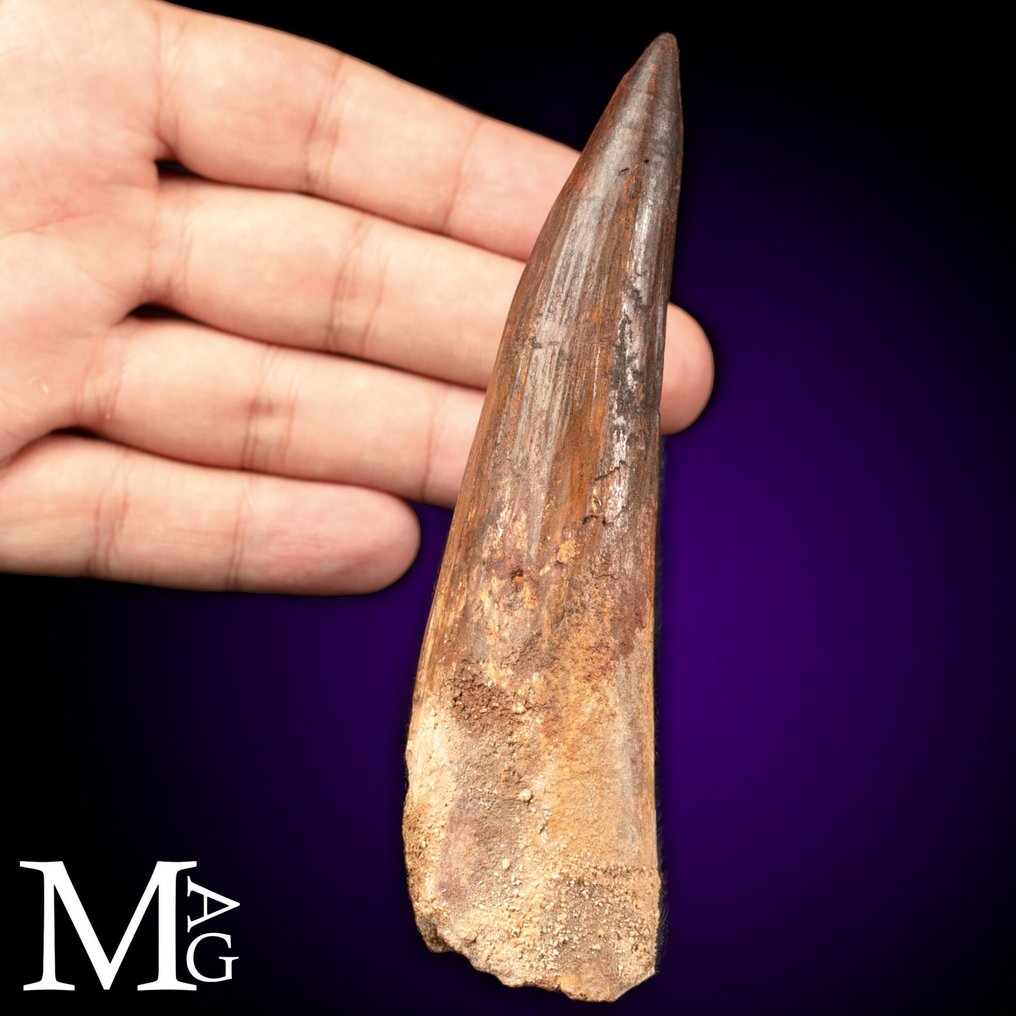
Spinosaurus Fossil Tooth – Cretaceous Predator - Fossil tooth - Spinosaurus Aegyptiacus - 135mm - 135 mm - 35 mm



04
days
22
hours
05
minutes
24
seconds
Current bid
€ 14
Reserve price not met

Expert
Selected by Jonas Rathaj
Has worked with taxidermy since childhood and gained retailer experience.
Estimate € 650 - € 750
10 other people are watching this object
| Bidder 2494 | €14 |
|---|
Catawiki Buyer Protection
Your payment’s safe with us until you receive your object.View details
Trustpilot 4.4 | 123053 reviews
Rated Excellent on Trustpilot.
Specimen: Spinosaurus fossil tooth – Cretaceous predator; Scientific name: Spinosaurus aegyptiacus; Origin: Kem Kem Formation, Moroccan Sahara; Geological period: Late Cretaceous, Cenomanian around 95 million years ago; Condition: Improved; Weight: 92 g; Height: 135 mm; Width: 35 mm; Depth: 20 mm.
AI-assisted summary
Description from the seller
This impressive fossilized tooth belongs to an individual of Spinosaurus Aegyptiacus, one of the largest predatory dinosaurs ever to have lived. With an estimated length that could have exceeded 15 meters, the Spinosaurus dominated the freshwater ecosystems of the Late Cretaceous, about 95 million years ago, in what is now North Africa.
The tooth, massive and well-preserved, has the typical slightly curved conical shape, without serrations, suitable for catching slippery fish. In fact, the Spinosaurus is known for its semi-aquatic habits, unique among the large theropods, with adaptations such as an elongated crocodile-like snout, retracted nostrils, and specialized dentition.
Features of the specimen
Species: Spinosaurus aegyptiacus
Geological age: Upper Cretaceous, Cenomanian (about 95 million years)
Provenance: Kem Kem Formation, Moroccan Sahara
Material: Authentic fossil.
Conservation: Excellent apical curvature, visible striation structure, and still-present root portion.
Spinosaurus has been the subject of intense paleontological research in recent decades. Recent studies have highlighted the presence of a dorsal sail supported by elongated neural spines, and its possible swimming ability, making it an extraordinarily adapted predator for a mixed water-land environment.
Seller's Story
The Mineral Art Gallery offers minerals, fossils, shells and natural elements.
Born in Italy in 2017, today she collaborates with international galleries and collectors, she is a direct importer of large minerals and naturalistic collectible elements; deals with the processing to insert them inside the living space. A section of the gallery was dedicated to the Wunderkammer, "chamber of wonders or cabinet of curiosities" in which Mirabilia elements are presented: naturalia and italiania, a union between "the present is the past".
All lots are shipped via DHL Express and Fercam couriers, with insured parcel and tracking.
Translated by Google TranslateThis impressive fossilized tooth belongs to an individual of Spinosaurus Aegyptiacus, one of the largest predatory dinosaurs ever to have lived. With an estimated length that could have exceeded 15 meters, the Spinosaurus dominated the freshwater ecosystems of the Late Cretaceous, about 95 million years ago, in what is now North Africa.
The tooth, massive and well-preserved, has the typical slightly curved conical shape, without serrations, suitable for catching slippery fish. In fact, the Spinosaurus is known for its semi-aquatic habits, unique among the large theropods, with adaptations such as an elongated crocodile-like snout, retracted nostrils, and specialized dentition.
Features of the specimen
Species: Spinosaurus aegyptiacus
Geological age: Upper Cretaceous, Cenomanian (about 95 million years)
Provenance: Kem Kem Formation, Moroccan Sahara
Material: Authentic fossil.
Conservation: Excellent apical curvature, visible striation structure, and still-present root portion.
Spinosaurus has been the subject of intense paleontological research in recent decades. Recent studies have highlighted the presence of a dorsal sail supported by elongated neural spines, and its possible swimming ability, making it an extraordinarily adapted predator for a mixed water-land environment.
Seller's Story
The Mineral Art Gallery offers minerals, fossils, shells and natural elements.
Born in Italy in 2017, today she collaborates with international galleries and collectors, she is a direct importer of large minerals and naturalistic collectible elements; deals with the processing to insert them inside the living space. A section of the gallery was dedicated to the Wunderkammer, "chamber of wonders or cabinet of curiosities" in which Mirabilia elements are presented: naturalia and italiania, a union between "the present is the past".
All lots are shipped via DHL Express and Fercam couriers, with insured parcel and tracking.
Translated by Google TranslateDetails
Specimen
Spinosaurus Fossil Tooth – Cretaceous Predator
Scientific name
Spinosaurus Aegyptiacus - 135mm
Country of Origin
Kem Kem Formation, Moroccan Sahara
Geological Period
Upper Cretaceous, Cenomanian (about 95 million years ago)
Condition
Enhanced
Weight
92 g
Height
135 mm
Width
35 mm
Depth
20 mm
Sold by