Luigi Ghirri - Pensare per immagini - 2013



00
days
16
hours
26
minutes
30
seconds

50 other people are watching this object
 Bidder 5418 Bidder 5418 | €80 | |
|---|---|---|
 Bidder 1417 Bidder 1417 | €75 | |
 Bidder 6590 Bidder 6590 | €20 | |
Catawiki Buyer Protection
Your payment’s safe with us until you receive your object.View details
Trustpilot 4.4 | 123294 reviews
Rated Excellent on Trustpilot.
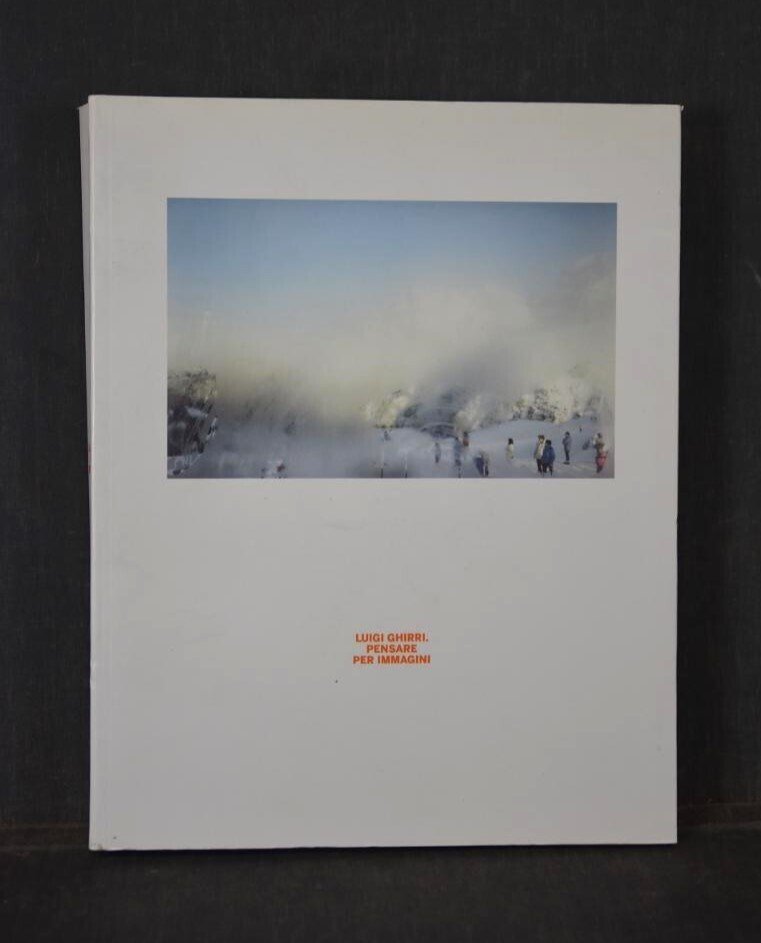
Luigi Ghirri Pensare per immagini is a 1st edition Italian-language paperback of 432 pages, measuring 25 by 20 cm, published in 2013, in very good condition.
AI-assisted summary
Description from the seller
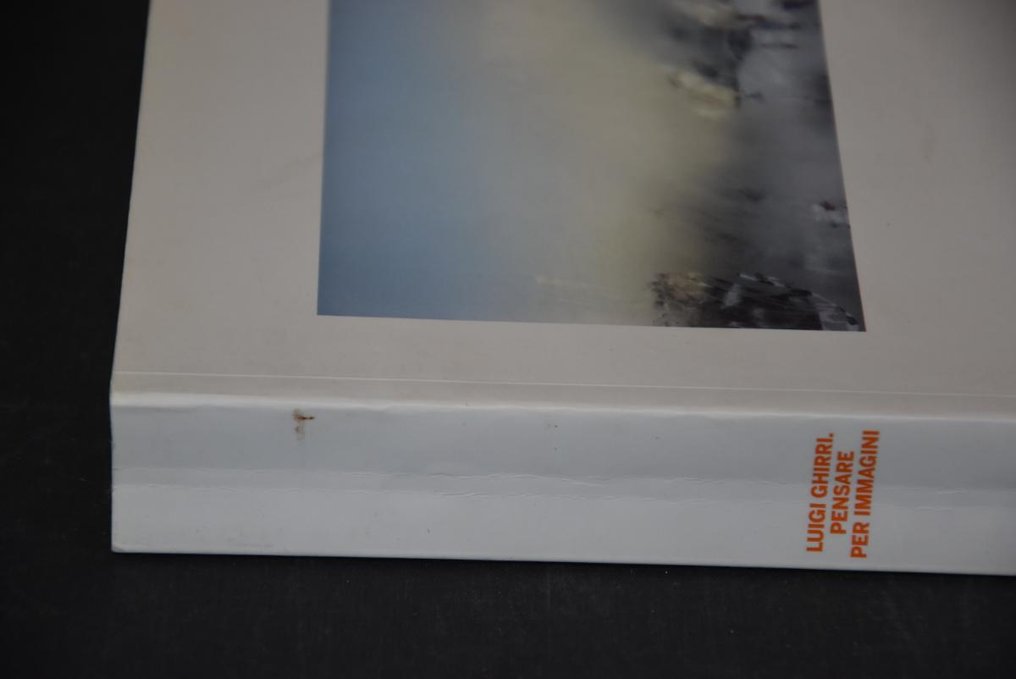
Luigi Ghirri. Thinking in Images. Milan, Electa, 2013. 25 x 20 cm, hardcover, 432 pages. Color photographs. In good condition — minor signs of use on the cover (see photo). The book 'Luigi Ghirri. Thinking in Images' explores the work of the Italian photographer through critical essays and is a comprehensive volume of images. It is a fundamental text for understanding his poetic and philosophical approach to photography. The volume, which served as the catalog for the solo exhibition held at MAXXI in Rome in 2013, examines Ghirri's work from various perspectives.
Luigi Ghirri (Scandiano, January 5, 1943 – Reggio Emilia, February 14, 1992) was an Italian photographer.
Biography
Born in Fellegara di Scandiano, in the province of Reggio Emilia, Ghirri began photographing in 1969, collaborating and engaging with conceptual artists. A surveyor by profession, artistically throughout the seventies he developed series evocative of various themes of vision: the natural image and the artificial one, the ambiguity of the contemporary landscape, the citation of history, and the imaginary of consumption. During those years, he came into contact with Massimo Mussini and Arturo Carlo Quintavalle, and began a fruitful collaboration with CSAC, which now holds the largest collection of his original prints, to which he periodically donates updates of his work. He also collaborates as a member of the scientific committee of the Photography Section, suggesting and indicating historical materials to acquire.
In 1979, CSAC dedicated a broad review to him that anthologizes all his previous work and marks a turning point in his career. He then continued with research focused on landscape and architecture (prompted by Aldo Rossi), collaborated with and befriended writers and musicians (including Gianni Celati, Ermanno Cavazzoni, Antonio Tabucchi, Lucio Dalla), and organized very original collective ventures, involving other photographers active on the same themes, such as the description of the Italian landscape, including Viaggio in Italia (1984) and Esplorazioni sulla Via Emilia (1986).
The Italy Travel project, in particular, conceived by Ghirri and curated not only by him but also by Gianni Leone and Enzo Velati, is a milestone for Italian photography, constituting an unofficial manifesto of the Italian landscape school that emerged in those years. It is a book (Luigi Ghirri, Gianni Leone, Enzo Velati, edited by, Travel in Italy - Il Quadrante, Alessandria 1984) and a traveling exhibition that gathered images from many authors, both Italian and, to a lesser extent, foreign, such as Olivo Barbieri, Gabriele Basilico, Giannantonio Battistella, Vincenzo Castella, Andrea Cavazzuti, Giovanni Chiaramonte, Mario Cresci, Vittore Fossati, Carlo Garzia, Guido Guidi, Luigi Ghirri, Shelley Hill, Mimmo Jodice, Gianni Leone, Claude Nori, Umberto Sartorello, Mario Tinelli, Ernesto Tuliozi, Fulvio Ventura, Cuchi White. From 1983 to 1985, he taught courses on the History of Photography at the Institute of Art History at the University of Parma.
In 2024, the publishing house Quodlibet will publish a facsimile of the book 'Viaggio in Italia,' which has meanwhile become difficult to find except at high prices on the collectors' market. It will be accompanied by a 48-page booklet featuring an essay on the genesis and critical reception of 'Viaggio in Italia,' curated by Matteo Balduzzi, Fabio De Chirico, Gabriella Guerci, and Matteo Piccioni, with a note by Adele Ghirri and French and English translations of the original texts by Arturo Carlo Quintavalle and Gianni Celati (published in Italian in the book).
Since 1981, at the request of Vittorio Savi, he has been engaged with architectural photography in the territory. In particular, he photographed for Savi himself, Aldo Rossi, and Paolo Zermani. During the same years, he befriended the writer Gianni Celati. His landscapes are suspended, not realistic, in some ways metaphysical, often lacking human figures but never without human intervention. The use of delicate, non-saturated colors is fundamental to his poetic, stemming from close collaboration with his printer Arrigo Ghi. Noteworthy are the shots of the Bologna studio on via Fondazza by painter Giorgio Morandi. He was also the author of covers for numerous albums for RCA, both classical music and Italian artists such as Lucio Dalla, Gianni Morandi, Luca Carboni, CCCP - Fedeli alla linea (Epica Etica Etnica Pathos), Stadio, Ciao Fellini, Robert & Cara, and others. He suddenly passed away due to a heart attack in 1992, at the age of 49. As Massimo Mussini described him, he was undoubtedly one of the greatest and most influential Italian photographers of the twentieth century.
References and tributes
Modena City Ramblers dedicated the song L'uomo delle pianure to them, published in the album Fuori Campo in 1999.
Elisabetta Sgarbi presented at the 2009 Venice Film Festival a film about the photographer from Scandiano titled Deserto Rosa.
The collection of CCCP faithful to the line titled Ecco i miei gioielli del 1992 is dedicated to L. Ghirri.
Resources
The Luigi Ghirri Archive, located at the artist's last residence in Roncocesi, was established in 1992 to disseminate and enhance the photographer's work. The films are preserved at the photo archive of the Panizzi Library in Reggio Emilia. The rights related to the use of the images are exclusively owned by the Luigi Ghirri Heirs.
Luigi Ghirri is represented by the Matthew Marks galleries and Mai 36 Galerie.
The Parma Center for Studies and Archives of Communication houses an archival collection of Luigi Ghirri, consisting of works created by the artist throughout his career. This collection contains 670 prints, 3 mixed-media works (Slot-machine, Km 0.250 of exhibition, Infinity), as well as 147 color prints measuring 30x40 cm, made by Arrigo Ghi in 1993 under the curatorship of Paola Borgonzoni Ghirri for the exhibition Walls of Paper/Biennale di Venezia 1993. The collection is public and accessible, except for some series and objects which, for conservation reasons, are also excluded from lending.
Tools
The cameras
1967-1968: Voigtlander Bessamatic 24x36mm rangefinder with fixed lens and disposable camera from Ali.
1969-1972: Olympus Pen (24x18mm) and the first reflex camera.
1977-1978: Canon AE-1
From 1979 onwards: various Polaroid models, 100, SX-70, 600, and Image.
In 1980, he was invited by Polaroid Intl. in Amsterdam to use an experimental camera of 20x24" and 8x10" formats.
1980s: Pentax 645 (6x4.5 cm) and Pentax 67 (6x7 cm).
From the mid-1980s: Mamiya RB67 and Mamiya RZ67 (6x7cm).
The optics
He mainly worked with intermediate focal objectives and sometimes used wide-angle and telephoto lenses.
The negatives
Luigi Ghirri used negatives and slides in formats: 24x36 mm, 3.5x5 cm, 4.5x6 cm, 5.5x5.5 cm, 5x6 cm, 6x6 cm, 6x7 cm, 6x8 cm, 6x9 cm.
Opere
Catalog (1971-1972)
Week End - Atlante (1973)
Km. 0.250 (1973)
Infinito (1974)
Cardboard landscapes (1971-1974)
Breakfast on the Grass (1972-1974)
Kodachrome (1970-1978)
In Scala (1977-1978)
Views (1970-1979)
Italy ailati (1971-1979)
The Land of Toys (1972-1979)
Identikit (1976–1979)
Aperture 11, 1/125, natural light (1979)
Imaginary Geography (1979-1980)
Snapshot (1980)
Still life (1978-1981)
Polaroid (1980-1981)
Topography-Iconography (1980-1981)
Between dawns and sunsets (1982-1983)
The work of artisans (1984)
Explorations on the Via Emilia - Views in the landscape (1985)
Versailles (1985)
Thermal Baths of Emilia-Romagna (1987)
The Palace of Art (1980-1988)
A foot in Eden (1984-1988)
Le case (1976-1989)
Italian landscape (1980-1989)
The profile of the clouds (1980-1989)
City views (1976-1990)
The theatrical places (1983-1990)
The architectures (1982-1992)
Luigi Ghirri. Thinking in Images. Milan, Electa, 2013. 25 x 20 cm, hardcover, 432 pages. Color photographs. In good condition — minor signs of use on the cover (see photo). The book 'Luigi Ghirri. Thinking in Images' explores the work of the Italian photographer through critical essays and is a comprehensive volume of images. It is a fundamental text for understanding his poetic and philosophical approach to photography. The volume, which served as the catalog for the solo exhibition held at MAXXI in Rome in 2013, examines Ghirri's work from various perspectives.
Luigi Ghirri (Scandiano, January 5, 1943 – Reggio Emilia, February 14, 1992) was an Italian photographer.
Biography
Born in Fellegara di Scandiano, in the province of Reggio Emilia, Ghirri began photographing in 1969, collaborating and engaging with conceptual artists. A surveyor by profession, artistically throughout the seventies he developed series evocative of various themes of vision: the natural image and the artificial one, the ambiguity of the contemporary landscape, the citation of history, and the imaginary of consumption. During those years, he came into contact with Massimo Mussini and Arturo Carlo Quintavalle, and began a fruitful collaboration with CSAC, which now holds the largest collection of his original prints, to which he periodically donates updates of his work. He also collaborates as a member of the scientific committee of the Photography Section, suggesting and indicating historical materials to acquire.
In 1979, CSAC dedicated a broad review to him that anthologizes all his previous work and marks a turning point in his career. He then continued with research focused on landscape and architecture (prompted by Aldo Rossi), collaborated with and befriended writers and musicians (including Gianni Celati, Ermanno Cavazzoni, Antonio Tabucchi, Lucio Dalla), and organized very original collective ventures, involving other photographers active on the same themes, such as the description of the Italian landscape, including Viaggio in Italia (1984) and Esplorazioni sulla Via Emilia (1986).
The Italy Travel project, in particular, conceived by Ghirri and curated not only by him but also by Gianni Leone and Enzo Velati, is a milestone for Italian photography, constituting an unofficial manifesto of the Italian landscape school that emerged in those years. It is a book (Luigi Ghirri, Gianni Leone, Enzo Velati, edited by, Travel in Italy - Il Quadrante, Alessandria 1984) and a traveling exhibition that gathered images from many authors, both Italian and, to a lesser extent, foreign, such as Olivo Barbieri, Gabriele Basilico, Giannantonio Battistella, Vincenzo Castella, Andrea Cavazzuti, Giovanni Chiaramonte, Mario Cresci, Vittore Fossati, Carlo Garzia, Guido Guidi, Luigi Ghirri, Shelley Hill, Mimmo Jodice, Gianni Leone, Claude Nori, Umberto Sartorello, Mario Tinelli, Ernesto Tuliozi, Fulvio Ventura, Cuchi White. From 1983 to 1985, he taught courses on the History of Photography at the Institute of Art History at the University of Parma.
In 2024, the publishing house Quodlibet will publish a facsimile of the book 'Viaggio in Italia,' which has meanwhile become difficult to find except at high prices on the collectors' market. It will be accompanied by a 48-page booklet featuring an essay on the genesis and critical reception of 'Viaggio in Italia,' curated by Matteo Balduzzi, Fabio De Chirico, Gabriella Guerci, and Matteo Piccioni, with a note by Adele Ghirri and French and English translations of the original texts by Arturo Carlo Quintavalle and Gianni Celati (published in Italian in the book).
Since 1981, at the request of Vittorio Savi, he has been engaged with architectural photography in the territory. In particular, he photographed for Savi himself, Aldo Rossi, and Paolo Zermani. During the same years, he befriended the writer Gianni Celati. His landscapes are suspended, not realistic, in some ways metaphysical, often lacking human figures but never without human intervention. The use of delicate, non-saturated colors is fundamental to his poetic, stemming from close collaboration with his printer Arrigo Ghi. Noteworthy are the shots of the Bologna studio on via Fondazza by painter Giorgio Morandi. He was also the author of covers for numerous albums for RCA, both classical music and Italian artists such as Lucio Dalla, Gianni Morandi, Luca Carboni, CCCP - Fedeli alla linea (Epica Etica Etnica Pathos), Stadio, Ciao Fellini, Robert & Cara, and others. He suddenly passed away due to a heart attack in 1992, at the age of 49. As Massimo Mussini described him, he was undoubtedly one of the greatest and most influential Italian photographers of the twentieth century.
References and tributes
Modena City Ramblers dedicated the song L'uomo delle pianure to them, published in the album Fuori Campo in 1999.
Elisabetta Sgarbi presented at the 2009 Venice Film Festival a film about the photographer from Scandiano titled Deserto Rosa.
The collection of CCCP faithful to the line titled Ecco i miei gioielli del 1992 is dedicated to L. Ghirri.
Resources
The Luigi Ghirri Archive, located at the artist's last residence in Roncocesi, was established in 1992 to disseminate and enhance the photographer's work. The films are preserved at the photo archive of the Panizzi Library in Reggio Emilia. The rights related to the use of the images are exclusively owned by the Luigi Ghirri Heirs.
Luigi Ghirri is represented by the Matthew Marks galleries and Mai 36 Galerie.
The Parma Center for Studies and Archives of Communication houses an archival collection of Luigi Ghirri, consisting of works created by the artist throughout his career. This collection contains 670 prints, 3 mixed-media works (Slot-machine, Km 0.250 of exhibition, Infinity), as well as 147 color prints measuring 30x40 cm, made by Arrigo Ghi in 1993 under the curatorship of Paola Borgonzoni Ghirri for the exhibition Walls of Paper/Biennale di Venezia 1993. The collection is public and accessible, except for some series and objects which, for conservation reasons, are also excluded from lending.
Tools
The cameras
1967-1968: Voigtlander Bessamatic 24x36mm rangefinder with fixed lens and disposable camera from Ali.
1969-1972: Olympus Pen (24x18mm) and the first reflex camera.
1977-1978: Canon AE-1
From 1979 onwards: various Polaroid models, 100, SX-70, 600, and Image.
In 1980, he was invited by Polaroid Intl. in Amsterdam to use an experimental camera of 20x24" and 8x10" formats.
1980s: Pentax 645 (6x4.5 cm) and Pentax 67 (6x7 cm).
From the mid-1980s: Mamiya RB67 and Mamiya RZ67 (6x7cm).
The optics
He mainly worked with intermediate focal objectives and sometimes used wide-angle and telephoto lenses.
The negatives
Luigi Ghirri used negatives and slides in formats: 24x36 mm, 3.5x5 cm, 4.5x6 cm, 5.5x5.5 cm, 5x6 cm, 6x6 cm, 6x7 cm, 6x8 cm, 6x9 cm.
Opere
Catalog (1971-1972)
Week End - Atlante (1973)
Km. 0.250 (1973)
Infinito (1974)
Cardboard landscapes (1971-1974)
Breakfast on the Grass (1972-1974)
Kodachrome (1970-1978)
In Scala (1977-1978)
Views (1970-1979)
Italy ailati (1971-1979)
The Land of Toys (1972-1979)
Identikit (1976–1979)
Aperture 11, 1/125, natural light (1979)
Imaginary Geography (1979-1980)
Snapshot (1980)
Still life (1978-1981)
Polaroid (1980-1981)
Topography-Iconography (1980-1981)
Between dawns and sunsets (1982-1983)
The work of artisans (1984)
Explorations on the Via Emilia - Views in the landscape (1985)
Versailles (1985)
Thermal Baths of Emilia-Romagna (1987)
The Palace of Art (1980-1988)
A foot in Eden (1984-1988)
Le case (1976-1989)
Italian landscape (1980-1989)
The profile of the clouds (1980-1989)
City views (1976-1990)
The theatrical places (1983-1990)
The architectures (1982-1992)
Details
Number of Books
1
Subject
Photography
Book Title
Pensare per immagini
Author/ Illustrator
Luigi Ghirri
Condition
Very good
Publication year oldest item
2013
Height
25 cm
Edition
1st Edition
Width
20 cm
Language
Italian
Original language
Yes
Binding/ Material
Softback
Number of pages
432
Sold by