Byzantine Iron axe - 23 cm



Opens tomorrow
Starting bid
€ 1
Add to your favourites to get an alert when the auction starts.

Expert
Selected by Ruth Garrido Vila
Directed the Ifergan Collection Museum, specialising in Phoenician and Mediterranean archaeology.
Estimate € 900 - € 1,100
Catawiki Buyer Protection
Your payment’s safe with us until you receive your object.View details
Trustpilot 4.4 | 123193 reviews
Rated Excellent on Trustpilot.
Description from the seller
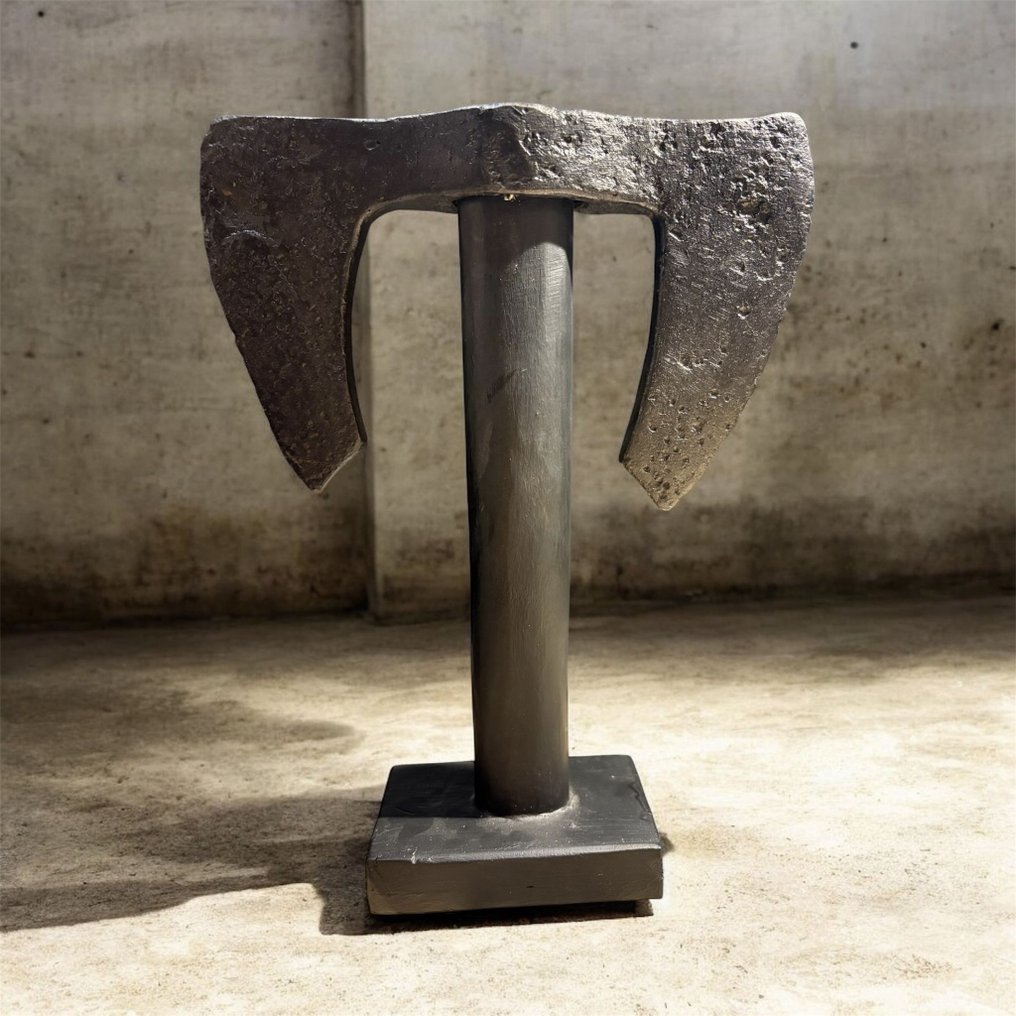
Byzantine double-bladed axe (labrys)
Byzantine Empire / Caucasus, 10th–11th centuries AD
Wrought iron
Description
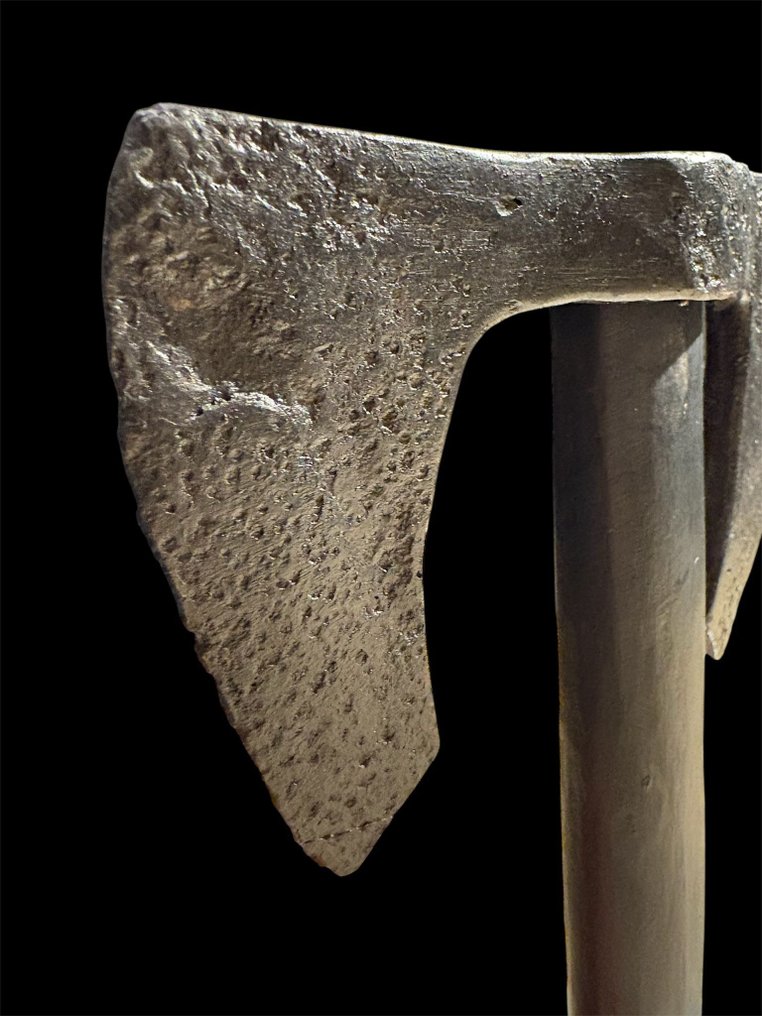
Double-edged axe in forged iron, of the labrys type, with symmetrical curved blades and a gently outwardly swept edge. It features a central tubular eye for the handle, with lateral reinforcements, and a robust profile that indicates its functional use as a combat weapon.
This type of double axes is rare in the archaeological record but is well documented in iconographic sources and medieval manuscripts from the Byzantine and Caucasian spheres, where they are associated with both the armies of the Eastern Byzantine Empire and Armenian contingents.
It is mounted on a modern wooden display stand, custom-made, consisting of a stable base and a vertical shaft that is inserted into the central tubular eye, allowing for proper viewing without intervention or modification of the piece.
Historical context
During the 10th and 11th centuries, the Byzantine Empire maintained a complex military structure that integrated regular troops, mercenaries, and allied contingents from Armenia and the Caucasus. In this context, double-edged axes were used as light combat weapons, especially by infantry and light cavalry.
These weapons are depicted in illuminated manuscripts and medieval works of art, confirming their actual use beyond symbolic tradition. Some typological parallels show affinities with contemporary eastern weapons, such as certain cavalry axes used in the medieval Islamic world, reflecting the cultural and military exchange typical of the eastern Mediterranean.
Technique and typology
Forged iron
Symmetrical double leaf
Central tubular eye
Compact and balanced profile, suitable for military use.
Dimensions and weight (Axe)
Total width: approximately 20.5 cm.
• Weight: approx. 940 g
Dimensions with wooden base:
Total height: 26 cm
Total width: 20.5 cm
Condition of preservation
The piece is kept in good overall condition, with an ancient patina consistent with its age. It has been professionally cleaned and stabilized in the past, preserving its structural integrity and original morphology.
Origin
From a private collection in California, USA, formed in the 1960s.
Ex European Market of the 90s.
Legal and export note
Historical object over 100 years old.
According to current Spanish legislation, any international shipment from Spain may require an export permit from the Ministry of Culture.
The seller offers full management of the administrative process, including the preparation and submission of the necessary documentation.
The official fees and administrative costs arising from said permit will be borne by the buyer.
The estimated timeline for the granting of the permit is approximately 6-8 weeks.
The work may not be sent outside Spain until the relevant permit is obtained.
Byzantine double-bladed axe (labrys)
Byzantine Empire / Caucasus, 10th–11th centuries AD
Wrought iron
Description
Double-edged axe in forged iron, of the labrys type, with symmetrical curved blades and a gently outwardly swept edge. It features a central tubular eye for the handle, with lateral reinforcements, and a robust profile that indicates its functional use as a combat weapon.
This type of double axes is rare in the archaeological record but is well documented in iconographic sources and medieval manuscripts from the Byzantine and Caucasian spheres, where they are associated with both the armies of the Eastern Byzantine Empire and Armenian contingents.
It is mounted on a modern wooden display stand, custom-made, consisting of a stable base and a vertical shaft that is inserted into the central tubular eye, allowing for proper viewing without intervention or modification of the piece.
Historical context
During the 10th and 11th centuries, the Byzantine Empire maintained a complex military structure that integrated regular troops, mercenaries, and allied contingents from Armenia and the Caucasus. In this context, double-edged axes were used as light combat weapons, especially by infantry and light cavalry.
These weapons are depicted in illuminated manuscripts and medieval works of art, confirming their actual use beyond symbolic tradition. Some typological parallels show affinities with contemporary eastern weapons, such as certain cavalry axes used in the medieval Islamic world, reflecting the cultural and military exchange typical of the eastern Mediterranean.
Technique and typology
Forged iron
Symmetrical double leaf
Central tubular eye
Compact and balanced profile, suitable for military use.
Dimensions and weight (Axe)
Total width: approximately 20.5 cm.
• Weight: approx. 940 g
Dimensions with wooden base:
Total height: 26 cm
Total width: 20.5 cm
Condition of preservation
The piece is kept in good overall condition, with an ancient patina consistent with its age. It has been professionally cleaned and stabilized in the past, preserving its structural integrity and original morphology.
Origin
From a private collection in California, USA, formed in the 1960s.
Ex European Market of the 90s.
Legal and export note
Historical object over 100 years old.
According to current Spanish legislation, any international shipment from Spain may require an export permit from the Ministry of Culture.
The seller offers full management of the administrative process, including the preparation and submission of the necessary documentation.
The official fees and administrative costs arising from said permit will be borne by the buyer.
The estimated timeline for the granting of the permit is approximately 6-8 weeks.
The work may not be sent outside Spain until the relevant permit is obtained.
Details
Culture
Byzantine
Century/ Timeframe
10th-11th century AD
Name of object
axe
Acquired from
Private collection
Year acquired
2022
Material
Iron
Country acquired from
United Kingdom
Condition
Very good
Previous owner acquired from
Private collection
Height
23 cm
Previous owner - year acquired
1960
Width
20.5 cm
Previous owner - country acquired from
United States
I verify that I have obtained this object legally and that I am allowed to sell it
Yes
Disclaimer
The seller was informed by Catawiki about documentation requirements and guarantees the following: - the object was legally obtained, - the seller has the right to sell and/or export the object, as relevant, - the seller will provide the necessary provenance information and arrange required documentation and permits/licenses, as applicable and as per local laws, - the seller will notify the buyer of any delays in obtaining permits/licenses. By bidding, you acknowledge that import documentation may be required depending on your country of residence and that obtaining permits/licenses may cause delays in the delivery of your object.
The seller was informed by Catawiki about documentation requirements and guarantees the following: - the object was legally obtained, - the seller has the right to sell and/or export the object, as relevant, - the seller will provide the necessary provenance information and arrange required documentation and permits/licenses, as applicable and as per local laws, - the seller will notify the buyer of any delays in obtaining permits/licenses. By bidding, you acknowledge that import documentation may be required depending on your country of residence and that obtaining permits/licenses may cause delays in the delivery of your object.
