Gio Ponti - Domus 1928-1999 - 2006


13
days
01
hour
18
minutes
11
seconds
Current bid
€ 180
No reserve price

Expert
Selected by Tom Hopman
Studied history and managed a large online book catalogue with 13 years' antiquarian bookshop experience.
Estimate € 400 - € 500
35 other people are watching this object
 Bidder 6568 Bidder 6568 | €180 | |
|---|---|---|
 Bidder 0048 Bidder 0048 | €170 | |
| Bidder 6568 | €160 | |
Catawiki Buyer Protection
Your payment’s safe with us until you receive your object.View details
Trustpilot 4.4 | 123253 reviews
Rated Excellent on Trustpilot.
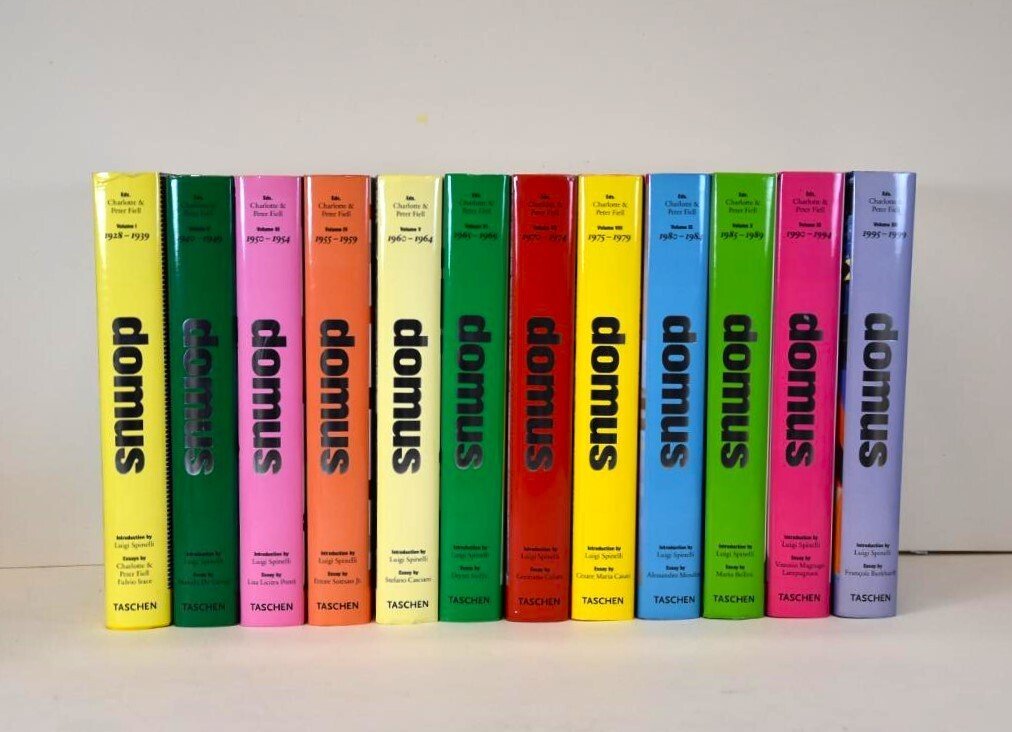
Gio Ponti's Domus 1928-1999, a monumental twelve‑volume Taschen edition in hardback with an index CD, 7,000 pages and 20,000 images, in English and Italian; first edition, 2006; in excellent condition.
AI-assisted summary
Description from the seller
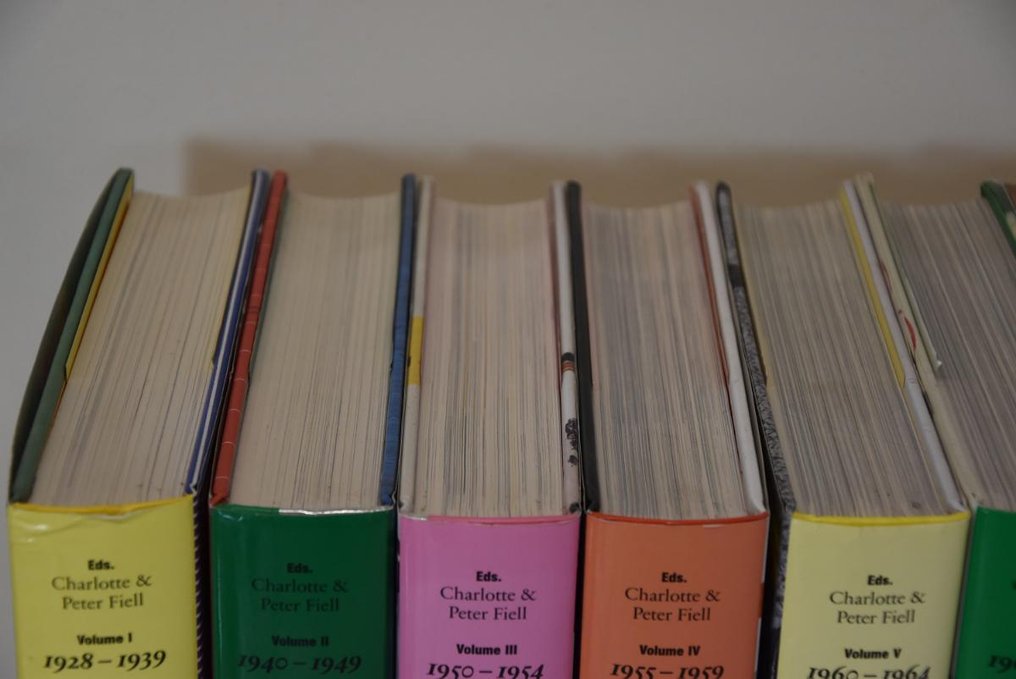
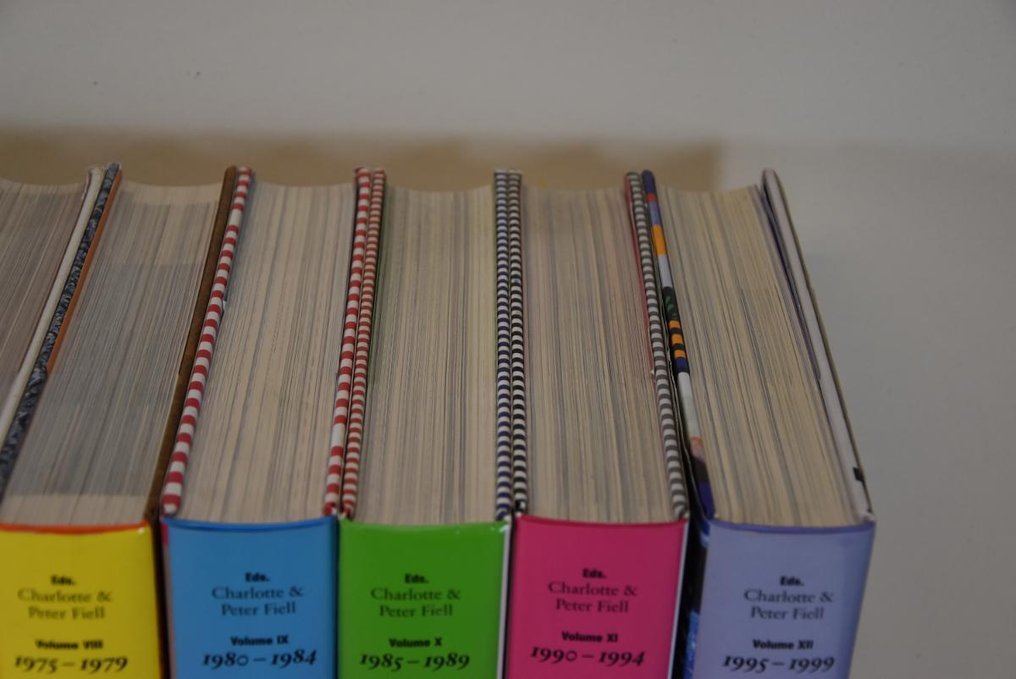
Domus. 1928-1999. Monumental anthology reprint in twelve volumes + index CD. Volumes in excellent condition (never consulted) with minimal signs of aging on the covers. Twelve volumes, 7,000 pages, and 20,000 images (weighing 30 kg!).
Domus is considered the most influential architecture and design magazine in the world. Founded in 1928 by the renowned Milanese architect Gio Ponti, the magazine's primary goal has always been to offer a privileged perspective for identifying the style of a particular era, from Art Déco to the Modern Movement, Functionalism, Post-War, Pop, Postmodernism, and Late Modernism. Beautifully designed and extensively documented, Domus presents, page after page, some of the most interesting design and architecture projects worldwide. The twelve-volume reprint by TASCHEN features a selection of highlights from the years 1928 to 1999. Reproducing the pages as they originally appeared, each volume is rich with articles that highlight the incredible history of modern design and architecture. A truly comprehensive lexicon of styles and movements, the volumes are accompanied by specially commissioned introductory texts that not only outline the magazine's history but also describe what was happening in design and architecture during each era covered. These texts have been written by many of the magazine's renowned editors: Mario Bellini, François Burkhardt, Cesare Maria Casati, Stefano Casciani, Germano Celant, Manolo De Giorgi, Fulvio Irace, Vittorio Magnago Lampugnani, Alessandro Mendini, Lisa Licitra Ponti, Ettore Sottsass Jr., Luigi Spinelli, and Deyan Sudjic. The volumes are also carefully indexed, allowing readers easy access to key articles, many of which are translated into English for the first time. The TASCHEN Domus collection represents a significant publishing milestone and is a must-have for all design and architecture schools, architects, designers, collectors, students, and anyone passionate about design. Wallpaper Magazine's Best Book Award: Wallpaper*, the world's trendiest interior and design magazine, awarded the TASCHEN Domus collection the 'Best Books' prize. The jury, composed of Ron Arad, Jane Birkin, Naoto Fukasawa, Matteo di Montezemolo, Ian Schrager, and Viktor & Rolf, selected the Domus series as one of the six best books of 2007. We couldn't think of a better recognition! Gio Ponti: Founder and longtime editor.
Alessandro Mendini, Mario Bellini, Vittorio Magnago, Fulvio Irace, Italo Lupi: recent editors who have marked the magazine.
International Architects and Studios Present: Bjarke Ingels, Norman Foster, Steven Holl, Tadao Ando, Jean Nouvel, David Chipperfield, Rem Koolhaas (OMA), Atelier Kempe Thill, Atelier Masōmi, Ateliers Jean Nouvel. David Chipperfield, Michele De Lucchi, Christo and Jeanne-Claude, Gropius, Renzo Piano, Luigi Caccia Dominioni, Franco Albini, Vico Magistretti, Pietro Derossi, Agnoldomenico Pica, Portaluppi, Banfi, Belgioioso, Peressutti, Rogers, Gio Ponti, Carlo Mollino, Franco Albini, Osvaldo Borsani, Piero Fornasetti, Ettore Sottsass, Achille Castiglioni, Vico Magistretti, Gae Aulenti, Afra and Tobia Scarpa, Mario Bellini, Enzo Mari, Bruno Munari.
Giovanni Ponti, known as Gio, (Milan, November 18, 1891 – Milan, September 16, 1979), was an Italian architect and designer among the most important of the post-war period.
Biography
Italians are born to build. Building is a characteristic of their race, a shape of their mind, a vocation and commitment of their destiny, an expression of their existence, the supreme and immortal sign of their history.
Gio Ponti, Architectural Vocation of Italians, 1940
Son of Enrico Ponti and Giovanna Rigone, Gio Ponti graduated in architecture from the then Royal Higher Technical Institute (the future Politecnico di Milano) in 1921, after suspending his studies during his participation in the First World War. In the same year, he married the noble Giulia Vimercati, from an ancient Brianzola family, with whom he had four children (Lisa, Giovanna, Letizia, and Giulio).
Twenty and thirty years old
Casa Marmont in Milan, 1934
The Montecatini Palace in Milan, 1938
Initially, in 1921, he opened a studio with architects Mino Fiocchi and Emilio Lancia (1926-1933), before collaborating with engineers Antonio Fornaroli and Eugenio Soncini (1933-1945). In 1923, he participated in the First Biennale of Decorative Arts held at the ISIA in Monza and was subsequently involved in organizing various Triennials, both in Monza and Milan.
In the twenties, he started his career as a designer in the ceramic industry with Richard-Ginori, reworking the company's overall industrial design strategy; with his ceramics, he won the 'Grand Prix' at the 1925 International Exhibition of Modern Decorative and Industrial Arts in Paris. During those years, his production was more influenced by classical themes reinterpreted in a Deco style, aligning more closely with the Novecento movement, an exponent of rationalism. Also in those same years, he began his editorial activity: in 1928, he founded the magazine Domus, which he directed until his death, except for the period from 1941 to 1948 when he was the director of Stile. Along with Casabella, Domus would represent the center of the cultural debate on Italian architecture and design in the second half of the twentieth century.
Coffee service 'Barbara' designed by Ponti for Richard Ginori in 1930.
Ponti's activities in the 1930s extended to organizing the V Milan Triennale (1933) and creating sets and costumes for La Scala Theatre. He participated in the Industrial Design Association (ADI) and was among the supporters of the Golden Compass award, promoted by La Rinascente department stores. Among other honors, he received numerous national and international awards, eventually becoming a tenured professor at the Faculty of Architecture of the Polytechnic University of Milan in 1936, a position he held until 1961. In 1934, the Italian Academy awarded him the Mussolini Prize for the arts.
In 1937, he commissioned Giuseppe Cesetti to create a large ceramic floor, exhibited at the Universal Exhibition in Paris, in a hall that also featured works by Gino Severini and Massimo Campigli.
The 1940s and 1950s
In 1941, during World War II, Ponti founded the regime's architecture and design magazine STILE. In the magazine, which clearly supported the Rome-Berlin axis, Ponti did not hesitate to include comments in his editorials such as 'In the post-war period, Italy will have enormous tasks... in the relations with its exemplary ally, Germany,' and 'our great allies [Nazi Germany] give us an example of tenacious, serious, organized, and orderly application' (from Stile, August 1941, p. 3). Stile lasted only a few years and closed after the Anglo-American invasion of Italy and the defeat of the Italo-German Axis. In 1948, Ponti reopened the magazine Domus, where he remained as editor until his death.
In 1951, he joined the studio along with Fornaroli, architect Alberto Rosselli. In 1952, he established the Ponti-Fornaroli-Rosselli studio with architect Alberto Rosselli. This marked the beginning of the most intense and fruitful period of activity in both architecture and design, abandoning frequent links to the neoclassical past and focusing on more innovative ideas.
the sixties and seventies
Between 1966 and 1968, he collaborated with the ceramic manufacturing company Ceramica Franco Pozzi of Gallarate [without a source].
The Communication Studies and Archive Center of Parma houses a collection dedicated to Gio Ponti, consisting of 16,512 sketches and drawings, 73 models and maquettes. The Ponti archive was donated by the architect's heirs (donors Anna Giovanna Ponti, Letizia Ponti, Salvatore Licitra, Matteo Licitra, Giulio Ponti) in 1982. This collection, whose design material documents the works created by the Milanese designer from the twenties to the seventies, is public and accessible.
Gio Ponti died in Milan in 1979: he is buried at the Milan Monumental Cemetery. His name has earned him a place in the cemetery's memorial register.
Stile
Gio Ponti designed many objects across a wide range of fields, from theatrical sets, lamps, chairs, and kitchen objects to interiors of transatlantic ships. Initially, in the art of ceramics, his designs reflected the Viennese Secession and argued that traditional decoration and modern art were not incompatible. His approach of reconnecting with and utilizing the values of the past found supporters in the fascist regime, which was inclined to safeguard the 'Italian identity' and recover the ideals of 'Romanity,' which was later fully expressed in architecture through the simplified neoclassicism of Piacentini.
La Pavoni coffee machine, designed by Ponti in 1948.
In 1950, Ponti began working on the design of 'fitted walls', or entire prefabricated walls that allowed for the fulfillment of various needs by integrating appliances and equipment that had previously been autonomous into a single system. We also remember Ponti for the design of the 'Superleggera' seat in 1955 (produced by Cassina), created by modifying an existing object typically handcrafted: the Chiavari chair, improved in materials and performance.
Despite this, Ponti built the School of Mathematics in the University City of Rome in 1934 (one of the first works of Italian Rationalism), and in 1936, the first of the office buildings for Montecatini in Milan. The latter, with strongly personal characteristics, reflects in its architectural details, of refined elegance, the designer's penchant for style.
In the 1950s, Ponti's style became more innovative, and while remaining classical in the second office building for Montecatini (1951), it was fully expressed in his most significant work: the Pirelli Skyscraper in Piazza Duca d'Aosta in Milan (1955-1958). The structure was built around a central framework designed by Nervi (127.1 meters). The building appears as a slender and harmonious glass slab that cuts through the architectural space of the sky, designed with a balanced curtain wall, with its long sides narrowing into almost two vertical lines. Even with its character of 'excellence,' this work rightly belongs to the Modern Movement in Italy.
Domus. 1928-1999. Monumental anthology reprint in twelve volumes + index CD. Volumes in excellent condition (never consulted) with minimal signs of aging on the covers. Twelve volumes, 7,000 pages, and 20,000 images (weighing 30 kg!).
Domus is considered the most influential architecture and design magazine in the world. Founded in 1928 by the renowned Milanese architect Gio Ponti, the magazine's primary goal has always been to offer a privileged perspective for identifying the style of a particular era, from Art Déco to the Modern Movement, Functionalism, Post-War, Pop, Postmodernism, and Late Modernism. Beautifully designed and extensively documented, Domus presents, page after page, some of the most interesting design and architecture projects worldwide. The twelve-volume reprint by TASCHEN features a selection of highlights from the years 1928 to 1999. Reproducing the pages as they originally appeared, each volume is rich with articles that highlight the incredible history of modern design and architecture. A truly comprehensive lexicon of styles and movements, the volumes are accompanied by specially commissioned introductory texts that not only outline the magazine's history but also describe what was happening in design and architecture during each era covered. These texts have been written by many of the magazine's renowned editors: Mario Bellini, François Burkhardt, Cesare Maria Casati, Stefano Casciani, Germano Celant, Manolo De Giorgi, Fulvio Irace, Vittorio Magnago Lampugnani, Alessandro Mendini, Lisa Licitra Ponti, Ettore Sottsass Jr., Luigi Spinelli, and Deyan Sudjic. The volumes are also carefully indexed, allowing readers easy access to key articles, many of which are translated into English for the first time. The TASCHEN Domus collection represents a significant publishing milestone and is a must-have for all design and architecture schools, architects, designers, collectors, students, and anyone passionate about design. Wallpaper Magazine's Best Book Award: Wallpaper*, the world's trendiest interior and design magazine, awarded the TASCHEN Domus collection the 'Best Books' prize. The jury, composed of Ron Arad, Jane Birkin, Naoto Fukasawa, Matteo di Montezemolo, Ian Schrager, and Viktor & Rolf, selected the Domus series as one of the six best books of 2007. We couldn't think of a better recognition! Gio Ponti: Founder and longtime editor.
Alessandro Mendini, Mario Bellini, Vittorio Magnago, Fulvio Irace, Italo Lupi: recent editors who have marked the magazine.
International Architects and Studios Present: Bjarke Ingels, Norman Foster, Steven Holl, Tadao Ando, Jean Nouvel, David Chipperfield, Rem Koolhaas (OMA), Atelier Kempe Thill, Atelier Masōmi, Ateliers Jean Nouvel. David Chipperfield, Michele De Lucchi, Christo and Jeanne-Claude, Gropius, Renzo Piano, Luigi Caccia Dominioni, Franco Albini, Vico Magistretti, Pietro Derossi, Agnoldomenico Pica, Portaluppi, Banfi, Belgioioso, Peressutti, Rogers, Gio Ponti, Carlo Mollino, Franco Albini, Osvaldo Borsani, Piero Fornasetti, Ettore Sottsass, Achille Castiglioni, Vico Magistretti, Gae Aulenti, Afra and Tobia Scarpa, Mario Bellini, Enzo Mari, Bruno Munari.
Giovanni Ponti, known as Gio, (Milan, November 18, 1891 – Milan, September 16, 1979), was an Italian architect and designer among the most important of the post-war period.
Biography
Italians are born to build. Building is a characteristic of their race, a shape of their mind, a vocation and commitment of their destiny, an expression of their existence, the supreme and immortal sign of their history.
Gio Ponti, Architectural Vocation of Italians, 1940
Son of Enrico Ponti and Giovanna Rigone, Gio Ponti graduated in architecture from the then Royal Higher Technical Institute (the future Politecnico di Milano) in 1921, after suspending his studies during his participation in the First World War. In the same year, he married the noble Giulia Vimercati, from an ancient Brianzola family, with whom he had four children (Lisa, Giovanna, Letizia, and Giulio).
Twenty and thirty years old
Casa Marmont in Milan, 1934
The Montecatini Palace in Milan, 1938
Initially, in 1921, he opened a studio with architects Mino Fiocchi and Emilio Lancia (1926-1933), before collaborating with engineers Antonio Fornaroli and Eugenio Soncini (1933-1945). In 1923, he participated in the First Biennale of Decorative Arts held at the ISIA in Monza and was subsequently involved in organizing various Triennials, both in Monza and Milan.
In the twenties, he started his career as a designer in the ceramic industry with Richard-Ginori, reworking the company's overall industrial design strategy; with his ceramics, he won the 'Grand Prix' at the 1925 International Exhibition of Modern Decorative and Industrial Arts in Paris. During those years, his production was more influenced by classical themes reinterpreted in a Deco style, aligning more closely with the Novecento movement, an exponent of rationalism. Also in those same years, he began his editorial activity: in 1928, he founded the magazine Domus, which he directed until his death, except for the period from 1941 to 1948 when he was the director of Stile. Along with Casabella, Domus would represent the center of the cultural debate on Italian architecture and design in the second half of the twentieth century.
Coffee service 'Barbara' designed by Ponti for Richard Ginori in 1930.
Ponti's activities in the 1930s extended to organizing the V Milan Triennale (1933) and creating sets and costumes for La Scala Theatre. He participated in the Industrial Design Association (ADI) and was among the supporters of the Golden Compass award, promoted by La Rinascente department stores. Among other honors, he received numerous national and international awards, eventually becoming a tenured professor at the Faculty of Architecture of the Polytechnic University of Milan in 1936, a position he held until 1961. In 1934, the Italian Academy awarded him the Mussolini Prize for the arts.
In 1937, he commissioned Giuseppe Cesetti to create a large ceramic floor, exhibited at the Universal Exhibition in Paris, in a hall that also featured works by Gino Severini and Massimo Campigli.
The 1940s and 1950s
In 1941, during World War II, Ponti founded the regime's architecture and design magazine STILE. In the magazine, which clearly supported the Rome-Berlin axis, Ponti did not hesitate to include comments in his editorials such as 'In the post-war period, Italy will have enormous tasks... in the relations with its exemplary ally, Germany,' and 'our great allies [Nazi Germany] give us an example of tenacious, serious, organized, and orderly application' (from Stile, August 1941, p. 3). Stile lasted only a few years and closed after the Anglo-American invasion of Italy and the defeat of the Italo-German Axis. In 1948, Ponti reopened the magazine Domus, where he remained as editor until his death.
In 1951, he joined the studio along with Fornaroli, architect Alberto Rosselli. In 1952, he established the Ponti-Fornaroli-Rosselli studio with architect Alberto Rosselli. This marked the beginning of the most intense and fruitful period of activity in both architecture and design, abandoning frequent links to the neoclassical past and focusing on more innovative ideas.
the sixties and seventies
Between 1966 and 1968, he collaborated with the ceramic manufacturing company Ceramica Franco Pozzi of Gallarate [without a source].
The Communication Studies and Archive Center of Parma houses a collection dedicated to Gio Ponti, consisting of 16,512 sketches and drawings, 73 models and maquettes. The Ponti archive was donated by the architect's heirs (donors Anna Giovanna Ponti, Letizia Ponti, Salvatore Licitra, Matteo Licitra, Giulio Ponti) in 1982. This collection, whose design material documents the works created by the Milanese designer from the twenties to the seventies, is public and accessible.
Gio Ponti died in Milan in 1979: he is buried at the Milan Monumental Cemetery. His name has earned him a place in the cemetery's memorial register.
Stile
Gio Ponti designed many objects across a wide range of fields, from theatrical sets, lamps, chairs, and kitchen objects to interiors of transatlantic ships. Initially, in the art of ceramics, his designs reflected the Viennese Secession and argued that traditional decoration and modern art were not incompatible. His approach of reconnecting with and utilizing the values of the past found supporters in the fascist regime, which was inclined to safeguard the 'Italian identity' and recover the ideals of 'Romanity,' which was later fully expressed in architecture through the simplified neoclassicism of Piacentini.
La Pavoni coffee machine, designed by Ponti in 1948.
In 1950, Ponti began working on the design of 'fitted walls', or entire prefabricated walls that allowed for the fulfillment of various needs by integrating appliances and equipment that had previously been autonomous into a single system. We also remember Ponti for the design of the 'Superleggera' seat in 1955 (produced by Cassina), created by modifying an existing object typically handcrafted: the Chiavari chair, improved in materials and performance.
Despite this, Ponti built the School of Mathematics in the University City of Rome in 1934 (one of the first works of Italian Rationalism), and in 1936, the first of the office buildings for Montecatini in Milan. The latter, with strongly personal characteristics, reflects in its architectural details, of refined elegance, the designer's penchant for style.
In the 1950s, Ponti's style became more innovative, and while remaining classical in the second office building for Montecatini (1951), it was fully expressed in his most significant work: the Pirelli Skyscraper in Piazza Duca d'Aosta in Milan (1955-1958). The structure was built around a central framework designed by Nervi (127.1 meters). The building appears as a slender and harmonious glass slab that cuts through the architectural space of the sky, designed with a balanced curtain wall, with its long sides narrowing into almost two vertical lines. Even with its character of 'excellence,' this work rightly belongs to the Modern Movement in Italy.
Details
Number of Books
12
Subject
Architecture, Interior design
Book Title
Domus 1928-1999
Author/ Illustrator
Gio Ponti
Condition
Fine
Publication year oldest item
2006
Height
32 cm
Edition
1st Edition
Width
22.5 cm
Language
English, Italian
Original language
Yes
Publisher
Taschen
Binding/ Material
Hardback
Number of pages
7000
Sold by