Richard Avedon - In The American West - 1994



Empezar a pujar
€ 1
Añádelo a tus favoritos para recibir una alerta cuando empiece la subasta.

Protección del Comprador de Catawiki
Tu pago está protegido con nosotros hasta que recibas tu objeto.Ver detalles
Trustpilot 4.4 | 137663 valoraciones
Valoración Excelente en Trustpilot.
Descripción del vendedor
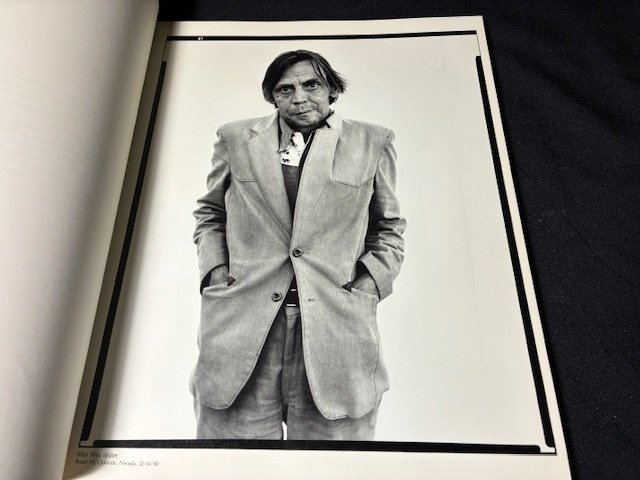
LEGENDARY PHOTOGRAPHIC PORTRAITS OF AMERICAN MEN AND WOMEN from across a variety of walks of life by famous American photographer Richard Avedon (1923–2004).
Martin Parr, The Photobook, vol 2, page 38.
Very beautiful and highly impressive photobook, quickly becoming a classic of the genre -
in VERY FRESH AND CLEAN CONDITION.
A master of American fashion and art photography turns his artistry to capturing - in a series of photograph portraits - the cowboys, roustabouts, drifters, gamblers, bar girls, and others who characterize the modern Western experience.
Published on the occasion of the big exibition tour of Richard Avedon through the USA in 1985 to 1987 -
with stops at "Amon Carter Museum, Fort Worth, Texas", at "Corcoran Gallery of Art, Washington", at "San Francisco Museum of Modern Art", San Francisco, California, at "The Art Institute of Chicago, Illinois, at "Phoenix Art Museum", Phoenix, Arizona, at "The Institute of Contemporary Art", Boston, Massachusetts and at "The High Museum of Art", Atlanta, Georgia.
Harry N. Abrams. 1994. Fourth printing.
Paperback (as issued). 280 x 355 mm. 174 pages. More than 100 duotone plates. Photos: Richard Avedon. Designed by Marvin Israel and by Elizabeth Avedon. Foreword: Richard Avedon. Text in English.
Condition:
Inside and outside fresh and clean, much better than usual condition with light trace of use only; pages smell a bit like smoke, no other remarkable flaws or defects. Overall very fine condition.
Breath-taking, very important landmark book by Richard Avedon in very fresh and clean and much better than usual condition.
"Richard Avedon was born and lived in New York City. His interest in photography began at an early age, and he joined the Young Men’s Hebrew Association (YMHA) camera club when he was twelve years old. He attended DeWitt Clinton High School in the Bronx, where he co-edited the school’s literary magazine, The Magpie, with James Baldwin. He was named Poet Laureate of New York City High Schools in 1941.
Avedon joined the armed forces in 1942 during World War II, serving as Photographer’s Mate Second Class in the U.S. Merchant Marine. As he described it, “My job was to do identity photographs. I must have taken pictures of one hundred thousand faces before it occurred to me I was becoming a photographer."
After two years of service, he left the Merchant Marine to work as a professional photographer, initially creating fashion images and studying with art director Alexey Brodovitch at the Design Laboratory of the New School for Social Research.
At the age of twenty-two, Avedon began working as a freelance photographer, primarily for Harper’s Bazaar. Initially denied the use of a studio by the magazine, he photographed models and fashions on the streets, in nightclubs, at the circus, on the beach and at other uncommon locations, employing the endless resourcefulness and inventiveness that became a hallmark of his art. Under Brodovitch’s tutelage, he quickly became the lead photographer for Harper’s Bazaar.
From the beginning of his career, Avedon made formal portraits for publication in Theatre Arts, Life, Look, and Harper’s Bazaar magazines, among many others. He was fascinated by photography’s capacity for suggesting the personality and evoking the life of his subjects. He registered poses, attitudes, hairstyles, clothing and accessories as vital, revelatory elements of an image. He had complete confidence in the two-dimensional nature of photography, the rules of which he bent to his stylistic and narrative purposes. As he wryly said, “My photographs don’t go below the surface. I have great faith in surfaces. A good one is full of clues.”
After guest-editing the April 1965 issue of Harper’s Bazaar, Avedon quit the magazine after facing a storm of criticism over his collaboration with models of color. He joined Vogue, where he worked for more than twenty years. In 1992, Avedon became the first staff photographer at The New Yorker, where his portraiture helped redefine the aesthetic of the magazine. During this period, his fashion photography appeared almost exclusively in the French magazine Égoïste.
Throughout, Avedon ran a successful commercial studio, and is widely credited with erasing the line between “art” and “commercial” photography. His brand-defining work and long associations with Calvin Klein, Revlon, Versace, and dozens of other companies resulted in some of the best-known advertising campaigns in American history. These campaigns gave Avedon the freedom to pursue major projects in which he explored his cultural, political, and personal passions. He is known for his extended portraiture of the American Civil Rights movement, the Vietnam war and a celebrated cycle of photographs of his father, Jacob Israel Avedon. In 1976, for Rolling Stone magazine, he produced “The Family,” a collective portrait of the American power elite at the time of the country’s bicentennial election. From 1979 to 1985, he worked extensively on a commission from the Amon Carter Museum of American Art, ultimately producing the show and book In the American West.
Avedon’s first museum retrospective was held at the Smithsonian Institution in 1962. Many major museum shows followed, including two at the Metropolitan Museum of Art (1978 and 2002), the Minneapolis Institute of Arts (1970), the Amon Carter Museum of American Art (1985), and the Whitney Museum of American Art (1994). His first book of photographs, Observations, with an essay by Truman Capote, was published in 1959. He continued to publish books of his works throughout his life, including Nothing Personal in 1964 (with an essay by James Baldwin), Portraits 1947–1977 (1978, with an essay by Harold Rosenberg), An Autobiography (1993), Evidence 1944–1994 (1994, with essays by Jane Livingston and Adam Gopnik), and The Sixties (1999, with interviews by Doon Arbus).
After suffering a cerebral hemorrhage while on assignment for The New Yorker, Richard Avedon died in San Antonio, Texas on October 1, 2004. He established The Richard Avedon Foundation during his lifetime."
(Richard Avedon foundation's website)
El vendedor y su historia
bienvenido a las 5h30.
5Uhr30 tiene su sede en Ehrenfeld, el barrio más de moda de Colonia, con una tienda y una sala de exposiciones de fotografía.
5H30 ofrece álbumes de fotos muy raros, muy hermosos y muy especiales: agotados, modernos, anticuarios y anticuarios. también ofrecemos tarjetas de invitación con fotografías, carteles de películas y fotografías, catálogos de fotografías e impresiones fotográficas originales.
5Uhr30 está especializado en publicaciones fotográficas alemanas,
pero también tiene una interesante gama de álbumes de fotos de toda Europa, Japón, América del Norte y América del Sur. folletos de viajes, libros infantiles, folletos de empresa... todo lo que tenga que ver con la fotografía en sentido estricto o amplio nos inspira. por favor visítenos si usted está en Colonia o sus alrededores. ¡No te arrepentirás! :)
5:30 am siempre trata de ofrecer las mejores condiciones.
5h30 se envía a todo el mundo, rápido y seguro -
con 100% de protección, con seguro a todo riesgo y con número de seguimiento.
contáctenos por correo electrónico, si tiene alguna pregunta o si está buscando algo especial, porque solo una parte de nuestras ofertas están en línea.
Gracias por tu interés.
ecki heuser y equipo
Traducido por el Traductor de GoogleLEGENDARY PHOTOGRAPHIC PORTRAITS OF AMERICAN MEN AND WOMEN from across a variety of walks of life by famous American photographer Richard Avedon (1923–2004).
Martin Parr, The Photobook, vol 2, page 38.
Very beautiful and highly impressive photobook, quickly becoming a classic of the genre -
in VERY FRESH AND CLEAN CONDITION.
A master of American fashion and art photography turns his artistry to capturing - in a series of photograph portraits - the cowboys, roustabouts, drifters, gamblers, bar girls, and others who characterize the modern Western experience.
Published on the occasion of the big exibition tour of Richard Avedon through the USA in 1985 to 1987 -
with stops at "Amon Carter Museum, Fort Worth, Texas", at "Corcoran Gallery of Art, Washington", at "San Francisco Museum of Modern Art", San Francisco, California, at "The Art Institute of Chicago, Illinois, at "Phoenix Art Museum", Phoenix, Arizona, at "The Institute of Contemporary Art", Boston, Massachusetts and at "The High Museum of Art", Atlanta, Georgia.
Harry N. Abrams. 1994. Fourth printing.
Paperback (as issued). 280 x 355 mm. 174 pages. More than 100 duotone plates. Photos: Richard Avedon. Designed by Marvin Israel and by Elizabeth Avedon. Foreword: Richard Avedon. Text in English.
Condition:
Inside and outside fresh and clean, much better than usual condition with light trace of use only; pages smell a bit like smoke, no other remarkable flaws or defects. Overall very fine condition.
Breath-taking, very important landmark book by Richard Avedon in very fresh and clean and much better than usual condition.
"Richard Avedon was born and lived in New York City. His interest in photography began at an early age, and he joined the Young Men’s Hebrew Association (YMHA) camera club when he was twelve years old. He attended DeWitt Clinton High School in the Bronx, where he co-edited the school’s literary magazine, The Magpie, with James Baldwin. He was named Poet Laureate of New York City High Schools in 1941.
Avedon joined the armed forces in 1942 during World War II, serving as Photographer’s Mate Second Class in the U.S. Merchant Marine. As he described it, “My job was to do identity photographs. I must have taken pictures of one hundred thousand faces before it occurred to me I was becoming a photographer."
After two years of service, he left the Merchant Marine to work as a professional photographer, initially creating fashion images and studying with art director Alexey Brodovitch at the Design Laboratory of the New School for Social Research.
At the age of twenty-two, Avedon began working as a freelance photographer, primarily for Harper’s Bazaar. Initially denied the use of a studio by the magazine, he photographed models and fashions on the streets, in nightclubs, at the circus, on the beach and at other uncommon locations, employing the endless resourcefulness and inventiveness that became a hallmark of his art. Under Brodovitch’s tutelage, he quickly became the lead photographer for Harper’s Bazaar.
From the beginning of his career, Avedon made formal portraits for publication in Theatre Arts, Life, Look, and Harper’s Bazaar magazines, among many others. He was fascinated by photography’s capacity for suggesting the personality and evoking the life of his subjects. He registered poses, attitudes, hairstyles, clothing and accessories as vital, revelatory elements of an image. He had complete confidence in the two-dimensional nature of photography, the rules of which he bent to his stylistic and narrative purposes. As he wryly said, “My photographs don’t go below the surface. I have great faith in surfaces. A good one is full of clues.”
After guest-editing the April 1965 issue of Harper’s Bazaar, Avedon quit the magazine after facing a storm of criticism over his collaboration with models of color. He joined Vogue, where he worked for more than twenty years. In 1992, Avedon became the first staff photographer at The New Yorker, where his portraiture helped redefine the aesthetic of the magazine. During this period, his fashion photography appeared almost exclusively in the French magazine Égoïste.
Throughout, Avedon ran a successful commercial studio, and is widely credited with erasing the line between “art” and “commercial” photography. His brand-defining work and long associations with Calvin Klein, Revlon, Versace, and dozens of other companies resulted in some of the best-known advertising campaigns in American history. These campaigns gave Avedon the freedom to pursue major projects in which he explored his cultural, political, and personal passions. He is known for his extended portraiture of the American Civil Rights movement, the Vietnam war and a celebrated cycle of photographs of his father, Jacob Israel Avedon. In 1976, for Rolling Stone magazine, he produced “The Family,” a collective portrait of the American power elite at the time of the country’s bicentennial election. From 1979 to 1985, he worked extensively on a commission from the Amon Carter Museum of American Art, ultimately producing the show and book In the American West.
Avedon’s first museum retrospective was held at the Smithsonian Institution in 1962. Many major museum shows followed, including two at the Metropolitan Museum of Art (1978 and 2002), the Minneapolis Institute of Arts (1970), the Amon Carter Museum of American Art (1985), and the Whitney Museum of American Art (1994). His first book of photographs, Observations, with an essay by Truman Capote, was published in 1959. He continued to publish books of his works throughout his life, including Nothing Personal in 1964 (with an essay by James Baldwin), Portraits 1947–1977 (1978, with an essay by Harold Rosenberg), An Autobiography (1993), Evidence 1944–1994 (1994, with essays by Jane Livingston and Adam Gopnik), and The Sixties (1999, with interviews by Doon Arbus).
After suffering a cerebral hemorrhage while on assignment for The New Yorker, Richard Avedon died in San Antonio, Texas on October 1, 2004. He established The Richard Avedon Foundation during his lifetime."
(Richard Avedon foundation's website)
El vendedor y su historia
bienvenido a las 5h30.
5Uhr30 tiene su sede en Ehrenfeld, el barrio más de moda de Colonia, con una tienda y una sala de exposiciones de fotografía.
5H30 ofrece álbumes de fotos muy raros, muy hermosos y muy especiales: agotados, modernos, anticuarios y anticuarios. también ofrecemos tarjetas de invitación con fotografías, carteles de películas y fotografías, catálogos de fotografías e impresiones fotográficas originales.
5Uhr30 está especializado en publicaciones fotográficas alemanas,
pero también tiene una interesante gama de álbumes de fotos de toda Europa, Japón, América del Norte y América del Sur. folletos de viajes, libros infantiles, folletos de empresa... todo lo que tenga que ver con la fotografía en sentido estricto o amplio nos inspira. por favor visítenos si usted está en Colonia o sus alrededores. ¡No te arrepentirás! :)
5:30 am siempre trata de ofrecer las mejores condiciones.
5h30 se envía a todo el mundo, rápido y seguro -
con 100% de protección, con seguro a todo riesgo y con número de seguimiento.
contáctenos por correo electrónico, si tiene alguna pregunta o si está buscando algo especial, porque solo una parte de nuestras ofertas están en línea.
Gracias por tu interés.
ecki heuser y equipo
Traducido por el Traductor de GoogleDatos
Número de libros
1
Tema
Arte, Fotografía
Título del libro
In The American West
Autor/ Ilustrador
Richard Avedon
Estado
Bien Conservada BC
Año de publicación artículo más antiguo
1994
Alto
355 mm
Edición
Primera edición
Ancho
280 mm
Idioma
Inglés
Lengua original
Sí
Editorial
Harry N. Abrams
Encuadernación
Libro en rústica
Número de páginas
174
Vendido por
AlemaniaVerificado
protop
Rechtliche Informationen des Verkäufers
- Unternehmen:
- 5Uhr30.com
- Repräsentant:
- Ecki Heuser
- Adresse:
- 5Uhr30.com
Thebäerstr. 34
50823 Köln
GERMANY - Telefonnummer:
- +491728184000
- Email:
- photobooks@5Uhr30.com
- USt-IdNr.:
- DE154811593
AGB
AGB des Verkäufers. Mit einem Gebot auf dieses Los akzeptieren Sie ebenfalls die AGB des Verkäufers.
Widerrufsbelehrung
- Frist: 14 Tage sowie gemäß den hier angegebenen Bedingungen
- Rücksendkosten: Käufer trägt die unmittelbaren Kosten der Rücksendung der Ware
- Vollständige Widerrufsbelehrung