N.º 98774694

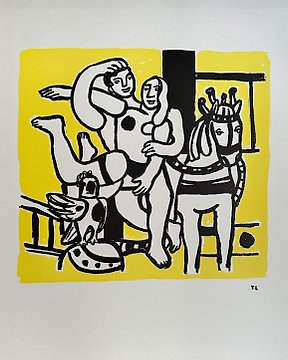
Joan Miro (1893-1983) - Sortilèges
N.º 98774694

Joan Miro (1893-1983) - Sortilèges
Joan Miró (Barcelona, 1893 – Palma, 1983).
"Sortilèges".
Lithography.
1957.
28 x 22,5 cm.
CONDITON: Good condition.
PROVENANCE: Pierre Bergé et associés.
PUBLISHED:
- Various authors. 1975. Miró Lithographer II (1953–1963). Catalogue raisonné of lithographs. Paris. Ed. Maeght. No. 180.
- Verdet, A. 1957. Collection Sortilèges. Nice. Ed. Galerie Matarasso.
DESCRIPTION:
Lithograph belonging to the ‘Sortilèges Collection’, created for the book ‘Joan Miró’, with text by André Verdet (Galerie Matarasso, Nice, 1957). Hand-signed copy, unnumbered. The first print run of the book, consisting of 100 copies, contains a copy of this lithograph on Arches vellum paper (Velin d'Arches), printed by Mourlot, numbered and signed. André Verdet (1913-2004) was a multidisciplinary artist, a personal friend of Miró and a member of the Resistance, for which he was arrested in 1944 by the Gestapo and deported to the Auschwitz and Buchenwald camps. Together with Yves P. Boulongne, he compiled the poems of his fellow camp inmates, which were published alongside his own in the Anthologie des poèmes de Buchenwald (Robert Laffont, 1946).
Within his graphic work, which was fundamental to his career, Miró produced various engravings and lithographs to illustrate texts about his own work, both written by himself (Je travaille comme un jardinier, 1964, and L’enfance d’Ubu, 1975) and by other authors, as well as collaborating with magazines, such as the Cahiers d’Art monograph dedicated to his work in 1935. The ‘Sortilèges Collection’ is a series of lithographs made to illustrate the monograph on the painter written by a kindred artist, Verdet, published on the occasion of the Miró exhibition that opened on 17 May 1957 in the gallery of the art dealer and bookseller Jacques Matarasso in Nice. Founded in 1941, the gallery-bookshop soon became a meeting place for artists and writers, as Matarasso sold books as well as engravings and lithographs, and was actively interested in promoting the work of young artists.
This lithograph is also testimony to a very specific moment in Miró's career, when the artist abandoned painting to focus exclusively on graphic art and ceramics (1955-1959). Settled in his studio in Palma, the artist explored new artistic avenues through the small format and versatility of engraving and lithography. This was a period of intense work for Miró, who was already internationally renowned. In 1957, he combined major projects such as the UNESCO murals and the preparation of his retrospective exhibition at MoMA in New York, which was held in 1959, with private work in his studio, particularly in the field of lithography. That same year, he produced Woman Before the Mirror, one of his best-known lithographs, and used the same technique for the cover of the special issue of the magazine Papeles de Son Armadans dedicated to his work, with texts by Camilo José Cela. In January, his exhibition ‘Original Lithographs by Joan Miró’ at the Sala Gaspar in Barcelona had formally marked his return to his hometown. During the rest of the year, his lithographs were also exhibited in Germany (travelling to several cities) and in Nice, in the latter case in an exhibition linked precisely to the ‘Sortilèges Collection’.
Joan Miró (Barcelona, 1893 – Palma, 1983) was one of the most important figures in 20th-century Western art. He developed a personal style close to surrealism that had a powerful influence on both his contemporaries and subsequent generations. From his formative years at the La Llotja School and the innovative Galí Academy, Miró became involved with the avant-garde circles of Barcelona, where he met some of his great friends: the critic Sebastià Gasch, the poet J. V. Foix, the painter Llorens Artigas and the art dealer Joan Prats. In 1918, he held his first exhibition at the Galerías Dalmau in Barcelona, and two years later he left for Paris, where he would spend the most crucial years of his artistic career, developing his own visual language.
In the French capital, Miró became friends with André Masson, around whom the so-called Rue Blomet group gathered, the future nucleus of Surrealism. Under the influence of the Surrealist poets and painters, with whom he shared many of his theoretical ideas, the young Miró matured his style, seeking to transpose Surrealist poetry into the visual realm and drawing on memory, fantasy and the irrational to do so. His style then began to evolve towards increasingly ethereal works, where organic forms and figures were reduced to abstract dots, lines and patches of colour. In 1924, he signed the first Surrealist manifesto, although the evolution of his work, which was too complex, did not allow him to be ascribed to any particular orthodoxy. His third exhibition in Paris, in 1928, marked his first major triumph: the Museum of Modern Art in New York acquired two of his works. From the following decade onwards, Miró established himself as one of the most prominent figures on the international art scene.
It was precisely at this point that the artist, a non-conformist by nature, entered a phase he called the ‘murder of painting’, in which he voluntarily renounced being a painter and experimented with other media, such as collage, drawing on papers of different textures, and the construction of ‘objects’ with found elements, his first approach to sculpture. Thus, although he soon returned to painting, Miró never abandoned his desire to experiment with all kinds of materials and techniques. He returned to Spain in 1941, and that same year the Museum of Modern Art in New York dedicated a retrospective to him, which marked his definitive international recognition. From 1956 until his death in 1983, he lived in Palma in a kind of internal exile, while his international fame grew.
Miró received important awards such as the Grand Prize at the Venice Biennale in 1954 and from the Guggenheim Foundation in 1959, the Carnegie Prize for Painting in 1966 and the Gold Medals of the Generalitat of Catalonia (1978) and Fine Arts (1980). Today, his work can be seen at the Joan Miró Foundation in Barcelona, which opened in 1975, as well as at the Thyssen-Bornemisza Museum and the MNCARS in Madrid, the MoMA in New York, the National Gallery in Washington, the MNAM in Paris and the Albright-Knox Art Gallery in Buffalo, among other collections.
Objetos similares
-
-
-
-
-
-
-
-
-
-
Este objeto apareció en
Cómo comprar en Catawiki
1. Descubre algo especial
2. Haz la puja más alta
3. Paga de manera segura