101578143

Plus disponible
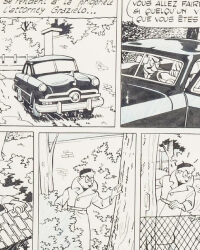
Akashi Seiichi - 1 Original page - Kodomo no Kuni - The Weasel | Emonogatari - 1935
Offres terminées
Il y a 1 jour

Akashi Seiichi - 1 Original page - Kodomo no Kuni - The Weasel | Emonogatari - 1935

Akashi Seiichi | The weasel Large full color original art for an emonogatari published by Kodomo no Kuni around 1935 Size : 38.7 x 29.2 cm Mixed Media : pencil, watercolor & acrylic on sturdy drawing paper Condition : Very good Akashi Seiichi (1886–?) was a Japanese illustrator and manga artist working at a time when illustration, emonogatari, and early forms of manga overlapped and were not yet separated into distinct genres. He contributed extensively to major children’s publications, particularly those issued by Kodansha, one of the central publishers of prewar Japanese children’s books and magazines. More than one hundred surviving items bear his name, including work in Kodansha Picture Book, Children’s Friend, and Manga and Heroic Picture Stories. Early in his career, Akashi published under the pen name Akashi Akako, producing frontispieces and illustrations for Shōjo no Tomo (Girl’s Friend), and later creating manga and illustrations for magazines such as Nihon Shōnen and Jitsugyō no Nihon. While he published early forms of manga, he worked primarily in emonogatari, illustrated stories in which images carried the narrative alongside short captions or explanatory text. Among his known works is The Elephant’s Glasses (Zō no Megane, 1935, Kodomo no Kuni), a children’s picture story that demonstrates the hybrid character of his work, blending picture books, emonogatari, and manga. In 1933, he co-founded the Japan Children’s Manga Artists Association alongside Kawahara Kunio, Yasuyasu, Imoto Suimei, Nakagawa Morihisa, Tagawa Suihō, and others, reflecting his recognized standing in the field. Akashi Seiichi is best understood as a prolific prewar children’s manga and emonogatari artist whose work shaped early twentieth-century Japanese children’s visual culture. His surviving illustrations, picture stories, and sugoroku offer valuable insight into the forms of manga-related storytelling that existed before the medium was redefined after World War II. Check out our other items for more classic, vintage or underground manga. Combine your purchases to save on shipping cost or opt to collect your item(s) at our gallery in Antwerp, Belgium

101578143

Plus disponible
Akashi Seiichi - 1 Original page - Kodomo no Kuni - The Weasel | Emonogatari - 1935

Akashi Seiichi - 1 Original page - Kodomo no Kuni - The Weasel | Emonogatari - 1935

Akashi Seiichi | The weasel
Large full color original art for an emonogatari published by Kodomo no Kuni around 1935

Size : 38.7 x 29.2 cm
Mixed Media : pencil, watercolor & acrylic on sturdy drawing paper
Condition : Very good

Akashi Seiichi (1886–?) was a Japanese illustrator and manga artist working at a time when illustration, emonogatari, and early forms of manga overlapped and were not yet separated into distinct genres.
He contributed extensively to major children’s publications, particularly those issued by Kodansha, one of the central publishers of prewar Japanese children’s books and magazines. More than one hundred surviving items bear his name, including work in Kodansha Picture Book, Children’s Friend, and Manga and Heroic Picture Stories.

Early in his career, Akashi published under the pen name Akashi Akako, producing frontispieces and illustrations for Shōjo no Tomo (Girl’s Friend), and later creating manga and illustrations for magazines such as Nihon Shōnen and Jitsugyō no Nihon. While he published early forms of manga, he worked primarily in emonogatari, illustrated stories in which images carried the narrative alongside short captions or explanatory text.

Among his known works is The Elephant’s Glasses (Zō no Megane, 1935, Kodomo no Kuni), a children’s picture story that demonstrates the hybrid character of his work, blending picture books, emonogatari, and manga. In 1933, he co-founded the Japan Children’s Manga Artists Association alongside Kawahara Kunio, Yasuyasu, Imoto Suimei, Nakagawa Morihisa, Tagawa Suihō, and others, reflecting his recognized standing in the field.

Akashi Seiichi is best understood as a prolific prewar children’s manga and emonogatari artist whose work shaped early twentieth-century Japanese children’s visual culture. His surviving illustrations, picture stories, and sugoroku offer valuable insight into the forms of manga-related storytelling that existed before the medium was redefined after World War II.

Check out our other items for more classic, vintage or underground manga. Combine your purchases to save on shipping cost or opt to collect your item(s) at our gallery in Antwerp, Belgium

Offres terminées
Filippo Piras
Expert
Estimation  € 280 - € 350

Objets similaires

Pour vous

Art original de bandes dessinées

Définir une alerte de recherche
Définissez une alerte de recherche pour être informé lorsque de nouveaux objets correspondant à votre recherche sont disponibles.

Cet objet a été présenté dans


Comment acheter sur Catawiki ?

En savoir plus sur notre Protection des acheteurs

      1. Découvrez des objets d’exception

      Découvrez des milliers d'objets d'exception sélectionnés par nos experts. Consultez les photos, les informations détaillées et la valeur estimée de chaque objet d'exception. 

      2. Faites la meilleure offre

      Trouvez l’objet de vos rêves et faites l’offre la plus élevée. Vous pouvez suivre la vente jusqu'à sa clôture ou laisser notre système faire les offres à votre place. Il vous suffit de fixer une enchère maximale correspondant au montant que vous souhaitez payer. 

      3. Effectuez un paiement sécurisé

      Réglez votre objet d'exception et nous garderons votre paiement en toute sécurité jusqu’à ce que vous ayez bien reçu votre objet d’exception. Toutes les transactions sont effectuées par un système de paiement de confiance. 

Vous souhaitez vendre un objet similaire ?

Que vous débutiez dans les ventes en ligne ou que vous soyez vendeur professionnel, nous pouvons vous aider à gagner plus d'argent pour vos objets d'exception.

Vendez votre objet