102294422

Vendu
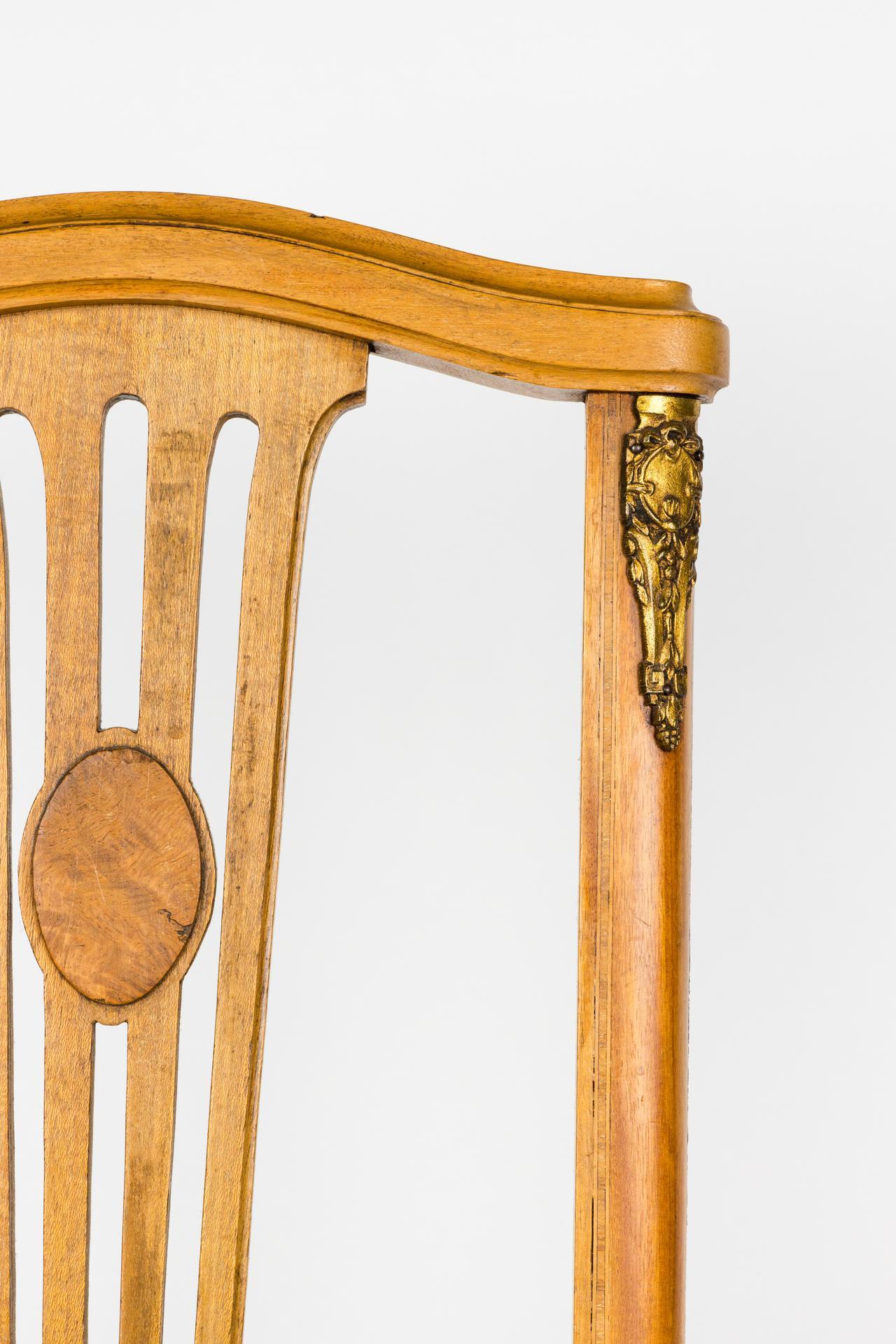
Table - Bois, Hêtre, Chêne - Table de style Thonet des années 1910.
Offre finale
€ 140
Sans prix de réserve
Il y a 11 semaines

Table - Bois, Hêtre, Chêne - Table de style Thonet des années 1910.

A square of quiet authority, poised upon four attenuated limbs, this 1910s Thonet style table stands as a lucid testament to the mature phase of Central European bentwood craftsmanship. At once restrained and expressive, it embodies the technical refinement and formal discipline that defined Thonet’s production in the early twentieth century—when industrial logic and artisanal sensitivity were not adversaries, but collaborators. The table’s silhouette is deceptively simple: a rectilinear top with softly eased edges rests upon slender, gently tapering legs. Yet beneath this apparent modesty lies a structural intelligence characteristic of the Thonet manufactory. The legs, likely steam-bent beech, descend in a subtle outward cant before resolving into elegant, slightly splayed feet. This curvature is neither ornamental excess nor mere flourish; it is the visual residue of a process perfected in the late nineteenth century—controlled steam bending that allowed solid wood to assume tensile, resilient arcs without sacrificing strength. The understructure reveals the true poetry of the piece. A sinuous stretcher system, composed of bentwood elements that loop and converge with rhythmic clarity, braces the legs while maintaining visual permeability. The negative space between these components is as deliberate as the wood itself. Such economy of line is a hallmark of Thonet’s ethos: material reduced to its essential trajectory, structure made legible, weight dissolved into contour. The tabletop—likely solid beech or a beech veneer over a stable substrate—presents a warm, darkened patina consistent with age. Its surface bears the quiet record of use: faint tonal variations, minute abrasions, the mellowing of finish. These are not defects but historical inscriptions. Over more than a century, oxidation and handling have deepened the timber’s chromatic register, producing that particular reddish-brown depth so often associated with early Thonet café and domestic tables. Stylistically, the table occupies a transitional moment. It retains the organic linearity of late Historicism and the Secessionist impulse toward refined curvature, yet it anticipates the rational simplifications that would culminate in interwar modernism. There is no applied carving, no superfluous ornament. Its beauty arises from proportion, joinery, and the disciplined repetition of bentwood arcs. In this sense, it participates in the broader narrative of industrial design’s evolution: from decorative embellishment toward structural honesty. Functionally, such tables were conceived for versatility. Compact in footprint yet stable in stance, they served equally well in Viennese cafés, bourgeois parlors, and modest urban apartments. Their relatively light mass allowed easy rearrangement, while their robust joinery ensured durability under constant use. This duality—mobility paired with endurance—was central to Thonet’s global success. Today, the table reads not as a relic but as a quietly authoritative presence. In a contemporary interior, it converses fluently with both period furnishings and minimalist environments. Its graphic legibility—the interplay of straight plane and curved support—offers a compositional anchor without visual heaviness. It is, in essence, a study in balance: between craft and industry, curve and line, delicacy and strength. To encounter a 1910s Thonet table is to witness a chapter in the democratization of design. Here, the innovations of bentwood technology are distilled into a form that is unpretentious yet exacting. More than an occasional table, it is an artifact of modernity’s formative decades—where technique, economy, and elegance converged into enduring form.

102294422

Vendu
Table - Bois, Hêtre, Chêne - Table de style Thonet des années 1910.

Table - Bois, Hêtre, Chêne - Table de style Thonet des années 1910.

A square of quiet authority, poised upon four attenuated limbs, this 1910s Thonet style table stands as a lucid testament to the mature phase of Central European bentwood craftsmanship. At once restrained and expressive, it embodies the technical refinement and formal discipline that defined Thonet’s production in the early twentieth century—when industrial logic and artisanal sensitivity were not adversaries, but collaborators.

The table’s silhouette is deceptively simple: a rectilinear top with softly eased edges rests upon slender, gently tapering legs. Yet beneath this apparent modesty lies a structural intelligence characteristic of the Thonet manufactory. The legs, likely steam-bent beech, descend in a subtle outward cant before resolving into elegant, slightly splayed feet. This curvature is neither ornamental excess nor mere flourish; it is the visual residue of a process perfected in the late nineteenth century—controlled steam bending that allowed solid wood to assume tensile, resilient arcs without sacrificing strength.

The understructure reveals the true poetry of the piece. A sinuous stretcher system, composed of bentwood elements that loop and converge with rhythmic clarity, braces the legs while maintaining visual permeability. The negative space between these components is as deliberate as the wood itself. Such economy of line is a hallmark of Thonet’s ethos: material reduced to its essential trajectory, structure made legible, weight dissolved into contour.

The tabletop—likely solid beech or a beech veneer over a stable substrate—presents a warm, darkened patina consistent with age. Its surface bears the quiet record of use: faint tonal variations, minute abrasions, the mellowing of finish. These are not defects but historical inscriptions. Over more than a century, oxidation and handling have deepened the timber’s chromatic register, producing that particular reddish-brown depth so often associated with early Thonet café and domestic tables.

Stylistically, the table occupies a transitional moment. It retains the organic linearity of late Historicism and the Secessionist impulse toward refined curvature, yet it anticipates the rational simplifications that would culminate in interwar modernism. There is no applied carving, no superfluous ornament. Its beauty arises from proportion, joinery, and the disciplined repetition of bentwood arcs. In this sense, it participates in the broader narrative of industrial design’s evolution: from decorative embellishment toward structural honesty.

Functionally, such tables were conceived for versatility. Compact in footprint yet stable in stance, they served equally well in Viennese cafés, bourgeois parlors, and modest urban apartments. Their relatively light mass allowed easy rearrangement, while their robust joinery ensured durability under constant use. This duality—mobility paired with endurance—was central to Thonet’s global success.

Today, the table reads not as a relic but as a quietly authoritative presence. In a contemporary interior, it converses fluently with both period furnishings and minimalist environments. Its graphic legibility—the interplay of straight plane and curved support—offers a compositional anchor without visual heaviness. It is, in essence, a study in balance: between craft and industry, curve and line, delicacy and strength.

To encounter a 1910s Thonet table is to witness a chapter in the democratization of design. Here, the innovations of bentwood technology are distilled into a form that is unpretentious yet exacting. More than an occasional table, it is an artifact of modernity’s formative decades—where technique, economy, and elegance converged into enduring form.

Offre finale
€ 140
Sans prix de réserve
Michel Karis
Expert
Estimation  € 230 - € 280

Objets similaires

Pour vous

Antiquités et meubles classiques

Définir une alerte de recherche
Définissez une alerte de recherche pour être informé lorsque de nouveaux objets correspondant à votre recherche sont disponibles.

Cet objet a été présenté dans


Comment acheter sur Catawiki ?

En savoir plus sur notre Protection des acheteurs

      1. Découvrez des objets d’exception

      Découvrez des milliers d'objets d'exception sélectionnés par nos experts. Consultez les photos, les informations détaillées et la valeur estimée de chaque objet d'exception. 

      2. Faites la meilleure offre

      Trouvez l’objet de vos rêves et faites l’offre la plus élevée. Vous pouvez suivre la vente jusqu'à sa clôture ou laisser notre système faire les offres à votre place. Il vous suffit de fixer une enchère maximale correspondant au montant que vous souhaitez payer. 

      3. Effectuez un paiement sécurisé

      Réglez votre objet d'exception et nous garderons votre paiement en toute sécurité jusqu’à ce que vous ayez bien reçu votre objet d’exception. Toutes les transactions sont effectuées par un système de paiement de confiance. 

Vous souhaitez vendre un objet similaire ?

Que vous débutiez dans les ventes en ligne ou que vous soyez vendeur professionnel, nous pouvons vous aider à gagner plus d'argent pour vos objets d'exception.

Vendez votre objet