99795009

Plus disponible
Lajos Kassak (1887-1967) - Concrete Composition
Offres terminées
Il y a 3 semaines

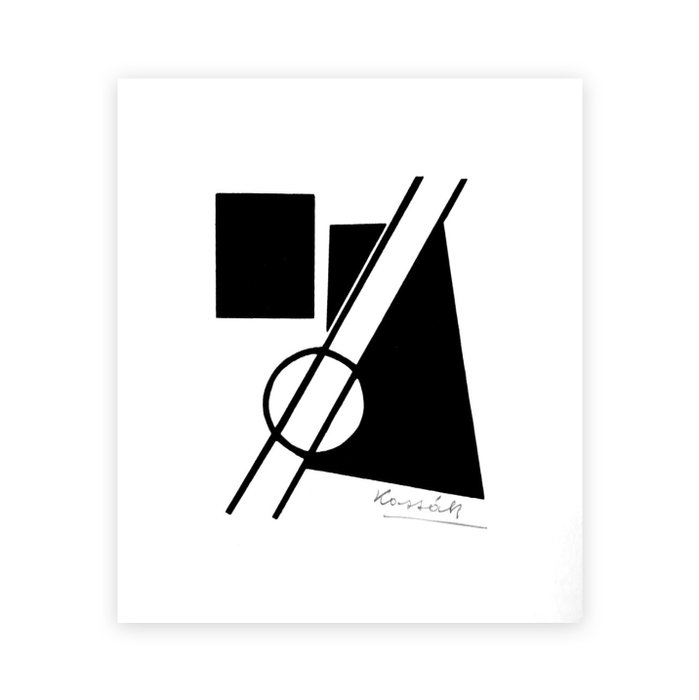
Lajos Kassak (1887-1967) - Concrete Composition

Lajos Kassák "Composition" from La Lune en Rodage III Medium: Linocut Material: Paper Dimensions: 25 x 21.5 cm on 32 x 32 cm cardboard Editor: Edition Panderma, Basel Year: published 1977 Edition: This is an unnumbered copy of 230 editions (65 hors commerce were unnumbered) Signature: Signed Provenance: Edition Panderma, Carl Laszlo, Basel Galerie von Bartha, Basel Private Collection, Basel Condition / Restauration: mint archival condition Further Information: A rare limited edition of the portable collection of post-war and contemporary art La Lune en Rodage III. This is an unnumbered copy of 230 editions (65 hors commerce were unnumbered) and part of the third serie of the La Lune en Rodage books. La Lune en Rodage was published in three volumes in 1960, 1965 and 1977 containing a total of approximately 180 art pieces which provide an account of the artistic avant-garde scene between the 1950s and 1970s. The art works were gathered by Carl Laslzo and included the greatest artists of the time who contributed with important pieces, often marking a turning point in their production and carriers: Enrico Castellani’s work for example is his first documented graphic work and Piero Manzoni's multiple Achrome is the only one produced by the artist. Biography: Lajos Kassák was born in the small village of Ersekujvár, Hungary, on 21 March 1887. After only a few years at school, he served an apprenticeship as a locksmith. Lajos Kassák then became a metal worker in Györ and Budapest. At the age of twenty, Kassák began to teach himself painting and to write poetry. In 1915 he founded the revolutionary periodical "A Tett" ["The Deed"], around which he collected young artists and writers who were against the war. After "A Tett" was proscribed, Lajos Kassák founded and edited the avant-garde Activist journal "MA" ["Today"] in 1916. In it he published work by Grosz, Schwitters and Hans Richter until 1921. After the failure of the Hungarian Communist Republic, Lajos Kassák emigrated in 1920 to Vienna, where he continued to publish "MA". Although Kassák's early work was strongly influenced by Dada, he became a Constructivist since he was now inspired by László Moholy-Nagy, who later taught at the "Bauhaus". It was in "MA" that Lajos Kassák formulated the theoretical agenda of Hungarian Constructivism in 1921. In November 1924 Kassák joined many well-known sculptors and painters of his day, including Brancusi, Arp and Schwitters, in showing work at the "First International Exhibition of Modern Art" in Bucharest. In 1926 Kassák met Le Corbusier, Amedée Ozenfant, Goll and Dermée in Paris. In November that same year he returned from exile to Budapest.Lajos Kassák was devastated by the National Socialist take-over in Germany and the puppet regime in Hungary. After Hungary was freed of the NS yoke, Kassák was active in the Hungarian Arts Council and as an editor but by the mid-1950s was forced from public office although his international reputation remained untarnished. Exhibitions were devoted to the work of this versatile and prolific painter, sculptor, printmaker and collagist in Paris, Munich, Warsaw, Cologne and Paris. In 1966 Kassák participated in the large-scale Dada exhibition mounted by the Zurich Kunsthalle and the Musée d'Art Moderne in Paris. In 1967, the year he died, Lajos Kassák was honoured by a retrospective at the Adolf Fényes Gallery in Budapest.

99795009

Plus disponible
Lajos Kassak (1887-1967) - Concrete Composition

Lajos Kassak (1887-1967) - Concrete Composition

Lajos Kassák "Composition" from La Lune en Rodage III

Medium: Linocut
Material: Paper
Dimensions: 25 x 21.5 cm on 32 x 32 cm cardboard
Editor: Edition Panderma, Basel
Year: published 1977
Edition: This is an unnumbered copy of 230 editions (65 hors commerce were unnumbered)
Signature: Signed

Provenance:
Edition Panderma, Carl Laszlo, Basel
Galerie von Bartha, Basel
Private Collection, Basel

Condition / Restauration:
mint archival condition

Further Information:

A rare limited edition of the portable collection of post-war and contemporary art La Lune en Rodage III. This is an unnumbered copy of 230 editions (65 hors commerce were unnumbered) and part of the third serie of the La Lune en Rodage books. La Lune en Rodage was published in three volumes in 1960, 1965 and 1977 containing a total of approximately 180 art pieces which provide an account of the artistic avant-garde scene between the 1950s and 1970s. The art works were gathered by Carl Laslzo and included the greatest artists of the time who contributed with important pieces, often marking a turning point in their production and carriers: Enrico Castellani’s work for example is his first documented graphic work and Piero Manzoni's multiple Achrome is the only one produced by the artist.


Biography:

Lajos Kassák was born in the small village of Ersekujvár, Hungary, on 21 March 1887. After only a few years at school, he served an apprenticeship as a locksmith. Lajos Kassák then became a metal worker in Györ and Budapest. At the age of twenty, Kassák began to teach himself painting and to write poetry. In 1915 he founded the revolutionary periodical "A Tett" ["The Deed"], around which he collected young artists and writers who were against the war. After "A Tett" was proscribed, Lajos Kassák founded and edited the avant-garde Activist journal "MA" ["Today"] in 1916. In it he published work by Grosz, Schwitters and Hans Richter until 1921. After the failure of the Hungarian Communist Republic, Lajos Kassák emigrated in 1920 to Vienna, where he continued to publish "MA". Although Kassák's early work was strongly influenced by Dada, he became a Constructivist since he was now inspired by László Moholy-Nagy, who later taught at the "Bauhaus". It was in "MA" that Lajos Kassák formulated the theoretical agenda of Hungarian Constructivism in 1921. In November 1924 Kassák joined many well-known sculptors and painters of his day, including Brancusi, Arp and Schwitters, in showing work at the "First International Exhibition of Modern Art" in Bucharest. In 1926 Kassák met Le Corbusier, Amedée Ozenfant, Goll and Dermée in Paris. In November that same year he returned from exile to Budapest.Lajos Kassák was devastated by the National Socialist take-over in Germany and the puppet regime in Hungary. After Hungary was freed of the NS yoke, Kassák was active in the Hungarian Arts Council and as an editor but by the mid-1950s was forced from public office although his international reputation remained untarnished. Exhibitions were devoted to the work of this versatile and prolific painter, sculptor, printmaker and collagist in Paris, Munich, Warsaw, Cologne and Paris. In 1966 Kassák participated in the large-scale Dada exhibition mounted by the Zurich Kunsthalle and the Musée d'Art Moderne in Paris. In 1967, the year he died, Lajos Kassák was honoured by a retrospective at the Adolf Fényes Gallery in Budapest.

Offres terminées
Sylvia Kellermann
Expert
Estimation  € 250 - € 350

Objets similaires

Pour vous

Gravures et multiples

Définir une alerte de recherche
Définissez une alerte de recherche pour être informé lorsque de nouveaux objets correspondant à votre recherche sont disponibles.

Cet objet a été présenté dans


Comment acheter sur Catawiki ?

En savoir plus sur notre Protection des acheteurs

      1. Découvrez des objets d’exception

      Découvrez des milliers d'objets d'exception sélectionnés par nos experts. Consultez les photos, les informations détaillées et la valeur estimée de chaque objet d'exception. 

      2. Faites la meilleure offre

      Trouvez l’objet de vos rêves et faites l’offre la plus élevée. Vous pouvez suivre la vente jusqu'à sa clôture ou laisser notre système faire les offres à votre place. Il vous suffit de fixer une enchère maximale correspondant au montant que vous souhaitez payer. 

      3. Effectuez un paiement sécurisé

      Réglez votre objet d'exception et nous garderons votre paiement en toute sécurité jusqu’à ce que vous ayez bien reçu votre objet d’exception. Toutes les transactions sont effectuées par un système de paiement de confiance. 

Vous souhaitez vendre un objet similaire ?

Que vous débutiez dans les ventes en ligne ou que vous soyez vendeur professionnel, nous pouvons vous aider à gagner plus d'argent pour vos objets d'exception.

Vendez votre objet