99950777

Vendu
Collier - 18 carats Or jaune, Or rose - Émail, antique, 1810
Offre finale
€ 2 475
Il y a 1 semaine

Collier - 18 carats Or jaune, Or rose - Émail, antique, 1810

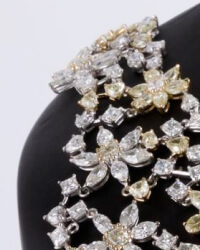
This exquisite French antique necklace, circa 1810, is a remarkable exemplar of the Empire style, reflecting the grandeur of early 19th-century design. Crafted in 18K bi-color gold, it showcases the intricate art of enamelling, a skill refined since ancient times, evoking a sense of nostalgia. Its design, characteristic of Bresse Enamel, is esteemed for its vibrant and enduring beauty, imbuing the piece with an air of elegance. Termed a 'collier d'esclave', this necklace carries a rich narrative of French heritage, often considered the most precious gift at weddings. Adorned with the hallmark of a rooster's head, it not only epitomizes elegance but also inspires wonder with its historical and cultural significance. Antique jewelry object group: necklace Condition: excellent condition   -  (more info on our condition scale) Country of origin: France Style: Empire - The Empire style, sometimes considered the second phase of Neoclassicism, is an early-19th-century design movement in architecture, furniture, other decorative arts, and the visual arts followed in Europe and America up to around 1830. The style originated in and takes its name from the period when Napoleon I ruled France, known as the First French Empire, where it was intended to idealize Napoleon's leadership and the French state. The style corresponds to the Biedermeier style in the German-speaking lands, Federal style in the United States and to the Regency style in Britain. An earlier phase of the style was called the Adam style in Great Britain and "Louis Seize" or Louis XVI, in France.   -  See also: Empire or more info on styles Period: ca. 1810   -  (events & facts of this era, poetry of this era, fashion of this era) Material: 18K bi-color (yellow and red) gold   -  (more info on precious metals) Technique: Enamelling is an old and widely-adopted technology. The ancient Egyptians applied enamels to pottery and stone objects. The ancient Greeks, Celts, Russians, and Chinese also used enameling processes on metal objects. Enamel is the colorful result of fusing powdered glass to a substrate by firing, usually between 750 and 850 degrees Celsius. The powder melts and flows and hardens to a smooth, durable vitreous coating on metal, glass or ceramic. According to some sources, the word enamel comes from the High German word smelzan (to smelt) via the Old French esmail. Used as a noun, "an enamel" is a usually small decorative object, coated with enamel coating, such as a champlevé or a cloisonné (different techniques). The type of enameling is typical for the city Bresse in France, hence the name Bresse Enamel. Extra information: Collier d'esclavage - Esclavage is French and literally it means slavery. We'll leave it to your imagination to give an interpretation to this naming. It is a type of necklace composed of three or more chains or strings of beads or jewels in which the chains or strings hang approximately equidistant from each other. They were worn in Normandy as peasant jewelry in the mid-18th century. Such jewels were in many regions of France the most beautiful jewel offered by the bridegroom to his bride the day of their wedding. The definition of 'collier esclavage' appears for the first time in the 'Dictionnaire de Trévoux' in 1752. This necklace knows a very large geographical diffusion. In Normandy the gold pieces were often engraved. A collier d'esclave is an extremely rare article to find and we are proud to be able to offer one here. Hallmarks: The French hallmark depicting a rooster's head which was used in France for 18K gold around 1810.   -  (more info on hallmarks) Dimensions: length 51,00 cm (20,08 inch) cm Weight: 13,90 gram (8,94 dwt) Reference Nº: 15128-0176 - Accompanied by a professional report of authenticity for your peace of mind. - Shipped insured and registered for your security, though you're most welcome to collect in person. - For shipments outside the EU, import duties and other charges may apply. We advise checking this in advance. - We invite you to browse through our customer feedback to discover the level of satisfaction we consistently provide. - See more of our products, visit: https://auction.catawiki.com/lotsfrom/Adin - It is common for antique & vintage jewellery to be thoughtfully refurbished, remodelled, or repaired to extend its life of wearability. Older items may well show signs of this loving attention.

99950777

Vendu
Collier - 18 carats Or jaune, Or rose - Émail, antique, 1810

Collier - 18 carats Or jaune, Or rose - Émail, antique, 1810

This exquisite French antique necklace, circa 1810, is a remarkable exemplar of the Empire style, reflecting the grandeur of early 19th-century design. Crafted in 18K bi-color gold, it showcases the intricate art of enamelling, a skill refined since ancient times, evoking a sense of nostalgia. Its design, characteristic of Bresse Enamel, is esteemed for its vibrant and enduring beauty, imbuing the piece with an air of elegance. Termed a 'collier d'esclave', this necklace carries a rich narrative of French heritage, often considered the most precious gift at weddings. Adorned with the hallmark of a rooster's head, it not only epitomizes elegance but also inspires wonder with its historical and cultural significance.

Antique jewelry object group: necklace

Condition: excellent condition
  -  (more info on our condition scale)

Country of origin: France

Style: Empire - The Empire style, sometimes considered the second phase of Neoclassicism, is an early-19th-century design movement in architecture, furniture, other decorative arts, and the visual arts followed in Europe and America up to around 1830. The style originated in and takes its name from the period when Napoleon I ruled France, known as the First French Empire, where it was intended to idealize Napoleon's leadership and the French state. The style corresponds to the Biedermeier style in the German-speaking lands, Federal style in the United States and to the Regency style in Britain. An earlier phase of the style was called the Adam style in Great Britain and "Louis Seize" or Louis XVI, in France.
  -  See also: Empire or more info on styles

Period: ca. 1810
  -  (events & facts of this era, poetry of this era, fashion of this era)

Material: 18K bi-color (yellow and red) gold
  -  (more info on precious metals)

Technique: Enamelling is an old and widely-adopted technology. The ancient Egyptians applied enamels to pottery and stone objects. The ancient Greeks, Celts, Russians, and Chinese also used enameling processes on metal objects. Enamel is the colorful result of fusing powdered glass to a substrate by firing, usually between 750 and 850 degrees Celsius. The powder melts and flows and hardens to a smooth, durable vitreous coating on metal, glass or ceramic. According to some sources, the word enamel comes from the High German word smelzan (to smelt) via the Old French esmail. Used as a noun, "an enamel" is a usually small decorative object, coated with enamel coating, such as a champlevé or a cloisonné (different techniques).

The type of enameling is typical for the city Bresse in France, hence the name Bresse Enamel.

Extra information: Collier d'esclavage - Esclavage is French and literally it means slavery. We'll leave it to your imagination to give an interpretation to this naming. It is a type of necklace composed of three or more chains or strings of beads or jewels in which the chains or strings hang approximately equidistant from each other. They were worn in Normandy as peasant jewelry in the mid-18th century. Such jewels were in many regions of France the most beautiful jewel offered by the bridegroom to his bride the day of their wedding. The definition of 'collier esclavage' appears for the first time in the 'Dictionnaire de Trévoux' in 1752. This necklace knows a very large geographical diffusion. In Normandy the gold pieces were often engraved. A collier d'esclave is an extremely rare article to find and we are proud to be able to offer one here.

Hallmarks: The French hallmark depicting a rooster's head which was used in France for 18K gold around 1810.
  -  (more info on hallmarks)

Dimensions: length 51,00 cm (20,08 inch) cm

Weight: 13,90 gram (8,94 dwt)

Reference Nº: 15128-0176

- Accompanied by a professional report of authenticity for your peace of mind.

- Shipped insured and registered for your security, though you're most welcome to collect in person.
- For shipments outside the EU, import duties and other charges may apply. We advise checking this in advance.

- We invite you to browse through our customer feedback to discover the level of satisfaction we consistently provide.
- See more of our products, visit: https://auction.catawiki.com/lotsfrom/Adin

- It is common for antique & vintage jewellery to be thoughtfully refurbished, remodelled, or repaired to extend its life of wearability. Older items may well show signs of this loving attention.

Offre finale
€ 2 475
Laura Trevino
Expert
Estimation  € 3 000 - € 3 600

Objets similaires

Pour vous

Bijoux

Définir une alerte de recherche
Définissez une alerte de recherche pour être informé lorsque de nouveaux objets correspondant à votre recherche sont disponibles.

Cet objet a été présenté dans


Comment acheter sur Catawiki ?

En savoir plus sur notre Protection des acheteurs

      1. Découvrez des objets d’exception

      Découvrez des milliers d'objets d'exception sélectionnés par nos experts. Consultez les photos, les informations détaillées et la valeur estimée de chaque objet d'exception. 

      2. Faites la meilleure offre

      Trouvez l’objet de vos rêves et faites l’offre la plus élevée. Vous pouvez suivre la vente jusqu'à sa clôture ou laisser notre système faire les offres à votre place. Il vous suffit de fixer une enchère maximale correspondant au montant que vous souhaitez payer. 

      3. Effectuez un paiement sécurisé

      Réglez votre objet d'exception et nous garderons votre paiement en toute sécurité jusqu’à ce que vous ayez bien reçu votre objet d’exception. Toutes les transactions sont effectuées par un système de paiement de confiance. 

Vous souhaitez vendre un objet similaire ?

Que vous débutiez dans les ventes en ligne ou que vous soyez vendeur professionnel, nous pouvons vous aider à gagner plus d'argent pour vos objets d'exception.

Vendez votre objet