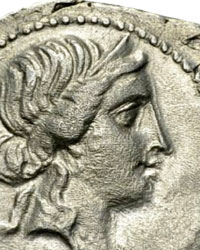
República Romana. Octaviano. Denarius Spring-early summer 36 BC


Abre às 11:00
Licitação inicial
€ 1
Adicione aos seus favoritos para receber um alerta quando o leilão começar.

Especialista
Selecionado por Carmen Vera Gutiérrez
Avaliadora experiente em antiguidades, especializada em moedas espanholas e antigas.
Estimativa € 1.800 - € 2.000
Proteção do comprador da Catawiki
O seu pagamento está seguro connosco até receber o seu objeto.Ver detalhes
Trustpilot 4.4 | 128340 avaliações
Classificada como Excelente na Trustpilot.
Descrição fornecida pelo vendedor
Very Scarce and Rare Gaius Octavius Gens: Julia Year and mint: 36 BC
DR-871 | Crawford: 540/2
Gaius Octavius
Gens: Julia Year and mint: 36 BC - ?Weight 3.85g, diameter 20mm
Obverse: Right-facing, bearded bust of Octavian. Dotted border.
Legend: IMP CAESAR DIVI F III VIR ITER R P C
Reverse: Tetrastyle temple; inside, a veiled figure holding a lituus in her right hand; above the architrave, DIVO·IVL; within the pediment, a star; to the left, an illuminated altar. Dotted border.
Legend: COS ITER ET TER DESIG
Commentary: The gens Julia was one of the oldest patrician families in Rome, claiming descent from Venus and Aeneas. Its most celebrated member, Julius Caesar, was assassinated on the Ides of March in 44 BC and soon became an official deity as Divus Iulius. His adopted heir, Gaius Octavius, knew how to exploit this divine lineage to legitimize his power during the turbulent period of the civil wars, presenting himself as divi filius, “son of the god.”
The denarius minted in 36 BC is an exceptional piece of propaganda, issued in the context of the campaign against Sextus Pompey, son of Caesar's great rival and master of the sea at that time. The obverse features the bust of a bearded Octavian, accompanied by the legend IMP CAESAR DIVI F III VIR ITER R P C. The beard, known as barba pietatis, symbolized mourning and an oath of vengeance for Caesar, even though Octavian had already shaved after Philippi. With this, the message was unequivocal: there was still an enemy to be eliminated to complete the revenge.
The reverse depicts the Temple of the Divine Julius (DIVO IVL) in the Roman Forum, erected on the site of his cremation. The statue of Caesar veiled in a lituus, the star of the Sidus Iulium on the pediment, and the burning altar evoke his apotheosis and solidify the cult that Octavian promoted in honor of his adoptive father. Although the temple was still under construction, its representation on the coin had clear propagandistic value: it proclaimed that Octavian's policy remained focused on avenging Caesar and fulfilling his destiny as heir. The inscription COS ITER ET TER DESIG underscores his political consolidation, indicating that he was already serving his second consulship and was designated for a third.
This denarius served a dual purpose: to finance the legions during the Sicilian War and to present the fight against Sextus Pompey as the culmination of revenge for Caesar. The decisive victory came shortly afterward, at the Battle of Naulochus (September 3, 36 BC), where Agrippa's fleet destroyed Sextus's, forcing him to flee eastward. Captured at Miletus the following year and executed on the orders of Mark Antony, Sextus was the last obstacle on Octavian's path to absolute power.
This coin embodies the key elements of early Augustan propaganda: divine lineage, the memory of Caesar, the promise of vengeance, and political legitimacy. Beyond its beauty, this piece encapsulates the transition between the civil wars and the unstoppable rise of the future Augustus
Very Scarce and Rare Gaius Octavius Gens: Julia Year and mint: 36 BC
DR-871 | Crawford: 540/2
Gaius Octavius
Gens: Julia Year and mint: 36 BC - ?Weight 3.85g, diameter 20mm
Obverse: Right-facing, bearded bust of Octavian. Dotted border.
Legend: IMP CAESAR DIVI F III VIR ITER R P C
Reverse: Tetrastyle temple; inside, a veiled figure holding a lituus in her right hand; above the architrave, DIVO·IVL; within the pediment, a star; to the left, an illuminated altar. Dotted border.
Legend: COS ITER ET TER DESIG
Commentary: The gens Julia was one of the oldest patrician families in Rome, claiming descent from Venus and Aeneas. Its most celebrated member, Julius Caesar, was assassinated on the Ides of March in 44 BC and soon became an official deity as Divus Iulius. His adopted heir, Gaius Octavius, knew how to exploit this divine lineage to legitimize his power during the turbulent period of the civil wars, presenting himself as divi filius, “son of the god.”
The denarius minted in 36 BC is an exceptional piece of propaganda, issued in the context of the campaign against Sextus Pompey, son of Caesar's great rival and master of the sea at that time. The obverse features the bust of a bearded Octavian, accompanied by the legend IMP CAESAR DIVI F III VIR ITER R P C. The beard, known as barba pietatis, symbolized mourning and an oath of vengeance for Caesar, even though Octavian had already shaved after Philippi. With this, the message was unequivocal: there was still an enemy to be eliminated to complete the revenge.
The reverse depicts the Temple of the Divine Julius (DIVO IVL) in the Roman Forum, erected on the site of his cremation. The statue of Caesar veiled in a lituus, the star of the Sidus Iulium on the pediment, and the burning altar evoke his apotheosis and solidify the cult that Octavian promoted in honor of his adoptive father. Although the temple was still under construction, its representation on the coin had clear propagandistic value: it proclaimed that Octavian's policy remained focused on avenging Caesar and fulfilling his destiny as heir. The inscription COS ITER ET TER DESIG underscores his political consolidation, indicating that he was already serving his second consulship and was designated for a third.
This denarius served a dual purpose: to finance the legions during the Sicilian War and to present the fight against Sextus Pompey as the culmination of revenge for Caesar. The decisive victory came shortly afterward, at the Battle of Naulochus (September 3, 36 BC), where Agrippa's fleet destroyed Sextus's, forcing him to flee eastward. Captured at Miletus the following year and executed on the orders of Mark Antony, Sextus was the last obstacle on Octavian's path to absolute power.
This coin embodies the key elements of early Augustan propaganda: divine lineage, the memory of Caesar, the promise of vengeance, and political legitimacy. Beyond its beauty, this piece encapsulates the transition between the civil wars and the unstoppable rise of the future Augustus
Dados
Era
Antes de 1400
Cultura/Região
República Romana
Ano / Período e Variação
Spring-early summer 36 BC
Governante
Octaviano
Denominação
Denarius
Metal
AR
Estado
Sem classificação
Vendido por