Wild Chrysanthemum - Beauty of Simplicity and Blank with Box - Attributed to Kano Tan'yū 狩野探幽 (1602-1674) - Japão - Início do período Edo (Sem preço de reserva)


02
dias
10
horas
08
minutos
46
segundos
Licitação atual
€ 55
Sem preço de reserva

Especialista
Selecionado por Giovanni Bottero
Possui mestrado em História da Arte Japonesa e mais de 10 anos de experiência.
Estimativa € 400 - € 500
37 outras pessoas estão de olho neste objeto
 Licitador 1281 Licitador 1281 | €55 | |
|---|---|---|
 Licitador 1180 Licitador 1180 | €50 | |
| Licitador 1281 | €45 | |
Proteção do comprador da Catawiki
O seu pagamento está seguro connosco até receber o seu objeto.Ver detalhes
Trustpilot 4.4 | 121798 avaliações
Classificada como Excelente na Trustpilot.
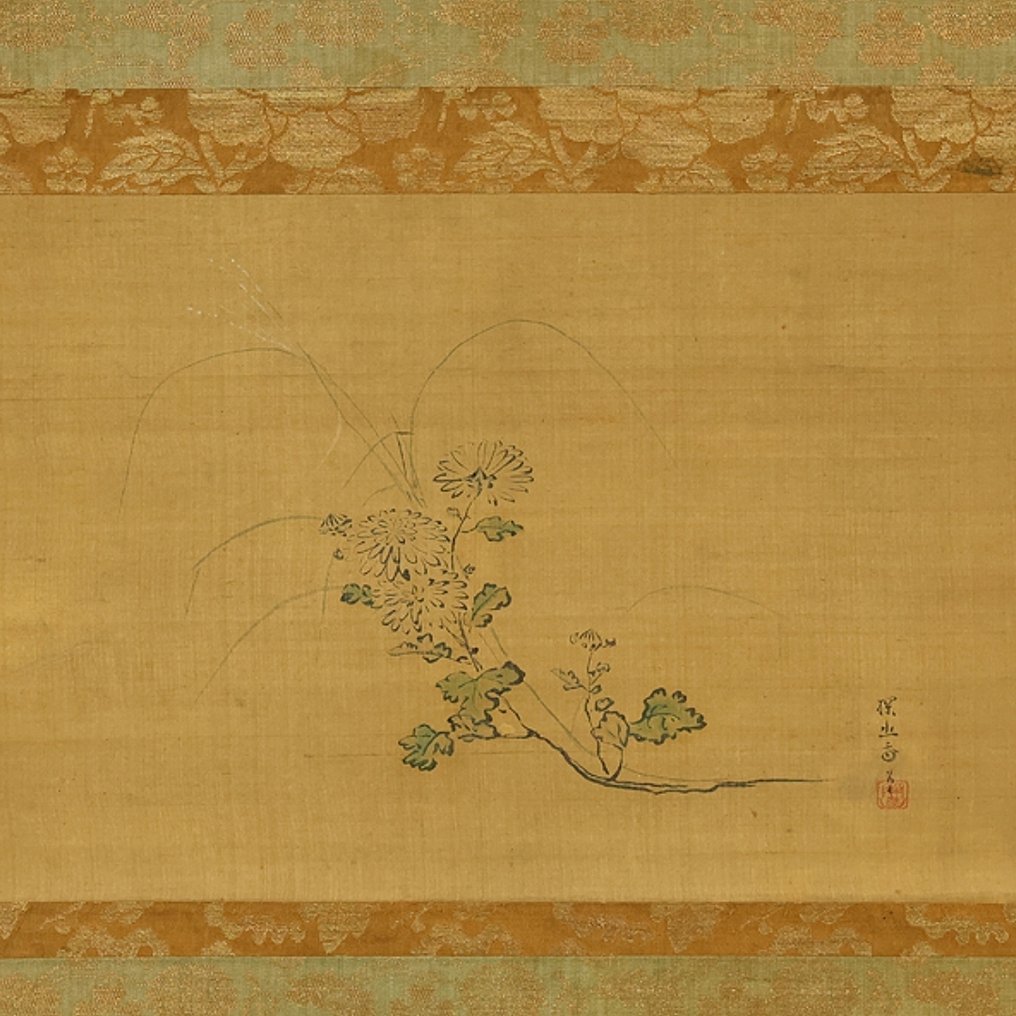
Uma kakejiku refinada atribuída a Kano Tan’yū do século XVII, pintada à mão com nogiku e uma composição minimalista que convida à contemplação.
Resumo assistido por IA
Descrição fornecida pelo vendedor
狩野探幽 Kano Tanyu (1602-1674)
Painter of the early Edo period and establisher of Edo Kano school. The eldest son of 狩野孝信 Kano Takanobu (1751-1618) and grandson of Kano Eitoku (1543-1590). Founder of the Kajibashi Kano school. He is said to be a precocious genius and is praised as the second coming of Eitoku. His wide range of works includes Sansui landscapes, figures, flowers, and birds. Tanyu's elegant new style, which made use of marginal spaces, was called the Edo Kano style, and it was inherited as the standard of the Kano school thereafter. He was active in the paintings of castles such as Nijo Castle, Osaka Castle, Nagoya Castle, and Edo Castle, as well as in the painting of the inner court. He was also in charge of the decoration of the Tokugawa family mausoleums such as Nikko Toshogu, Zojoji, Kan-eiji, and Edo Castle's Momijiyama.
with signature 'Tanyusai hitsu' 探幽斎筆 and seal 'Tanyu' 探幽
A refined Japanese hanging scroll attributed to Kanō Tan’yū (狩野探幽), a leading master of the early Edo period and one of the most influential painters of the Kanō school. The artwork presents a delicate rendering of wild chrysanthemums (nogiku), executed in subtle ink and color with a minimalist composition. In Japanese aesthetics, wild chrysanthemums symbolize modesty, transience, and seasonal change. Their understated beauty reflects the principles of wabi (quiet elegance) and kanso (simplicity), while the use of blank space (ma) invites contemplation and emotional resonance. Tan’yū’s botanical works are known for their poetic restraint and refined brushwork, capturing nature’s essence with minimal means. The scroll is accompanied by a preservation box. Likely produced in the mid-17th century, it embodies the philosophical depth and visual clarity of classical Japanese painting.
Attributed to 狩野探幽 Kano Tan'yū (1602-1674) Japanese antique art kakejiku kakemono wall hanging scroll / Wild Chrysanthemum - Beauty of Simplicity and Blank with Box
Whole dimensions: 20.3" W x 41.5" H / 51.6cm x 105.5cm
Inside dimensions: 14" W x 8.8" H / 35.6cm x 22.5cm
Material: Silk
Technique: Handpainted
Roller ends: Bone
Weight: 580g including Box
Condition
Antique items have originally crease, stain, damage, and more. I would like you to refer to the listing photos, but please understand that it's difficult to show all conditions by the photos. Special notes: STAIN, CREASE, DAMAGE a little, FOLD, STAIN in the back of the mounting.
Shipping
"FREE SHIPPING" all over the world by Registered Airmail, EMS, or DHL.
Mais sobre o vendedor
Reiwa Antiques é um antiquário oficialmente licenciado com sede no Japão, que oferece uma variedade de antiguidades japonesas autênticas, incluindo pinturas tradicionais, caligrafia requintada e lindos utensílios de chá. Nosso objetivo é continuar proporcionando a você uma experiência de compra agradável. Como parte disso, para reduzir ao máximo a sua carga de IVA e Imposto de Importação, oferecemos frete grátis. Lidamos com transações no exterior há mais de 10 anos. Tenha certeza de que sempre embalaremos seus itens com cuidado e faremos o nosso melhor para entregá-los com segurança. Os métodos de envio usuais são Correio Aéreo Registrado, EMS (Postal Expedido) ou DHL. Não hesite em entrar em contato comigo se tiver alguma dúvida ou precisar de ajuda.
Atenciosamente,
Antiguidades Reiwa
Traduzido pelo Google Tradutor狩野探幽 Kano Tanyu (1602-1674)
Painter of the early Edo period and establisher of Edo Kano school. The eldest son of 狩野孝信 Kano Takanobu (1751-1618) and grandson of Kano Eitoku (1543-1590). Founder of the Kajibashi Kano school. He is said to be a precocious genius and is praised as the second coming of Eitoku. His wide range of works includes Sansui landscapes, figures, flowers, and birds. Tanyu's elegant new style, which made use of marginal spaces, was called the Edo Kano style, and it was inherited as the standard of the Kano school thereafter. He was active in the paintings of castles such as Nijo Castle, Osaka Castle, Nagoya Castle, and Edo Castle, as well as in the painting of the inner court. He was also in charge of the decoration of the Tokugawa family mausoleums such as Nikko Toshogu, Zojoji, Kan-eiji, and Edo Castle's Momijiyama.
with signature 'Tanyusai hitsu' 探幽斎筆 and seal 'Tanyu' 探幽
A refined Japanese hanging scroll attributed to Kanō Tan’yū (狩野探幽), a leading master of the early Edo period and one of the most influential painters of the Kanō school. The artwork presents a delicate rendering of wild chrysanthemums (nogiku), executed in subtle ink and color with a minimalist composition. In Japanese aesthetics, wild chrysanthemums symbolize modesty, transience, and seasonal change. Their understated beauty reflects the principles of wabi (quiet elegance) and kanso (simplicity), while the use of blank space (ma) invites contemplation and emotional resonance. Tan’yū’s botanical works are known for their poetic restraint and refined brushwork, capturing nature’s essence with minimal means. The scroll is accompanied by a preservation box. Likely produced in the mid-17th century, it embodies the philosophical depth and visual clarity of classical Japanese painting.
Attributed to 狩野探幽 Kano Tan'yū (1602-1674) Japanese antique art kakejiku kakemono wall hanging scroll / Wild Chrysanthemum - Beauty of Simplicity and Blank with Box
Whole dimensions: 20.3" W x 41.5" H / 51.6cm x 105.5cm
Inside dimensions: 14" W x 8.8" H / 35.6cm x 22.5cm
Material: Silk
Technique: Handpainted
Roller ends: Bone
Weight: 580g including Box
Condition
Antique items have originally crease, stain, damage, and more. I would like you to refer to the listing photos, but please understand that it's difficult to show all conditions by the photos. Special notes: STAIN, CREASE, DAMAGE a little, FOLD, STAIN in the back of the mounting.
Shipping
"FREE SHIPPING" all over the world by Registered Airmail, EMS, or DHL.
Mais sobre o vendedor
Reiwa Antiques é um antiquário oficialmente licenciado com sede no Japão, que oferece uma variedade de antiguidades japonesas autênticas, incluindo pinturas tradicionais, caligrafia requintada e lindos utensílios de chá. Nosso objetivo é continuar proporcionando a você uma experiência de compra agradável. Como parte disso, para reduzir ao máximo a sua carga de IVA e Imposto de Importação, oferecemos frete grátis. Lidamos com transações no exterior há mais de 10 anos. Tenha certeza de que sempre embalaremos seus itens com cuidado e faremos o nosso melhor para entregá-los com segurança. Os métodos de envio usuais são Correio Aéreo Registrado, EMS (Postal Expedido) ou DHL. Não hesite em entrar em contato comigo se tiver alguma dúvida ou precisar de ajuda.
Atenciosamente,
Antiguidades Reiwa
Traduzido pelo Google TradutorDados
Artista
Attributed to Kano Tan'yū 狩野探幽 (1602-1674)
Atribuição
Atribuído a
Título da obra de arte
Wild Chrysanthemum - Beauty of Simplicity and Blank with Box
Assinatura
Assinado à mão
País de origem
Japão
Estado
Bom estado
Altura
105,5 cm
Largura
51,6 cm
Peso
580 g
Imagem/Tema
Plantas e flores
Estilo
Clássico
Período
do século XVII
Estilo/Período dinástico
Início do período Edo
Origem
Galeria / Antiquário
Vendido por
