Oene Romkes de Jongh (1812–1896) - Dorpstraat met Figuren en Paardenkar (NO RESERVE)



07
days
15
hours
15
minutes
24
seconds
Current bid
€ 325
No reserve price

Expert
Selected by Leo Setz
Over 30 years’ experience as art dealer, appraiser and restorer.
Estimate € 1,400 - € 1,700
79 other people are watching this object
 Bidder 7036 Bidder 7036 | €325 | |
|---|---|---|
 Bidder 4556 Bidder 4556 | €304 | |
 Bidder 7610 Bidder 7610 | €284 | |
Catawiki Buyer Protection
Your payment’s safe with us until you receive your object.View details
Trustpilot 4.4 | 123779 reviews
Rated Excellent on Trustpilot.
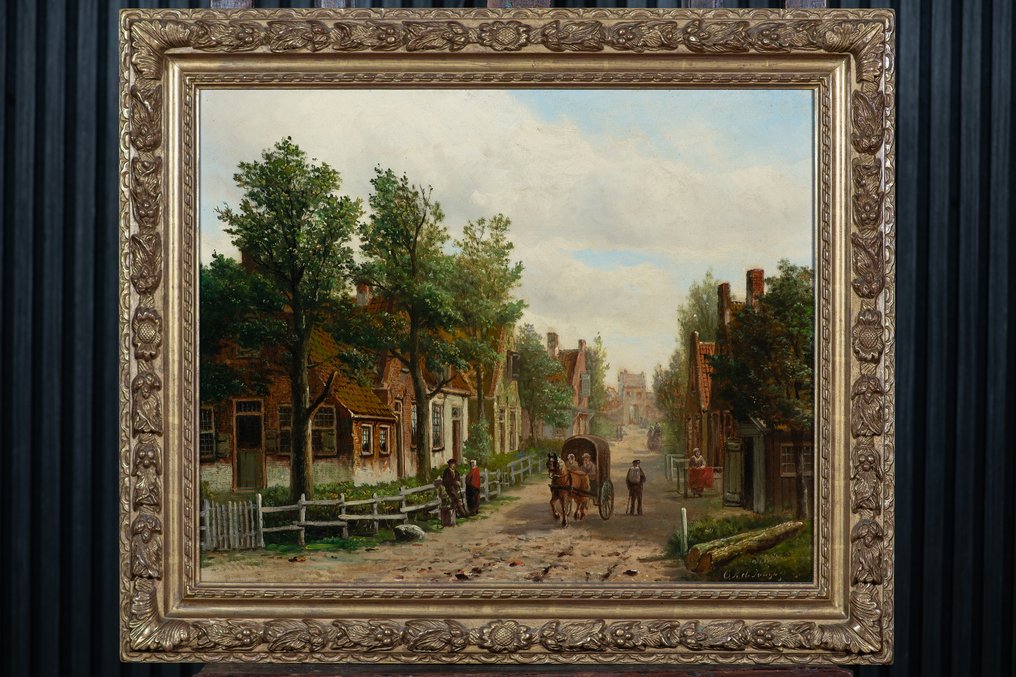
Dorpstraat met Figuren en Paardenkar, a 19th‑century oil on canvas by Oene Romkes de Jongh (Netherlands), signed, in good condition, with a frame, measuring 69.5 × 82 cm including the frame.
AI-assisted summary
Description from the seller
Oene Romkes de Jongh (1812–1896)
Dorpstraat with figures and a horse-drawn carriage
Oil painting on canvas, 54 × 66.5 cm; with frame 69.5 × 82 cm
hand-signed at the bottom right
Condition: light craquelure; minimal retouchings visible under UV light.
Introduction
This characteristic village scene belongs to the core repertoire of Oene Romkes de Jongh, a painter who gained significant recognition in the nineteenth century for his meticulously detailed Dutch street views and intimate, recognizable atmospheric images. His work demonstrates a pronounced focus on architecture, artisanal detailing, and the liveliness of everyday village life. Within the context of Dutch Romanticism, this painting is a representative and high-quality example of the genre landscape that helped De Jongh build a solid reputation.
Description of the work
The scene depicts a wide village street flanked by low brick houses, wooden fences, and mature trees that give the street a pleasant rhythm. Central in the composition, a horse-drawn cart slowly moves along the dusty road, accompanied by walking figures and residents who seem to be conversing. On the right side, a woman leans over a doorpost, while further in the distance, the street narrows towards a building resembling a city gate. De Jongh arranges these elements with remarkable clarity: he constructs the scene from a low horizon and a deep perspective that gradually guides the viewer's eye to the background. The refined detailing of windows, roof tiles, fences, and vegetation is characteristic of his work and contributes to the authentic character of the scene.
Technique and use of color
De Jongh works with a disciplined, subtle oil painting technique that emphasizes precise brushwork and controlled tonal transitions. The color palette is warm and harmonious, with earth tones for architecture, saturated greens for foliage, and bright light in the sky and clouds. The atmospheric transparency and subtle modulation between light and shadow give the canvas a convincing sense of depth. The paint layer shows slight craquelure, appropriate for the age of the painting; under UV light, only minor and carefully executed retouchings are visible, indicating a stable and well-preserved condition.
Composition and art historical context
Within Dutch Romanticism, De Jongh occupies a place among artists who shaped the historical, rural, and small-town identity of the Netherlands with a strong emphasis on character, atmosphere, and recognizability. His work aligns with the nineteenth-century reevaluation of the national landscape and Dutch life, where tradition, craftsmanship, and picturesque simplicity were central. The balanced composition, narrative detail, and historical sensitivity clearly place this work within this movement, which includes, among others, Cornelis Springer, Adrianus Eversen, Charles Busson, and Carl Hasch as stylistic contemporaries.
The artist
Oene Romkes de Jongh was born in Harlingen and developed into a skilled painter of Dutch city and village scenes. He was active during a period when interest in realistic detailed topographical representations greatly increased, and his body of work is characterized by a consistent dedication to accurate architectural depiction and lively genre elements. His street scenes are among the most valued parts of his oeuvre and form a recognizable contribution to Dutch Romanticism of the second half of the nineteenth century.
Condition
The painting is in good, stable condition. The paint shows a light, even craquelure that is consistent with the age of the work. UV examination reveals some minimal retouching that has been carefully and discreetly carried out, without compromising the integrity of the image. The canvas is firmly stretched and is presented in a richly profiled, decorative frame that gives the work a representative appearance.
Final remarks
This painting forms a pure and attractive example of Oene Romkes de Jongh's contribution to Dutch Romanticism. The combination of topographical accuracy, narrative liveliness, and technical refinement makes it a particularly collectible work within the genre of nineteenth-century village scenes. The authentic signature, well-preserved condition, and characteristic themes contribute to the museum-like appearance that makes this work especially appealing in a premium auction context.
The work 'Dorpstraat met Figuren en Paardenkar' is in a gilded bronze-golden wooden frame with plaster ornaments.
Total dimensions: 69.5 × 82 cm
Canvas dimensions: 54 × 66.5 cm
All shipments are sent in professional packaging via FedEx, DPD, or PostNL.
For all shipments, a surcharge for packaging material applies, which is already included in the stated shipping price.
Shipping artworks always carries certain risks. While shipping is possible, we recommend collecting the artwork in person when this option is available. If shipping is chosen, this is entirely at the buyer's risk. Collection ensures that the artwork will be received undamaged and in perfect condition. After purchase, you can easily schedule an appointment to collect the artwork from our workshop and studio, where it will be safely and carefully prepared for you.
Transport quotation request via our website (Service-transport) or via Catawiki support.
When purchasing this artwork, you have the option to have it delivered with or without a frame. The frame, richly decorated and matching the artwork, is offered free of charge so you can hang the painting immediately. Although we take utmost care in professional packaging and shipping, there is a small risk of damage to the frame or glass during transport. Any damage to the frame or glass that does not affect the artwork itself will not be accepted as a valid reason for a claim or cancellation. We recommend collecting the artwork in person or arranging your own transportation, as damage to the frame, especially the plaster ornaments, will not be covered.
We aim to deliver your artwork to you safely and in optimal condition, paying careful attention to packaging and the shipping process. If you have any questions or special requests, you can always contact Catawiki customer service.
The customer is responsible for any customs duties and additional costs that may apply upon delivery abroad.
Seller's Story
Welcome to Vandenberg Fine Art BV on Catawiki.
Vandenberg Fine Art BV specializes in painting from the 15th through the 19th century, with a particular focus on Dutch, Flemish, and Italian masters. Our carefully curated collection comprises high-quality artworks distinguished by their artistic merit, authenticity, and historical significance.
Our offering includes works by leading artists of the Dutch and Flemish schools, as well as important representatives of the Italian Renaissance and Baroque. Each artwork is selected with expertise and care, with close attention paid to condition, provenance, and art-historical relevance.
At Vandenberg Fine Art, reliability and transparency are fundamental values. We provide detailed descriptions, high-quality images, and thoroughly conducted provenance research. Our aim is to support both experienced collectors and emerging art enthusiasts in making well-informed decisions.
Explore our exclusive collection and experience the rich history and enduring beauty of classical painting.
Translated by Google TranslateOene Romkes de Jongh (1812–1896)
Dorpstraat with figures and a horse-drawn carriage
Oil painting on canvas, 54 × 66.5 cm; with frame 69.5 × 82 cm
hand-signed at the bottom right
Condition: light craquelure; minimal retouchings visible under UV light.
Introduction
This characteristic village scene belongs to the core repertoire of Oene Romkes de Jongh, a painter who gained significant recognition in the nineteenth century for his meticulously detailed Dutch street views and intimate, recognizable atmospheric images. His work demonstrates a pronounced focus on architecture, artisanal detailing, and the liveliness of everyday village life. Within the context of Dutch Romanticism, this painting is a representative and high-quality example of the genre landscape that helped De Jongh build a solid reputation.
Description of the work
The scene depicts a wide village street flanked by low brick houses, wooden fences, and mature trees that give the street a pleasant rhythm. Central in the composition, a horse-drawn cart slowly moves along the dusty road, accompanied by walking figures and residents who seem to be conversing. On the right side, a woman leans over a doorpost, while further in the distance, the street narrows towards a building resembling a city gate. De Jongh arranges these elements with remarkable clarity: he constructs the scene from a low horizon and a deep perspective that gradually guides the viewer's eye to the background. The refined detailing of windows, roof tiles, fences, and vegetation is characteristic of his work and contributes to the authentic character of the scene.
Technique and use of color
De Jongh works with a disciplined, subtle oil painting technique that emphasizes precise brushwork and controlled tonal transitions. The color palette is warm and harmonious, with earth tones for architecture, saturated greens for foliage, and bright light in the sky and clouds. The atmospheric transparency and subtle modulation between light and shadow give the canvas a convincing sense of depth. The paint layer shows slight craquelure, appropriate for the age of the painting; under UV light, only minor and carefully executed retouchings are visible, indicating a stable and well-preserved condition.
Composition and art historical context
Within Dutch Romanticism, De Jongh occupies a place among artists who shaped the historical, rural, and small-town identity of the Netherlands with a strong emphasis on character, atmosphere, and recognizability. His work aligns with the nineteenth-century reevaluation of the national landscape and Dutch life, where tradition, craftsmanship, and picturesque simplicity were central. The balanced composition, narrative detail, and historical sensitivity clearly place this work within this movement, which includes, among others, Cornelis Springer, Adrianus Eversen, Charles Busson, and Carl Hasch as stylistic contemporaries.
The artist
Oene Romkes de Jongh was born in Harlingen and developed into a skilled painter of Dutch city and village scenes. He was active during a period when interest in realistic detailed topographical representations greatly increased, and his body of work is characterized by a consistent dedication to accurate architectural depiction and lively genre elements. His street scenes are among the most valued parts of his oeuvre and form a recognizable contribution to Dutch Romanticism of the second half of the nineteenth century.
Condition
The painting is in good, stable condition. The paint shows a light, even craquelure that is consistent with the age of the work. UV examination reveals some minimal retouching that has been carefully and discreetly carried out, without compromising the integrity of the image. The canvas is firmly stretched and is presented in a richly profiled, decorative frame that gives the work a representative appearance.
Final remarks
This painting forms a pure and attractive example of Oene Romkes de Jongh's contribution to Dutch Romanticism. The combination of topographical accuracy, narrative liveliness, and technical refinement makes it a particularly collectible work within the genre of nineteenth-century village scenes. The authentic signature, well-preserved condition, and characteristic themes contribute to the museum-like appearance that makes this work especially appealing in a premium auction context.
The work 'Dorpstraat met Figuren en Paardenkar' is in a gilded bronze-golden wooden frame with plaster ornaments.
Total dimensions: 69.5 × 82 cm
Canvas dimensions: 54 × 66.5 cm
All shipments are sent in professional packaging via FedEx, DPD, or PostNL.
For all shipments, a surcharge for packaging material applies, which is already included in the stated shipping price.
Shipping artworks always carries certain risks. While shipping is possible, we recommend collecting the artwork in person when this option is available. If shipping is chosen, this is entirely at the buyer's risk. Collection ensures that the artwork will be received undamaged and in perfect condition. After purchase, you can easily schedule an appointment to collect the artwork from our workshop and studio, where it will be safely and carefully prepared for you.
Transport quotation request via our website (Service-transport) or via Catawiki support.
When purchasing this artwork, you have the option to have it delivered with or without a frame. The frame, richly decorated and matching the artwork, is offered free of charge so you can hang the painting immediately. Although we take utmost care in professional packaging and shipping, there is a small risk of damage to the frame or glass during transport. Any damage to the frame or glass that does not affect the artwork itself will not be accepted as a valid reason for a claim or cancellation. We recommend collecting the artwork in person or arranging your own transportation, as damage to the frame, especially the plaster ornaments, will not be covered.
We aim to deliver your artwork to you safely and in optimal condition, paying careful attention to packaging and the shipping process. If you have any questions or special requests, you can always contact Catawiki customer service.
The customer is responsible for any customs duties and additional costs that may apply upon delivery abroad.
Seller's Story
Welcome to Vandenberg Fine Art BV on Catawiki.
Vandenberg Fine Art BV specializes in painting from the 15th through the 19th century, with a particular focus on Dutch, Flemish, and Italian masters. Our carefully curated collection comprises high-quality artworks distinguished by their artistic merit, authenticity, and historical significance.
Our offering includes works by leading artists of the Dutch and Flemish schools, as well as important representatives of the Italian Renaissance and Baroque. Each artwork is selected with expertise and care, with close attention paid to condition, provenance, and art-historical relevance.
At Vandenberg Fine Art, reliability and transparency are fundamental values. We provide detailed descriptions, high-quality images, and thoroughly conducted provenance research. Our aim is to support both experienced collectors and emerging art enthusiasts in making well-informed decisions.
Explore our exclusive collection and experience the rich history and enduring beauty of classical painting.
Translated by Google TranslateDetails
Artist
Oene Romkes de Jongh (1812–1896)
Sold with frame
Yes
Title of artwork
Dorpstraat met Figuren en Paardenkar (NO RESERVE)
Technique
Oil painting
Signature
Hand signed
Country of Origin
Netherlands
Condition
Good condition
Height
69.5 cm
Width
82 cm
Depiction/Theme
Cityscape
Style
Romanticism
Period
19th century
Sold by
