Hartmann Schedel - The Nuremberg Chronicle (Liber Chronicarum) - Folio 181 - 1493




08
days
05
hours
00
minutes
29
seconds

No bids placed
Catawiki Buyer Protection
Your payment’s safe with us until you receive your object.View details
Trustpilot 4.4 | 122910 reviews
Rated Excellent on Trustpilot.
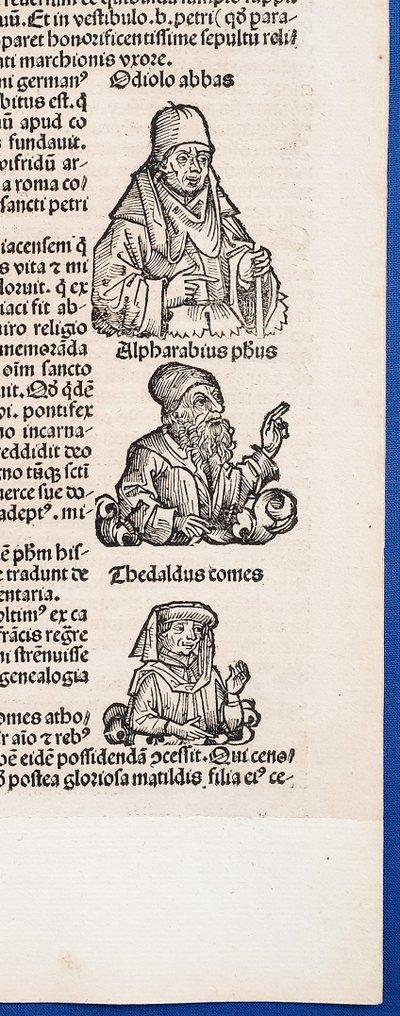
Hartmann Schedel’s The Nuremberg Chronicle (Liber Chronicarum), Folio 181, a single 1493 Latin edition item measuring 42 × 28 cm with 12 woodcuts, in good condition with bottom restoration and a small tear.
AI-assisted summary
Description from the seller
Folio CLXXXI (181) from the Latin edition of The Nuremberg Chronicle (Liber Chronicarum) by Hartman Schedel from 1493 - 42 x 28 cm - with 12 wood engravings.
Folio 181 - Recto - contains descriptions and images of:
Otto II (955–983), emperor of the Holy Roman Empire from 973 until his death in 983.
Odilo of Cluny (ca. 962–1049), an important abbot of the Abbey of Cluny.
Al-Farabi (ca. 872–950), a renowned Islamic philosopher, scientist, and musician.
Ibn al-Athir (1160–1233), a well-known Arab historian.
- Bruno van Keulen (925–965), archbishop of Keulen and Duke of Lotharingen.
Eduardus Rex (c. 1003–1066), King of England from 1042 to 1066. He is known for the construction of Westminster Abbey.
- Ludovicus rex: Louis the Pious (778–840), son of Charlemagne and emperor of the Frankish Empire, or Louis VI (1081–1137), king of France.
Folio 181 - Verso - contains wood engravings of the popes.
Johannes XV (reigned from 985 to 996)
- Gregory V (reigned 996–999)
Sylvester II (reigned 999–1003)
Johannes XVII (ruled for a few months in 1003)
Johannes XVIII (reigned 1003–1009)
The Chronicle was written by Hartmann Schedel, a doctor, humanist, and book collector from Nuremberg. The work was completed in 1493 and is one of the most extensive illustrated books of the 15th century. It is a universal history from the creation of the world to the end of the 15th century, combining biblical, mythological, and historical stories with images of cities, people, and events.
The book contains 1,809 woodcuts, created by Michael Wolgemut and Wilhelm Pleydenwurff, and possibly also by the young Albrecht Dürer, who was working in their studio at the time.
State: the page was restored at the bottom (stabilized), but still shows a small crack. The page is in good condition.
Folio CLXXXI (181) from the Latin edition of The Nuremberg Chronicle (Liber Chronicarum) by Hartman Schedel from 1493 - 42 x 28 cm - with 12 wood engravings.
Folio 181 - Recto - contains descriptions and images of:
Otto II (955–983), emperor of the Holy Roman Empire from 973 until his death in 983.
Odilo of Cluny (ca. 962–1049), an important abbot of the Abbey of Cluny.
Al-Farabi (ca. 872–950), a renowned Islamic philosopher, scientist, and musician.
Ibn al-Athir (1160–1233), a well-known Arab historian.
- Bruno van Keulen (925–965), archbishop of Keulen and Duke of Lotharingen.
Eduardus Rex (c. 1003–1066), King of England from 1042 to 1066. He is known for the construction of Westminster Abbey.
- Ludovicus rex: Louis the Pious (778–840), son of Charlemagne and emperor of the Frankish Empire, or Louis VI (1081–1137), king of France.
Folio 181 - Verso - contains wood engravings of the popes.
Johannes XV (reigned from 985 to 996)
- Gregory V (reigned 996–999)
Sylvester II (reigned 999–1003)
Johannes XVII (ruled for a few months in 1003)
Johannes XVIII (reigned 1003–1009)
The Chronicle was written by Hartmann Schedel, a doctor, humanist, and book collector from Nuremberg. The work was completed in 1493 and is one of the most extensive illustrated books of the 15th century. It is a universal history from the creation of the world to the end of the 15th century, combining biblical, mythological, and historical stories with images of cities, people, and events.
The book contains 1,809 woodcuts, created by Michael Wolgemut and Wilhelm Pleydenwurff, and possibly also by the young Albrecht Dürer, who was working in their studio at the time.
State: the page was restored at the bottom (stabilized), but still shows a small crack. The page is in good condition.
Details
Number of Books
1
Book Title
Hartmann Schedel - The Nuremberg Chronicle (Liber Chronicarum) - Folio 181
Condition
Good
Publication year oldest item
1493
Height
42 cm
Width
28 cm
