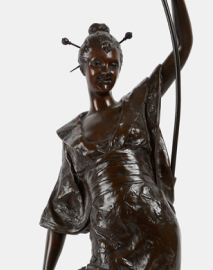
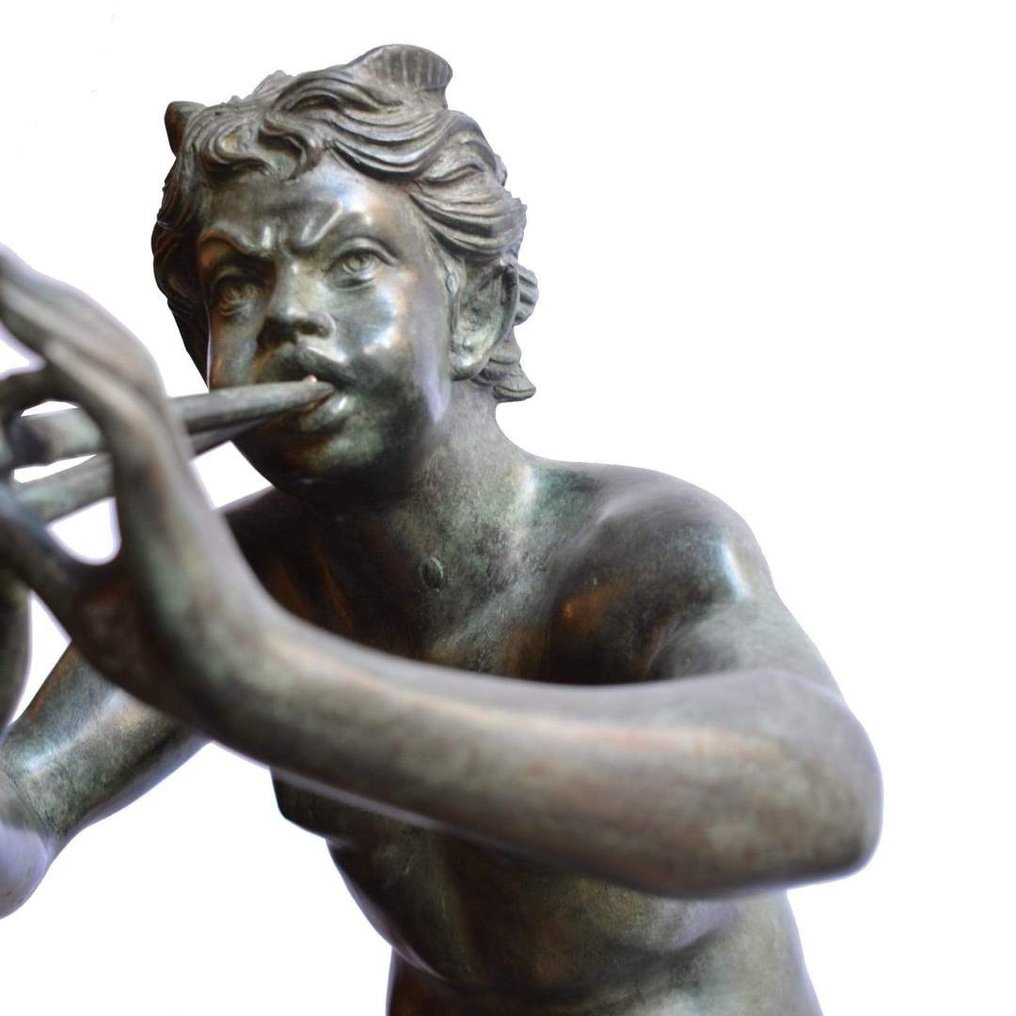
Sculpture, Pan Con Pifferi - 71 cm - Bronze


01
day
22
hours
17
minutes
57
seconds
Current bid
€ 550
Reserve price not met

Expert
Selected by Paul Wullems
He accumulated 18 years' experience, worked as junior specialist at Sotheby’s and managed Kunsthandel Jacques Fijnaut.
Estimate € 1,300 - € 1,600
30 other people are watching this object
 Bidder 2974 Bidder 2974 | €550 | |
|---|---|---|
 Bidder 3162 Bidder 3162 | €9 | |
 Bidder 4470 Bidder 4470 | €8 | |
Catawiki Buyer Protection
Your payment’s safe with us until you receive your object.View details
Trustpilot 4.4 | 123253 reviews
Rated Excellent on Trustpilot.
Description from the seller
Faun with pipes — Bronze sculpture in lost wax technique inspired by Pompeian art
Brief description
Bronze sculpture depicting a Faun with pipes, inspired by drawings found during the excavations of Pompeii and by a fresco preserved at the National Archaeological Museum of Naples. A work of great mythological and decorative charm, handcrafted in Italy.
Extended description
This sculpture depicts the Faun, a nature deity from the Greco-Roman world, represented with goat legs, a tail, and a human torso, engaged in playing the pipes. The work draws inspiration from Pompeian iconographic evidence — drawings and frescoes — which reflect the ancient imagery associated with music, the forest, and pastoral life.
Central figure of Greek mythology, the Faun is also known as Pan, god of the fields, pastures, and forests. Symbol of freedom, instinctive joy, and primal vitality, he embodies the wildest and most fertile aspect of nature, oscillating between benevolence and unease, celebration and mystery.
The sculpture is made of bronze using the lost wax casting technique, a traditional method that allows for high detail definition and a strong plastic presence. The base, also in bronze, ensures stability and material continuity of the work.
Technical specifications
Material: bronze, lost wax casting
Bronze, lost wax casting.
Overall dimensions (HxLxW): 71 x 36 x 24.5 cm
Base height: 18 cm
Weight: about 14 kg
Production: artisanal, Italy
Mythological context and historical curiosities
According to myth, the Faun did not dwell in Olympus but in the woods and fields, where his presence could instill fear in travelers with sudden voices and unsettling sounds. Several traditions recount his origins: one of them claims he is the son of Zeus and the nymph Callisto.
God of fertility, unrestrained freedom, and vital instinct, the Faun is also credited with the invention of the flute. Legend tells that the nymph Siringa, to escape his advances, sought help from the Naiads and was transformed into a reed. From the sound produced by the wind among the reeds, Pan drew inspiration to create the musical instrument that bears his name.
Conditions and maintenance.
To preserve the beauty of the sculpture, regular cleaning with a soft, dry cloth is recommended. Avoid the use of aggressive chemical cleaners that could alter the patina. When necessary, a specific wax for bronzes can be applied to revive the surface.
Note:
Decorative work with a strong visual impact and symbolic and mythological significance.
Ideal for collectors, classic or contemporary environments, and representative spaces.
Professional shipping and packaging.
Faun with pipes — Bronze sculpture in lost wax technique inspired by Pompeian art
Brief description
Bronze sculpture depicting a Faun with pipes, inspired by drawings found during the excavations of Pompeii and by a fresco preserved at the National Archaeological Museum of Naples. A work of great mythological and decorative charm, handcrafted in Italy.
Extended description
This sculpture depicts the Faun, a nature deity from the Greco-Roman world, represented with goat legs, a tail, and a human torso, engaged in playing the pipes. The work draws inspiration from Pompeian iconographic evidence — drawings and frescoes — which reflect the ancient imagery associated with music, the forest, and pastoral life.
Central figure of Greek mythology, the Faun is also known as Pan, god of the fields, pastures, and forests. Symbol of freedom, instinctive joy, and primal vitality, he embodies the wildest and most fertile aspect of nature, oscillating between benevolence and unease, celebration and mystery.
The sculpture is made of bronze using the lost wax casting technique, a traditional method that allows for high detail definition and a strong plastic presence. The base, also in bronze, ensures stability and material continuity of the work.
Technical specifications
Material: bronze, lost wax casting
Bronze, lost wax casting.
Overall dimensions (HxLxW): 71 x 36 x 24.5 cm
Base height: 18 cm
Weight: about 14 kg
Production: artisanal, Italy
Mythological context and historical curiosities
According to myth, the Faun did not dwell in Olympus but in the woods and fields, where his presence could instill fear in travelers with sudden voices and unsettling sounds. Several traditions recount his origins: one of them claims he is the son of Zeus and the nymph Callisto.
God of fertility, unrestrained freedom, and vital instinct, the Faun is also credited with the invention of the flute. Legend tells that the nymph Siringa, to escape his advances, sought help from the Naiads and was transformed into a reed. From the sound produced by the wind among the reeds, Pan drew inspiration to create the musical instrument that bears his name.
Conditions and maintenance.
To preserve the beauty of the sculpture, regular cleaning with a soft, dry cloth is recommended. Avoid the use of aggressive chemical cleaners that could alter the patina. When necessary, a specific wax for bronzes can be applied to revive the surface.
Note:
Decorative work with a strong visual impact and symbolic and mythological significance.
Ideal for collectors, classic or contemporary environments, and representative spaces.
Professional shipping and packaging.
Details
Era
1900-2000
Country of Origin
Italy
Material
Bronze
Title of artwork
Pan Con Pifferi
Signature
Not signed
Condition
Excellent condition
Height
71 cm
Width
36 cm
Depth
24 cm
Weight
13 kg
Sold by