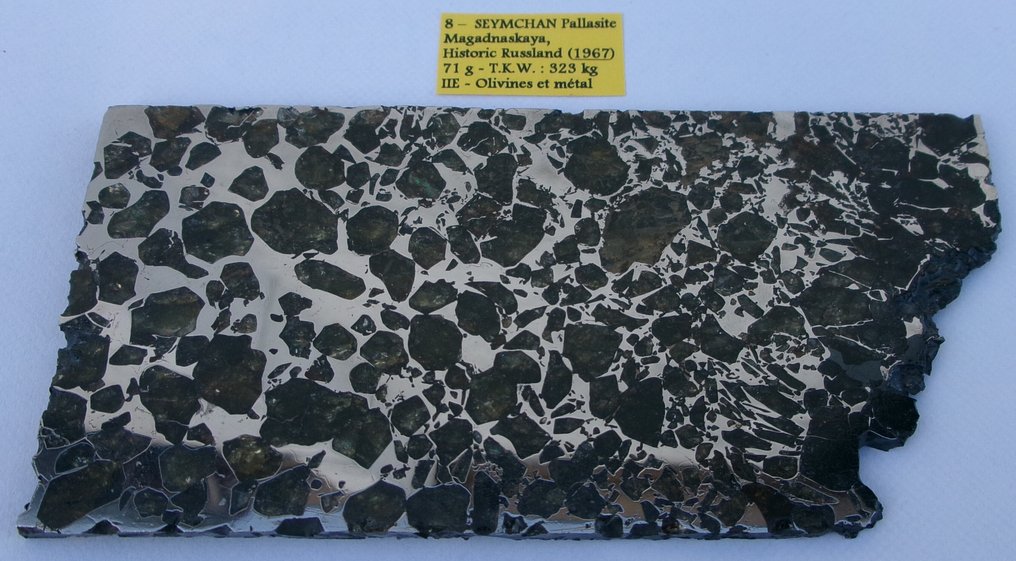
Seymchan meteorite Pallasitic - Height: 10.5 cm - Width: 5.3 cm - 71 g - (1)


00
days
16
hours
41
minutes
50
seconds
Current bid
€ 121
Reserve price not met

Expert
Selected by Francesco Moser
Over 20 years collecting meteorites; former museum curator and experienced restorer.
Estimate € 1,300 - € 1,500
20 other people are watching this object
 Bidder 8276 Bidder 8276 | €121 | |
|---|---|---|
 Bidder 8436 Bidder 8436 | €111 | |
| Bidder 4347 | €101 | |
Catawiki Buyer Protection
Your payment’s safe with us until you receive your object.View details
Trustpilot 4.4 | 123718 reviews
Rated Excellent on Trustpilot.
Description from the seller
SEYMCHAN Pallasite
Magadnaskaya
Historic Russia (1967)
70.98g - T.K.W.: 323 kg
IIE - Olivines and metal
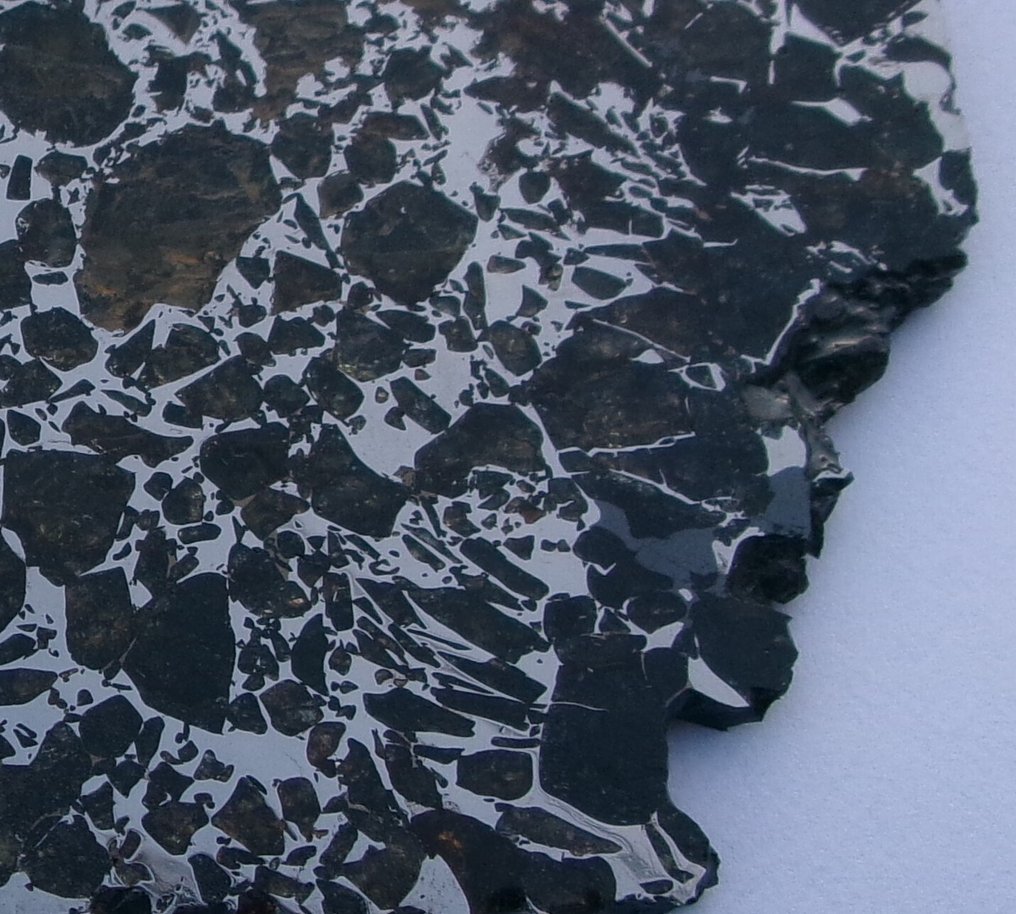
Exceptional slice of Seymchan meteorite, Museum quality with olivines perfectly detached from the matrix!
The quality of this thick slice with a superb mirror finish reveals, under light, beautiful translucent olivines with various hues!
Seymchan is a meteorite called 'Pallasite'; discovered in the dried bed of the Hekandue River, in the Magadan district (Russia), near the colony of Seymchan, in 1967.
The main mass of 272.3 kg was discovered during a study conducted in June 1967 by geologist FA Mednikov. The mass was triangular in shape, lying among the stones of the streambed.
A second specimen weighing 51 kg was found with a mine detector 20 meters from the first one in October by Markov.
The main mass was preserved at the USSR Academy of Sciences.
During a new expedition in 2004, Dmitri Kachalin recovered approximately 50 kg of new material. Remarkably, about 20% of the new specimens contained olivine crystals. The pallasitic structure had not yet been discovered during studies on small sections of the original mass, which consisted solely of metal.
Seymchan belongs to the main group of pallasites, but it is considered abnormal due to its high iridium content. Before the discovery of its pallasitic structure, it was classified as an anomalous coarse octahedrite IIE.
This perfect slice of Seymchan is considered to be stable, resistant to rust.
Beautiful specimen of quality to keep in your collection!!!
SEYMCHAN Pallasite
Magadnaskaya
Historic Russia (1967)
70.98g - T.K.W.: 323 kg
IIE - Olivines and metal
Exceptional slice of Seymchan meteorite, Museum quality with olivines perfectly detached from the matrix!
The quality of this thick slice with a superb mirror finish reveals, under light, beautiful translucent olivines with various hues!
Seymchan is a meteorite called 'Pallasite'; discovered in the dried bed of the Hekandue River, in the Magadan district (Russia), near the colony of Seymchan, in 1967.
The main mass of 272.3 kg was discovered during a study conducted in June 1967 by geologist FA Mednikov. The mass was triangular in shape, lying among the stones of the streambed.
A second specimen weighing 51 kg was found with a mine detector 20 meters from the first one in October by Markov.
The main mass was preserved at the USSR Academy of Sciences.
During a new expedition in 2004, Dmitri Kachalin recovered approximately 50 kg of new material. Remarkably, about 20% of the new specimens contained olivine crystals. The pallasitic structure had not yet been discovered during studies on small sections of the original mass, which consisted solely of metal.
Seymchan belongs to the main group of pallasites, but it is considered abnormal due to its high iridium content. Before the discovery of its pallasitic structure, it was classified as an anomalous coarse octahedrite IIE.
This perfect slice of Seymchan is considered to be stable, resistant to rust.
Beautiful specimen of quality to keep in your collection!!!
Details
Number of items
1
Name of meteorite
Seymchan meteorite
Type of meteorite
Pallasitic
Supplement
HUGE! An exceptional slice of Seymchan Pallasite, polished to a mirror finish with translucent
Weight
71 g
Origin (Region/ City)
Magadnaskaya
Country of Origin
Russia
Height
10.5 cm
Width
5.3 cm
Depth
0.3 cm
Sold by