Surahi, an elegant wine bottle made from bronze casting using the lost wax process. - Bronze - India - Mughal Empire (1526-1857)




02
days
06
hours
49
minutes
13
seconds
Starting bid
€ 1
Reserve price not met

Expert
Selected by Surya Rutten
Has over 25 years' experience in Asian art and owned an art gallery.
Estimate € 210 - € 240
No bids placed
Catawiki Buyer Protection
Your payment’s safe with us until you receive your object.View details
Trustpilot 4.4 | 123113 reviews
Rated Excellent on Trustpilot.
Bronze surahi from the Mughal Empire (1526–1857), northern India, attributed Originale, 20 cm high, produced by lost-wax bronze casting with incised vegetal motifs.
AI-assisted summary
Description from the seller
Elegant Surāhī in bronze engraved with lost-wax casting
Northern India, Indo-Persian area, 18th century (or earlier)
Imposing surāhī (ritual vessel or container for liquids), entirely made of cast bronze using the lost-wax technique, with a surface finely engraved with stylized vegetal motifs. The piece is a fine example of northern Indian metallurgical art, likely originating from the Mughal area or within the Indo-Persian cultural sphere, where the production of everyday metal objects was closely linked to both ceremonial practices and courtly aesthetics.
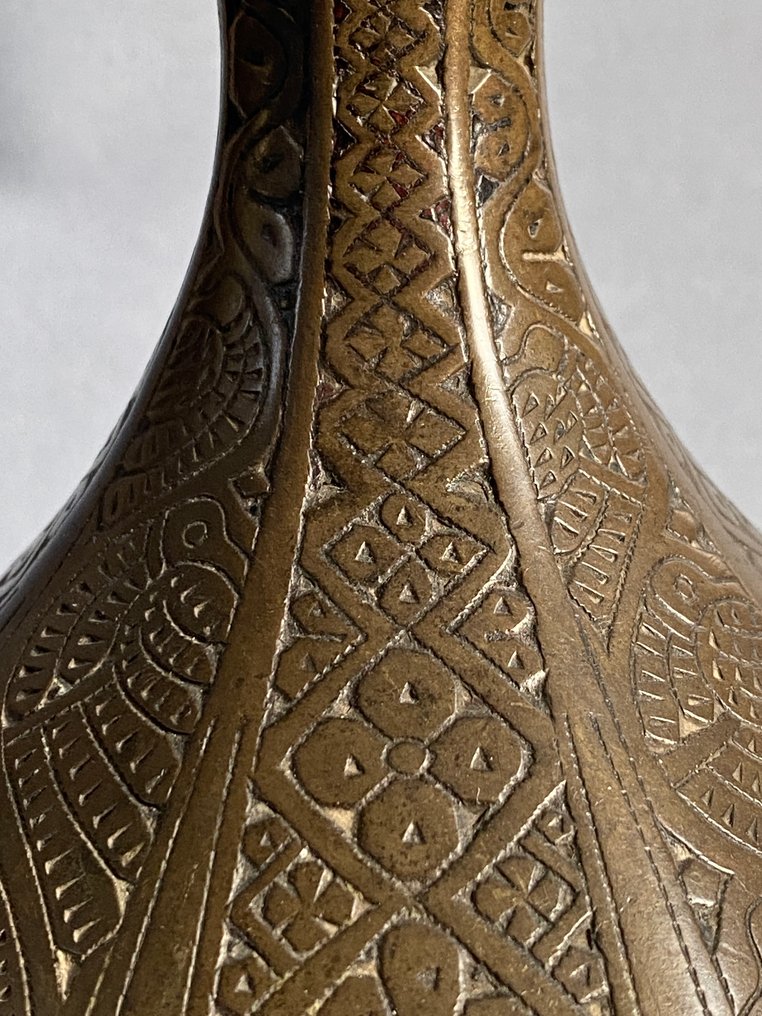
The shape features a slender structure, with a globular, polylobed body, a tapered and flared neck, and an elegant disc-shaped constriction, a distinctive feature of many Moghul-era productions from the 17th to 18th centuries. The entire surface of the vessel is divided into vertical registers decorated with intricate floral scrolls, intertwined branches, and stylized leaves, incised with a sharp and continuous stroke, following a decorative tradition that directly parallels motifs found in Islamic book and miniature art. These embellishments serve not only an aesthetic purpose but also reflect the spiritual and contemplative dimension of the object itself, often intended for ceremonial or elite domestic settings.
The typology of surāhī is well documented in the literature and is frequently compared across specimens published in museum catalogues, notably including Mark Zebrowski's 'Gold, Silver and Bronze from Mughal India' (1981), where similar models, although more richly decorated, are illustrated in the sections dedicated to the metalworking production of the Deccan and northern India. This specimen, due to its sober elegance and formal purity, belongs to a functional typology, but one of the highest execution standards.
The contact wear and the rich brown patina with light oxidation attest to prolonged use consistent with the antiquity of the work. The smooth, unsigned base suggests a refined workshop production, but not necessarily intended for the imperial sphere, rather for a high private or noble clientele.
N.B.
For administrative reasons, Italian buyers are required to provide their fiscal code, which is essential for the proper issuance of the electronic invoice.
For administrative reasons related to current Italian regulations, foreign customers are kindly asked to provide their place and date of birth via email message using the appropriate form on Catawiki.
Seller's Story
Ethnologica was born from the love and passion for the ancient culture of Oriental, Islamic and Indian art. Refined works of art make up a constantly evolving collection capable of satisfying the needs of admirers, enthusiasts and collectors.
Ethnologica has also contributed as a lender to sector cultural exhibitions alongside prestigious public and private cultural associations and foundations.
Translated by Google TranslateElegant Surāhī in bronze engraved with lost-wax casting
Northern India, Indo-Persian area, 18th century (or earlier)
Imposing surāhī (ritual vessel or container for liquids), entirely made of cast bronze using the lost-wax technique, with a surface finely engraved with stylized vegetal motifs. The piece is a fine example of northern Indian metallurgical art, likely originating from the Mughal area or within the Indo-Persian cultural sphere, where the production of everyday metal objects was closely linked to both ceremonial practices and courtly aesthetics.
The shape features a slender structure, with a globular, polylobed body, a tapered and flared neck, and an elegant disc-shaped constriction, a distinctive feature of many Moghul-era productions from the 17th to 18th centuries. The entire surface of the vessel is divided into vertical registers decorated with intricate floral scrolls, intertwined branches, and stylized leaves, incised with a sharp and continuous stroke, following a decorative tradition that directly parallels motifs found in Islamic book and miniature art. These embellishments serve not only an aesthetic purpose but also reflect the spiritual and contemplative dimension of the object itself, often intended for ceremonial or elite domestic settings.
The typology of surāhī is well documented in the literature and is frequently compared across specimens published in museum catalogues, notably including Mark Zebrowski's 'Gold, Silver and Bronze from Mughal India' (1981), where similar models, although more richly decorated, are illustrated in the sections dedicated to the metalworking production of the Deccan and northern India. This specimen, due to its sober elegance and formal purity, belongs to a functional typology, but one of the highest execution standards.
The contact wear and the rich brown patina with light oxidation attest to prolonged use consistent with the antiquity of the work. The smooth, unsigned base suggests a refined workshop production, but not necessarily intended for the imperial sphere, rather for a high private or noble clientele.
N.B.
For administrative reasons, Italian buyers are required to provide their fiscal code, which is essential for the proper issuance of the electronic invoice.
For administrative reasons related to current Italian regulations, foreign customers are kindly asked to provide their place and date of birth via email message using the appropriate form on Catawiki.
Seller's Story
Ethnologica was born from the love and passion for the ancient culture of Oriental, Islamic and Indian art. Refined works of art make up a constantly evolving collection capable of satisfying the needs of admirers, enthusiasts and collectors.
Ethnologica has also contributed as a lender to sector cultural exhibitions alongside prestigious public and private cultural associations and foundations.
Translated by Google TranslateDetails
Dynastic Style/Period
Mughal Empire (1526-1857)
No. of items
1
Country of Origin
India
Attribution
Original
Material
Bronze
Height
20 cm
Width
0 cm
Title of artwork
Surahi, an elegant wine bottle made from bronze casting using the lost wax process.
Depth
0 cm
Condition
Good condition
Provenance
Auction house
Sold by