Interesting collection of three ancient bronze rings with protective and talismanic qualities. - Amulet ring - Collection of three rings




05
days
14
hours
08
minutes
32
seconds
Starting bid
€ 1
Reserve price not met

Expert
Selected by Surya Rutten
Has over 25 years' experience in Asian art and owned an art gallery.
Estimate € 170 - € 200
No bids placed
Catawiki Buyer Protection
Your payment’s safe with us until you receive your object.View details
Trustpilot 4.4 | 122910 reviews
Rated Excellent on Trustpilot.
Collection of three ancient Hindu bronze rings cast in the lost-wax method from India, dating to the 19th century in the Moghul period, sold as original with stand and private provenance.
AI-assisted summary
Description from the seller
Three tribal Hindu rings in bronze with Persian wax design, India, 19th century
Lotto consisting of three rare ethnographic tribal rings cast in bronze using the lost wax technique, an authentic expression of popular and tribal Hindu culture in India. The pieces, differing in type and function, share a strong symbolic and ritual value that transcends their purely decorative aspect, positioning them as talismanic objects linked to protection, spirituality, and community identity.
The first ring, the largest, is a traditional big toe ring (bichiya) characterized by a prominent hemispherical central hump, an apotropaic element associated with fertility, vital energy, and protection; the surface shows an ancient patina and slight wear consistent with prolonged use over time.
The second ring features a complex double mandir or double pagoda architecture, with stylized towers and nodular decorations, a clear reference to Hindu temples and the concept of the sacred axis, and is to be interpreted as a ritual-talismanic ring for the hand, intended to evoke spiritual protection and connection with the divine.
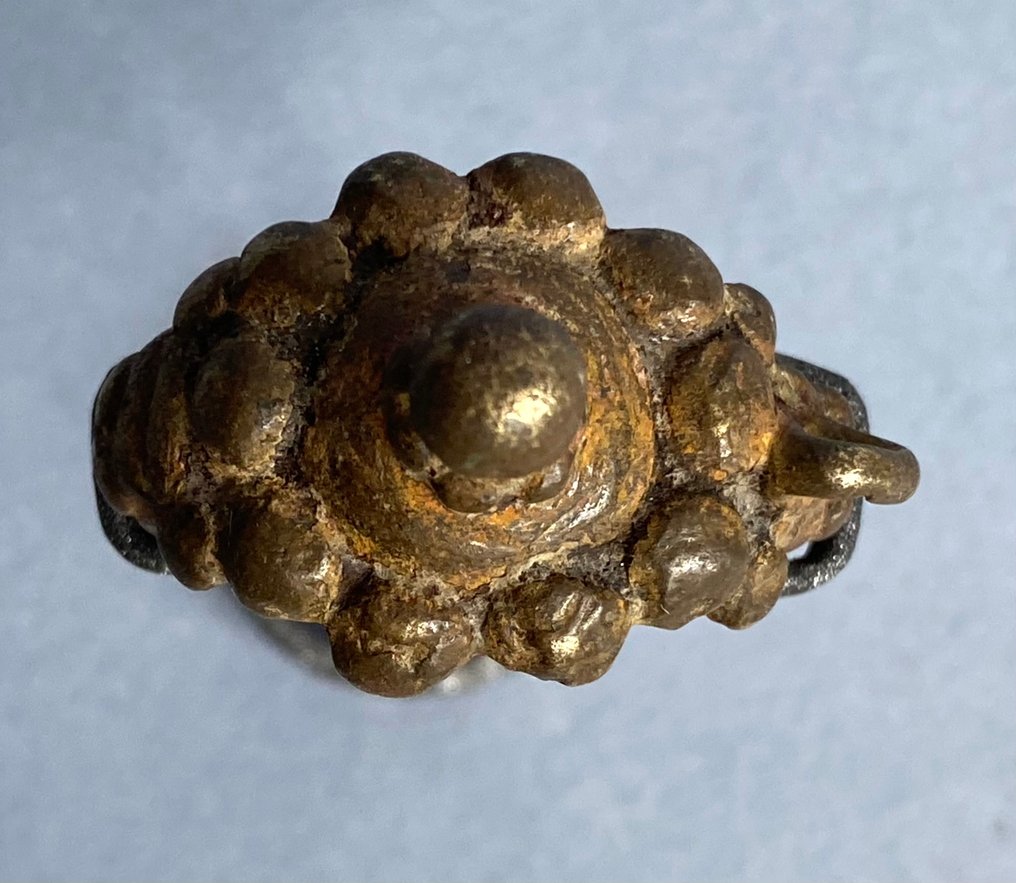
The third ring, also for the hand, is characterized by a stylized flower corolla with engraved motifs of solar and mandalic types, symbols of cosmic harmony, rebirth, and cyclicality, and it is the only example without support.
The lost wax casting technique, the controlled formal irregularity, and the natural patina of the bronze confirm an pre-industrial tribal artisanal production. The most plausible geographical origin is central and northwestern India, particularly tribal areas of Rajasthan, Madhya Pradesh, Gujarat interior, and Maharashtra, contexts in which these rings were an integral part of ritual costume and daily life.
The plausible dating for the entire lot is the 19th century. The condition is generally good, with signs of wear and oxidation consistent with age and use, which enhance its authenticity and ethnographic charm.
The lot, considered in its entirety, represents a significant testimony of Hindu tribal art and the symbolic value attributed to ornament as a vehicle of protection and spirituality.
Three tribal Hindu rings in bronze with Persian wax design, India, 19th century
Lotto consisting of three rare ethnographic tribal rings cast in bronze using the lost wax technique, an authentic expression of popular and tribal Hindu culture in India. The pieces, differing in type and function, share a strong symbolic and ritual value that transcends their purely decorative aspect, positioning them as talismanic objects linked to protection, spirituality, and community identity.
The first ring, the largest, is a traditional big toe ring (bichiya) characterized by a prominent hemispherical central hump, an apotropaic element associated with fertility, vital energy, and protection; the surface shows an ancient patina and slight wear consistent with prolonged use over time.
The second ring features a complex double mandir or double pagoda architecture, with stylized towers and nodular decorations, a clear reference to Hindu temples and the concept of the sacred axis, and is to be interpreted as a ritual-talismanic ring for the hand, intended to evoke spiritual protection and connection with the divine.
The third ring, also for the hand, is characterized by a stylized flower corolla with engraved motifs of solar and mandalic types, symbols of cosmic harmony, rebirth, and cyclicality, and it is the only example without support.
The lost wax casting technique, the controlled formal irregularity, and the natural patina of the bronze confirm an pre-industrial tribal artisanal production. The most plausible geographical origin is central and northwestern India, particularly tribal areas of Rajasthan, Madhya Pradesh, Gujarat interior, and Maharashtra, contexts in which these rings were an integral part of ritual costume and daily life.
The plausible dating for the entire lot is the 19th century. The condition is generally good, with signs of wear and oxidation consistent with age and use, which enhance its authenticity and ethnographic charm.
The lot, considered in its entirety, represents a significant testimony of Hindu tribal art and the symbolic value attributed to ornament as a vehicle of protection and spirituality.
Details
Era
1400-1900
Laboratory Report
No laboratory report
Estimated period
1850-1900
Metal
Interesting collection of three ancient bronze rings with protective and talismanic qualities.
Brand jewellery
No
Total weight
68 g
Condition
Good condition - used with some signs of wear
Gender
Women
Country of Origin
India
Dynastic Style/Period
Mughal Empire (1526-1857)
Provenance
Private collection
Title additional information
Collection of three rings
Attribution
Original
Sold with stand
Yes
Sold by