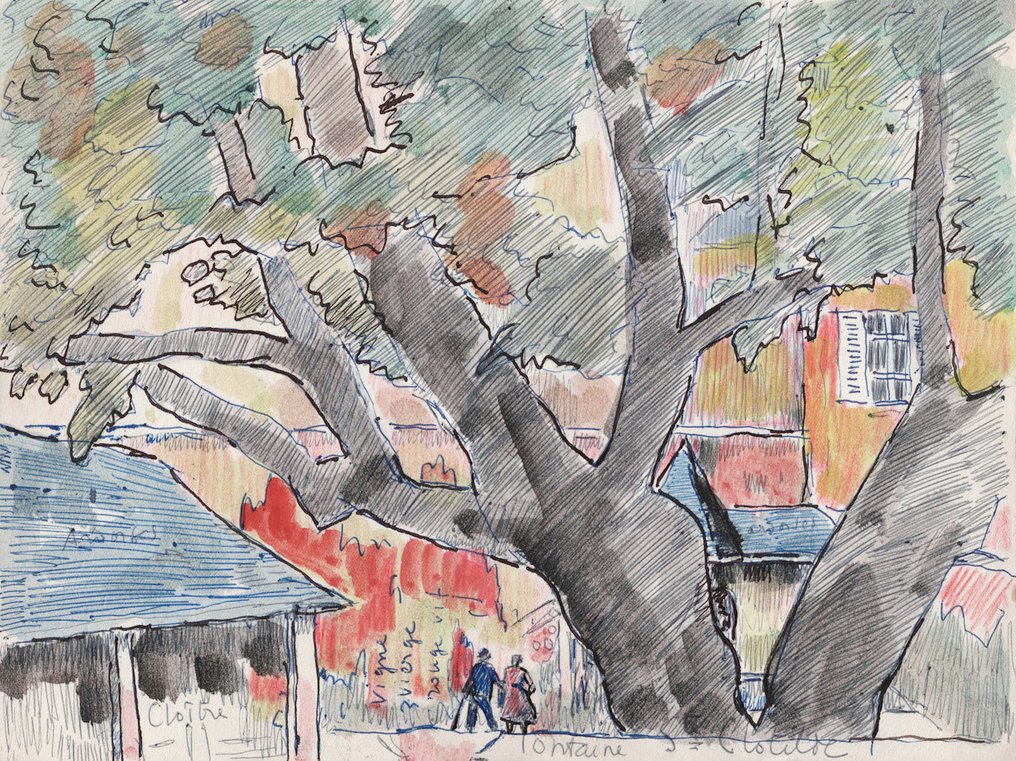
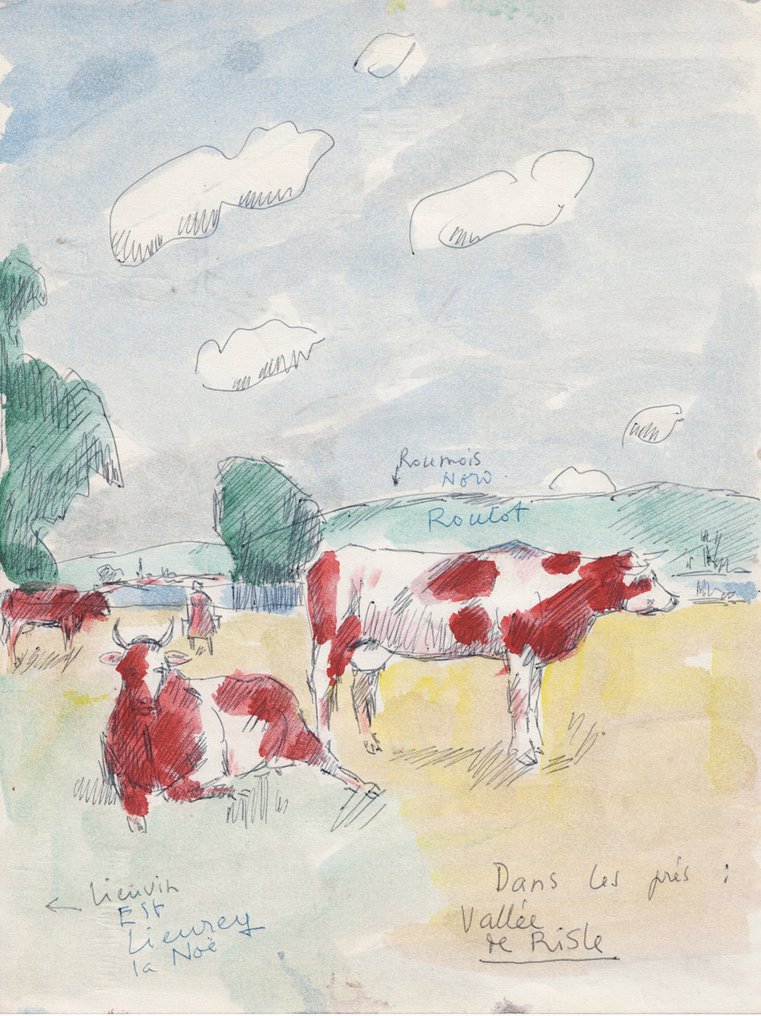
René Sautin (1881-1968) - La Fontaine Sainte Clotilde - Dans les près


09
days
20
hours
22
minutes
24
seconds
Starting bid
€ 1
Reserve price not met

Expert
Selected by Caroline Bokobza
Graduated as French auctioneer and worked in Sotheby’s Paris valuation department.
Estimate € 400 - € 500
No bids placed
Catawiki Buyer Protection
Your payment’s safe with us until you receive your object.View details
Trustpilot 4.4 | 122910 reviews
Rated Excellent on Trustpilot.
La Fontaine Sainte Clotilde – Dans les près, a 1950–1960 watercolour landscape by René Sautin (France), original edition, in excellent condition, unframed, measuring 21 × 27 cm and non signed.
AI-assisted summary
Description from the seller
René SAUTIN (1881-1968)
The Fountain of Sainte Clotilde - In the meadows
Sketch excerpt from the artist's sketchbooks.
Ink and watercolor on double-sided paper
Dimensions of the artwork: 21 x 27 cm
Unsigned
Provenance: Private collection, Les Andelys.
Exhibition: René Sautin, the 'off' exhibition, Les Andelys, October 2018.
Reproduced in the catalog, page 143.
Watercolor in perfect condition
Unframed
This painting will be listed in the catalogue raisonné of the artist's work currently being prepared by Robert and Thierry Tuffier.
Original artwork delivered with invoice and certificate of authenticity.
Fast, careful, and insured shipping.
Buy with confidence!
René Sautin (1881-1968) was born in Montfort-sur-Risle in 1881.
He entered the Beaux-Arts de Rouen in the painting workshop of the painter P. Zacharie, then in Paris in the Ferrier workshop where he received advice from Albert Lebourg, a native of the same village. He then joined the Indépendants with Signac and Luce.
He married in 1910, with Marthe, settled in Les Andelys in 1911, and befriended the Pissarro, Signac, Luce, Derain, Guillaumin, Lebasque, Bigot, and Gernez sons, who gathered in Les Andelys to paint along the banks of the Seine.
Imbued with his Norman land, René Sautin will primarily be a landscape painter. Around 1923, he abandons the impressionist style for a calm and reasoned Fauvism.
The painter, having found balance in his means of expression starting in 1925, reached his full potential in the 1950s. He is one of the few Norman painters to depict his landscapes in such a personal manner through their power, a certain controlled violence, and a strong sensitivity.
A proud, distinguished, and highly cultivated man, he suffered greatly from not being understood in his time and regretted this isolation: "My life has often been hard and difficult..."
René Sautin was born in the same village as the famous painter Albert Lebourg, in Montfort sur Risle. But it is in Les Andelys that he will spend the greatest part of his life.
After primary and secondary studies in Montfort sur Risle and Pont-Audemer, René Sautin immediately turned to drawing: 'Once my studies were finished, equipped with a classical background, I entered the École des Beaux-Arts in Rouen, in the workshop of painter Philippe Zacharie, a distinguished master for whom drawing was a precious metal. Then I moved to Paris, where I spent a year in the Ferrier workshop... and I embarked on painting with some good friends, listening to the advice of painter Albert Lebourg.'
René Sautin will leave the capital in 1911 to settle in the Andelys with his wife Marthe.
The first period of his work is heavily influenced by Albert Lebourg, but his temperament quickly draws him towards a Fauvist style with calm and well-considered colors. He himself described his painting as follows: "Painting, essentially, is spreading dough and not rubbing. From there, I paint thickly in full paste, without smoothing, each stroke being definitive. I never revisit a tone once the stroke is laid down. This gives great power and character to my painting. Damn it! Nature is assertive. What makes the beauty of a tone is its daring and rich color. All the art of painting lies in doing or interpreting as one feels, as one sees; everything else is snobbery. Painting is about externalizing one's temperament. It is an interpretation of one's thoughts that is passed on to others."
The period of the Second World War profoundly unsettles the artist, because without a doubt, René Sautin is a true lover of Andelys. He constantly paints the Seine, the quays of Petit-Andely, and Château Gaillard. He often paints in the same places, but each time he creates a new work.
Or, on June 8, 1940, the Germans bombed the town of Les Andelys. It was then discovered that the city was ninety percent destroyed. The churches were spared, as were a few houses, but the entire town center disappeared under the barrage of explosive and incendiary bombs.
During this period, artists lost their desire to paint. Nevertheless, René Sautin created a series of watercolors the day after the bombings, as if he wished to preserve a testimony for future generations of the city's apocalyptic vision.
From then on, his work changes. His drawing becomes more defined, outlined in black.
On the Seine, barges have the tricolour pennant. In the 1950s, René Sautin continued this trend of emphasizing his drawing. Unfortunately, he gradually lost his sight. The artist compensated for his vision loss with increasingly violent and vivid colors. He stopped painting permanently in 1964, four years before his death.
Seller's Story
Specialist since 1989 painters of the Ecole Normande - School of Rouen, Art Seine, is an art gallery located in Le Havre where we present works of the 19th, Impressionist and Modern. We scrupulously check the origins of the works and we surround ourselves with all the precautions in use on the art market. We, we are the spokesperson of the seller as the buyer for transactions to be made in the best conditions. Any work sold is accompanied by an invoice and a certificate of authenticity engage our responsibility for a period of 30 years. In collaboration with specialized freight forwarders and carriers we can ensure shipment in France and around the world.
Translated by Google TranslateRené SAUTIN (1881-1968)
The Fountain of Sainte Clotilde - In the meadows
Sketch excerpt from the artist's sketchbooks.
Ink and watercolor on double-sided paper
Dimensions of the artwork: 21 x 27 cm
Unsigned
Provenance: Private collection, Les Andelys.
Exhibition: René Sautin, the 'off' exhibition, Les Andelys, October 2018.
Reproduced in the catalog, page 143.
Watercolor in perfect condition
Unframed
This painting will be listed in the catalogue raisonné of the artist's work currently being prepared by Robert and Thierry Tuffier.
Original artwork delivered with invoice and certificate of authenticity.
Fast, careful, and insured shipping.
Buy with confidence!
René Sautin (1881-1968) was born in Montfort-sur-Risle in 1881.
He entered the Beaux-Arts de Rouen in the painting workshop of the painter P. Zacharie, then in Paris in the Ferrier workshop where he received advice from Albert Lebourg, a native of the same village. He then joined the Indépendants with Signac and Luce.
He married in 1910, with Marthe, settled in Les Andelys in 1911, and befriended the Pissarro, Signac, Luce, Derain, Guillaumin, Lebasque, Bigot, and Gernez sons, who gathered in Les Andelys to paint along the banks of the Seine.
Imbued with his Norman land, René Sautin will primarily be a landscape painter. Around 1923, he abandons the impressionist style for a calm and reasoned Fauvism.
The painter, having found balance in his means of expression starting in 1925, reached his full potential in the 1950s. He is one of the few Norman painters to depict his landscapes in such a personal manner through their power, a certain controlled violence, and a strong sensitivity.
A proud, distinguished, and highly cultivated man, he suffered greatly from not being understood in his time and regretted this isolation: "My life has often been hard and difficult..."
René Sautin was born in the same village as the famous painter Albert Lebourg, in Montfort sur Risle. But it is in Les Andelys that he will spend the greatest part of his life.
After primary and secondary studies in Montfort sur Risle and Pont-Audemer, René Sautin immediately turned to drawing: 'Once my studies were finished, equipped with a classical background, I entered the École des Beaux-Arts in Rouen, in the workshop of painter Philippe Zacharie, a distinguished master for whom drawing was a precious metal. Then I moved to Paris, where I spent a year in the Ferrier workshop... and I embarked on painting with some good friends, listening to the advice of painter Albert Lebourg.'
René Sautin will leave the capital in 1911 to settle in the Andelys with his wife Marthe.
The first period of his work is heavily influenced by Albert Lebourg, but his temperament quickly draws him towards a Fauvist style with calm and well-considered colors. He himself described his painting as follows: "Painting, essentially, is spreading dough and not rubbing. From there, I paint thickly in full paste, without smoothing, each stroke being definitive. I never revisit a tone once the stroke is laid down. This gives great power and character to my painting. Damn it! Nature is assertive. What makes the beauty of a tone is its daring and rich color. All the art of painting lies in doing or interpreting as one feels, as one sees; everything else is snobbery. Painting is about externalizing one's temperament. It is an interpretation of one's thoughts that is passed on to others."
The period of the Second World War profoundly unsettles the artist, because without a doubt, René Sautin is a true lover of Andelys. He constantly paints the Seine, the quays of Petit-Andely, and Château Gaillard. He often paints in the same places, but each time he creates a new work.
Or, on June 8, 1940, the Germans bombed the town of Les Andelys. It was then discovered that the city was ninety percent destroyed. The churches were spared, as were a few houses, but the entire town center disappeared under the barrage of explosive and incendiary bombs.
During this period, artists lost their desire to paint. Nevertheless, René Sautin created a series of watercolors the day after the bombings, as if he wished to preserve a testimony for future generations of the city's apocalyptic vision.
From then on, his work changes. His drawing becomes more defined, outlined in black.
On the Seine, barges have the tricolour pennant. In the 1950s, René Sautin continued this trend of emphasizing his drawing. Unfortunately, he gradually lost his sight. The artist compensated for his vision loss with increasingly violent and vivid colors. He stopped painting permanently in 1964, four years before his death.
Seller's Story
Specialist since 1989 painters of the Ecole Normande - School of Rouen, Art Seine, is an art gallery located in Le Havre where we present works of the 19th, Impressionist and Modern. We scrupulously check the origins of the works and we surround ourselves with all the precautions in use on the art market. We, we are the spokesperson of the seller as the buyer for transactions to be made in the best conditions. Any work sold is accompanied by an invoice and a certificate of authenticity engage our responsibility for a period of 30 years. In collaboration with specialized freight forwarders and carriers we can ensure shipment in France and around the world.
Translated by Google TranslateDetails
Artist
René Sautin (1881-1968)
Sold with frame
No
Sold by
Gallery
Edition
Original
Title of artwork
La Fontaine Sainte Clotilde - Dans les près
Technique
Watercolour painting
Signature
Not signed
Country of Origin
France
Condition
Excellent condition
Height
21 cm
Width
27 cm
Depiction/Theme
Landscape
Style
Fauvism
Period
1950-1960
Sold by
