Bartolomeo Sacchi da Platina - Päpstliche Chronica. Das ist Warhafftige, gründliche und außführliche Beschreibung aller und jeder - 1603



05
days
12
hours
59
minutes
59
seconds
Current bid
€ 320
Reserve price not met

Expert
Selected by Volker Riepenhausen
Specialist in travel literature and pre-1600 rare prints with 28 years experience.
Estimate € 550 - € 1,200
7 other people are watching this object
 Bidder 0209 Bidder 0209 | €320 | |
|---|---|---|
| Bidder 0209 | €300 | |
| Bidder 0209 | €280 |
Catawiki Buyer Protection
Your payment’s safe with us until you receive your object.View details
Trustpilot 4.4 | 123113 reviews
Rated Excellent on Trustpilot.
Bartolomeo Sacchi da Platina, author of the work Päpstliche Chronica. Das ist Warhafftige, gründliche und außführliche Beschreibung aller und jeder, in a German folio edition of 1603, published by Th. Schönwetter, Freiburg, bound in parchment with 869 pages and a very good condition.
AI-assisted summary
Description from the seller
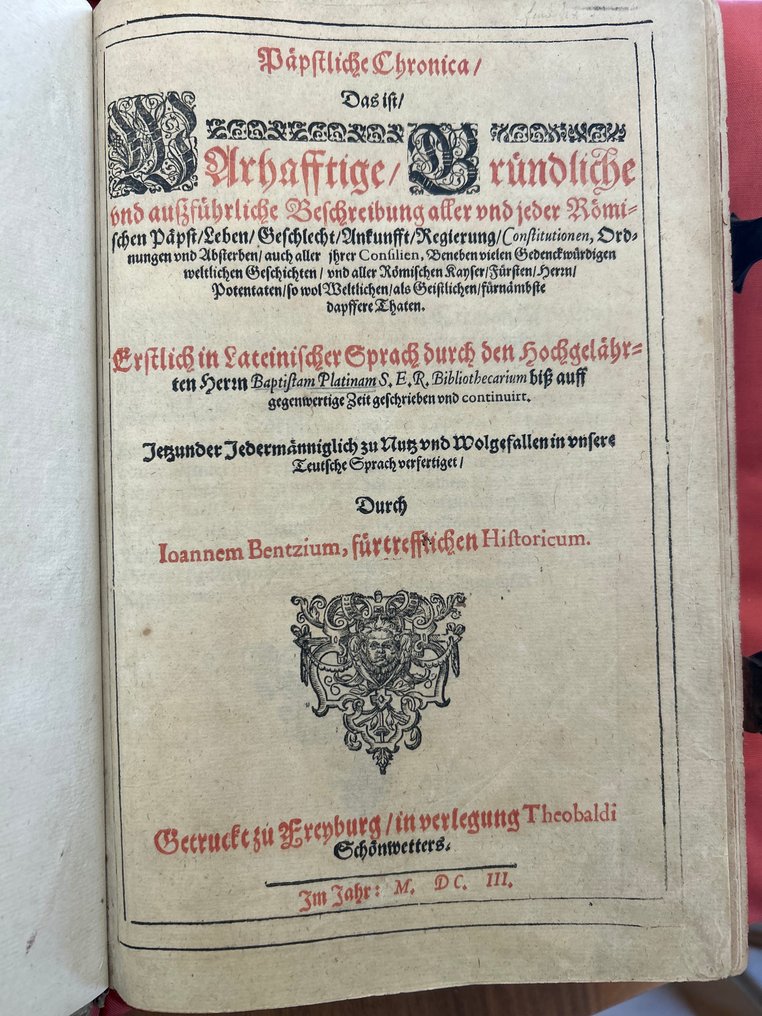
Bartolomeo Platina (d.i. B. Sacchi). Papal Chronicles. This is a truthful, thorough, and detailed description of the lives, lineage, origins, reigns, constitutions, orders, and deaths of all and every Roman Popes [...] translated into our German language by Ioannem Bentzium.
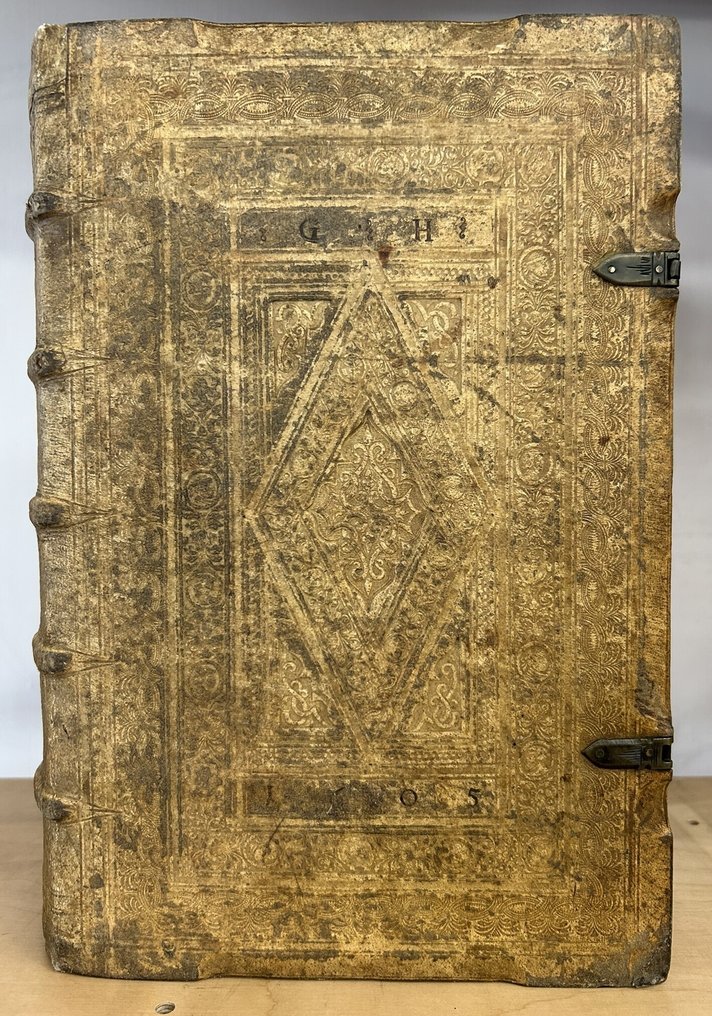
Freiburg [and Frankfurt a. M.], Th. Schönwetter, 1603. Folio. 30.8 x 21.6 cm. Title in red and black, [1] leaf, 764 (correctly 762), 107 pages. With woodcut vignette on the title, many initials, few head- and tailpieces. Blind-embossed pigskin binding with two renewed clasps (slightly bumped). – VD17 3:321404B - Jöcher III, 1623. Rare.
The 'Papal Chronicle' is a historical account of the Roman popes from Peter to Clement VIII. It contains detailed information about their arrival, lineage, coats of arms, symbols, and their relationships with secular rulers. It also includes descriptions of churches, monasteries, palaces, and buildings in Rome. The chronicle is complemented by a timeless chronology of all Roman and Constantinopolitan emperors as well as all cardinals.
Bartolomeo Sacchi da Platina (1421 - 1481) was an Italian humanist who was appointed head of the Vatican Library under Pope Sixtus IV.
His main work set standards in methodology (source analysis, criticism) and became a model for subsequent generations of church historians. Platina depicted the popes as political decision-makers who understood themselves as secular rulers with worldly ambitions. To do this, Platina used works written by historians outside the church. His concerns about legends were groundbreaking (such as in the case of Pope Joan, pages 191ff and 34, part 2, omitted).
The book received broad reception not only among Protestants but also due to its open criticism of church morals, exemplified by Matthias Flacius (1520-75), who counted Platina among the witnesses of the truth (BBKL XXII, 1098-1103). The work was added to the index in 1580 because of Platina's humanist perspective and his critical description of Paul II's actions.
As a child from a poor family, Platina initially worked as a soldier until he secured a position as a house teacher for Marquis Ludovico Gonzaga, which enabled him to study in Florence in 1457 under the famous Byzantine humanist Argyropulos, who had also taught Leonardo da Vinci. In 1462, Platina went to Rome, where he enjoyed the protection of several cardinals and held the office of abbreviator (an official of the papal chancery) under the humanist Pope Pius II. With the election of Pope Paul II, Platina's favor in the Vatican ended. This was followed by fierce disputes and imprisonments, which only ended with the appointment of the humanist Pope Sixtus IV. In 1475, Sixtus IV appointed Platina as the first librarian of the modern Vatican Library. During this time, the present work was also created at the Pope's behest. His papal chronicle, which was later appreciated by both Catholics and Protestants, is especially valuable as a source for the period it describes. It was first published in print in 1479, and the first German edition appeared in 1546.
On the front cover handwritten dated 'G H 1605'. - Endpapers renewed. Inside browned, sporadically stained, with a few handwritten notes. Pagination jumps. Last pages with wormholes (with minor text loss) and page 107 duplicated. - Exlibris on the inside cover.
Weight: 2480 g
Bartolomeo Platina (d.i. B. Sacchi). Papal Chronicles. This is a truthful, thorough, and detailed description of the lives, lineage, origins, reigns, constitutions, orders, and deaths of all and every Roman Popes [...] translated into our German language by Ioannem Bentzium.
Freiburg [and Frankfurt a. M.], Th. Schönwetter, 1603. Folio. 30.8 x 21.6 cm. Title in red and black, [1] leaf, 764 (correctly 762), 107 pages. With woodcut vignette on the title, many initials, few head- and tailpieces. Blind-embossed pigskin binding with two renewed clasps (slightly bumped). – VD17 3:321404B - Jöcher III, 1623. Rare.
The 'Papal Chronicle' is a historical account of the Roman popes from Peter to Clement VIII. It contains detailed information about their arrival, lineage, coats of arms, symbols, and their relationships with secular rulers. It also includes descriptions of churches, monasteries, palaces, and buildings in Rome. The chronicle is complemented by a timeless chronology of all Roman and Constantinopolitan emperors as well as all cardinals.
Bartolomeo Sacchi da Platina (1421 - 1481) was an Italian humanist who was appointed head of the Vatican Library under Pope Sixtus IV.
His main work set standards in methodology (source analysis, criticism) and became a model for subsequent generations of church historians. Platina depicted the popes as political decision-makers who understood themselves as secular rulers with worldly ambitions. To do this, Platina used works written by historians outside the church. His concerns about legends were groundbreaking (such as in the case of Pope Joan, pages 191ff and 34, part 2, omitted).
The book received broad reception not only among Protestants but also due to its open criticism of church morals, exemplified by Matthias Flacius (1520-75), who counted Platina among the witnesses of the truth (BBKL XXII, 1098-1103). The work was added to the index in 1580 because of Platina's humanist perspective and his critical description of Paul II's actions.
As a child from a poor family, Platina initially worked as a soldier until he secured a position as a house teacher for Marquis Ludovico Gonzaga, which enabled him to study in Florence in 1457 under the famous Byzantine humanist Argyropulos, who had also taught Leonardo da Vinci. In 1462, Platina went to Rome, where he enjoyed the protection of several cardinals and held the office of abbreviator (an official of the papal chancery) under the humanist Pope Pius II. With the election of Pope Paul II, Platina's favor in the Vatican ended. This was followed by fierce disputes and imprisonments, which only ended with the appointment of the humanist Pope Sixtus IV. In 1475, Sixtus IV appointed Platina as the first librarian of the modern Vatican Library. During this time, the present work was also created at the Pope's behest. His papal chronicle, which was later appreciated by both Catholics and Protestants, is especially valuable as a source for the period it describes. It was first published in print in 1479, and the first German edition appeared in 1546.
On the front cover handwritten dated 'G H 1605'. - Endpapers renewed. Inside browned, sporadically stained, with a few handwritten notes. Pagination jumps. Last pages with wormholes (with minor text loss) and page 107 duplicated. - Exlibris on the inside cover.
Weight: 2480 g
Details
Number of Books
1
Subject
Biographies and memoirs, Religion, Vatican
Book Title
Päpstliche Chronica. Das ist Warhafftige, gründliche und außführliche Beschreibung aller und jeder
Author/ Illustrator
Bartolomeo Sacchi da Platina
Condition
Very good
Publication year oldest item
1603
Height
30.8 cm
Edition
Other edition
Width
21.6 cm
Language
German
Original language
No
Publisher
Th. Schönwetter, Freiburg
Binding/ Material
Vellum
Number of pages
869
