El Pintor / Jef Last - Wat Hassan zag - 1943


07
days
16
hours
47
minutes
11
seconds
Starting bid
€ 1
Reserve price not met

Expert
Selected by Tom Hopman
Studied history and managed a large online book catalogue with 13 years' antiquarian bookshop experience.
Estimate € 150 - € 200
No bids placed
Catawiki Buyer Protection
Your payment’s safe with us until you receive your object.View details
Trustpilot 4.4 | 122910 reviews
Rated Excellent on Trustpilot.
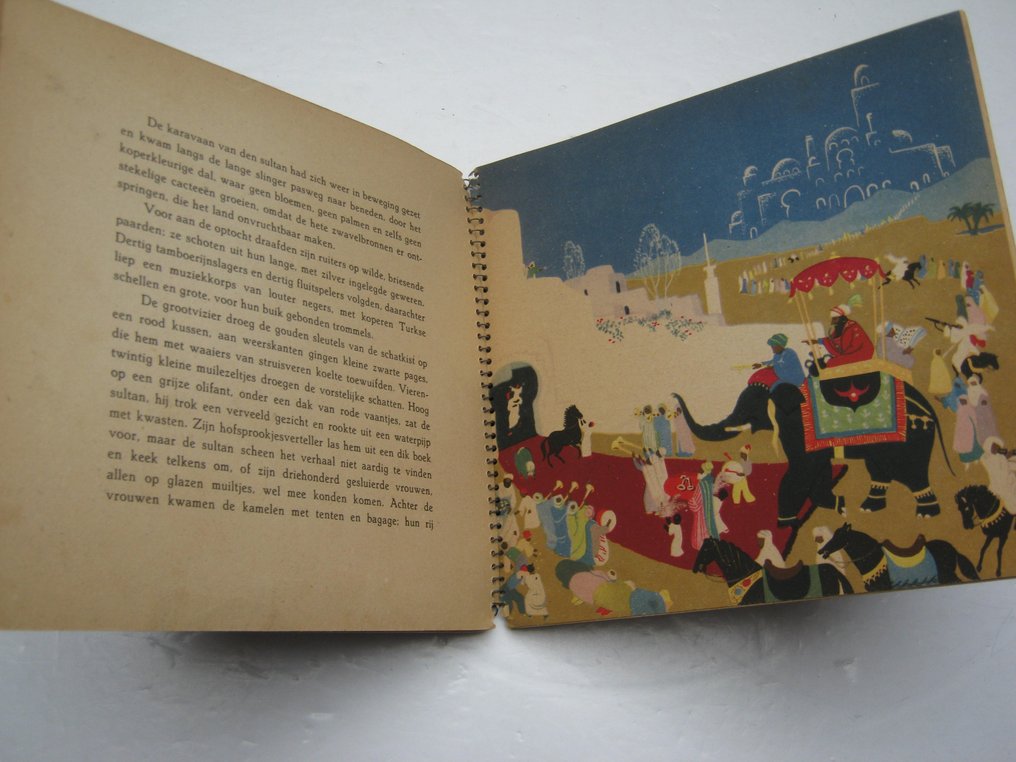
Wat Hassan zag, an illustrated edition by El Pintor / Jef Last, published in Amsterdam by [Corunda], circa 1943, in Dutch, 16 pages, 19 × 20 cm, in good condition.
AI-assisted summary
Description from the seller
Rare specimen
Between 1941 and 1944, during the German occupation, a remarkably beautiful series of children's books and games appeared, created by a mysterious character who called himself 'El Pintor.'
The New Art School in Amsterdam
Jacob Kloot and Galinka Ehrenfest jointly created the character El Pintor.
He managed the affairs of the New Art School and also handled the secretariat as a jack-of-all-trades. At the age of twenty-five, he founded the trading company Corunda, which published several titles in the El Pintor series and a few other children's books.
They met each other in 1935 through their mutual teacher and friend, Paul Citroen, at the Nieuwe Kunstschool in Amsterdam. -also the little Paulienke Citroen came to their house, and Chaja Goldstein-.
There was no such thing as a collective, such as El Pintor is sometimes called. All employees were managed by Jacob and Galinka.
The end of El Pintor
In June 1943, Jacob was arrested in Leiden, transported to Westerbork and Sobibor, where he was almost immediately murdered after arrival.
Galinka knew nothing of her fate and lived under great pressure. She took over the management of the company and also continued the resistance activities. In 1944, she managed to produce two more issues, but in the final phase of the occupation, production came to a halt.
Publisher Corunda was also a cover for illegal activities. The income, including that from the German market, was used through the company to support those in hiding and other resistance work.
Illustrations were mainly created by Galinka Ehrenfest; picture books emerged between 1941 and 1943.
For much more information: Jewish Virtual Museum
Josephus Carel Franciscus (Jef) Last (The Hague, May 2, 1898 – Laren, February 15, 1972) Dutch revolutionary, poet, prose writer, translator, and traveler.
In May 1940, Jef Last, a former Spain fighter, had to go into hiding immediately, but if necessary, he could turn to his friend and publisher George Kroonder in Bussum.
During World War II, in 1941, he was a co-founder of the ISB version (International Socialist Movement) of the resistance paper De Vonk.
Book description
What Hassan saw / [The Painter]
Author: El Pintor
Employee: Josephus Carel Franciscus Last (1898-1972)
Year: [ca. 1943]
Publisher: [n.p.: n.p.]
Series: El Pintor's travels
Annotation: Text: Jef Last (source: Theo Gielen)
Annotation provenance
Handwritten assignment on the back of the front cover probably indicates Jewish-Hague.
Rijnveld family, Holocaust survivors.
Dating: not in Brinkman; based on K-numbers estimated between 1941 and 1948.
Front cover mentions: K 128. - On the last page: K 374. - Back cover mentions: G.R.M.12 and f. 1,30.
Extent: [16] p
Illustration: black and white and colored illustration.
Size: 19 × 20 cm
ISBN: (spiral binding)
signs of use and coloration over time
Scratches and old stains on edges and flat covers.
Good and complete copy in the original cover (without publisher mention).
Rare specimen
Between 1941 and 1944, during the German occupation, a remarkably beautiful series of children's books and games appeared, created by a mysterious character who called himself 'El Pintor.'
The New Art School in Amsterdam
Jacob Kloot and Galinka Ehrenfest jointly created the character El Pintor.
He managed the affairs of the New Art School and also handled the secretariat as a jack-of-all-trades. At the age of twenty-five, he founded the trading company Corunda, which published several titles in the El Pintor series and a few other children's books.
They met each other in 1935 through their mutual teacher and friend, Paul Citroen, at the Nieuwe Kunstschool in Amsterdam. -also the little Paulienke Citroen came to their house, and Chaja Goldstein-.
There was no such thing as a collective, such as El Pintor is sometimes called. All employees were managed by Jacob and Galinka.
The end of El Pintor
In June 1943, Jacob was arrested in Leiden, transported to Westerbork and Sobibor, where he was almost immediately murdered after arrival.
Galinka knew nothing of her fate and lived under great pressure. She took over the management of the company and also continued the resistance activities. In 1944, she managed to produce two more issues, but in the final phase of the occupation, production came to a halt.
Publisher Corunda was also a cover for illegal activities. The income, including that from the German market, was used through the company to support those in hiding and other resistance work.
Illustrations were mainly created by Galinka Ehrenfest; picture books emerged between 1941 and 1943.
For much more information: Jewish Virtual Museum
Josephus Carel Franciscus (Jef) Last (The Hague, May 2, 1898 – Laren, February 15, 1972) Dutch revolutionary, poet, prose writer, translator, and traveler.
In May 1940, Jef Last, a former Spain fighter, had to go into hiding immediately, but if necessary, he could turn to his friend and publisher George Kroonder in Bussum.
During World War II, in 1941, he was a co-founder of the ISB version (International Socialist Movement) of the resistance paper De Vonk.
Book description
What Hassan saw / [The Painter]
Author: El Pintor
Employee: Josephus Carel Franciscus Last (1898-1972)
Year: [ca. 1943]
Publisher: [n.p.: n.p.]
Series: El Pintor's travels
Annotation: Text: Jef Last (source: Theo Gielen)
Annotation provenance
Handwritten assignment on the back of the front cover probably indicates Jewish-Hague.
Rijnveld family, Holocaust survivors.
Dating: not in Brinkman; based on K-numbers estimated between 1941 and 1948.
Front cover mentions: K 128. - On the last page: K 374. - Back cover mentions: G.R.M.12 and f. 1,30.
Extent: [16] p
Illustration: black and white and colored illustration.
Size: 19 × 20 cm
ISBN: (spiral binding)
signs of use and coloration over time
Scratches and old stains on edges and flat covers.
Good and complete copy in the original cover (without publisher mention).
Details
Number of Books
1
Subject
Children's books, Graphic design, Illustrated, Judaica
Book Title
Wat Hassan zag
Author/ Illustrator
El Pintor / Jef Last
Condition
Good
Publication year oldest item
1943
Height
19 cm
Edition
Illustrated Edition
Width
20 cm
Language
Dutch
Original language
Yes
Publisher
Uitgever: Amsterdam : [Corunda]
Number of pages
16
Sold by
