Manuscript sheet, Deccan, princely state of Hyderabad, 18th-19th century. - Paper, Metallo - India - Maratha Empire (1674-1818)



02
days
09
hours
32
minutes
55
seconds
Starting bid
€ 1
Reserve price not met

Expert
Selected by Surya Rutten
Has over 25 years' experience in Asian art and owned an art gallery.
Estimate € 250 - € 350
No bids placed
Catawiki Buyer Protection
Your payment’s safe with us until you receive your object.View details
Trustpilot 4.4 | 123077 reviews
Rated Excellent on Trustpilot.
An Islamic calligraphic manuscript sheet on paper, mounted on a folding metal frame, from the Deccan’s Hyderabad Princely State in the 18th–19th century, attributed Original, in good condition.
AI-assisted summary
Description from the seller
Calligraphic sheet in the Islamic context, Deccan region, princely state of Hyderabad, 19th century.
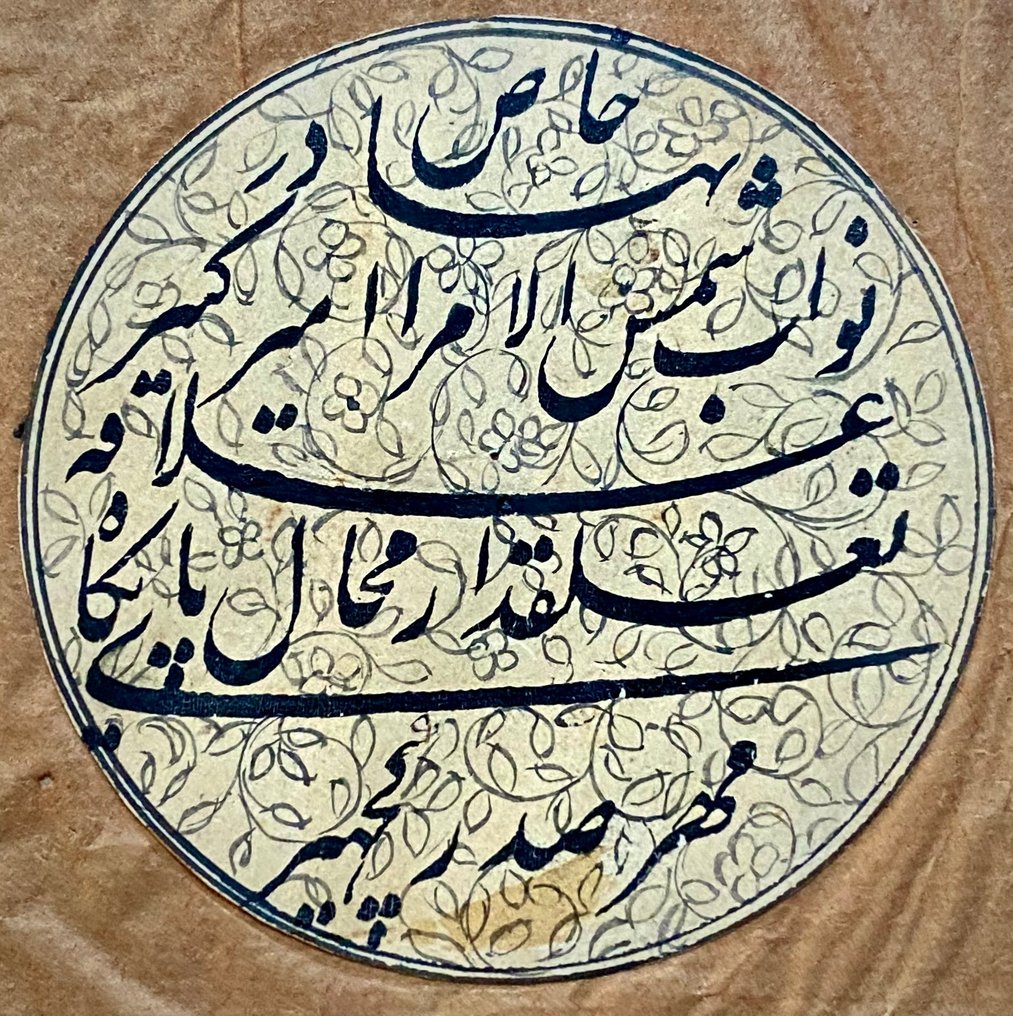
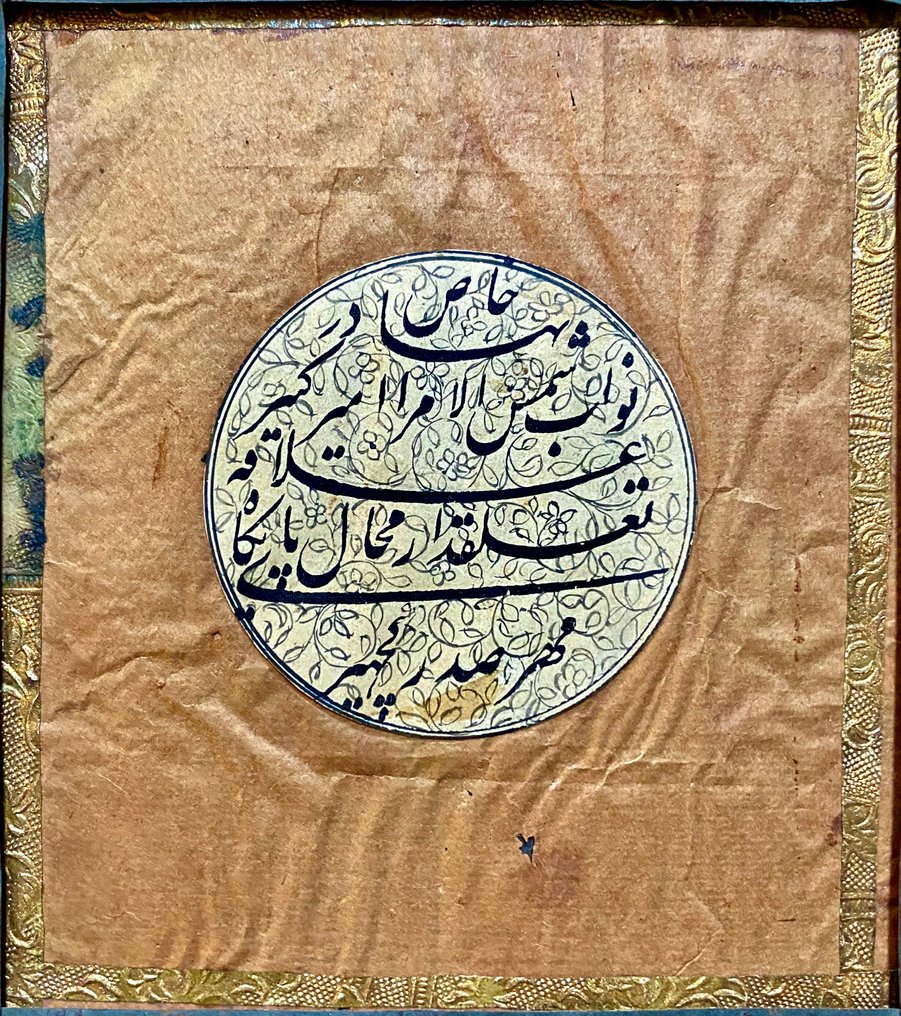
Calligraphic sheet on thin, browned paper, mounted on an original support made of folded metal sheet that serves as a frame and border, with the back made from the same sheet. The front is enhanced by a gilded perimeter frame with floral and geometric decorations achieved through hot stamping, while at the center there is a circular handwritten cartouche set up like a 'khātam' (seal), executed in black ink on a background decorated with tiny hand-drawn vegetal scrolls. The script is in Persian calligraphy of the Nastaliq style, typical of the calligraphic production of Islamic India from the 18th to 19th centuries, particularly from the Deccan region and the princely state of Hyderabad.
The text appears as an honorific and nominal formula. Readable titles include 'khātam' (seal), 'Shams al-‘Umarā' (شمس الأمراء, 'Sun of the Nobles'), 'al-Amīr' (الأمير), as well as an identifiable personal name 'Muhammad Rahīm' (محمد رحیم). The text likely refers to a high dignitary known as Bahādur-i Khāss, Shams-ul-‘Umarā, a great Amīr, with the rank and function of ta‘alluqdār (tax administrator and civil magistrate in the State of Hyderabad under British administration), linked to the Paygāh properties; additionally, a respectful epithet (mehr) and a reference to the religious-legal title of Sadr are present. The last word or marginal formula remains of uncertain reading, as is often the case in calligraphic compositions of this type.
The set suggests an object of representation or commemoration, conceived as a personal emblem or honorary seal, rather than as a simple calligraphic exercise.
Condition: folds and waves in the paper, small stains and signs of aging, marginal wear, and natural oxidation of the metal sheet; the central decoration is well preserved and of notable aesthetic quality.
N.B.
For administrative reasons, Italian buyers are required to provide their fiscal code, which is essential for the proper issuance of the electronic invoice.
For administrative reasons related to current Italian regulations, foreign customers are kindly asked to provide their place and date of birth via email message using the appropriate form on Catawiki.
Seller's Story
Ethnologica was born from the love and passion for the ancient culture of Oriental, Islamic and Indian art. Refined works of art make up a constantly evolving collection capable of satisfying the needs of admirers, enthusiasts and collectors.
Ethnologica has also contributed as a lender to sector cultural exhibitions alongside prestigious public and private cultural associations and foundations.
Translated by Google TranslateCalligraphic sheet in the Islamic context, Deccan region, princely state of Hyderabad, 19th century.
Calligraphic sheet on thin, browned paper, mounted on an original support made of folded metal sheet that serves as a frame and border, with the back made from the same sheet. The front is enhanced by a gilded perimeter frame with floral and geometric decorations achieved through hot stamping, while at the center there is a circular handwritten cartouche set up like a 'khātam' (seal), executed in black ink on a background decorated with tiny hand-drawn vegetal scrolls. The script is in Persian calligraphy of the Nastaliq style, typical of the calligraphic production of Islamic India from the 18th to 19th centuries, particularly from the Deccan region and the princely state of Hyderabad.
The text appears as an honorific and nominal formula. Readable titles include 'khātam' (seal), 'Shams al-‘Umarā' (شمس الأمراء, 'Sun of the Nobles'), 'al-Amīr' (الأمير), as well as an identifiable personal name 'Muhammad Rahīm' (محمد رحیم). The text likely refers to a high dignitary known as Bahādur-i Khāss, Shams-ul-‘Umarā, a great Amīr, with the rank and function of ta‘alluqdār (tax administrator and civil magistrate in the State of Hyderabad under British administration), linked to the Paygāh properties; additionally, a respectful epithet (mehr) and a reference to the religious-legal title of Sadr are present. The last word or marginal formula remains of uncertain reading, as is often the case in calligraphic compositions of this type.
The set suggests an object of representation or commemoration, conceived as a personal emblem or honorary seal, rather than as a simple calligraphic exercise.
Condition: folds and waves in the paper, small stains and signs of aging, marginal wear, and natural oxidation of the metal sheet; the central decoration is well preserved and of notable aesthetic quality.
N.B.
For administrative reasons, Italian buyers are required to provide their fiscal code, which is essential for the proper issuance of the electronic invoice.
For administrative reasons related to current Italian regulations, foreign customers are kindly asked to provide their place and date of birth via email message using the appropriate form on Catawiki.
Seller's Story
Ethnologica was born from the love and passion for the ancient culture of Oriental, Islamic and Indian art. Refined works of art make up a constantly evolving collection capable of satisfying the needs of admirers, enthusiasts and collectors.
Ethnologica has also contributed as a lender to sector cultural exhibitions alongside prestigious public and private cultural associations and foundations.
Translated by Google TranslateDetails
Dynastic Style/Period
Maratha Empire (1674-1818)
No. of items
1
Country of Origin
India
Attribution
Original
Material
Metallo, Paper
Height
11.7 cm
Width
10.5 cm
Title of artwork
Manuscript sheet, Deccan, princely state of Hyderabad, 18th-19th century.
Depth
0.2 cm
Condition
Good condition
Sold by