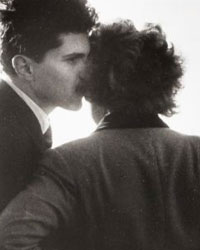
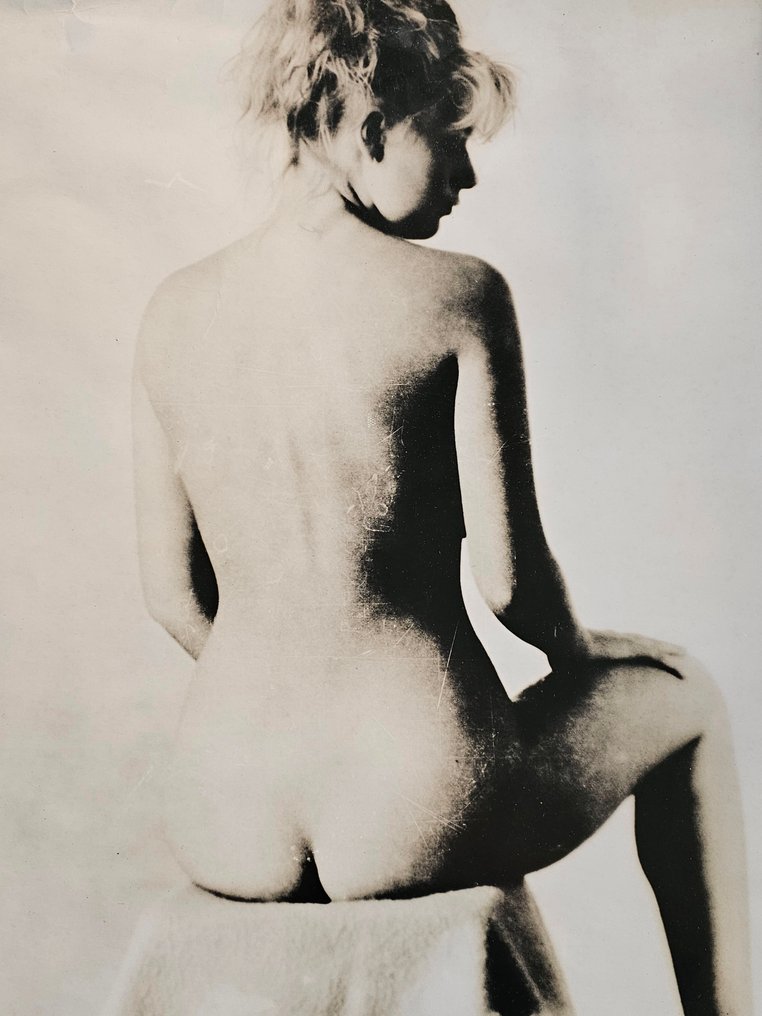
Michael Joseph (1941-) - Nude on upturned bucket



02
days
16
hours
47
minutes
39
seconds
Current bid
€ 40
No reserve price

Expert
Selected by Kai Brückner
Over 35 years' experience; former gallery owner and Museum Folkwang curator.
Estimate € 400 - € 500
28 other people are watching this object
 Bidder 8349 Bidder 8349 | €40 | |
|---|---|---|
 Bidder 9030 Bidder 9030 | €35 | |
 Bidder 0423 Bidder 0423 | €30 | |
Catawiki Buyer Protection
Your payment’s safe with us until you receive your object.View details
Trustpilot 4.4 | 123779 reviews
Rated Excellent on Trustpilot.
Description from the seller
This is not Nivea.
There was no glossy budget, no perfect retouching, no advertising department smoothing every curve into submission. It is not slimmer, not shinier, not cosmetically flawless — and that is precisely why it matters.
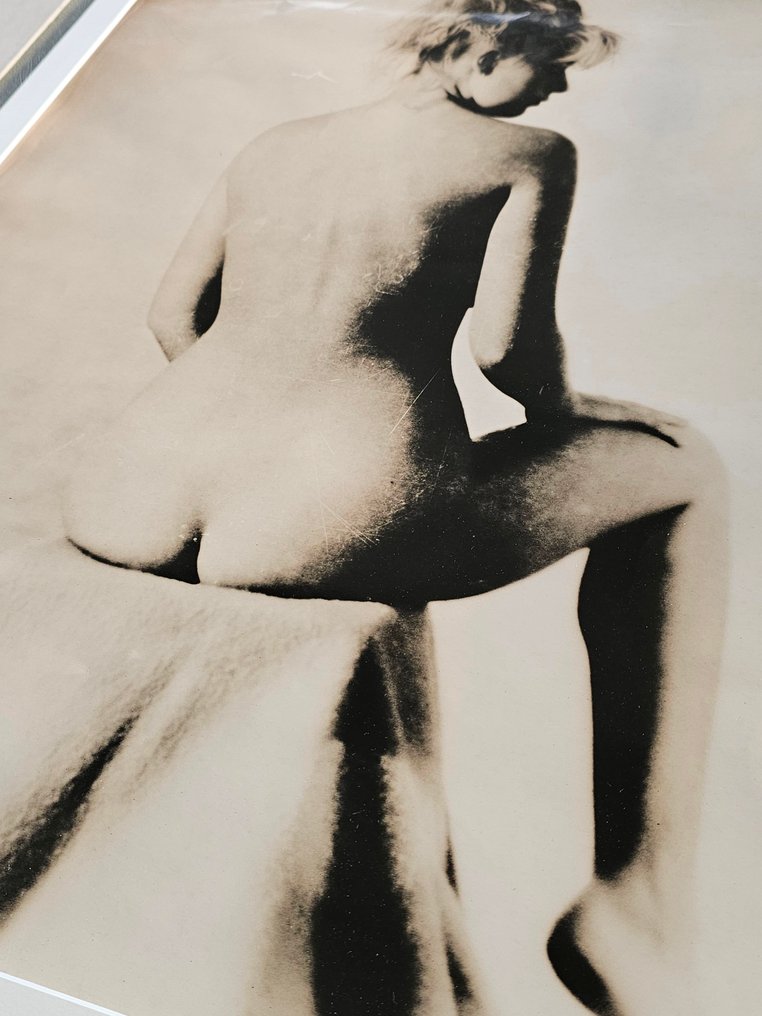
What you see here is a darkroom-born object, made at scale and difficulty that few printers would dare attempt. At 58 × 44 cm visible image (mount 70cm tall by 50cm wide), this is a large, awkward, technically demanding format for an analogue print — especially one that has been toned, handled, lived with, and allowed to age honestly. The surface bears its history: fine scratches, marks, traces of process. Not damage — evidence.
The image itself is quietly audacious. A nude reduced to form, shadow and suggestion; a body turning away, refusing spectacle while becoming it. The echo of Man Ray’s Violon d’Ingres is unmistakable — but this is not homage by imitation. This is a photographer working with light, chemistry and time, letting imperfection speak louder than polish.
Yes, it’s not as “pretty.”
Yes, it’s not perfectly presented.
And yet — it is far more compelling.
This is photography as object, not reproduction. A moment when the image passed through the photographer’s hands, through trays and toners, before the world decided everything should be clean, flat and endlessly repeatable.
If you win this auction, you won’t just own a photograph.
You’ll become the custodian of a singular moment in photographic history — one that could never be replicated, reprinted, or convincingly faked.
Man Ray, Violon d’Ingres — eat your heart out.
Seller's Story
My father, Michael Joseph, was an advertising photographer based in London from the mid-sixties to the early nineties. During that time, he created some truly remarkable work — his most famous moment being the Beggars Banquet gatefold for the Rolling Stones.
My ongoing mission is to share and celebrate what we call 'the other photos' — the lesser-known but equally captivating pieces from his archive. Within this collection, you'll find a mix of test prints, images from specific photo shoots, and more personal works, all created with his characteristic passion and devotion.
Many of these images owe their atmosphere to the magic of the darkroom: intricate group scenes, striking still lifes, and moments that draw the viewer in and stir emotion. Variety is key - and I often offer unique, one-off pieces.
I hope you enjoy discovering my father’s work, and I look forward to sending you a genuine piece of photographic history.
Translated by Google TranslateThis is not Nivea.
There was no glossy budget, no perfect retouching, no advertising department smoothing every curve into submission. It is not slimmer, not shinier, not cosmetically flawless — and that is precisely why it matters.
What you see here is a darkroom-born object, made at scale and difficulty that few printers would dare attempt. At 58 × 44 cm visible image (mount 70cm tall by 50cm wide), this is a large, awkward, technically demanding format for an analogue print — especially one that has been toned, handled, lived with, and allowed to age honestly. The surface bears its history: fine scratches, marks, traces of process. Not damage — evidence.
The image itself is quietly audacious. A nude reduced to form, shadow and suggestion; a body turning away, refusing spectacle while becoming it. The echo of Man Ray’s Violon d’Ingres is unmistakable — but this is not homage by imitation. This is a photographer working with light, chemistry and time, letting imperfection speak louder than polish.
Yes, it’s not as “pretty.”
Yes, it’s not perfectly presented.
And yet — it is far more compelling.
This is photography as object, not reproduction. A moment when the image passed through the photographer’s hands, through trays and toners, before the world decided everything should be clean, flat and endlessly repeatable.
If you win this auction, you won’t just own a photograph.
You’ll become the custodian of a singular moment in photographic history — one that could never be replicated, reprinted, or convincingly faked.
Man Ray, Violon d’Ingres — eat your heart out.
Seller's Story
My father, Michael Joseph, was an advertising photographer based in London from the mid-sixties to the early nineties. During that time, he created some truly remarkable work — his most famous moment being the Beggars Banquet gatefold for the Rolling Stones.
My ongoing mission is to share and celebrate what we call 'the other photos' — the lesser-known but equally captivating pieces from his archive. Within this collection, you'll find a mix of test prints, images from specific photo shoots, and more personal works, all created with his characteristic passion and devotion.
Many of these images owe their atmosphere to the magic of the darkroom: intricate group scenes, striking still lifes, and moments that draw the viewer in and stir emotion. Variety is key - and I often offer unique, one-off pieces.
I hope you enjoy discovering my father’s work, and I look forward to sending you a genuine piece of photographic history.
Translated by Google TranslateDetails
Date of print
1986
Artist
Michael Joseph (1941-)
Sold by
Owner or reseller
Title of artwork
Nude on upturned bucket
Condition
Original State
Technique
Gelatin-silver print
Height
58.5 cm
Edition
Unique edition in this big size
Width
44.5 cm
Signature
Signed
Genre
Nude
Sold by