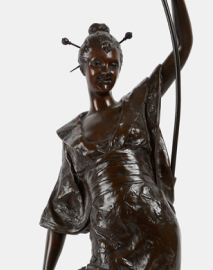
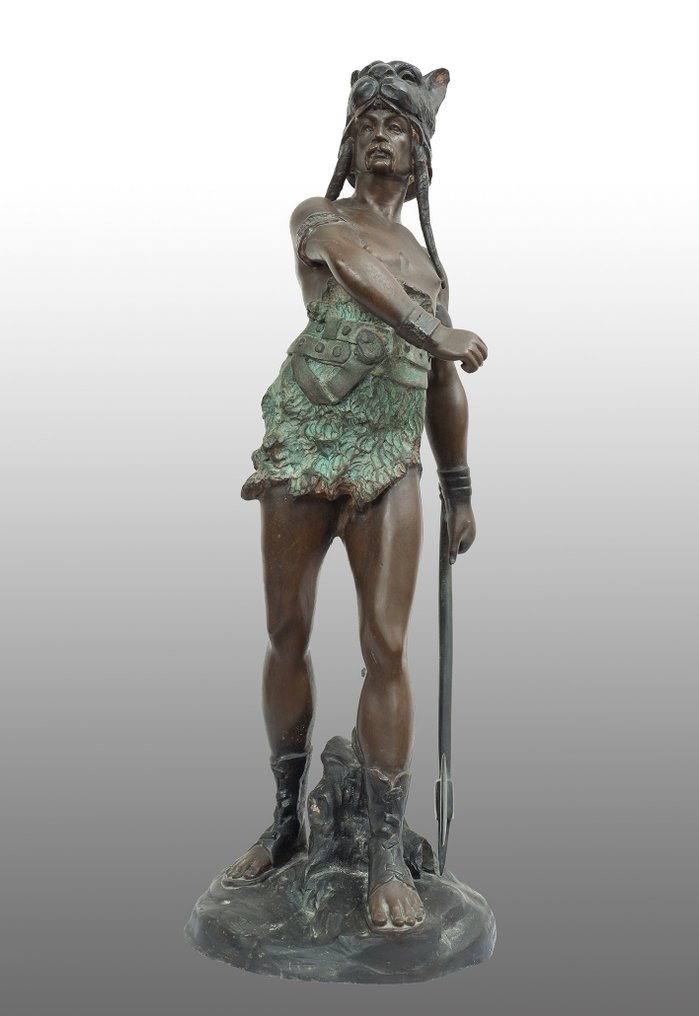
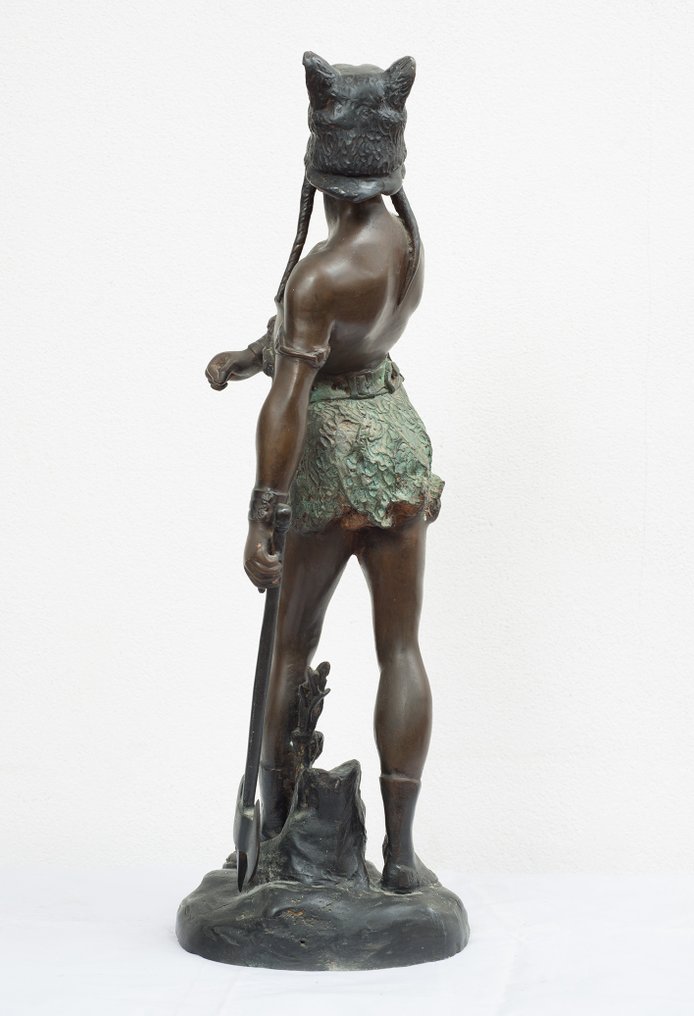
Sculpture, Guerriero con elmo di pelliccia - 60 cm - Bronze


03
days
02
hours
21
minutes
53
seconds
Current bid
€ 320
Reserve price met

Expert
Selected by Paul Wullems
He accumulated 18 years' experience, worked as junior specialist at Sotheby’s and managed Kunsthandel Jacques Fijnaut.
Estimate € 800 - € 1,200
6 other people are watching this object
 Bidder 8374 Bidder 8374 | €320 | |
|---|---|---|
| Bidder 8374 | €160 | |
 Bidder 4177 Bidder 4177 | €50 |
Catawiki Buyer Protection
Your payment’s safe with us until you receive your object.View details
Trustpilot 4.4 | 123951 reviews
Rated Excellent on Trustpilot.
Description from the seller
Son of the noble Celtillo, he was king of the Arverni, an influential Gallic people settled in what is now the Auvergne region. In his plan to repel the Roman invasion, he managed to unite most of the Gallic tribes and their leaders. He was one of the first chiefs able to federate a significant part of the Gallic peoples, overcoming traditional historical divisions. Facing one of the greatest strategists of all time, he showcased his excellent military talents. In 52 BC, he was defeated at the siege of Alesia by Gaius Julius Caesar. Surrendering himself, he was imprisoned in Rome for five years. In 46 BC, he was dragged in chains to adorn Caesar's triumph celebration. Immediately afterward, he was sentenced to death in the Mamertine prison.
In the 18th and 19th centuries, his figure, similar to that of Ambiorige in Belgium, experienced a rediscovery in France from a nationalist perspective. Under Napoleon III, his role as a representative of Gallo-Roman civilization was widely emphasized. Later, in the revanchist climate of Franco-German rivalry, he embodied the mythical figure of a national hero for a significant part of 19th-century French historiography. From 1870 to 1950, history education for generations of students portrayed him as the first leader of the French.
General conditions: excellent condition.
Origin: France 20th century.
Measurements: Diameter 20cm. Height 60cm.
Seller's Story
Borrelli Antichita is a company founded in 1964 by the founder Mario and continued over the years by his sons Arch.Giuseppe, Domenico and Massimiliano with professionalism and passion.
The choice is made through continuous travel abroad and in Italy with particular attention to the English and French markets as well as the Neapolitan one.
Unloading takes place on a monthly basis, offering customers the possibility of a wide choice at advantageous prices.
All this is guaranteed by our experience accumulated over the years.
Furthermore, we offer a restoration service carried out by expert hands in our laboratories, guaranteeing a workmanlike job.
The Architect graduated from the Federico II University of Naples in 1997 with consequent registration in the register, will give you a hand in the taste of seeking beauty in things, but above all in seeing them.
In short, asking for his help will certainly be the best idea you can have.
We purchase antique furniture, objects and paintings from private homes with maximum valuation and cash payment.
Shipping throughout Italy, Europe and the rest of the world at very low prices with maximum security and traceability.
Shipping will be agreed privately and will not be expensive.
Translated by Google TranslateSon of the noble Celtillo, he was king of the Arverni, an influential Gallic people settled in what is now the Auvergne region. In his plan to repel the Roman invasion, he managed to unite most of the Gallic tribes and their leaders. He was one of the first chiefs able to federate a significant part of the Gallic peoples, overcoming traditional historical divisions. Facing one of the greatest strategists of all time, he showcased his excellent military talents. In 52 BC, he was defeated at the siege of Alesia by Gaius Julius Caesar. Surrendering himself, he was imprisoned in Rome for five years. In 46 BC, he was dragged in chains to adorn Caesar's triumph celebration. Immediately afterward, he was sentenced to death in the Mamertine prison.
In the 18th and 19th centuries, his figure, similar to that of Ambiorige in Belgium, experienced a rediscovery in France from a nationalist perspective. Under Napoleon III, his role as a representative of Gallo-Roman civilization was widely emphasized. Later, in the revanchist climate of Franco-German rivalry, he embodied the mythical figure of a national hero for a significant part of 19th-century French historiography. From 1870 to 1950, history education for generations of students portrayed him as the first leader of the French.
General conditions: excellent condition.
Origin: France 20th century.
Measurements: Diameter 20cm. Height 60cm.
Seller's Story
Borrelli Antichita is a company founded in 1964 by the founder Mario and continued over the years by his sons Arch.Giuseppe, Domenico and Massimiliano with professionalism and passion.
The choice is made through continuous travel abroad and in Italy with particular attention to the English and French markets as well as the Neapolitan one.
Unloading takes place on a monthly basis, offering customers the possibility of a wide choice at advantageous prices.
All this is guaranteed by our experience accumulated over the years.
Furthermore, we offer a restoration service carried out by expert hands in our laboratories, guaranteeing a workmanlike job.
The Architect graduated from the Federico II University of Naples in 1997 with consequent registration in the register, will give you a hand in the taste of seeking beauty in things, but above all in seeing them.
In short, asking for his help will certainly be the best idea you can have.
We purchase antique furniture, objects and paintings from private homes with maximum valuation and cash payment.
Shipping throughout Italy, Europe and the rest of the world at very low prices with maximum security and traceability.
Shipping will be agreed privately and will not be expensive.
Translated by Google TranslateDetails
Era
1900-2000
Country of Origin
France
Material
Bronze
Title of artwork
Guerriero con elmo di pelliccia
Signature
Not signed
Colour
Bronze, Green
Condition
Fair condition
Height
60 cm
Width
20 cm
Depth
5 cm
Sold by