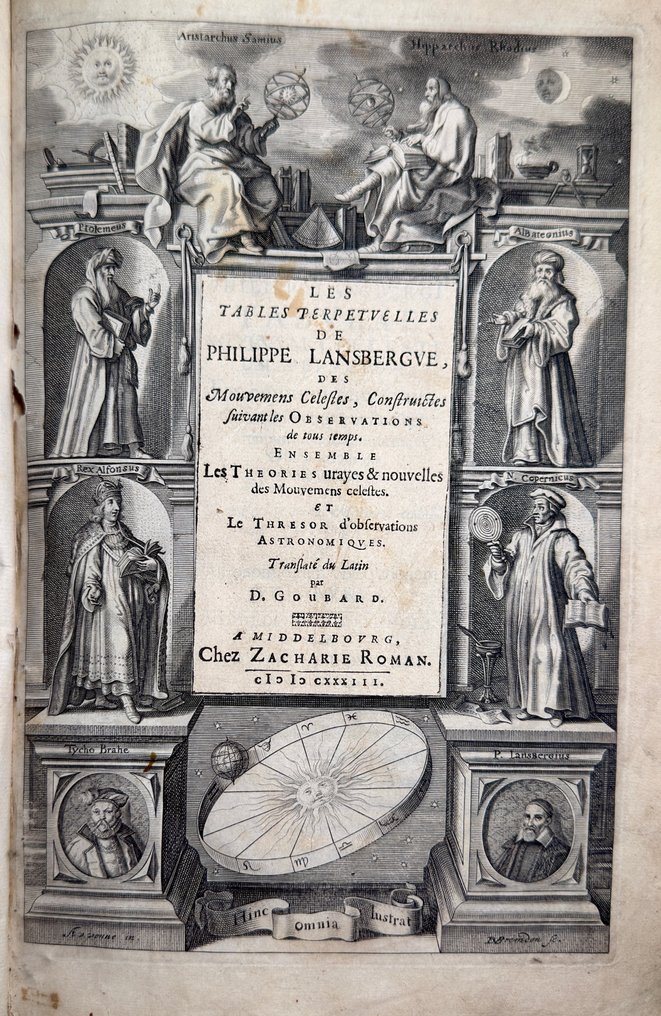
Philippe van Lansberge - (ASTRONOMY) Les Tables perpetuelles des mouvemens celestes - 1633


11
days
13
hours
42
minutes
59
seconds
Current bid
€ 370
No reserve price

Expert
Selected by Volker Riepenhausen
Specialist in travel literature and pre-1600 rare prints with 28 years experience.
Estimate € 2,200 - € 4,400
20 other people are watching this object
 Bidder 7748 Bidder 7748 | €370 | |
|---|---|---|
 Bidder 3168 Bidder 3168 | €350 | |
| Bidder 3168 | €330 | |
Catawiki Buyer Protection
Your payment’s safe with us until you receive your object.View details
Trustpilot 4.4 | 123113 reviews
Rated Excellent on Trustpilot.
Description from the seller
Kepler’s chief rival in print—a Copernican toolkit that powered 1630s astronomy.
THE BOOK
Philippe van Lansberge — Les Tables perpetuelles des mouvemens celestes.
(Middelburg: Chez Zacharie Roman, 1633; translated by David Goubard.)
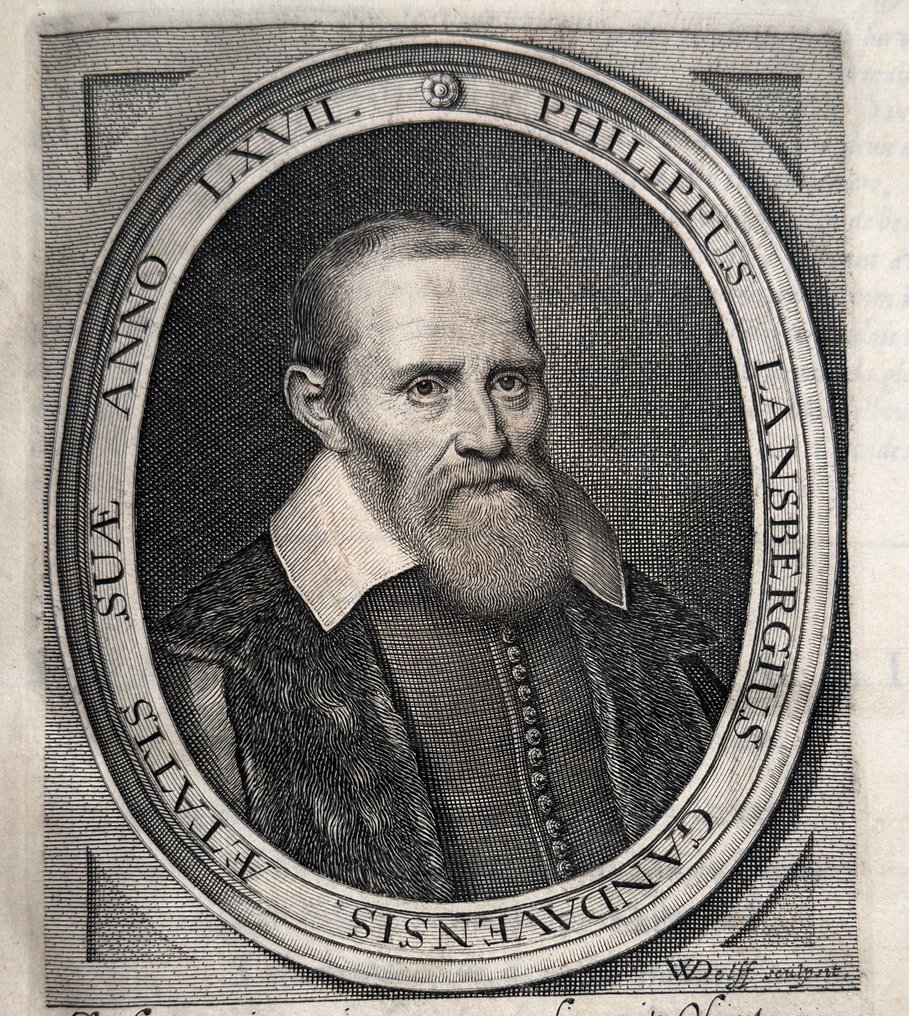
Folio, first French edition, four parts in one; engraved portrait of the author, numerous in-text diagrams, and one large folding typographical table. Complete. Bound in full period parchment. Scarce first edition.
MOUSEION CURATOR NOTE
“Built as a desk-side computational engine—tables, rules, and an observation treasury in one folio—this volume shows the scientific revolution at work. In the decade after publication, Lansberge’s Copernican tables were widely read and stood as the chief rival to Kepler’s Rudolphine Tables.”
DESCRIPTION
Scarce First French edition of Lansberge’s planetary tables.
Lansberge champions a Copernican frame while retaining circular schemes—widely used in the 1630s–40s and debated against Kepler’s ellipses.
The volume integrates:
Tables perpetuelles — longitudes/latitudes, anomalies, coefficients for Sun, Moon, and planets, designed for perpetual reuse (not ephemeral ephemerides).
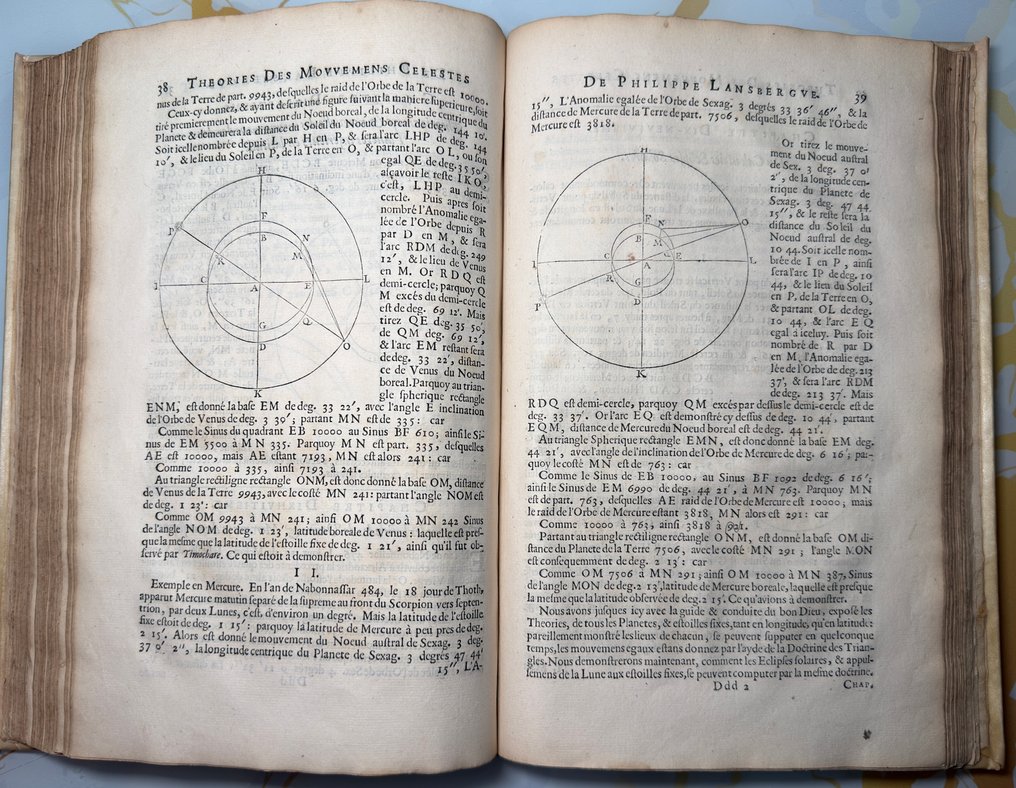
Théories nouvelles — the computational backbone: trigonometric procedures, worked examples, and rules tying method to table.
Trésor d’observations — a compiled dossier of observations from Antiquity to the early 17th century, used to validate and tune the tables.
The volume includes a wide folding table, typographically set for speed of reference.
Jeremiah Horrocks—before his landmark 1639 transit of Venus—first worked from Lansberge’s tables and only then moved to Kepler, a testament to how central and serviceable Lansberge’s canon was to the era’s practice.
Lansberge’s folio is a working calculus of the heavens: it fixes computations to a local Zeeland meridian (cited as “meridien Goesien”), sets out sexagesimal rules with prosthaphaeresis to turn multiplications into additions, and supplies auxiliary matter for refraction, parallax, semi-diameters, and eclipse magnitude in “digits”—all keyed to conversions between Anno Christi and the era of Nabonassar; the sections on obliquity, meridian differences, and selected fixed-star references show a tool built for real observers, not just theorists.
PROVENANCE
Owen Gingerich (1930–2023) — renowned astronomer & historian of science (Harvard); Bookplate on pastedown.
Gingerich flagged the book’s working meridian (Ghent/Goes), jotted conversion offsets for two other ephemeris meridians he often compared (Modena/Malvasia; Danzig/Hevelius), and tucked in a program printout showing a Lansberg-model solar position—with his own red correction.
CONDITION REPORT
Very good: clean, complete, and crisp; strong impressions of type and diagrams; folding table intact; cancel-slip present at Ddd3–Ddd4; mild, even toning; trivial handling consistent with careful scholarly use.
Engraved title with two tiny perforations in the inner blank margin.
Binding: full period parchment, sound and honest; expected light cockling; edges and corners well preserved.
FORMAT & COLLATION
Folio in sixes and fours; multiple alphabet cycles corresponding to the integrated parts.
Collation: *⁶ A–D⁶ E–F⁴ Aa¹² Bb–Nn⁶ Oo² Pp⁶ Qq⁴; Aaa–Ddd⁶; 4A–4H⁶. Complete.
Illustration: engraved author portrait; numerous text diagrams; one folding typographical table.
Cancel-slip: small printed diagram inserted between Ddd3 and Ddd4.
Kepler’s chief rival in print—a Copernican toolkit that powered 1630s astronomy.
THE BOOK
Philippe van Lansberge — Les Tables perpetuelles des mouvemens celestes.
(Middelburg: Chez Zacharie Roman, 1633; translated by David Goubard.)
Folio, first French edition, four parts in one; engraved portrait of the author, numerous in-text diagrams, and one large folding typographical table. Complete. Bound in full period parchment. Scarce first edition.
MOUSEION CURATOR NOTE
“Built as a desk-side computational engine—tables, rules, and an observation treasury in one folio—this volume shows the scientific revolution at work. In the decade after publication, Lansberge’s Copernican tables were widely read and stood as the chief rival to Kepler’s Rudolphine Tables.”
DESCRIPTION
Scarce First French edition of Lansberge’s planetary tables.
Lansberge champions a Copernican frame while retaining circular schemes—widely used in the 1630s–40s and debated against Kepler’s ellipses.
The volume integrates:
Tables perpetuelles — longitudes/latitudes, anomalies, coefficients for Sun, Moon, and planets, designed for perpetual reuse (not ephemeral ephemerides).
Théories nouvelles — the computational backbone: trigonometric procedures, worked examples, and rules tying method to table.
Trésor d’observations — a compiled dossier of observations from Antiquity to the early 17th century, used to validate and tune the tables.
The volume includes a wide folding table, typographically set for speed of reference.
Jeremiah Horrocks—before his landmark 1639 transit of Venus—first worked from Lansberge’s tables and only then moved to Kepler, a testament to how central and serviceable Lansberge’s canon was to the era’s practice.
Lansberge’s folio is a working calculus of the heavens: it fixes computations to a local Zeeland meridian (cited as “meridien Goesien”), sets out sexagesimal rules with prosthaphaeresis to turn multiplications into additions, and supplies auxiliary matter for refraction, parallax, semi-diameters, and eclipse magnitude in “digits”—all keyed to conversions between Anno Christi and the era of Nabonassar; the sections on obliquity, meridian differences, and selected fixed-star references show a tool built for real observers, not just theorists.
PROVENANCE
Owen Gingerich (1930–2023) — renowned astronomer & historian of science (Harvard); Bookplate on pastedown.
Gingerich flagged the book’s working meridian (Ghent/Goes), jotted conversion offsets for two other ephemeris meridians he often compared (Modena/Malvasia; Danzig/Hevelius), and tucked in a program printout showing a Lansberg-model solar position—with his own red correction.
CONDITION REPORT
Very good: clean, complete, and crisp; strong impressions of type and diagrams; folding table intact; cancel-slip present at Ddd3–Ddd4; mild, even toning; trivial handling consistent with careful scholarly use.
Engraved title with two tiny perforations in the inner blank margin.
Binding: full period parchment, sound and honest; expected light cockling; edges and corners well preserved.
FORMAT & COLLATION
Folio in sixes and fours; multiple alphabet cycles corresponding to the integrated parts.
Collation: *⁶ A–D⁶ E–F⁴ Aa¹² Bb–Nn⁶ Oo² Pp⁶ Qq⁴; Aaa–Ddd⁶; 4A–4H⁶. Complete.
Illustration: engraved author portrait; numerous text diagrams; one folding typographical table.
Cancel-slip: small printed diagram inserted between Ddd3 and Ddd4.
Details
Number of Books
1
Subject
Astronomy, Mathematics, Physics
Book Title
(ASTRONOMY) Les Tables perpetuelles des mouvemens celestes
Author/ Illustrator
Philippe van Lansberge
Condition
Very good
Publication year oldest item
1633
Height
29.2 cm
Edition
1st Edition
Width
18.4 cm
Language
French
Original language
No
Publisher
Chez Zacharie Roman
Extras
Fold out maps or plates
Number of pages
417
Sold by
