Archie Gittes (1903-1991) - NO RESERVE - Landscape


08
days
03
hours
39
minutes
14
seconds

No bids placed
Catawiki Buyer Protection
Your payment’s safe with us until you receive your object.View details
Trustpilot 4.4 | 122713 reviews
Rated Excellent on Trustpilot.
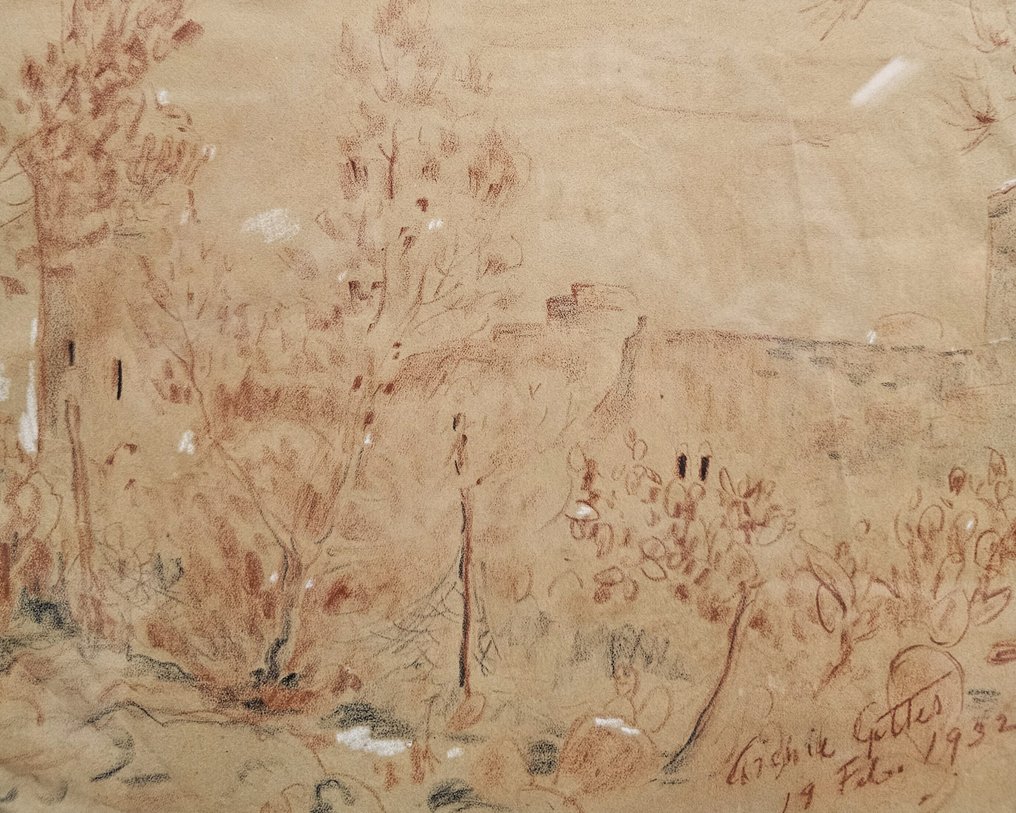
NO RESERVE - Landscape, a 1930s charcoal drawing by Archie Gittes (1903–1991), on paper, España, signed, original edition, framed, 51 × 41 cm framed, weight 2 kg, in good condition.
AI-assisted summary
Description from the seller
Technical sheet
Author: Archie Gittes (1903–1991)
Title: Landscape
Signed and dated in 1932
Technique: Drawing in greasy pencil and sanguine on paper.
Support: Cream-toned laid paper.
Measurements: 22 × 27 cm (artwork) · 41 × 51 cm (with frame)
Style: Poetic realism – Lyrical landscape painting
Painting school: modern European school, French environment.
Condition: Good, with a natural patina of time.
Original frame made of solid wood, with a straight and sober molding, featuring a neutral conservation mat.
2. Compositional and iconographic description
The work depicts an intimate rural landscape, structured through a succession of stylized trees framing a low and almost evanescent architecture in the background. The composition is horizontal and balanced, with an organic foreground of schematic vegetation guiding the eye toward the horizon.
The drawing is resolved with a loose, vibrant, and atmospheric stroke, where the line does not delimit but suggests volumes and natural rhythms.
The use of sanguine adds warmth and a meditative character, reinforcing the sense of silence and contemplation. There are no human figures: the focus is on the poetry of the landscape and its emotional resonance.
3. Style, School, and Comparative Valuation
This work clearly belongs to a poetic realism of French origin, close to the sensibility of artists such as Camille Corot, Charles-François Daubigny, or, in a modern key, certain intimate landscapes by Maurice Utrillo and Albert Marquet. The economy of means, the primacy of the environment, and the absence of narrative anecdote reinforce its lyrical character.
Archie Gittes demonstrates early maturity here, mastering drawing as an expressive tool rather than a descriptive one.
It is a refined work, consistent with the collector's taste for European drawings from the first third of the 20th century, especially those that combine modern sensitivity and landscape tradition.
An elegant, silent piece, and very well contextualized within its era.
Seller's Story
At Barcelona Art Gallery, we are a large family of art collectors in Barcelona who have been acquiring all kinds of paintings for 2 centuries.
Headquartered in the Les Corts neighborhood of Barcelona.
We offer part of our private collection for auction: high period and modern paintings that we have been acquiring over time, mainly from art galleries, antique dealers, auctions, private collections and very diverse origins.
Translated by Google TranslateTechnical sheet
Author: Archie Gittes (1903–1991)
Title: Landscape
Signed and dated in 1932
Technique: Drawing in greasy pencil and sanguine on paper.
Support: Cream-toned laid paper.
Measurements: 22 × 27 cm (artwork) · 41 × 51 cm (with frame)
Style: Poetic realism – Lyrical landscape painting
Painting school: modern European school, French environment.
Condition: Good, with a natural patina of time.
Original frame made of solid wood, with a straight and sober molding, featuring a neutral conservation mat.
2. Compositional and iconographic description
The work depicts an intimate rural landscape, structured through a succession of stylized trees framing a low and almost evanescent architecture in the background. The composition is horizontal and balanced, with an organic foreground of schematic vegetation guiding the eye toward the horizon.
The drawing is resolved with a loose, vibrant, and atmospheric stroke, where the line does not delimit but suggests volumes and natural rhythms.
The use of sanguine adds warmth and a meditative character, reinforcing the sense of silence and contemplation. There are no human figures: the focus is on the poetry of the landscape and its emotional resonance.
3. Style, School, and Comparative Valuation
This work clearly belongs to a poetic realism of French origin, close to the sensibility of artists such as Camille Corot, Charles-François Daubigny, or, in a modern key, certain intimate landscapes by Maurice Utrillo and Albert Marquet. The economy of means, the primacy of the environment, and the absence of narrative anecdote reinforce its lyrical character.
Archie Gittes demonstrates early maturity here, mastering drawing as an expressive tool rather than a descriptive one.
It is a refined work, consistent with the collector's taste for European drawings from the first third of the 20th century, especially those that combine modern sensitivity and landscape tradition.
An elegant, silent piece, and very well contextualized within its era.
Seller's Story
At Barcelona Art Gallery, we are a large family of art collectors in Barcelona who have been acquiring all kinds of paintings for 2 centuries.
Headquartered in the Les Corts neighborhood of Barcelona.
We offer part of our private collection for auction: high period and modern paintings that we have been acquiring over time, mainly from art galleries, antique dealers, auctions, private collections and very diverse origins.
Translated by Google TranslateDetails
Artist
Archie Gittes (1903-1991)
Sold with frame
Yes
Sold by
Gallery
Edition
Original
Title of artwork
NO RESERVE - Landscape
Technique
Charcoal
Signature
Hand signed
Country of Origin
Spain
Condition
Good condition
Height
41 cm
Width
51 cm
Weight
2 kg
Depiction/Theme
Landscape
Style
Impressionism
Period
1930-1940
Sold by
