conflict in Drenthe - Beilen, Diever, Noordenveld en Oostermoer vs Zuidenveld en Rolde - 1787


06
days
16
hours
58
minutes
36
seconds

6 other people are watching this object
 Bidder 4320 Bidder 4320 | €1 |
|---|
Catawiki Buyer Protection
Your payment’s safe with us until you receive your object.View details
Trustpilot 4.4 | 122910 reviews
Rated Excellent on Trustpilot.
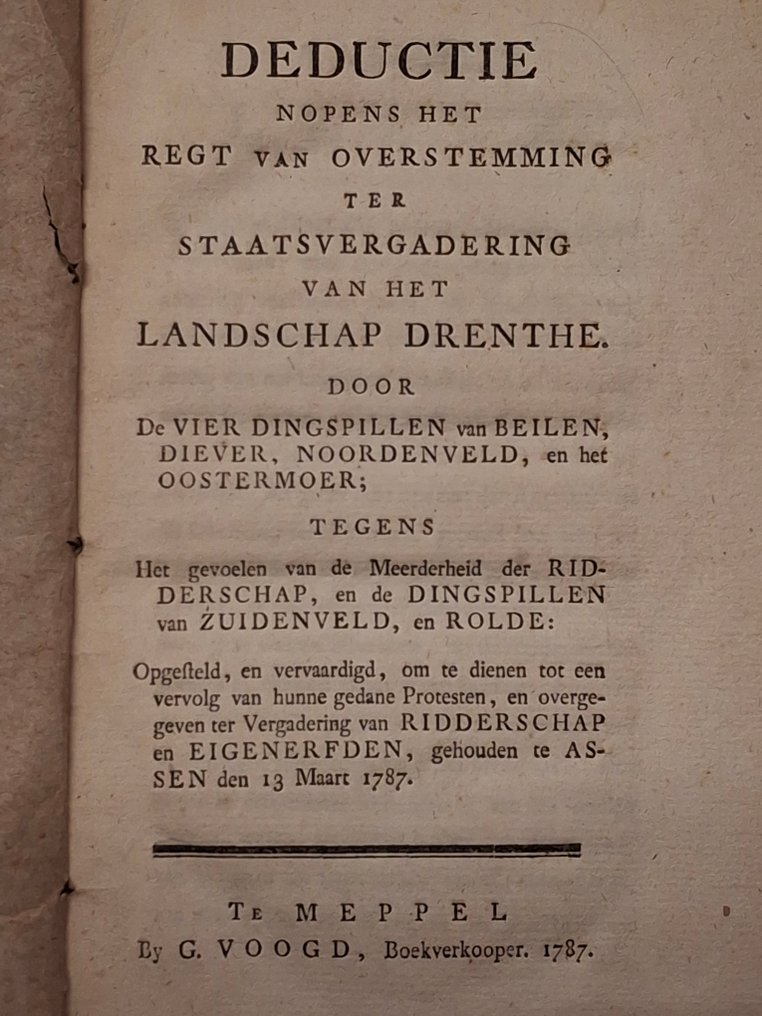
Beilen, Diever, Noordenveld en Oostermoer vs Zuidenveld en Rolde is a first edition pamphlet from 1787, in Dutch, published in Meppel by G. Voogd, with 57 pages, 22 x 15 cm, authored/illustrated by conflict in Drenthe, and in good condition.
AI-assisted summary
Description from the seller
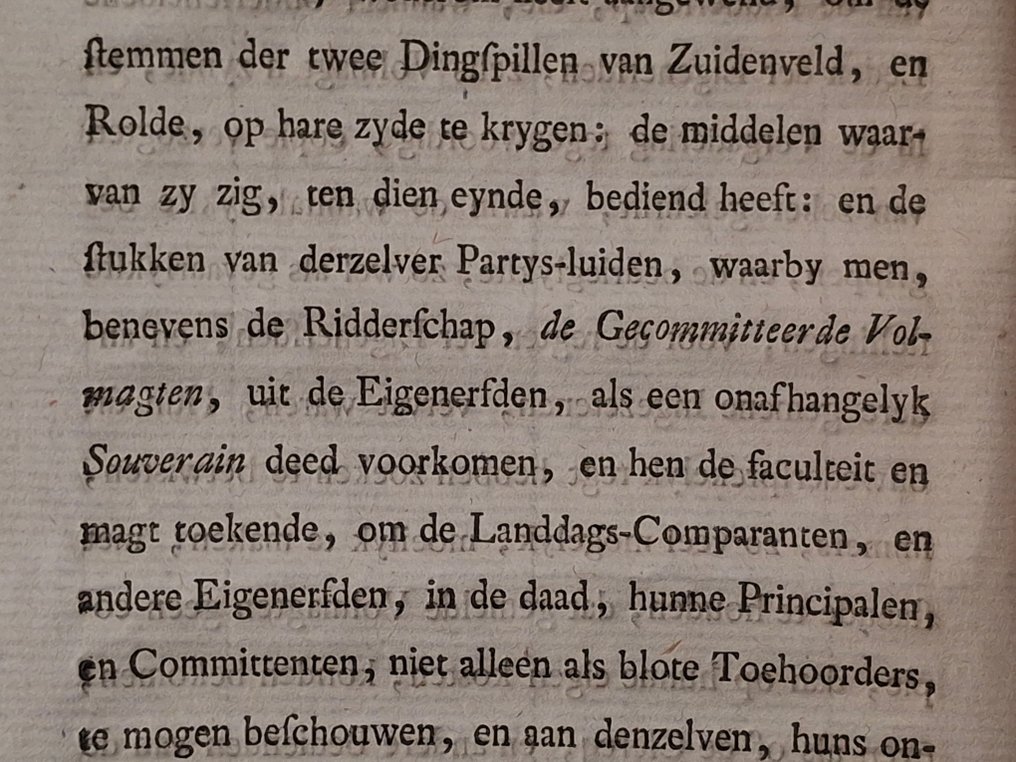
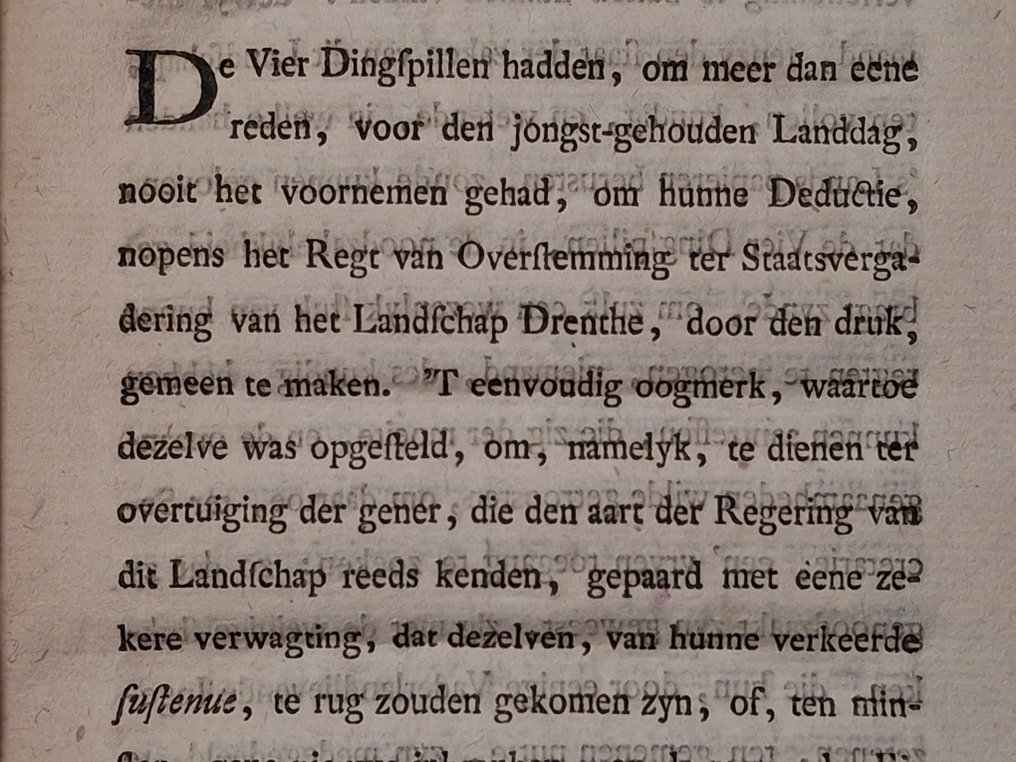
The pamphlet addresses a legal conflict over voting rights in the provincial assembly of Drenthe.
Four Drenthe entities (Beilen, Diever, Noordenveld, and Oostermoer) defended their right to decision-making (majority decision-making).
They faced the majority of the knighthood and the dingspillen of Zuidenveld and Rolde, who held a different stance.
In Drenthe, there was a unique governing model: the States meeting of ridderschap and eigenerfden.
The dingspillen were regional administrative districts, comparable to guilds or market associations.
The pamphlet reflects the tensions between the nobility and the free farmers over political power and voting rights.
The document is a deduction (legal justification or plea), in which the four involved parties defend their right to majority decision-making.
It was introduced during a meeting in Assen, the administrative center of Drenthe.
A dingspil was an old legal area in Drenthe that served as the administrative and legal division of the province.
Elk Dingspil dispatched representatives to the Supreme Court, the Etstoel, and played a role in the administration of the Landscape of Drenthe.
The word comes from 'thing,' a court session that was held several times a year in the Middle Ages.
A 'dingspil' was therefore the area where such court sessions took place.
Deduction regarding the right of consent at the state assembly of the landscape of Drenthe. By the four districts of Beilen, Diever, Noordenveld, and Oostermoer; against the opinion of the majority of the nobility, and the districts of Zuidenveld and Rolde; submitted at the assembly of nobility and freeholders, held in Assen - Meppel, G. Voogd, 1787 - 57 pages - 22 x 15 cm
The pamphlet addresses a legal conflict over voting rights in the provincial assembly of Drenthe.
Four Drenthe entities (Beilen, Diever, Noordenveld, and Oostermoer) defended their right to decision-making (majority decision-making).
They faced the majority of the knighthood and the dingspillen of Zuidenveld and Rolde, who held a different stance.
In Drenthe, there was a unique governing model: the States meeting of ridderschap and eigenerfden.
The dingspillen were regional administrative districts, comparable to guilds or market associations.
The pamphlet reflects the tensions between the nobility and the free farmers over political power and voting rights.
The document is a deduction (legal justification or plea), in which the four involved parties defend their right to majority decision-making.
It was introduced during a meeting in Assen, the administrative center of Drenthe.
A dingspil was an old legal area in Drenthe that served as the administrative and legal division of the province.
Elk Dingspil dispatched representatives to the Supreme Court, the Etstoel, and played a role in the administration of the Landscape of Drenthe.
The word comes from 'thing,' a court session that was held several times a year in the Middle Ages.
A 'dingspil' was therefore the area where such court sessions took place.
Deduction regarding the right of consent at the state assembly of the landscape of Drenthe. By the four districts of Beilen, Diever, Noordenveld, and Oostermoer; against the opinion of the majority of the nobility, and the districts of Zuidenveld and Rolde; submitted at the assembly of nobility and freeholders, held in Assen - Meppel, G. Voogd, 1787 - 57 pages - 22 x 15 cm
Details
Number of Books
1
Subject
History, Politics, Regional interest
Book Title
Beilen, Diever, Noordenveld en Oostermoer vs Zuidenveld en Rolde
Author/ Illustrator
conflict in Drenthe
Condition
Good
Publication year oldest item
1787
Height
22 cm
Edition
1st Edition
Width
15 cm
Language
Dutch
Original language
Yes
Publisher
Meppel, G. Voogd
Number of pages
57
