Bang & Olufsen - BeoSound Ouverture on Cd Rack with a pair of Beolab 6000 Hi-fi set - Multiple models


08
days
05
hours
48
minutes
00
seconds
Current bid
€ 2
Reserve price not met

Expert
Selected by Ariel Cabello
Holds dual bachelor's degrees in electronics and physics with 20 years in audio engineering.
Estimate € 1,100 - € 1,400
10 other people are watching this object
 Bidder 2497 Bidder 2497 | €2 | |
|---|---|---|
 Bidder 4837 Bidder 4837 | €1 |
Catawiki Buyer Protection
Your payment’s safe with us until you receive your object.View details
Trustpilot 4.4 | 122986 reviews
Rated Excellent on Trustpilot.
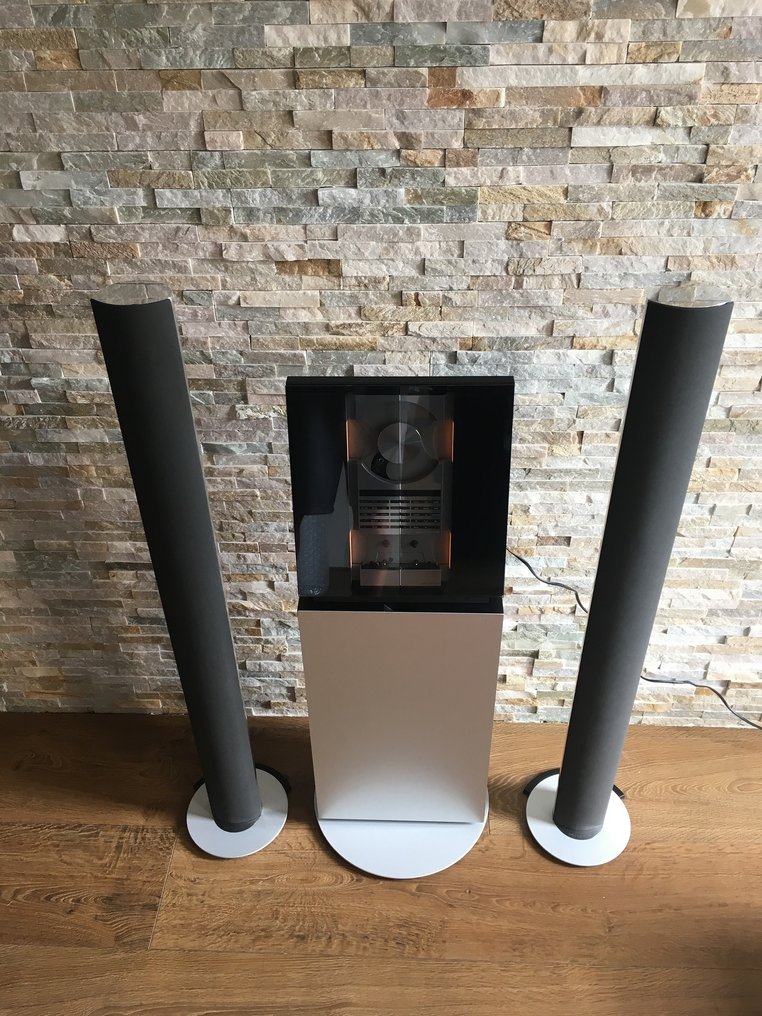
Bang & Olufsen BeoSound Ouverture on CD rack with a pair of Beolab 6000, four items in this lot, very good physical condition and tested and working, includes a power cord and extra item.
AI-assisted summary
Description from the seller
This lot included :
1x Beosound Ouverture type 2636 ( Tape belt need replacement )
1x cd floorstand/ cabinet
2x Beolab 6000
3x Powercords 220 volt
2x powerlink cables
“BeoSound Ouverture: the design may be a Bang & Olufsen classic, but BeoSound Ouverture and BeoSound 3000 refuse to rest on their laurels. Access to new musical sources and fresh loudspeaker options ensure that the concept remains an open invitation to make something special out of your music” (B&O catalogue 2001 -2002)
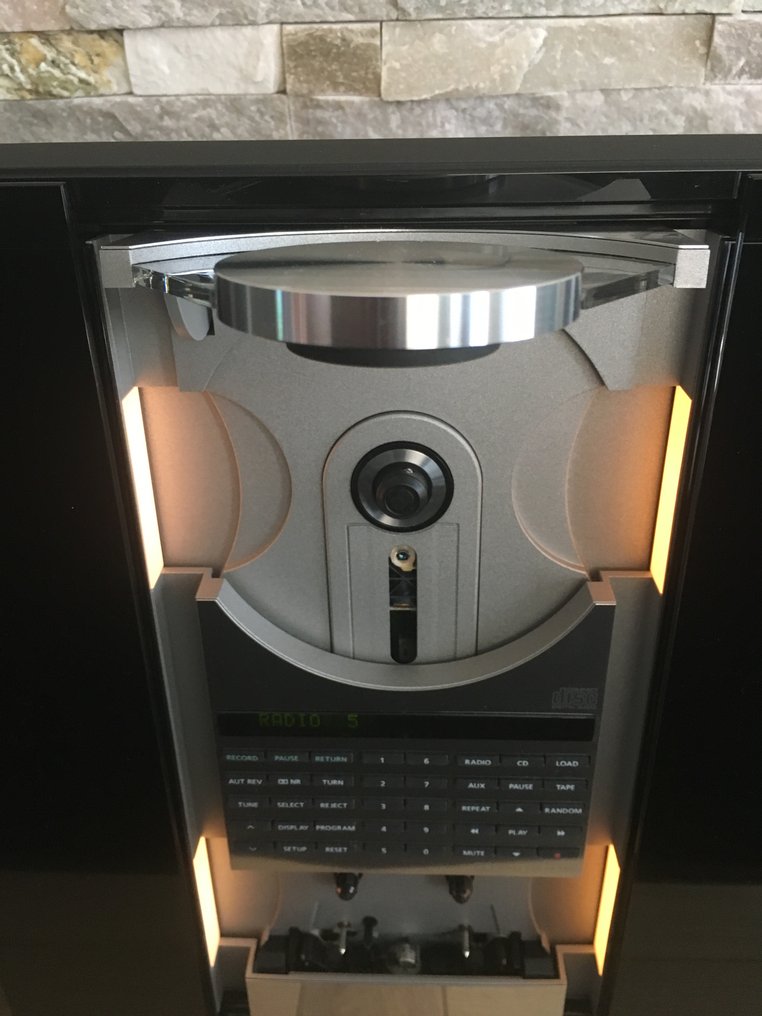
This stereo has two different names: BeoSound Ouverture in Europe and BeoSound 4000 in the rest of the world. This is the only stereo system, so far, to support the new MasterLink system without any add-ons. It’s really a follow up to the Beocenter 2500 which was the first and original stereo with this somewhat different look. Along with the launch of this unit in 1991 (as the BeoSound 2500) Bang & Olufsen also started selling the new remote control – Beo4. The difference between the Ouverture and Beocenter 2500 is that the newer model doesn’t feature two-way communication and it has instead a completely new CD mechanism. It also holds some new features when it comes to the CD. But the most important difference is the MasterLink connection. With this system you can connect the unit to, for example, a BeoLab 2000 or BeoLab 3500 without any further electronics. Reach out and the doors glide quietly aside, while a gentle light spreads from within. It’s BeoSound Ouverture’s way of saying, “welcome” and part of the experience every time you put on a new tape or CD. CD player with programming, tape recorder with auto reverse, FM/AM radio with pre-set, timer function, optional Beo4 remote control operation, connections for Beolink and headphones, optional wall bracket and floor stand. BeoSound Ouverture’s unassuming rubber key pad hides a contact foil, which, in turn, covers a matrix of vertical and horizontal cords. When a control is pressed, the cords connect and the microprocessor is activated.
Design
Music is more than just something you listen to, it’s an emotion you experience. So isn’t it time your favourite music was played on something that lets it express itself to the full? BeoSound Ouverture stands up and invites you to make something special out of your music – over and over again.
Features
Bring new life to old CDs by changing their track sequence with the Random Play function. Or programme it to skip over any unwanted tracks and to play the ones you want in the order you prefer. Transferring the music of a CD onto tape doesn’t have to mean poorer quality. The Ouverture constantly monitors and adjusts the signal during any recording to ensure a uniform sound level throughout – and will automatically stop recording when the CD finishes playing. There’s room for up to 30 pre-set stations on the Ouverture’s intelligent AM/FM radio.
So how do the sliding glass doors work?
The glass doors on the BeoSound 3000 and BeoSound Ouverture are opened and closed by steel wires driven by an electric motor via a gearbox. The motor is triggered by an infrared system that detects your approach… Why wake up to an annoying alarm clock when it could be your favourite piece of music instead? The timer function on the Ouverture can be programmed for the entire week and will automatically turn itself off again after playing for any length of time you choose.
Specials
Just raise a hand and watch as the glass doors glide silently aside. It’s the Ouverture’s way of saying “welcome” and reveals that a special experience is about to begin. Of course, a simple on/off button would do, but then what would be so special about that?
Easily Placed
It’s a dream come true – a music system that can fill your life with music without filling your home with equipment. The flat upright design of BeoSound Ouverture means that it’s slim enough to sit by itself upon the narrowest shelf or light enough to be hung directly on a wall with a pair of loudspeakers.
Use
With its mix of glass and aluminium, the Ouverture grabs the attention without shouting out loud. Its compact size and visual presence ensures that it enhances rather than dominates the surroundings in which it’s placed – which makes it the perfect audio system for the home and place of work. The stereo can also be controlled by the optional Beo4 remote control.
As easy on the eye as they are on the ear, BeoLab 6000 loudspeakers – designed by David Lewis – defy conventional thinking in delivering the maximum sound from the minimum of space.
There’s not much point in thinking about BeoLab 6000 in terms of watts, woofers or tweeters. There has never been loudspeakers that look like this – or so clear and rich a sound produced from such slender cabinets. BeoLab 6000 represents both the engineering skills as well as the design capabilities from Bang & Olufsen.
BeoLab 6000 is probably one of the most famous speakers around today being a part of the standard exhibition at the Museum of Modern Art in New York. The BeoLab 6000 is a smaller version of the BeoLab 8000 with the same active construction but with even smaller net volume: 3 litres.
A great advantage with the BeoLab 6000 is the fact that it has two PowerLink connections giving the possibility to loop-through the signal to the second speaker directly.
” When it comes to sound reproduction we believe there’s only one relevant parameter: How close can we come to the originally recorded sound. We feel an obligation not to disturb the intentions of the artist by adding unnatural elements to the acoustic image. Therefore all Bang & Olufsen loudspeakers share the same goal. They differ in size and shape and in terms of sound pressure level. But they are all developed to reproduce the natural, unaltered sound as closely as possible “ – Bang & Olufsen catalogue 2001 – 2002
Features:
BeoLab 6000 fills the room with sound
The choice is simple – you can fill your home with big black boxes, or you can make a stand with BeoLab 6000 and fill it with beautiful sound and beautiful looks.
Aluminium
Formed from a single piece of aluminium, BeoLab 6000 is shaped to stand out from its surroundings, but coloured to match any Bang & Olufsen audio or video setup.
Active loudspeaker benefits
How does B&O reduce the overall size of a loudspeaker, but improve its sound performance? It can only be done by placing the amplifiers directly into the loudspeaker cabinet. It’s called ‘Active Loudspeaker Technology’ and is used to combine the purest of sounds with the smallest and simplest of shapes.
Fits any room
With a height of just 110cm and a depth of 10cm, finding space for a pair of BeoLab 6000 speakers is never going to be a problem. Its superior sound capabilities ensure that its performance will never dictate your placement options. The polished aluminium cabinet is available in a range of colours – black, blue, green, red and natural – that will match any Bang & Olufsen audio or video setup.
Materials and finish
The deliberate choice of material, and the final surface treatment of the products’ finish, are characteristic of Bang & Olufsen and one of their true core competences. B&O’s designers know that people use several of their senses in experiencing a product. They therefore derive great pleasure from tactile experiences, whether they are touching a cold or a warm surface, or one that is smooth or textured. The span of materials used for Bang & Olufsen products is wider than that of any other company within the trade, and they are carefully selected for their high quality and their ability to fit naturally into a home environment. The finish is then refined to perfection and created to provide a tangible experience that supports the visual impression.
Why build amplifiers into the loudspeakers instead of keeping them separate?
Because you can reduce the size of the cabinet volume to one-third of the size of a conventional loudspeaker with the same sound capacity. The principle is called Active Loudspeakers, and what you get is a compact loudspeaker that can play at high volume without distortion or damage to its drive units.
Furthermore, when amplifier, treble and bass units are paired for the same task, they can be tailored to compensate for each other’s shortcomings. What you hear is music that sounds exactly like the instrument it originally came from (See active speakers)
Deep bass: how to make deep bass with a shallow cabinet
All loudspeakers, regardless of brand, size or construction, make sound by converting electric energy into acoustic energy. They push air in waves, which is what our ears pick up. To get high sound pressure, you need to move a lot of air.
You can use a very large diameter loudspeaker membrane, which moves a very short distance. Or (as Bang & Olufsen prefer), you can make the membrane “deeper”, in other words, make it move a greater distance with a smaller diameter. Imagine two balloons, one round and shaped like a ball, the other long and tubular. Both contain the same amount of air; it’s simply their shapes that are different.
A side benefit to the deeper membrane is that it allows a smaller cabinet, with greater freedom as far as form and function are concerned.
Since no two loudspeaker units have exactly the same physical characteristics, Bang & Olufsen calibrate them individually to make certain that the sound of each and every loudspeaker leaving our factory is identical. By employing an active electronic crossover network with equalization, we’re able to adjust frequencies before they’re amplified. The signal from the sound source is shaped before distribution to the separate power amplifiers for bass and treble.
In this way, the performance of the various components is “fine-tuned”, until they produce an ideal, harmonised output, which will be the same, no matter which BeoLab loudspeaker you feast your eyes upon. The custom made driver units of a BeoLab loudspeaker feature extra-heavy membranes with longer movement, which help produce a deeper bass.
Adaptive Bass Linearisation
Adaptive Bass Linearisation (ABL) is a process patented by B&O and is incorporated in BeoLab loudspeakers. The idea is to use the surplus capacity in amplifiers and driver units, arising by normal listening levels, for a bass extension – a sound reproduction with more bass, than the loudspeaker otherwise would be able to produce.
The function is adaptive. This means that the loudspeaker adapts to the signal it receives. Loudspeaker drivers are therefore fully exploited, without suffering mechanical or electronic abuse, and the built in amplifiers are not subjected to signals would otherwise create an overload situation.
ABL gives stunning bass reproduction considering the size of the loudspeaker in which it is incorporated, under normal listening levels.
BeoLab 6000: active loudspeaker, 2 power amplifier modules, adaptive bass linearisation and aluminium cabinet.
This lot included :
1x Beosound Ouverture type 2636 ( Tape belt need replacement )
1x cd floorstand/ cabinet
2x Beolab 6000
3x Powercords 220 volt
2x powerlink cables
“BeoSound Ouverture: the design may be a Bang & Olufsen classic, but BeoSound Ouverture and BeoSound 3000 refuse to rest on their laurels. Access to new musical sources and fresh loudspeaker options ensure that the concept remains an open invitation to make something special out of your music” (B&O catalogue 2001 -2002)
This stereo has two different names: BeoSound Ouverture in Europe and BeoSound 4000 in the rest of the world. This is the only stereo system, so far, to support the new MasterLink system without any add-ons. It’s really a follow up to the Beocenter 2500 which was the first and original stereo with this somewhat different look. Along with the launch of this unit in 1991 (as the BeoSound 2500) Bang & Olufsen also started selling the new remote control – Beo4. The difference between the Ouverture and Beocenter 2500 is that the newer model doesn’t feature two-way communication and it has instead a completely new CD mechanism. It also holds some new features when it comes to the CD. But the most important difference is the MasterLink connection. With this system you can connect the unit to, for example, a BeoLab 2000 or BeoLab 3500 without any further electronics. Reach out and the doors glide quietly aside, while a gentle light spreads from within. It’s BeoSound Ouverture’s way of saying, “welcome” and part of the experience every time you put on a new tape or CD. CD player with programming, tape recorder with auto reverse, FM/AM radio with pre-set, timer function, optional Beo4 remote control operation, connections for Beolink and headphones, optional wall bracket and floor stand. BeoSound Ouverture’s unassuming rubber key pad hides a contact foil, which, in turn, covers a matrix of vertical and horizontal cords. When a control is pressed, the cords connect and the microprocessor is activated.
Design
Music is more than just something you listen to, it’s an emotion you experience. So isn’t it time your favourite music was played on something that lets it express itself to the full? BeoSound Ouverture stands up and invites you to make something special out of your music – over and over again.
Features
Bring new life to old CDs by changing their track sequence with the Random Play function. Or programme it to skip over any unwanted tracks and to play the ones you want in the order you prefer. Transferring the music of a CD onto tape doesn’t have to mean poorer quality. The Ouverture constantly monitors and adjusts the signal during any recording to ensure a uniform sound level throughout – and will automatically stop recording when the CD finishes playing. There’s room for up to 30 pre-set stations on the Ouverture’s intelligent AM/FM radio.
So how do the sliding glass doors work?
The glass doors on the BeoSound 3000 and BeoSound Ouverture are opened and closed by steel wires driven by an electric motor via a gearbox. The motor is triggered by an infrared system that detects your approach… Why wake up to an annoying alarm clock when it could be your favourite piece of music instead? The timer function on the Ouverture can be programmed for the entire week and will automatically turn itself off again after playing for any length of time you choose.
Specials
Just raise a hand and watch as the glass doors glide silently aside. It’s the Ouverture’s way of saying “welcome” and reveals that a special experience is about to begin. Of course, a simple on/off button would do, but then what would be so special about that?
Easily Placed
It’s a dream come true – a music system that can fill your life with music without filling your home with equipment. The flat upright design of BeoSound Ouverture means that it’s slim enough to sit by itself upon the narrowest shelf or light enough to be hung directly on a wall with a pair of loudspeakers.
Use
With its mix of glass and aluminium, the Ouverture grabs the attention without shouting out loud. Its compact size and visual presence ensures that it enhances rather than dominates the surroundings in which it’s placed – which makes it the perfect audio system for the home and place of work. The stereo can also be controlled by the optional Beo4 remote control.
As easy on the eye as they are on the ear, BeoLab 6000 loudspeakers – designed by David Lewis – defy conventional thinking in delivering the maximum sound from the minimum of space.
There’s not much point in thinking about BeoLab 6000 in terms of watts, woofers or tweeters. There has never been loudspeakers that look like this – or so clear and rich a sound produced from such slender cabinets. BeoLab 6000 represents both the engineering skills as well as the design capabilities from Bang & Olufsen.
BeoLab 6000 is probably one of the most famous speakers around today being a part of the standard exhibition at the Museum of Modern Art in New York. The BeoLab 6000 is a smaller version of the BeoLab 8000 with the same active construction but with even smaller net volume: 3 litres.
A great advantage with the BeoLab 6000 is the fact that it has two PowerLink connections giving the possibility to loop-through the signal to the second speaker directly.
” When it comes to sound reproduction we believe there’s only one relevant parameter: How close can we come to the originally recorded sound. We feel an obligation not to disturb the intentions of the artist by adding unnatural elements to the acoustic image. Therefore all Bang & Olufsen loudspeakers share the same goal. They differ in size and shape and in terms of sound pressure level. But they are all developed to reproduce the natural, unaltered sound as closely as possible “ – Bang & Olufsen catalogue 2001 – 2002
Features:
BeoLab 6000 fills the room with sound
The choice is simple – you can fill your home with big black boxes, or you can make a stand with BeoLab 6000 and fill it with beautiful sound and beautiful looks.
Aluminium
Formed from a single piece of aluminium, BeoLab 6000 is shaped to stand out from its surroundings, but coloured to match any Bang & Olufsen audio or video setup.
Active loudspeaker benefits
How does B&O reduce the overall size of a loudspeaker, but improve its sound performance? It can only be done by placing the amplifiers directly into the loudspeaker cabinet. It’s called ‘Active Loudspeaker Technology’ and is used to combine the purest of sounds with the smallest and simplest of shapes.
Fits any room
With a height of just 110cm and a depth of 10cm, finding space for a pair of BeoLab 6000 speakers is never going to be a problem. Its superior sound capabilities ensure that its performance will never dictate your placement options. The polished aluminium cabinet is available in a range of colours – black, blue, green, red and natural – that will match any Bang & Olufsen audio or video setup.
Materials and finish
The deliberate choice of material, and the final surface treatment of the products’ finish, are characteristic of Bang & Olufsen and one of their true core competences. B&O’s designers know that people use several of their senses in experiencing a product. They therefore derive great pleasure from tactile experiences, whether they are touching a cold or a warm surface, or one that is smooth or textured. The span of materials used for Bang & Olufsen products is wider than that of any other company within the trade, and they are carefully selected for their high quality and their ability to fit naturally into a home environment. The finish is then refined to perfection and created to provide a tangible experience that supports the visual impression.
Why build amplifiers into the loudspeakers instead of keeping them separate?
Because you can reduce the size of the cabinet volume to one-third of the size of a conventional loudspeaker with the same sound capacity. The principle is called Active Loudspeakers, and what you get is a compact loudspeaker that can play at high volume without distortion or damage to its drive units.
Furthermore, when amplifier, treble and bass units are paired for the same task, they can be tailored to compensate for each other’s shortcomings. What you hear is music that sounds exactly like the instrument it originally came from (See active speakers)
Deep bass: how to make deep bass with a shallow cabinet
All loudspeakers, regardless of brand, size or construction, make sound by converting electric energy into acoustic energy. They push air in waves, which is what our ears pick up. To get high sound pressure, you need to move a lot of air.
You can use a very large diameter loudspeaker membrane, which moves a very short distance. Or (as Bang & Olufsen prefer), you can make the membrane “deeper”, in other words, make it move a greater distance with a smaller diameter. Imagine two balloons, one round and shaped like a ball, the other long and tubular. Both contain the same amount of air; it’s simply their shapes that are different.
A side benefit to the deeper membrane is that it allows a smaller cabinet, with greater freedom as far as form and function are concerned.
Since no two loudspeaker units have exactly the same physical characteristics, Bang & Olufsen calibrate them individually to make certain that the sound of each and every loudspeaker leaving our factory is identical. By employing an active electronic crossover network with equalization, we’re able to adjust frequencies before they’re amplified. The signal from the sound source is shaped before distribution to the separate power amplifiers for bass and treble.
In this way, the performance of the various components is “fine-tuned”, until they produce an ideal, harmonised output, which will be the same, no matter which BeoLab loudspeaker you feast your eyes upon. The custom made driver units of a BeoLab loudspeaker feature extra-heavy membranes with longer movement, which help produce a deeper bass.
Adaptive Bass Linearisation
Adaptive Bass Linearisation (ABL) is a process patented by B&O and is incorporated in BeoLab loudspeakers. The idea is to use the surplus capacity in amplifiers and driver units, arising by normal listening levels, for a bass extension – a sound reproduction with more bass, than the loudspeaker otherwise would be able to produce.
The function is adaptive. This means that the loudspeaker adapts to the signal it receives. Loudspeaker drivers are therefore fully exploited, without suffering mechanical or electronic abuse, and the built in amplifiers are not subjected to signals would otherwise create an overload situation.
ABL gives stunning bass reproduction considering the size of the loudspeaker in which it is incorporated, under normal listening levels.
BeoLab 6000: active loudspeaker, 2 power amplifier modules, adaptive bass linearisation and aluminium cabinet.
Details
Era
1900-2000
Brand
Bang & Olufsen
Model
BeoSound Ouverture on Cd Rack with a pair of Beolab 6000
Multiple Models
Yes
Physical condition
Very good
Nr of items
4
Includes
+ Extra item (see description), Power cord
Serial Number
14.....
Weight
23 kg
Functional condition
Tested and working/playable
Sold by