Yuri-Kinzai Porcelain Jar with Radial Starburst Pattern in Turquoise and Metallic Green - Ceramic - Jiro Ono / 小野次郎 (b. 1953) - Japan - Heisei period (1989-present)


04
days
14
hours
06
minutes
33
seconds
Current bid
€ 55
Reserve price not met

Expert
Selected by Marion Oliviero
Holds a master's in Chinese archaeology with extensive expertise in Japanese art.
Estimate € 600 - € 800
20 other people are watching this object
 Bidder 2909 Bidder 2909 | €55 | |
|---|---|---|
 Bidder 9005 Bidder 9005 | €50 | |
| Bidder 3030 | €20 | |
Catawiki Buyer Protection
Your payment’s safe with us until you receive your object.View details
Trustpilot 4.4 | 123077 reviews
Rated Excellent on Trustpilot.
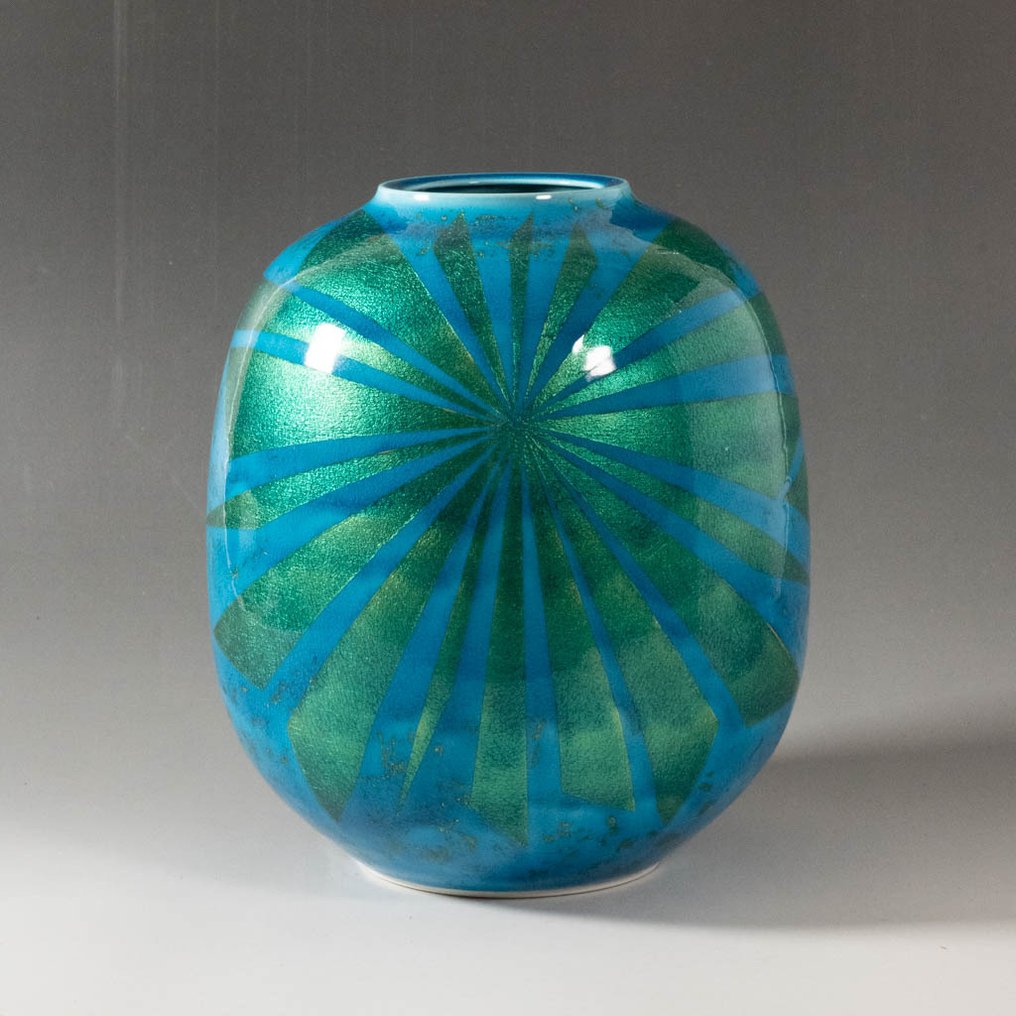
Heisei-period Yuri-Kinzai porcelain jar by Jiro Ono from Japan, 21.5 cm high and 18.5 cm wide, featuring a turquoise and metallic green radial starburst pattern, in excellent condition with its original signed wooden box.
AI-assisted summary
Description from the seller
A vessel where radiating geometry and metallic shimmer meet in harmonious balance.
Description:
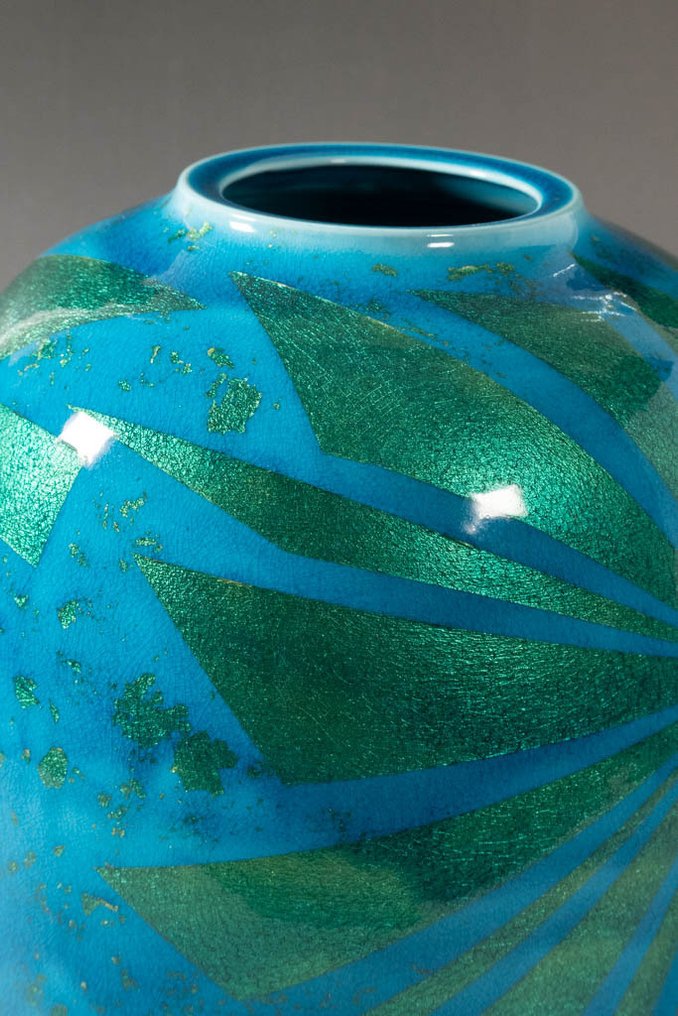
This ovoid jar presents a striking surface where blue and green fields converge in a radial starburst pattern. The body is adorned with alternating bands of turquoise blue and luminous metallic green that emanate from a central point on both the shoulder and base, creating a dynamic visual rhythm across the rounded form. The metallic green areas exhibit a distinctive textured surface that catches light with a subtle granular sparkle, while the smooth turquoise sections provide visual contrast and depth.
The form is gently rounded with soft shoulders that taper to a narrow neck opening finished in turquoise glaze. The glaze application shows deliberate variation, with the blue sections displaying natural pooling and subtle tonal shifts that add organic movement to the geometric composition. Small flecks of green appear scattered across the turquoise fields, creating additional visual interest and suggesting the layered complexity of the glazing process.
The base is finished with a white foot ring and center, providing stable support and revealing careful attention to the vessel's underside. A single character mark is incised into the recessed center. The interior of the neck opening shows the continuation of the turquoise glaze, demonstrating thorough craftsmanship.
Cultural & Art Context:
Yuri-kinzai, the technique of applying metallic decoration beneath the glaze, represents a sophisticated approach to ceramic surface enrichment that has captivated Japanese potters since the mid-20th century. The combination of geometric patterning with lustrous metallic effects reflects the postwar Japanese ceramic movement's interest in both traditional craftsmanship and contemporary aesthetic expression. Radial compositions of this kind create visual dynamism while maintaining the contemplative quality valued in Japanese decorative arts.
Collector Appeal:
Works featuring yuri-kinzai technique with geometric compositions are appreciated by collectors for their technical precision and visual impact. The piece comes with its original signed wooden box (tomobako) inscribed by the artist's wife Emi Ono, adding provenance and authentication value for the international market.
Dimensions:
Height: 21.5 cm
Width: 18.5 cm
Weight: 1300 g
Condition:
No chips, cracks or restorations.
Artist Profile:
Jiro Ono was born in 1953 in Tokyo as the second son of Hakuko Ono (1925–1996), one of Japan's most celebrated yuri-kinzai artists. His mother was designated as the holder of Saga Prefecture's Important Intangible Cultural Property for yuri-kinzai technique in 1992. After studying wheel-throwing techniques at the Arita Ceramic Research Institute, Jiro joined Kozan Kiln, which had been established by his grandfather, and began his career in ceramics.
Through extended observation of his mother's work in kinrande and yuri-kinzai techniques, he resolved to carry on her technical legacy after her passing in 1996. His achievements include numerous awards: Asahi Shimbun Gold Prize at the Japan Kogei Association Western Japan Exhibition (1980), NHK Prize at the Kyushu-Yamaguchi Ceramic Exhibition (1981, 1982), and Japan Kogei Association Prize (1982). He became a full member of the Japan Kogei Association in 1982. His work was acquired by the British Museum in 2001, and in 2002 he established Kohaku Togeisha in Ureshino, Saga Prefecture.
Jiro Ono's yuri-kinzai technique involves applying lacquer to the ceramic surface, affixing thin gold leaf, and then applying glaze—a process requiring patience and precision that creates the distinctive appearance for which his family's work is known. The tomobako for this piece bears inscription and seals by his wife, Emi Ono (小野ゑ満), authenticating the work.
Additional Notes
Please review all photos carefully as they are part of the item description.
Shipping Information
All items are shipped from Japan via DHL or Japan Post, depending on the destination.
Each piece is packed with great care using professional materials suitable for fine art shipping.
A tracking number will be provided once the shipment has been dispatched.
We cannot under-declare item values or mark shipments as gifts.
Import Duties & Taxes
Import duties, VAT, and any additional customs or processing fees are not included in the auction price.
These charges are the responsibility of the buyer.
Please check with your local customs office for details before bidding.
Customs Communication
Customs or the shipping carrier may contact you for additional information (such as ID verification or payment of duties).
Please respond promptly to avoid delays or returns.
Thank you very much for your understanding and cooperation.
Seller's Story
Holiday Closure Notice
In accordance with Japanese custom, please be advised that our shop will be closed for the New Year holidays.
Holiday closure period:
December 29 (Mon) – January 4 (Sun), Japan Standard Time
During this period, we will be unable to respond to orders or inquiries.
Orders for which payment is completed by December 28 (Sun) are scheduled to be shipped within the year.
Orders placed during the holiday period will be processed sequentially starting from January 5 (Mon).
We sincerely apologize for any inconvenience this may cause and greatly appreciate your kind understanding and cooperation.
Thank you very much for your continued support, and we look forward to serving you again.
J ANTIQUE ART -YOKOHAMA-
Where Japan’s quiet traditions meet the sensitivity of contemporary craftsmanship.
We curate antiques and contemporary works that embody the essence of Japanese aesthetics — pieces shaped by time, intention, and the intimate dialogue between human hands and natural materials. Every work is selected for its authenticity, balance, and the quiet presence it holds.
Our focus is not quantity but meaning. We present ceramics, lacquer, metalwork, and hand-crafted objects that speak softly yet carry the depth of Japanese beauty expressed through restraint and simplicity.
For contemporary pieces, we collaborate directly with artists and workshops whose dedication to technique and material reflects the highest standards of Japanese craft. For antiques, we look beyond surface appearance to the traces of use, devotion, and history that form their true character.
As licensed art dealers based in Yokohama, we are committed to clarity, accuracy, and respect in every transaction. Each piece is photographed and described with care, shipped worldwide with secure packaging, and handled personally to ensure it reaches collectors with confidence.
To collect from us is to join in the quiet preservation of culture — one work at a time, carried from our hands to yours.
A vessel where radiating geometry and metallic shimmer meet in harmonious balance.
Description:
This ovoid jar presents a striking surface where blue and green fields converge in a radial starburst pattern. The body is adorned with alternating bands of turquoise blue and luminous metallic green that emanate from a central point on both the shoulder and base, creating a dynamic visual rhythm across the rounded form. The metallic green areas exhibit a distinctive textured surface that catches light with a subtle granular sparkle, while the smooth turquoise sections provide visual contrast and depth.
The form is gently rounded with soft shoulders that taper to a narrow neck opening finished in turquoise glaze. The glaze application shows deliberate variation, with the blue sections displaying natural pooling and subtle tonal shifts that add organic movement to the geometric composition. Small flecks of green appear scattered across the turquoise fields, creating additional visual interest and suggesting the layered complexity of the glazing process.
The base is finished with a white foot ring and center, providing stable support and revealing careful attention to the vessel's underside. A single character mark is incised into the recessed center. The interior of the neck opening shows the continuation of the turquoise glaze, demonstrating thorough craftsmanship.
Cultural & Art Context:
Yuri-kinzai, the technique of applying metallic decoration beneath the glaze, represents a sophisticated approach to ceramic surface enrichment that has captivated Japanese potters since the mid-20th century. The combination of geometric patterning with lustrous metallic effects reflects the postwar Japanese ceramic movement's interest in both traditional craftsmanship and contemporary aesthetic expression. Radial compositions of this kind create visual dynamism while maintaining the contemplative quality valued in Japanese decorative arts.
Collector Appeal:
Works featuring yuri-kinzai technique with geometric compositions are appreciated by collectors for their technical precision and visual impact. The piece comes with its original signed wooden box (tomobako) inscribed by the artist's wife Emi Ono, adding provenance and authentication value for the international market.
Dimensions:
Height: 21.5 cm
Width: 18.5 cm
Weight: 1300 g
Condition:
No chips, cracks or restorations.
Artist Profile:
Jiro Ono was born in 1953 in Tokyo as the second son of Hakuko Ono (1925–1996), one of Japan's most celebrated yuri-kinzai artists. His mother was designated as the holder of Saga Prefecture's Important Intangible Cultural Property for yuri-kinzai technique in 1992. After studying wheel-throwing techniques at the Arita Ceramic Research Institute, Jiro joined Kozan Kiln, which had been established by his grandfather, and began his career in ceramics.
Through extended observation of his mother's work in kinrande and yuri-kinzai techniques, he resolved to carry on her technical legacy after her passing in 1996. His achievements include numerous awards: Asahi Shimbun Gold Prize at the Japan Kogei Association Western Japan Exhibition (1980), NHK Prize at the Kyushu-Yamaguchi Ceramic Exhibition (1981, 1982), and Japan Kogei Association Prize (1982). He became a full member of the Japan Kogei Association in 1982. His work was acquired by the British Museum in 2001, and in 2002 he established Kohaku Togeisha in Ureshino, Saga Prefecture.
Jiro Ono's yuri-kinzai technique involves applying lacquer to the ceramic surface, affixing thin gold leaf, and then applying glaze—a process requiring patience and precision that creates the distinctive appearance for which his family's work is known. The tomobako for this piece bears inscription and seals by his wife, Emi Ono (小野ゑ満), authenticating the work.
Additional Notes
Please review all photos carefully as they are part of the item description.
Shipping Information
All items are shipped from Japan via DHL or Japan Post, depending on the destination.
Each piece is packed with great care using professional materials suitable for fine art shipping.
A tracking number will be provided once the shipment has been dispatched.
We cannot under-declare item values or mark shipments as gifts.
Import Duties & Taxes
Import duties, VAT, and any additional customs or processing fees are not included in the auction price.
These charges are the responsibility of the buyer.
Please check with your local customs office for details before bidding.
Customs Communication
Customs or the shipping carrier may contact you for additional information (such as ID verification or payment of duties).
Please respond promptly to avoid delays or returns.
Thank you very much for your understanding and cooperation.
Seller's Story
Holiday Closure Notice
In accordance with Japanese custom, please be advised that our shop will be closed for the New Year holidays.
Holiday closure period:
December 29 (Mon) – January 4 (Sun), Japan Standard Time
During this period, we will be unable to respond to orders or inquiries.
Orders for which payment is completed by December 28 (Sun) are scheduled to be shipped within the year.
Orders placed during the holiday period will be processed sequentially starting from January 5 (Mon).
We sincerely apologize for any inconvenience this may cause and greatly appreciate your kind understanding and cooperation.
Thank you very much for your continued support, and we look forward to serving you again.
J ANTIQUE ART -YOKOHAMA-
Where Japan’s quiet traditions meet the sensitivity of contemporary craftsmanship.
We curate antiques and contemporary works that embody the essence of Japanese aesthetics — pieces shaped by time, intention, and the intimate dialogue between human hands and natural materials. Every work is selected for its authenticity, balance, and the quiet presence it holds.
Our focus is not quantity but meaning. We present ceramics, lacquer, metalwork, and hand-crafted objects that speak softly yet carry the depth of Japanese beauty expressed through restraint and simplicity.
For contemporary pieces, we collaborate directly with artists and workshops whose dedication to technique and material reflects the highest standards of Japanese craft. For antiques, we look beyond surface appearance to the traces of use, devotion, and history that form their true character.
As licensed art dealers based in Yokohama, we are committed to clarity, accuracy, and respect in every transaction. Each piece is photographed and described with care, shipped worldwide with secure packaging, and handled personally to ensure it reaches collectors with confidence.
To collect from us is to join in the quiet preservation of culture — one work at a time, carried from our hands to yours.
Details
Dynastic Style/Period
Heisei period (1989-present)
No. of items
1
Artist
Jiro Ono / 小野次郎 (b. 1953)
Country of Origin
Japan
Material
Ceramic
Height
21.5 cm
Width
18.5 cm
Title of artwork
Yuri-Kinzai Porcelain Jar with Radial Starburst Pattern in Turquoise and Metallic Green
Depth
18.5 cm
Condition
Excellent condition
Sold by
