Josef Wiesner - Wunderschön - Sehr selten - 156 Töne - - Bandoneón (No reserve price)


07
days
05
hours
41
minutes
22
seconds

4 other people are watching this object
 Bidder 9509 Bidder 9509 | €50 |
|---|
Catawiki Buyer Protection
Your payment’s safe with us until you receive your object.View details
Trustpilot 4.4 | 122910 reviews
Rated Excellent on Trustpilot.
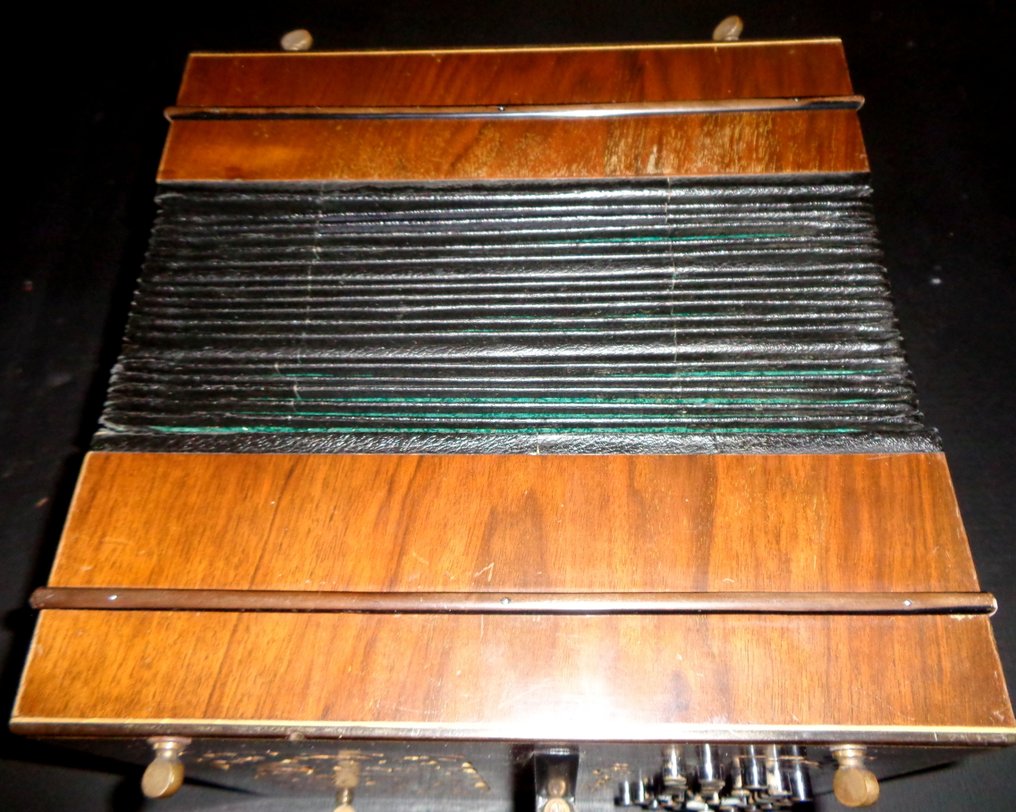
A wooden bandoneon by Gebr. Wiesner München, model “Wunderschön - Sehr selten - 156 Töne”, made in Germany (München), circa 1915–1920, tested and functional, with original case and parts, weight 4.8 kg, dimensions 40 x 27.5 x 26.5 cm, with all notes and buttons present and tuning still good.
AI-assisted summary
Description from the seller
Collection resolution
An absolute rarity that you don't find easily worldwide.
inheritance
Made in Germany / Munich
Bandoneon musical instrument from the company Gebr. Wiesner Munich. Owner Josef Wiesner.
With a note inside
Also the low serial numbers.
There is also the original suitcase in very good condition.
The bandoneon has 156 tones.
Homophonous and diatonic.
All voices are present.
All tones sound.
Not quite perfect, but still very good vocally for such an advanced age.
In this version, very rare.
Story:
Josef Wiesner
Munich 23
The Wiesner brothers produced bandoneons, concertinas, and harmonicas under their brand from 1906 to 1942.
Josef Wiesner was also a special manufacturer of the famous Munich Schrammel bandoneons.
This bandoneon was probably created around 1915-1920 at the beginning of the company.
A bandoneon is a harmonica-like musical instrument that Heinrich Band developed from the concertina in 1854.
The warm and woolly sound makes it suitable for playing melancholic music such as tango
An instrument with a wooden case.
The bag is airtight.
All tones are playable, all buttons and the very beautiful sound plates are present.
The condition of the instrument is still very good.
You surely understand this.
The bandoneon is not new, but rare and very old.
It can also be seen that it has been played.
Due to being over 100 years old, it is in excellent condition and has only very slight age-related signs of wear.
Only five mother-of-pearl button covers were replaced.
Please see the many original photos.
These are part of the description.
Private sale
I ship within Germany and also worldwide.
Collection resolution
An absolute rarity that you don't find easily worldwide.
inheritance
Made in Germany / Munich
Bandoneon musical instrument from the company Gebr. Wiesner Munich. Owner Josef Wiesner.
With a note inside
Also the low serial numbers.
There is also the original suitcase in very good condition.
The bandoneon has 156 tones.
Homophonous and diatonic.
All voices are present.
All tones sound.
Not quite perfect, but still very good vocally for such an advanced age.
In this version, very rare.
Story:
Josef Wiesner
Munich 23
The Wiesner brothers produced bandoneons, concertinas, and harmonicas under their brand from 1906 to 1942.
Josef Wiesner was also a special manufacturer of the famous Munich Schrammel bandoneons.
This bandoneon was probably created around 1915-1920 at the beginning of the company.
A bandoneon is a harmonica-like musical instrument that Heinrich Band developed from the concertina in 1854.
The warm and woolly sound makes it suitable for playing melancholic music such as tango
An instrument with a wooden case.
The bag is airtight.
All tones are playable, all buttons and the very beautiful sound plates are present.
The condition of the instrument is still very good.
You surely understand this.
The bandoneon is not new, but rare and very old.
It can also be seen that it has been played.
Due to being over 100 years old, it is in excellent condition and has only very slight age-related signs of wear.
Only five mother-of-pearl button covers were replaced.
Please see the many original photos.
These are part of the description.
Private sale
I ship within Germany and also worldwide.
Details
Era
1900-2000
Brand
Josef Wiesner
Multiple Models
No
Model
Wunderschön - Sehr selten - 156 Töne
Condition
Poor
Nr of items
1
Includes
Original case, Original parts
Weight
4.8 kg
Material
Wood
Tested and working
Tested and working/playable
Height
26.5 cm
Length
40 cm
Width
27.5 cm
Disclaimer
Bidders need to be aware that several countries do not allow importing objects derived from endangered and other protected species, even if a certificate of origin is provided. By bidding, you confirm that you have familiarised yourself with customs laws and regulations of your own country.
Bidders need to be aware that several countries do not allow importing objects derived from endangered and other protected species, even if a certificate of origin is provided. By bidding, you confirm that you have familiarised yourself with customs laws and regulations of your own country.