Signé; Félix Dubois - Tombouctou la mystérieuse. Illustré (.) d'après les photographies de l'auteur et de M. J. Drilhon - 1897



09
days
04
hours
21
minutes
37
seconds

6 other people are watching this object
 Bidder 0999 Bidder 0999 | €5 | |
|---|---|---|
| Bidder 0656 | €4 | |
 Bidder 3638 Bidder 3638 | €3 |
Catawiki Buyer Protection
Your payment’s safe with us until you receive your object.View details
Trustpilot 4.4 | 123053 reviews
Rated Excellent on Trustpilot.
Original edition of Tombouctou la mystérieuse, signed by Félix Dubois and illustrated from the author’s and M. J. Drilhon’s photographs, Paris Flammarion, 1897, in French, 420 pages, first edition, in good condition with a green half‑leather binding and gilt tooling on the spine; covers are present but the spine is missing.
AI-assisted summary
Description from the seller
Original edition. The journey of Félix Dubois (1862–1945) to French Sudan (present-day Upper Niger or Mali), richly illustrated with engravings based on photographs by the author and Mr. J. Drilhon.
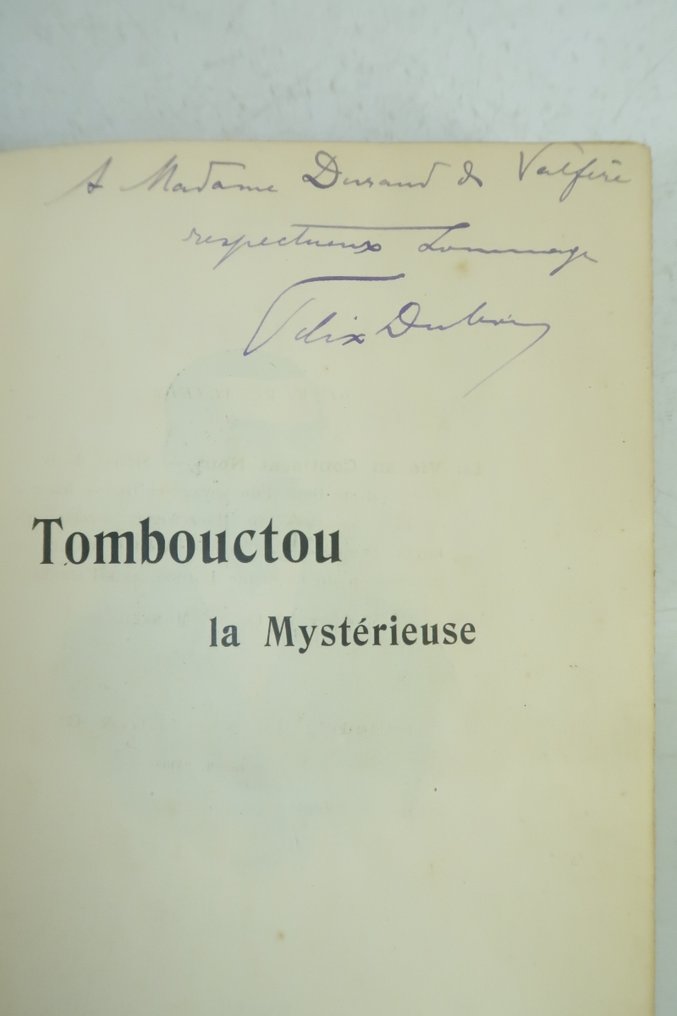
Enriched with a signed autograph from the author (see half-title).
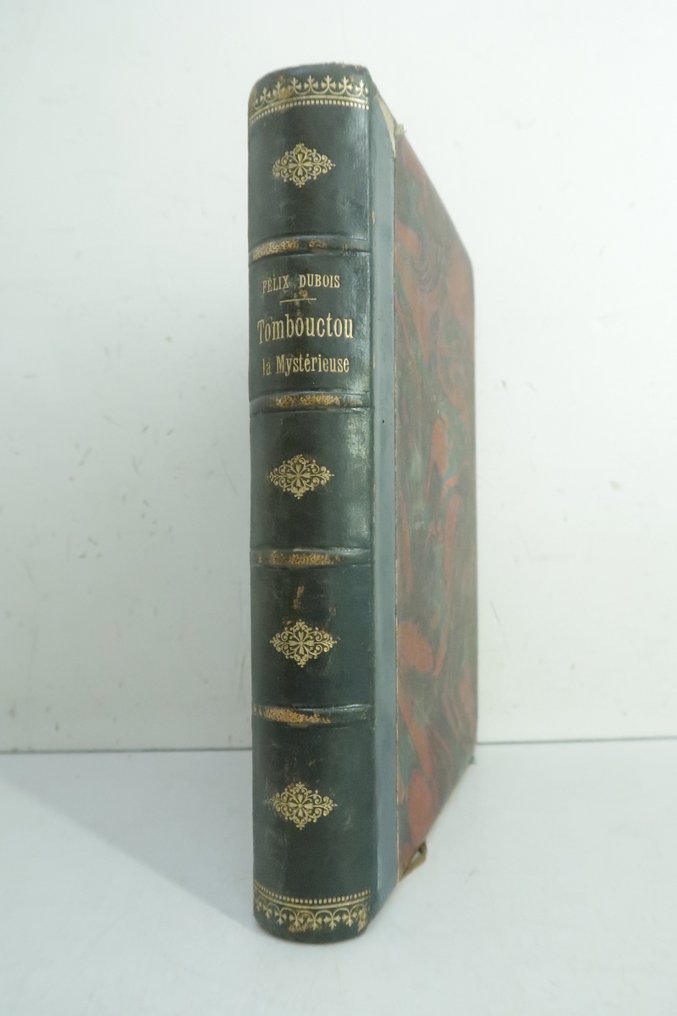
Dark green half-leather binding with corners, spine decorated with gold tools (title, author, and floral motifs). Covers preserved (without the spine).
Condition: Spine and corners rubbed. Slight scratch on the leather at the first hinge. Interior fresh, paper slightly yellowed. Good untrimmed copy.
The author, Félix Dubois (1862–1945), was a French journalist who, in 1895, traveled from Paris to Dakar, Senegal, and from there descended the Niger River into what was then called French Sudan. He visited the city of Jenne, which he called the 'jewel of the Niger Valley,' and from there continued to the ancient city of Timbuktu. Citing an old Soudanese chronicle that called Timbuktu 'the meeting place of all those who travel by camel or by canoe,' Dubois highlighted the city's importance as a commercial hub and transportation crossroads. 'Camels transfer their burdens onto the canoes, and the vessels entrust their cargo to the camels, with Timbuktu being the transshipment point.' The city is also an important literary and religious center, home to several mosques, libraries, and the University of Sankoré, founded in the 10th century with the establishment of the Sankoré Mosque. Dubois also discussed the early European travelers to Timbuktu, notably the Scottish explorer Mungo Park (1771–1806) and the German Heinrich Barth (1821–1865), and recounted the city's annexation by the French empire in 1893.
Table: From Paris to Niger. Niger. Niger Valley. City of Niger. Dienné. Founders of Dienné. Songhoi Empire. Moroccan invasion. Dienné then and now. From Dienné to Timbuktu. Timbuktu. Timbuktu through the centuries. Trade and life. The University of Sankoré. Politics and literature. Europe and Timbuktu. The French conquest.
Félix Dubois
Timbuktu the mysterious. Illustrated with numerous engravings, all executed based on photographs by the author and Mr. J. Drilhon, Naval Commissioner.
Paris, E. Flammarion, 1897
in-8 (23 x 15 cm); 420 pages.
Seller's Story
We are looking for old books for our bibliophile customers. We currently have a strong demand on the web.
On-site withdrawals are only from MONDAY TO FRIDAY, from 9 a.m. to 4 p.m.
Passage Bookstore - Gribaudo Vandamme Bookstore
48-62 Passage Jouffroy - 75009 Paris
Translated by Google TranslateOriginal edition. The journey of Félix Dubois (1862–1945) to French Sudan (present-day Upper Niger or Mali), richly illustrated with engravings based on photographs by the author and Mr. J. Drilhon.
Enriched with a signed autograph from the author (see half-title).
Dark green half-leather binding with corners, spine decorated with gold tools (title, author, and floral motifs). Covers preserved (without the spine).
Condition: Spine and corners rubbed. Slight scratch on the leather at the first hinge. Interior fresh, paper slightly yellowed. Good untrimmed copy.
The author, Félix Dubois (1862–1945), was a French journalist who, in 1895, traveled from Paris to Dakar, Senegal, and from there descended the Niger River into what was then called French Sudan. He visited the city of Jenne, which he called the 'jewel of the Niger Valley,' and from there continued to the ancient city of Timbuktu. Citing an old Soudanese chronicle that called Timbuktu 'the meeting place of all those who travel by camel or by canoe,' Dubois highlighted the city's importance as a commercial hub and transportation crossroads. 'Camels transfer their burdens onto the canoes, and the vessels entrust their cargo to the camels, with Timbuktu being the transshipment point.' The city is also an important literary and religious center, home to several mosques, libraries, and the University of Sankoré, founded in the 10th century with the establishment of the Sankoré Mosque. Dubois also discussed the early European travelers to Timbuktu, notably the Scottish explorer Mungo Park (1771–1806) and the German Heinrich Barth (1821–1865), and recounted the city's annexation by the French empire in 1893.
Table: From Paris to Niger. Niger. Niger Valley. City of Niger. Dienné. Founders of Dienné. Songhoi Empire. Moroccan invasion. Dienné then and now. From Dienné to Timbuktu. Timbuktu. Timbuktu through the centuries. Trade and life. The University of Sankoré. Politics and literature. Europe and Timbuktu. The French conquest.
Félix Dubois
Timbuktu the mysterious. Illustrated with numerous engravings, all executed based on photographs by the author and Mr. J. Drilhon, Naval Commissioner.
Paris, E. Flammarion, 1897
in-8 (23 x 15 cm); 420 pages.
Seller's Story
We are looking for old books for our bibliophile customers. We currently have a strong demand on the web.
On-site withdrawals are only from MONDAY TO FRIDAY, from 9 a.m. to 4 p.m.
Passage Bookstore - Gribaudo Vandamme Bookstore
48-62 Passage Jouffroy - 75009 Paris
Translated by Google TranslateDetails
Number of Books
1
Subject
Colonial history, Illustrated, Travels
Book Title
Tombouctou la mystérieuse. Illustré (.) d'après les photographies de l'auteur et de M. J. Drilhon
Author/ Illustrator
Signé; Félix Dubois
Condition
Good
Publication year oldest item
1897
Edition
1st Edition
Language
French
Original language
Yes
Extras
Signed by author
Number of pages
420
Sold by
