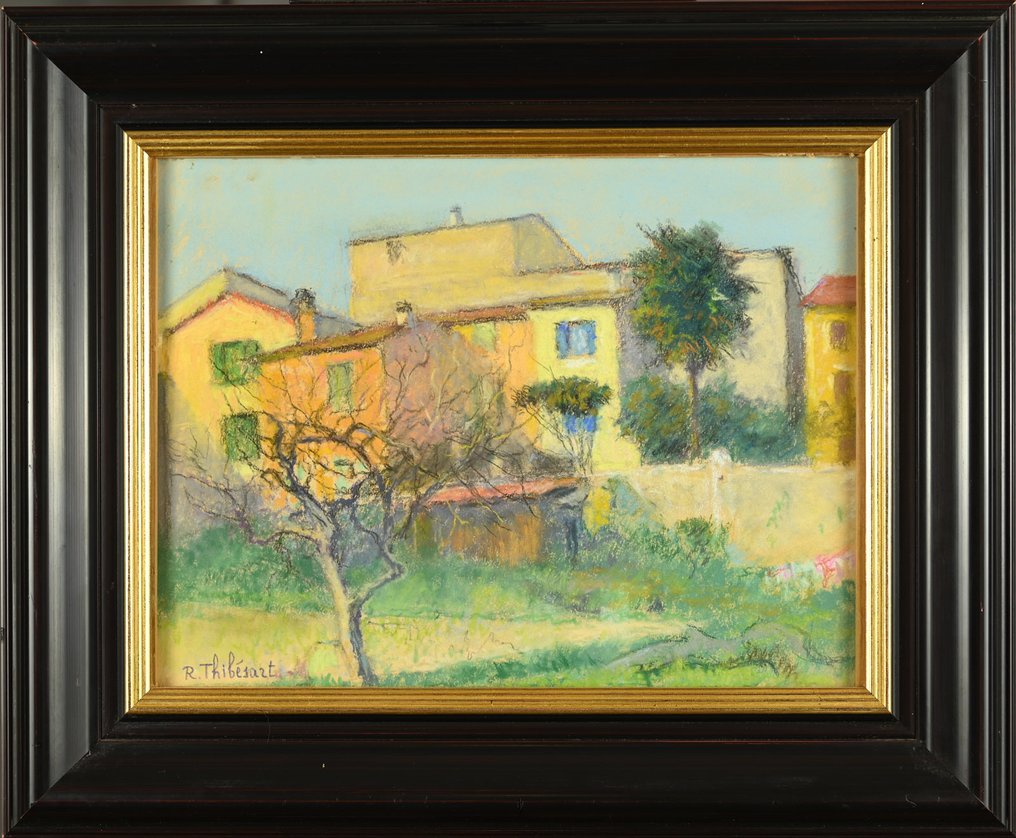
Raymond Thibesart (1874-1968) - Coin de jardin à Villeneuve-Loubet



05
days
11
hours
56
minutes
26
seconds
Current bid
€ 20
Reserve price not met

Expert
Selected by Caroline Bokobza
Graduated as French auctioneer and worked in Sotheby’s Paris valuation department.
Estimate € 700 - € 900
18 other people are watching this object
 Bidder 7584 Bidder 7584 | €20 | |
|---|---|---|
 Bidder 0720 Bidder 0720 | €1 |
Catawiki Buyer Protection
Your payment’s safe with us until you receive your object.View details
Trustpilot 4.4 | 123113 reviews
Rated Excellent on Trustpilot.
Original pastel on paper, Coin de jardin à Villeneuve-Loubet, by Raymond Thibesart (1874–1968), a 1920 French post-impressionist landscape, signed, in good condition, sold with frame, dimensions with frame 36.5 × 44 cm.
AI-assisted summary
Description from the seller
Raymond THIBESART (1874-1968)
Garden corner in Villeneuve-Loubet
Pastel on paper
Pastel dimensions: 24 x 31 cm
Signed at the bottom left.
Provenance: the artist's family collection
Pastel in good condition.
Free framing.
Dimensions with frame: 36.5 x 44 cm
Original artwork delivered with invoice and certificate of authenticity.
Fast, careful, and insured shipping.
Buy with confidence!
Born in Bar-sur-Aube in 1874, Raymond Thibesart grew up in a cultivated environment that encouraged his talent for drawing from an early age. In Enghien, he met the Boggio family and received instruction from Émile Boggio, a Venezuelan impressionist master whose influence would leave a lasting mark on his artistic sensitivity. Trained later at Lycée Rollin, at the École des Beaux‑Arts, and then at the Académie Julian, Thibesart was imbued with the symbolist and impressionist currents through Jules Lefèvre and Tony Robert-Fleury at Art en Seine.
At the turn of the 20th century, after several study trips to Italy with Boggio and Henri Martin, he established a decidedly Post-Impressionist style: a luminous, delicate painting attentive to atmospheric variations and the vibrations of nature. Based in Vaux-sur-Seine, he tirelessly worked on the motif, creating numerous pastels that later fed into his large oil paintings. His landscapes — Seine riverbanks, flowering orchards, frosted mornings, sun-drenched countryside — captivate with their poetry, spontaneity, and mastery of color.
Raymond Thibesart today holds a sought-after place among post-impressionist landscapers. His work, both accessible and refined, appeals to collectors.
Thibesart's works — pastels as oils — thus offer a beautiful opportunity to acquire a luminous and sensitive landscape, representative of an elegant French art deeply attached to nature.
Seller's Story
Specialist since 1989 painters of the Ecole Normande - School of Rouen, Art Seine, is an art gallery located in Le Havre where we present works of the 19th, Impressionist and Modern. We scrupulously check the origins of the works and we surround ourselves with all the precautions in use on the art market. We, we are the spokesperson of the seller as the buyer for transactions to be made in the best conditions. Any work sold is accompanied by an invoice and a certificate of authenticity engage our responsibility for a period of 30 years. In collaboration with specialized freight forwarders and carriers we can ensure shipment in France and around the world.
Translated by Google TranslateRaymond THIBESART (1874-1968)
Garden corner in Villeneuve-Loubet
Pastel on paper
Pastel dimensions: 24 x 31 cm
Signed at the bottom left.
Provenance: the artist's family collection
Pastel in good condition.
Free framing.
Dimensions with frame: 36.5 x 44 cm
Original artwork delivered with invoice and certificate of authenticity.
Fast, careful, and insured shipping.
Buy with confidence!
Born in Bar-sur-Aube in 1874, Raymond Thibesart grew up in a cultivated environment that encouraged his talent for drawing from an early age. In Enghien, he met the Boggio family and received instruction from Émile Boggio, a Venezuelan impressionist master whose influence would leave a lasting mark on his artistic sensitivity. Trained later at Lycée Rollin, at the École des Beaux‑Arts, and then at the Académie Julian, Thibesart was imbued with the symbolist and impressionist currents through Jules Lefèvre and Tony Robert-Fleury at Art en Seine.
At the turn of the 20th century, after several study trips to Italy with Boggio and Henri Martin, he established a decidedly Post-Impressionist style: a luminous, delicate painting attentive to atmospheric variations and the vibrations of nature. Based in Vaux-sur-Seine, he tirelessly worked on the motif, creating numerous pastels that later fed into his large oil paintings. His landscapes — Seine riverbanks, flowering orchards, frosted mornings, sun-drenched countryside — captivate with their poetry, spontaneity, and mastery of color.
Raymond Thibesart today holds a sought-after place among post-impressionist landscapers. His work, both accessible and refined, appeals to collectors.
Thibesart's works — pastels as oils — thus offer a beautiful opportunity to acquire a luminous and sensitive landscape, representative of an elegant French art deeply attached to nature.
Seller's Story
Specialist since 1989 painters of the Ecole Normande - School of Rouen, Art Seine, is an art gallery located in Le Havre where we present works of the 19th, Impressionist and Modern. We scrupulously check the origins of the works and we surround ourselves with all the precautions in use on the art market. We, we are the spokesperson of the seller as the buyer for transactions to be made in the best conditions. Any work sold is accompanied by an invoice and a certificate of authenticity engage our responsibility for a period of 30 years. In collaboration with specialized freight forwarders and carriers we can ensure shipment in France and around the world.
Translated by Google TranslateDetails
Artist
Raymond Thibesart (1874-1968)
Sold with frame
Yes
Sold by
Gallery
Edition
Original
Title of artwork
Coin de jardin à Villeneuve-Loubet
Technique
Pastel
Signature
Hand signed
Country of Origin
France
Year
1920
Condition
Good condition
Height
36.5 cm
Width
44 cm
Depiction/Theme
Landscape
Style
Post-Impressionism
Period
1910-1920
Sold by
