Nicolaas Grevinchoven - Der Remonstranten Kerck-gangh: dat is:verscheydene redenen, waerom de Remonstrans-ghesinde hare - 1619



08
days
03
hours
11
minutes
00
seconds
Current bid
€ 5
No reserve price

Expert
Selected by Volker Riepenhausen
Specialist in travel literature and pre-1600 rare prints with 28 years experience.
Estimate € 150 - € 200
5 other people are watching this object
 Bidder 6068 Bidder 6068 | €5 | |
|---|---|---|
| Bidder 5506 | €4 | |
| Bidder 6655 | €1 |
Catawiki Buyer Protection
Your payment’s safe with us until you receive your object.View details
Trustpilot 4.4 | 123053 reviews
Rated Excellent on Trustpilot.
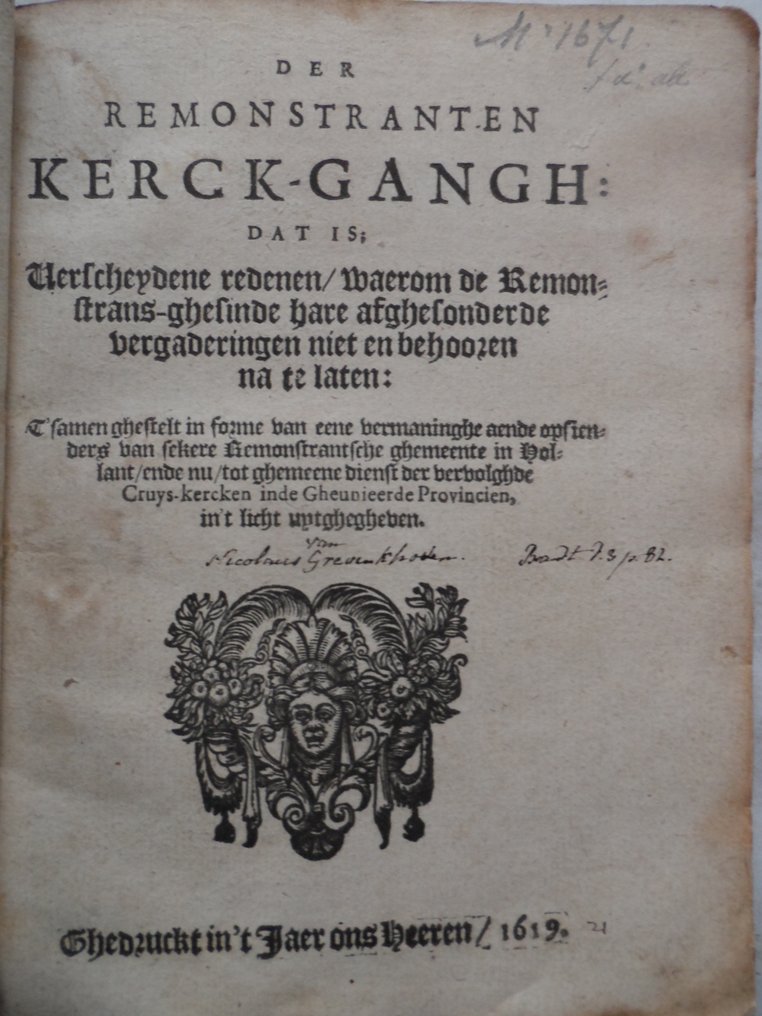
Nicolaas Grevinchoven; Der Remonstranten Kerck-gangh: dat is: verscheydene redenen, waerom de Remonstrans-ghesinde hare afghesonderde vergaderingen niet en behooren na te laten; Eerste druk, 1619; Language: Dutch; 134 pages; Soft cover; 18.6 × 14 cm; Condition: Good.
AI-assisted summary
Description from the seller
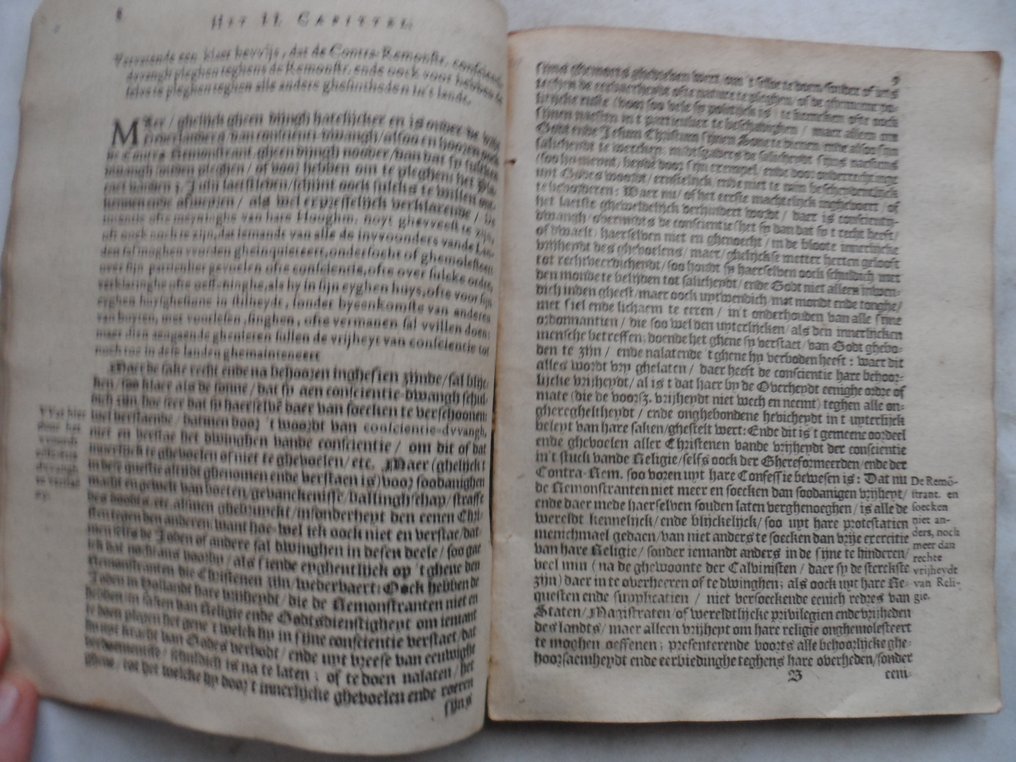
Nicolaas Grevinchoven: The Remonstrants' Church Walk: that is: various reasons why the Remonstrants' congregation should not and need not hold separate meetings: laid out in the form of a warning to the opponents of certain Remonstrant congregations in Holland / and now / for the common service of the subsequent Cross Churches in the United Provinces, published in light. Printed in the year of our Lord / 1619. 4o: 134 pages. Bound with a later paper cover in color with the title handwritten on the front. Cover damaged. Title page with the author's name handwritten and a number in pencil at the top. Paper here and there with a very light spot or discoloration.
Nicolaas Grevinckhoven (also Grevinkhoven or Grevinchovius), (? - 1632, Hamburg), was a Remonstrant preacher in Rotterdam during the conflict between the Remonstrants and Counter-Remonstrants at the beginning of the seventeenth century. He studied in Leiden and sided with Arminius in the debate between Arminius and Gomarus. After Arminius's death in 1609, he was a signatory of the Remonstrance of 1610 and participated in the Hague Conference on religion in 1611.
In Rotterdam, where a significant part of the population attended the Remonstrant services, he came into conflict with the strict Calvinists, particularly Adriaan Smout and Cornelis Geselius.
During the persecutions of the Remonstrants after the execution of Johan van Oldenbarnevelt and the Synod of Dordrecht, Grevinckhoven fled to Antwerp, where in 1621 he provided shelter to Hugo de Groot, who had just escaped from Loevestein. Later, Grevinckhoven moved to Northern Germany. He is one of the founders of the Remonstrant Reformed Brotherhood, together with colleagues such as Johannes Wtenbogaert, Eduard Poppius, Karl Niëlles, and Johan Arnold Corvinus.
Nicolaas Grevinchoven: The Remonstrants' Church Walk: that is: various reasons why the Remonstrants' congregation should not and need not hold separate meetings: laid out in the form of a warning to the opponents of certain Remonstrant congregations in Holland / and now / for the common service of the subsequent Cross Churches in the United Provinces, published in light. Printed in the year of our Lord / 1619. 4o: 134 pages. Bound with a later paper cover in color with the title handwritten on the front. Cover damaged. Title page with the author's name handwritten and a number in pencil at the top. Paper here and there with a very light spot or discoloration.
Nicolaas Grevinckhoven (also Grevinkhoven or Grevinchovius), (? - 1632, Hamburg), was a Remonstrant preacher in Rotterdam during the conflict between the Remonstrants and Counter-Remonstrants at the beginning of the seventeenth century. He studied in Leiden and sided with Arminius in the debate between Arminius and Gomarus. After Arminius's death in 1609, he was a signatory of the Remonstrance of 1610 and participated in the Hague Conference on religion in 1611.
In Rotterdam, where a significant part of the population attended the Remonstrant services, he came into conflict with the strict Calvinists, particularly Adriaan Smout and Cornelis Geselius.
During the persecutions of the Remonstrants after the execution of Johan van Oldenbarnevelt and the Synod of Dordrecht, Grevinckhoven fled to Antwerp, where in 1621 he provided shelter to Hugo de Groot, who had just escaped from Loevestein. Later, Grevinckhoven moved to Northern Germany. He is one of the founders of the Remonstrant Reformed Brotherhood, together with colleagues such as Johannes Wtenbogaert, Eduard Poppius, Karl Niëlles, and Johan Arnold Corvinus.
Details
Number of Books
1
Subject
History, Politics, Religion
Book Title
Der Remonstranten Kerck-gangh: dat is:verscheydene redenen, waerom de Remonstrans-ghesinde hare
Author/ Illustrator
Nicolaas Grevinchoven
Condition
Good
Publication year oldest item
1619
Height
18.6 cm
Edition
1st Edition
Width
14 cm
Language
Dutch
Original language
Yes
Publisher
Ghedruckt in 't Jaer ons Heeren / 1619.
Binding/ Material
Softback
Number of pages
134
Sold by
